
The question “what is the current Nasdaq?” is far more nuanced than a simple query about a numerical value at a specific moment. It’s a question that reflects an underlying interest in the pulse of the global technology sector, broader market sentiment, and the potential implications for investment portfolios. The Nasdaq, an acronym for the National Association of Securities Dealers Automated Quotations, is not merely a single number but a multifaceted entity comprising a global electronic stock exchange and a series of benchmark indices. To truly grasp its “current” state, one must delve into its operational mechanics, its significance in the global economy, the myriad factors influencing its performance, and how investors engage with it. For anyone navigating the world of personal finance and investing, understanding the Nasdaq is paramount.
Understanding the Nasdaq: More Than Just a Number
The Nasdaq often conjures images of tech giants and rapid innovation, but its identity is rooted in two distinct yet interconnected components: the stock market itself and its most famous index.
The Nasdaq Stock Market
The Nasdaq Stock Market is the second-largest stock exchange in the world by market capitalization, trailing only the New York Stock Exchange (NYSE). What truly sets it apart is its pioneering role as an electronic global marketplace. Established in 1971, Nasdaq revolutionized securities trading by introducing a fully computerized system, moving away from the traditional open-outcry floor trading model. This innovation democratized access to market data and facilitated faster, more efficient transactions. Today, it remains a fully electronic exchange, facilitating trades between buyers and sellers around the globe. Its listings are predominantly concentrated in the technology, biotechnology, telecommunications, and finance sectors, making it a primary venue for many of the world’s most innovative and growth-oriented companies. From burgeoning startups to established multinational corporations, being listed on Nasdaq signifies a company’s commitment to growth and visibility in the capital markets.
The Nasdaq Composite Index
While “the Nasdaq” is often colloquially used to refer to its most prominent index, it’s crucial to differentiate the exchange from the index. The Nasdaq Composite Index is a market-capitalization-weighted index of all common stocks and similar securities listed on the Nasdaq stock market. This means that companies with larger market capitalizations have a greater impact on the index’s value. The Composite Index acts as a crucial benchmark, providing a comprehensive snapshot of the performance of the entire Nasdaq ecosystem. Given its heavy concentration of technology and growth companies, it is widely regarded as an excellent barometer for the health and sentiment of these sectors, and by extension, a significant portion of the broader U.S. and global economy. While the Composite includes all listed securities, many investors also closely monitor the Nasdaq 100, a subset index comprising the 100 largest non-financial companies listed on the exchange, often seen as an even more concentrated indicator of mega-cap tech performance.
How the “Current Nasdaq” is Determined
When someone asks for “the current Nasdaq,” they are typically looking for the real-time value of the Nasdaq Composite Index or the Nasdaq 100. This value is in constant flux during market trading hours. It is determined by the aggregate price movements of its constituent stocks, weighted by their market capitalization. Every trade, every bid, and every ask price for a listed security contributes to the dynamic calculation of the index. Trading on Nasdaq doesn’t just happen during the regular market hours (9:30 AM to 4:00 PM ET). Pre-market trading allows investors to react to news before the official open, and after-hours trading extends opportunities to react to late-breaking developments, corporate earnings, and other announcements. These extended hours, while perhaps less liquid than regular trading, still contribute to the collective price discovery that ultimately shapes the index’s opening value the next day and informs investor sentiment throughout the 24-hour cycle.
The Significance of Nasdaq in the Global Economy
The Nasdaq’s influence extends far beyond the trading screens, acting as a critical indicator and catalyst for economic growth and innovation worldwide.
A Barometer for Technology and Innovation
Nasdaq’s roster reads like a who’s who of global innovation: Apple, Microsoft, Amazon, Google (Alphabet), Tesla, NVIDIA, and many more. This concentration makes the Nasdaq Composite, and particularly the Nasdaq 100, an unrivaled barometer for the technology sector’s health and investor sentiment towards innovation. When the Nasdaq performs strongly, it often signals robust investor confidence in future growth, disruptive technologies, and the companies driving them. Conversely, a downturn can indicate broader concerns about tech valuations, regulatory pressures, or a shift in economic priorities. It’s the exchange where new, groundbreaking companies often debut, raising the capital needed to fuel their expansion and bring new products and services to market, thus directly influencing the pace of technological advancement globally.
Impact on Investor Portfolios
For a vast number of investors, from individual retail accounts to massive institutional funds, exposure to Nasdaq-listed companies is a cornerstone of their portfolios. Many mutual funds, exchange-traded funds (ETFs), and individual stock portfolios hold significant positions in tech and growth companies that trade on Nasdaq. Therefore, the “current Nasdaq” directly impacts the value of these investments. A significant rise or fall in the Nasdaq can translate into substantial gains or losses for investors, affecting retirement savings, college funds, and overall financial well-being. Its performance often serves as a bellwether for the “growth” component of a diversified portfolio, influencing asset allocation decisions and risk management strategies.
Economic Indicator and Bellwether
Beyond individual portfolios, the Nasdaq’s performance offers insights into the broader economic landscape. Strong Nasdaq performance can correlate with periods of economic expansion, as innovative companies often thrive during times of increased consumer spending, business investment, and productivity gains. Conversely, a sustained decline might signal investor apprehension about economic growth, rising interest rates, or tightening credit conditions. Policymakers and economists frequently monitor the Nasdaq as part of their assessment of market health and investor confidence. Its global reach, attracting listings from diverse nations, further solidifies its role as a leading indicator of cross-border capital flows and global economic interconnectivity.

Factors Influencing the Current Nasdaq Performance
The “current Nasdaq” is a dynamic reflection of countless forces, from sweeping macroeconomic trends to granular corporate developments and the unpredictable shifts of market psychology.
Macroeconomic Trends
Global macroeconomic conditions exert a powerful influence on the Nasdaq. Interest rates, set by central banks like the Federal Reserve, are particularly impactful. Higher interest rates typically make it more expensive for companies to borrow and can compress the present value of future earnings, which disproportionately affects growth companies (many of which are Nasdaq-listed) whose valuations are often based on future growth prospects. Inflation, geopolitical events, global trade policies, and shifts in consumer confidence or spending patterns also play crucial roles. For instance, a strong jobs report might signal economic vigor and boost investor confidence, while escalating trade tensions could introduce uncertainty and lead to sell-offs, particularly in sectors heavily reliant on global supply chains.
Corporate Earnings and Guidance
The fundamental performance of Nasdaq-listed companies is a primary driver of the index’s value. Quarterly and annual earnings reports, detailing revenue, profits, and future guidance, are meticulously scrutinized by investors and analysts. A “beat” on earnings or an optimistic outlook can send a stock (and by extension, the index) soaring, while a “miss” or a cautious forecast can lead to significant declines. Beyond headline numbers, sector-specific news—such as breakthroughs in artificial intelligence, new drug approvals in biotech, or regulatory changes affecting digital platforms—can also trigger significant movements. The collective health and prospects of its constituent companies ultimately dictate the trajectory of the Nasdaq.
Investor Sentiment and Market Psychology
Human emotions and collective psychology play an undeniable role in market fluctuations. Fear and greed, speculative bubbles, and market corrections are driven by investor sentiment. News cycles, analyst ratings, and even the pervasive influence of social media can amplify certain narratives, leading to rapid shifts in perception and valuation. Technical analysis, which studies past price and volume data to forecast future price movements, also influences trading decisions for many, creating self-fulfilling prophecies in certain situations. Understanding the “current Nasdaq” therefore requires not just an analysis of fundamentals and economics, but also an awareness of the prevailing mood and behavioral tendencies of market participants.
Investing in the Nasdaq: Strategies and Considerations
For investors interested in participating in the growth stories of Nasdaq-listed companies, there are several avenues and crucial considerations for financial planning.
Direct Stock Ownership
One approach is to directly invest in individual Nasdaq-listed companies. This requires thorough research into a company’s business model, financial health, competitive landscape, management team, and growth prospects. While direct ownership offers the potential for significant returns from successful stock picks, it also carries higher risk due to lack of diversification. A single company’s poor performance or unforeseen challenges can disproportionately impact one’s portfolio. Therefore, investors pursuing this strategy often seek to build a diversified portfolio of individual stocks across various industries and market capitalizations.
Exchange-Traded Funds (ETFs) and Mutual Funds
For most investors, gaining exposure to the Nasdaq market is more effectively achieved through diversified vehicles like Exchange-Traded Funds (ETFs) and mutual funds. ETFs, such as those tracking the Nasdaq 100 (e.g., QQQ), offer instant diversification across a basket of the largest Nasdaq-listed non-financial companies. They trade like stocks throughout the day and typically have lower expense ratios than actively managed mutual funds. Mutual funds focused on technology or growth sectors, often with Nasdaq-heavy portfolios, provide professional management and broader diversification. These options allow investors to participate in the overall performance of the Nasdaq without the intensive research and higher risk associated with individual stock picking.
Risk Management and Long-Term Perspective
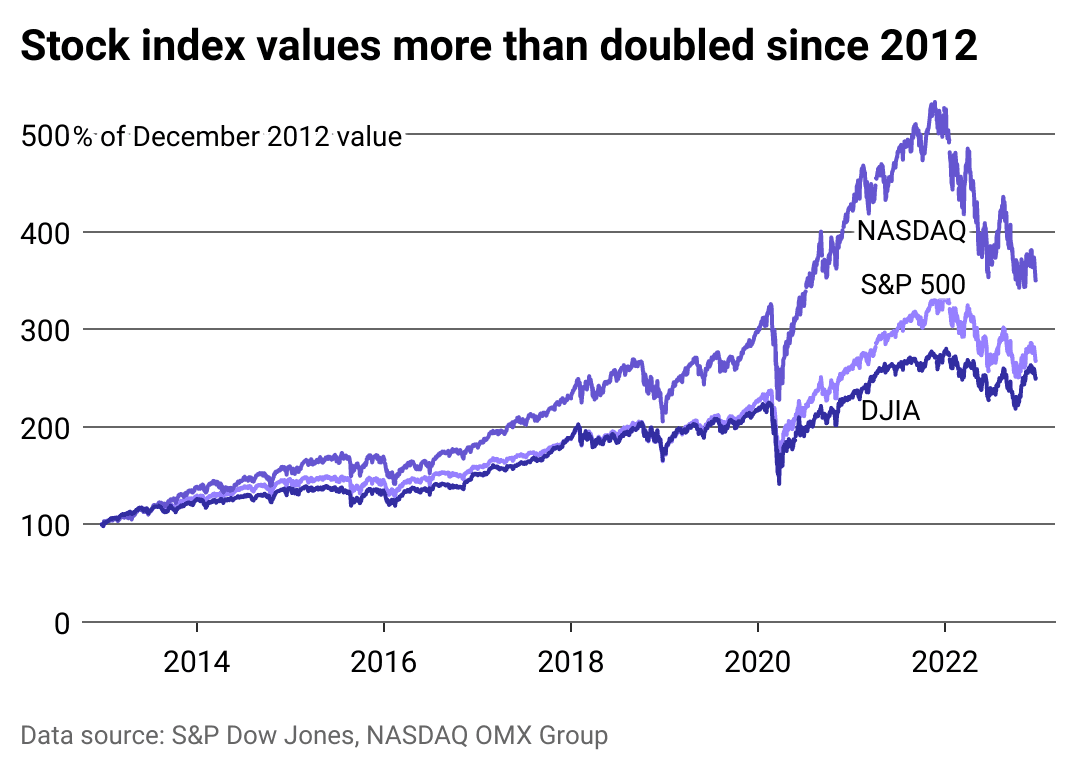
Investing in the Nasdaq, especially in growth-oriented sectors, inherently involves volatility. Market downturns and corrections are a normal part of the investment cycle. Effective risk management is crucial, including proper asset allocation, diversification across different asset classes (not just tech stocks), and investing within one’s personal risk tolerance. Strategies like dollar-cost averaging, where a fixed amount is invested regularly regardless of market fluctuations, can help mitigate the impact of volatility. Most importantly, adopting a long-term perspective is vital. The Nasdaq, despite its swings, has demonstrated a remarkable upward trend over decades, rewarding patient investors who remain committed to their financial goals through various market conditions. Understanding “the current Nasdaq” is not about predicting tomorrow’s movement, but about integrating its dynamic nature into a well-thought-out, long-term financial strategy.
Conclusion
The question “what is the current Nasdaq?” invites a deep dive into the heart of modern finance and innovation. It’s an inquiry into the real-time valuation of an electronic stock exchange that pioneered digital trading, and its key indices that serve as crucial benchmarks for the technology sector and broader economic health. From macroeconomic forces and corporate earnings to the intricate dance of investor sentiment, a myriad of factors constantly shape its value. For investors, understanding the Nasdaq is not just about tracking a number; it’s about discerning opportunities, managing risk, and aligning investment strategies with long-term financial objectives. As a dynamic barometer for technological progress and economic dynamism, the Nasdaq will continue to be a pivotal indicator, reflecting the ever-evolving landscape of global capitalism and innovation for years to come.
aViewFromTheCave is a participant in the Amazon Services LLC Associates Program, an affiliate advertising program designed to provide a means for sites to earn advertising fees by advertising and linking to Amazon.com. Amazon, the Amazon logo, AmazonSupply, and the AmazonSupply logo are trademarks of Amazon.com, Inc. or its affiliates. As an Amazon Associate we earn affiliate commissions from qualifying purchases.