
The completing the square method is a fundamental algebraic technique that transcends its origins in pure mathematics to become an invaluable tool in various technological disciplines. While often introduced as a way to solve quadratic equations, its true power in the tech world lies in its ability to transform complex quadratic expressions into a more insightful, standardized form. This transformation is crucial for understanding and optimizing algorithms, designing efficient software, and developing robust AI models. At its heart, completing the square allows us to reveal the vertex of a parabola, identify minimum or maximum values of quadratic functions, and simplify expressions that might otherwise be intractable for computational analysis. For anyone delving into the intricacies of data science, machine learning, computer graphics, or algorithm design, a deep understanding of this method provides a foundational mathematical bedrock.

The Core Concept: Rewriting Quadratics for Computational Clarity
At its essence, completing the square is a methodical process for converting a quadratic expression from its standard form, $ax^2 + bx + c$, into its vertex form, $a(x-h)^2 + k$. This conversion is not merely an algebraic parlor trick; it’s a strategic simplification that unveils critical properties of the function, such as its axis of symmetry, vertex coordinates, and direction of opening (for parabolas). In a computational context, this standardized form offers immediate insights that the original expanded form might obscure, making it easier for algorithms to process, optimize, or interpret.
The Algebraic Foundation
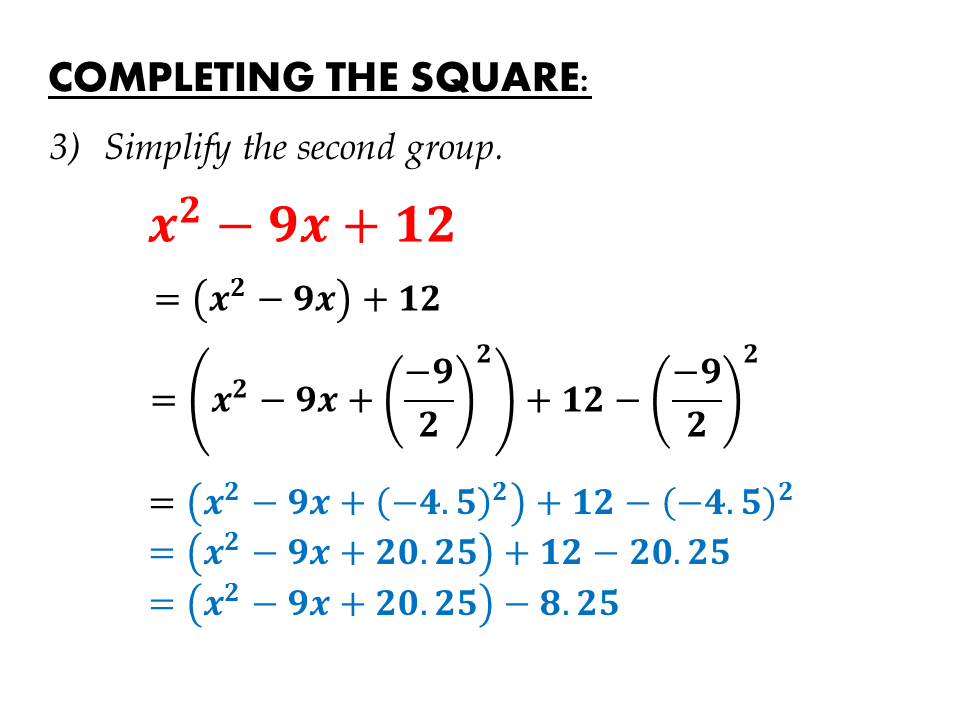
A perfect square trinomial is an expression that results from squaring a binomial, such as $(x+d)^2 = x^2 + 2dx + d^2$. Notice the relationship between the coefficient of the $x$ term ($2d$) and the constant term ($d^2$). The constant term is always the square of half the coefficient of the $x$ term, i.e., $d^2 = (frac{2d}{2})^2$. The completing the square method leverages this pattern.
Given a quadratic expression $ax^2 + bx + c$:
- Factor out ‘a’: If $a neq 1$, factor it out from the $x^2$ and $x$ terms: $a(x^2 + frac{b}{a}x) + c$.
- Find the “missing” term: Take half of the coefficient of the $x$ term ($frac{b}{a}$), square it, and add and subtract it inside the parenthesis. This step is where the “completing” part comes in, as it creates a perfect square trinomial. So, half of $frac{b}{a}$ is $frac{b}{2a}$, and squaring it gives $(frac{b}{2a})^2$.
- Rewrite as a perfect square: The expression inside the parenthesis now becomes $(x + frac{b}{2a})^2$.
- Simplify the constant term: Distribute $a$ back to the subtracted term and combine it with $c$.
This systematic transformation simplifies the expression, making its properties explicit. For software that needs to evaluate function minima/maxima or transform coordinate systems, this canonical form is highly advantageous.
Why it Matters for Software Engineers and Data Scientists
For software engineers, particularly those working on optimization algorithms, computer graphics, or scientific computing libraries, the vertex form obtained through completing the square is profoundly useful.
- Vertex Identification: The vertex $(h,k)$ of the parabola $a(x-h)^2+k$ directly gives the minimum or maximum value of the function. For optimization problems (e.g., finding the optimal parameters for a machine learning model), identifying this extreme point quickly is critical.
- Symmetry: The axis of symmetry is $x=h$. Understanding symmetry helps in designing efficient search algorithms or rendering processes.
- Standardization: Converting disparate quadratic expressions into a common form facilitates comparison, manipulation, and storage in databases or memory, streamlining computational tasks.
- Numerical Stability: In some numerical computations, the vertex form can be more numerically stable than the standard form, especially when dealing with very large or very small coefficients, helping to prevent floating-point errors.
Unpacking the Steps: A Practical Guide for Algorithm Understanding
To truly grasp how completing the square aids in technical applications, a detailed walkthrough of the method itself is essential. This breaks down the abstract concept into actionable steps that can be translated into computational logic.
Step-by-Step Breakdown with a General Formula
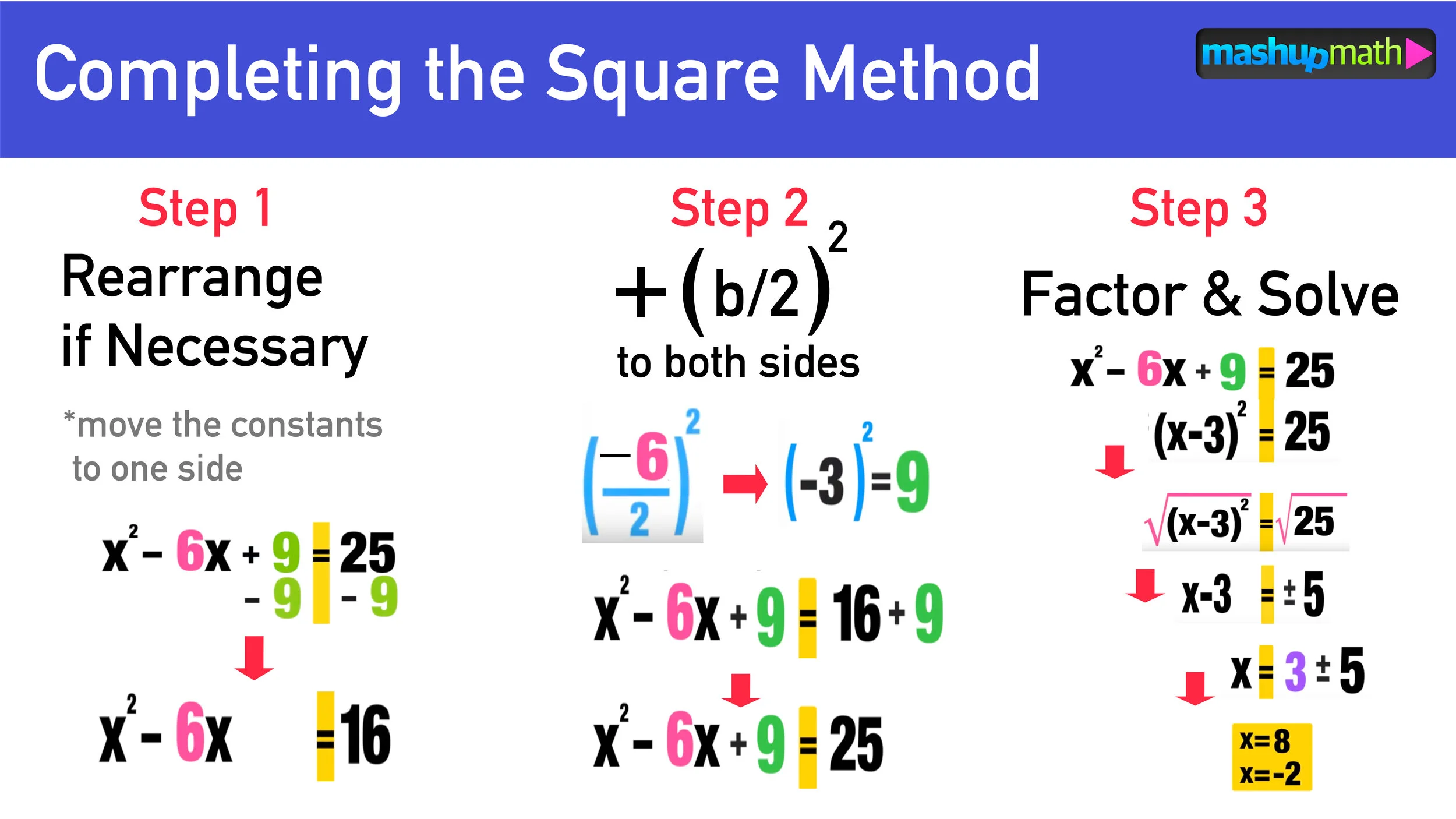
Let’s outline the process for a general quadratic equation $ax^2 + bx + c = 0$:
-
Isolate the variable terms: Move the constant term to the right side of the equation:
$ax^2 + bx = -c$ -
Normalize the leading coefficient: Divide the entire equation by $a$ (assuming $a neq 0$) so that the coefficient of $x^2$ is 1:
$x^2 + frac{b}{a}x = -frac{c}{a}$ -
Find the term to “complete the square”: Take half of the coefficient of the $x$ term, and then square it.
Half of $frac{b}{a}$ is $frac{b}{2a}$.
Squaring this gives $(frac{b}{2a})^2 = frac{b^2}{4a^2}$. -
Add this term to both sides: This step transforms the left side into a perfect square trinomial.
$x^2 + frac{b}{a}x + frac{b^2}{4a^2} = -frac{c}{a} + frac{b^2}{4a^2}$ -
Factor the perfect square trinomial: The left side can now be written as a binomial squared.
$(x + frac{b}{2a})^2 = frac{b^2}{4a^2} – frac{c}{a}$ -
Simplify the right side: Combine the terms on the right side by finding a common denominator.
$(x + frac{b}{2a})^2 = frac{b^2 – 4ac}{4a^2}$
-
Take the square root of both sides: Remember to include both positive and negative roots.
$x + frac{b}{2a} = pmsqrt{frac{b^2 – 4ac}{4a^2}}$ -
Isolate x: Solve for $x$ to find the roots.
$x = -frac{b}{2a} pm frac{sqrt{b^2 – 4ac}}{2a}$
$x = frac{-b pm sqrt{b^2 – 4ac}}{2a}$
This final expression is the quadratic formula, a direct byproduct of the completing the square method. Understanding this derivation is crucial for developers working on numerical solvers or anyone needing to implement quadratic functions from scratch.
Illustrative Example for Practical Application
Consider the equation $2x^2 – 12x + 10 = 0$.
- Isolate constant: $2x^2 – 12x = -10$
- Normalize: Divide by 2: $x^2 – 6x = -5$
- Find term: Half of -6 is -3; $(-3)^2 = 9$.
- Add term: $x^2 – 6x + 9 = -5 + 9$
- Factor: $(x – 3)^2 = 4$
- Take square root: $x – 3 = pmsqrt{4}$
$x – 3 = pm 2$ - Isolate x:
$x = 3 pm 2$
So, $x = 3 + 2 = 5$ or $x = 3 – 2 = 1$.
In a software context, this process could be encapsulated in a function or method that takes the coefficients $a, b, c$ as input and returns the roots or the vertex form, enabling quick analysis of quadratic behaviors within larger applications.
Beyond Solving Equations: Applications in Tech
The power of completing the square extends far beyond merely solving for $x$. Its ability to transform and simplify quadratic expressions makes it a cornerstone for understanding and implementing various technologies.
Optimization and Machine Learning
In machine learning, many algorithms are formulated as optimization problems where the goal is to minimize a cost or loss function. Often, these functions are quadratic or can be approximated as quadratic, especially in convex optimization problems. For example, the least squares method, fundamental to linear regression, involves minimizing a quadratic error function. Completing the square provides a direct analytical solution for finding the minimum (or maximum) of these functions, giving insights into the optimal parameters without resorting to iterative numerical methods in simple cases.
- Gradient Descent Insights: While gradient descent is an iterative approach, understanding the quadratic nature of the loss landscape, revealed by techniques like completing the square, helps in setting learning rates and understanding convergence properties.
- Convex Optimization: Identifying convex quadratic functions through their vertex form ensures that any local minimum found is also the global minimum, a critical property for reliable optimization.
Signal Processing and Data Analysis
Quadratic forms appear frequently in signal processing for tasks such as filtering, spectral analysis, and noise reduction. For instance, in Kalman filters or Wiener filters, quadratic cost functions are minimized to estimate signals from noisy data. Completing the square can help in deriving the optimal filter coefficients or understanding the error covariance.
- Pattern Recognition: In statistical pattern recognition, discriminant functions are often quadratic. Completing the square can help in classifying data points by transforming these functions into a more interpretable form, delineating decision boundaries.
- Data Fitting: When fitting curves to data that exhibit a parabolic or quadratic trend, completing the square aids in quickly identifying the turning point or the peak of the trend.
Geometric Modeling and Computer Graphics
In computer graphics, quadratic equations describe various shapes and surfaces, such as circles, ellipses, parabolas, and hyperbolas, as well as more complex quadratic surfaces. Completing the square is instrumental in:
- Transformation and Translation: Converting the general form of a conic section into its standard form (e.g., $(x-h)^2 + (y-k)^2 = r^2$ for a circle) directly reveals its center $(h,k)$ and radius $r$, which are essential for rendering, scaling, and translating objects in 2D or 3D space.
- Ray Tracing: When a ray intersects a quadratic surface, the intersection points are found by solving a quadratic equation. The completing the square method, or the quadratic formula derived from it, is used within rendering engines to calculate these intersections efficiently.
- Collision Detection: Determining if two objects, especially those defined by quadratic equations, collide often involves solving quadratic systems where completing the square can simplify the analysis.
The Method’s Enduring Relevance in Modern Computing
The completing the square method, despite being an ancient mathematical concept, maintains a profound and enduring relevance in modern computing. It is more than just an academic exercise; it’s a foundational technique that underpins efficient algorithm design, robust software development, and advanced analytical models. Its utility lies in its ability to bring clarity and structure to quadratic relationships, which are ubiquitous in the digital world.
Bridging Theoretical Math and Practical Algorithm Design
For tech professionals, understanding completing the square bridges the gap between abstract mathematical theory and concrete computational problems. It empowers developers to:
- Optimize Code: By recognizing quadratic patterns, developers can choose or implement algorithms that directly leverage the properties revealed by completing the square, leading to more efficient and faster computations.
- Debug and Analyze: When encountering issues with numerical stability or unexpected output in systems involving quadratic functions, understanding the vertex form can provide critical insights for debugging and performance analysis.
- Innovate: A strong grasp of fundamental mathematical techniques like completing the square fosters a deeper understanding of underlying principles, enabling engineers to innovate new algorithms, improve existing ones, and contribute to cutting-edge research in AI and data science.
In a landscape dominated by complex algorithms and vast datasets, the elegant simplicity and profound utility of completing the square serve as a powerful reminder of how foundational mathematical concepts continue to shape and enhance the technological advancements of our time. It’s a testament to the fact that sometimes, the most sophisticated solutions are built upon the most elegant mathematical truths.
aViewFromTheCave is a participant in the Amazon Services LLC Associates Program, an affiliate advertising program designed to provide a means for sites to earn advertising fees by advertising and linking to Amazon.com. Amazon, the Amazon logo, AmazonSupply, and the AmazonSupply logo are trademarks of Amazon.com, Inc. or its affiliates. As an Amazon Associate we earn affiliate commissions from qualifying purchases.