
Understanding the economy can often feel like navigating a complex maze of numbers, policies, and market fluctuations. Yet, at its core, much of this intricate system can be distilled into a surprisingly simple, elegant model: the circular flow of income. This fundamental economic concept illustrates how money, goods, and services move through an economy, connecting households, businesses, government, and the rest of the world. For anyone interested in personal finance, investing, business strategy, or even just making sense of daily financial news, grasping this flow is indispensable. It provides a foundational lens through which to view everything from market demand and employment rates to interest rate decisions and national economic health. Far from being a mere academic exercise, the circular flow model offers practical insights into how your income is generated, where your savings go, and how your financial decisions ripple through the broader economic landscape.

The Basic Two-Sector Model: Households and Firms
At its most elementary level, the economy can be simplified into two primary actors: households and firms. This two-sector model provides a clear initial picture of how money and resources circulate.
Households as Consumers and Resource Owners
Households represent individuals and families. In the circular flow, they play a dual role. Firstly, they are the ultimate consumers of goods and services produced by firms. Every purchase you make, from groceries to entertainment, constitutes a flow of money from households to firms. Secondly, and critically, households are the owners of the factors of production:
-
Labor: The human effort, skills, and knowledge used in producing goods and services.
-
Land: All natural resources used in production, including the space factories occupy and the raw materials extracted from the earth.
-
Capital: Manufactured resources used to produce other goods and services, such as machinery, tools, and buildings.
-
Entrepreneurship: The innovative spirit and risk-taking ability required to combine the other factors of production and create new businesses or products.
Households supply these factors of production to firms in exchange for income. This income comes in various forms: wages for labor, rent for land, interest for capital, and profits for entrepreneurial ventures.
Firms as Producers and Employers
Firms, on the other hand, are the entities that produce goods and services. To do this, they demand the factors of production supplied by households. They hire labor, rent land, borrow capital, and engage entrepreneurs. In return, firms pay out income to households, creating a flow of money in the opposite direction. Once firms produce goods and services, they then sell them back to households, completing the circuit of money and goods.
The Flow of Money and Resources
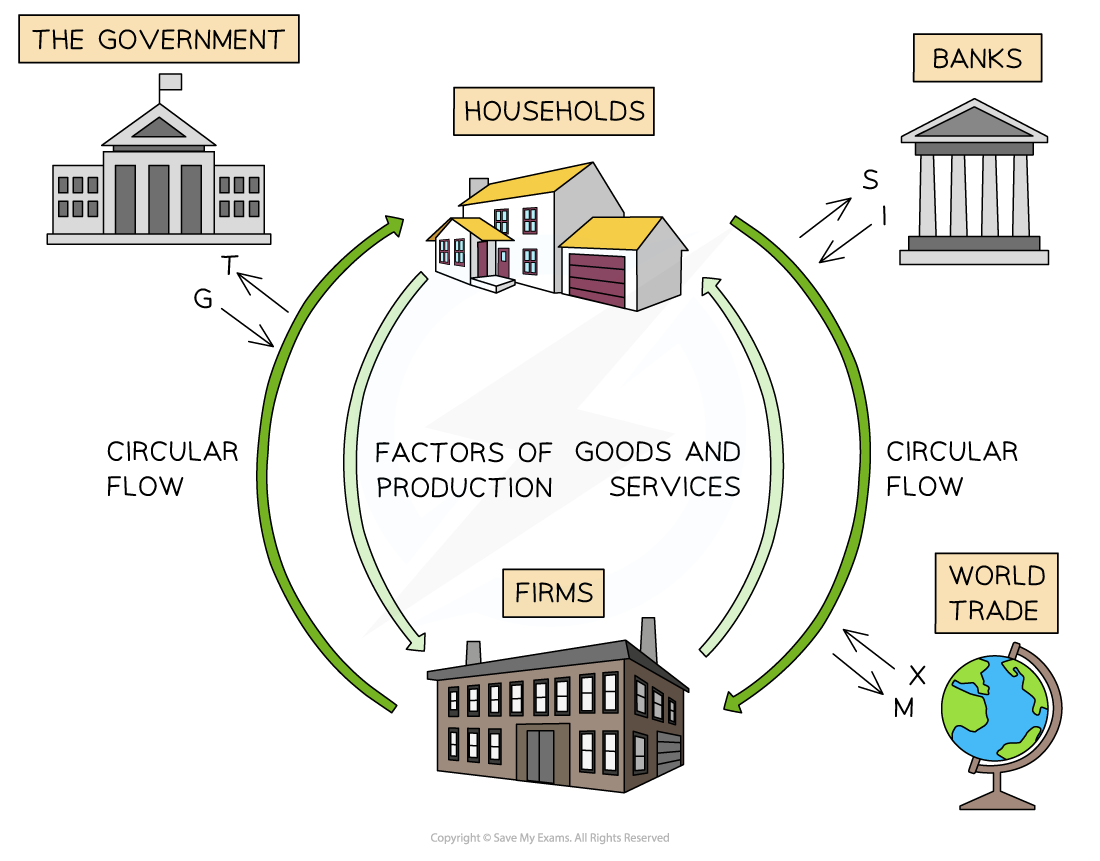
Visualizing this basic model reveals two distinct circuits:
-
The Inner Flow (Real Flow): This represents the physical movement of resources and goods. Households provide factors of production (labor, land, capital) to firms. In return, firms provide goods and services to households.
-
The Outer Flow (Money Flow): This is the monetary compensation for the real flow. Firms pay income (wages, rent, interest, profits) to households for the factors of production. Households, in turn, spend this income on goods and services purchased from firms.
This continuous exchange highlights a fundamental truth in economics: one entity’s spending is another entity’s income. For an individual managing personal finance, this means their salary (income from firms) enables their consumption (spending on firms’ products), directly linking their personal economic activity to the broader system. For a small business owner, understanding this basic flow is crucial for forecasting demand, managing payroll, and appreciating the cyclical nature of revenue.
Expanding the Model: Introducing Additional Sectors
While the two-sector model is a useful starting point, real economies are far more complex. To accurately reflect this complexity, economists expand the model to include three additional sectors: the financial sector, the government sector, and the foreign sector. These additions introduce concepts of “leakages” and “injections” that profoundly influence economic activity and are vital for comprehending business finance and national economic policy.
The Financial Sector (Banks and Financial Markets)
The financial sector comprises institutions like banks, investment funds, and stock markets. Its primary role is to act as an intermediary between savers and borrowers.
-
Savings (Leakage): Not all income earned by households is spent on consumption. A portion is saved, representing a leakage from the immediate circular flow of spending on goods and services. These savings are channeled into banks or invested in financial markets.
-
Investment (Injection): Firms and individuals, in turn, borrow these savings to finance investment in capital goods (e.g., new machinery, factories, technology) or expansion projects. This investment represents an injection back into the circular flow, boosting demand and production capacity.
For investors, understanding this sector is paramount. Your decision to save or invest directly impacts the availability of capital for businesses. Financial tools like savings accounts, mutual funds, and direct stock investments are the mechanisms through which your personal financial choices contribute to or draw from this critical economic flow. The health of the financial sector directly influences the ease with which businesses can access capital for growth, affecting job creation and innovation.
The Government Sector
The government plays a significant role in modern economies, influencing the circular flow through taxation and spending.
-
Taxes (Leakage): The government collects taxes from both households and firms (e.g., income tax, corporate tax, sales tax). These taxes represent another leakage from the circular flow, reducing the disposable income of households and the revenue available to firms.
-
Government Spending (Injection): The government injects money back into the economy through various expenditures, such as infrastructure projects, public services (education, healthcare), defense, and transfer payments (social security, unemployment benefits). This spending acts as a significant injection, stimulating demand and creating jobs.
Government fiscal policy (decisions on taxation and spending) directly manipulates the circular flow. For individuals, tax rates affect take-home pay, influencing personal finance decisions. For businesses, government contracts can be a vital source of revenue, while tax incentives can encourage investment.
The Foreign Sector (Rest of the World)
Modern economies are rarely isolated; they engage in trade with other countries. The foreign sector accounts for international trade.
-
Imports (Leakage): When households or firms purchase goods and services from abroad, money flows out of the domestic economy. This represents a leakage, as the spending benefits foreign producers rather than domestic ones.
-
Exports (Injection): Conversely, when domestic firms sell goods and services to foreign buyers, money flows into the domestic economy. This acts as an injection, stimulating domestic production and income.
The balance of trade (net exports) can significantly impact the circular flow. A strong export sector provides an injection, boosting domestic income and employment, which can be a boon for online income streams and businesses seeking global markets. Conversely, high import dependence can lead to significant leakages.

Leakages and Injections: Maintaining Economic Equilibrium
The expanded circular flow model highlights the critical interplay between leakages and injections. These concepts are central to understanding how an economy grows, contracts, or maintains stability.
Understanding Leakages
Leakages are any withdrawals from the immediate flow of income and spending in the economy. The three main types are:
-
Savings (S): Income not spent on consumption but held in financial institutions.
-
Taxes (T): Income paid to the government.
-
Imports (M): Spending on foreign goods and services.
Leakages reduce the amount of money available for domestic consumption and investment, potentially dampening economic activity if not offset by injections. For a household, high savings are a personal financial strength but can be a macroeconomic leakage if capital isn’t effectively re-channeled. For a business, high taxes reduce retained earnings for reinvestment.
Understanding Injections
Injections are any additions to the immediate flow of income and spending in the economy. The three main types are:
-
Investment (I): Spending by firms on capital goods (factories, machinery) or by households on new housing.
-
Government Spending (G): Spending by the government on goods, services, and transfers.
-
Exports (X): Spending by foreign buyers on domestic goods and services.
Injections stimulate economic activity by adding money back into the flow, increasing demand for goods and services, and encouraging production. For businesses, attracting investment is key to expansion. For individuals, jobs created by government spending or export demand mean income opportunities.
Equilibrium and Disequilibrium
For an economy to be in equilibrium, the total leakages must equal the total injections (S + T + M = I + G + X).
-
Equilibrium: When leakages equal injections, the economy is stable, with no tendency for output or income to change. This is a state of balanced growth or stability.
-
Disequilibrium:
-
If injections are greater than leakages (I + G + X > S + T + M), there’s an expansionary pressure. More money is entering the flow than leaving, leading to increased demand, production, employment, and income – potentially economic growth.
-
If leakages are greater than injections (S + T + M > I + G + X), there’s a contractionary pressure. More money is leaving the flow than entering, leading to decreased demand, production, employment, and income – potentially a recession.
-
Understanding this balance is crucial for financial planning. A robust economy (where injections consistently meet or exceed leakages) offers more opportunities for online income, side hustles, and investing. Conversely, an economy with dominant leakages signals caution.
Practical Implications for Businesses and Individuals
The circular flow of income isn’t just an abstract economic model; it has profound and tangible implications for real-world financial decisions, impacting both large corporations and individual households.
For Businesses (Business Finance & Strategy)
-
Understanding Market Demand: Firms need to recognize that their sales are directly linked to household income and spending. If leakages increase (e.g., higher taxes, increased savings due to uncertainty), consumer demand can fall, impacting revenue. Conversely, strong injections (e.g., government stimulus, increased investment) can boost demand.
-
Forecasting and Investment Decisions: Businesses must consider the overall economic flow when planning expansion, inventory, or hiring. Access to capital for investment (an injection) is facilitated by a healthy financial sector, itself fueled by household savings. Financial tools for businesses, such as lines of credit, business loans, and equity financing, are direct components of this flow.
-
Impact of Economic Policies: Businesses are directly affected by fiscal and monetary policies. Changes in corporate tax rates (government leakage) or interest rates (monetary policy affecting investment injections) can significantly alter their profitability and growth prospects.
-
Supply Chain Resilience: In a globalized world, understanding import and export dynamics is vital. Reliance on foreign components (imports) makes a business susceptible to leakages from the domestic economy, while robust exports can be a major source of revenue injection.
For Individuals (Personal Finance & Investing)
-
Income Streams and Spending Habits: Your salary is an income payment from firms for your labor (a factor of production). Your spending habits contribute to the consumption flow. Understanding how government policies (like tax cuts or increased social security benefits) affect your disposable income is a core aspect of personal finance.
-
Saving and Investment Decisions: Your decision to save (a leakage) versus spend influences the availability of capital for businesses (an injection). Through investment platforms and financial tools, your savings can be channeled into productive investments, potentially yielding returns and contributing to economic growth. Investing in stocks, bonds, or real estate directly fuels the investment injection.
-
Understanding Economic Cycles: The circular flow helps explain why economies experience booms and busts. During periods of high injections and low leakages, jobs are abundant, incomes rise, and investment opportunities flourish. During recessions, when leakages dominate, job security can diminish, and investment returns may suffer. This knowledge informs decisions about saving for retirement, managing debt, and timing large purchases.
-
Online Income and Side Hustles: Even in the gig economy, the principles hold. Your services (e.g., freelance work, selling products online) are factors of production or goods/services provided to firms or other households, generating income. The demand for these services is influenced by the overall health of the circular flow.
Role of Financial Tools and Institutions
Financial tools are not just accessories but crucial conduits within the circular flow. Banks aggregate household savings, transforming them into loans for businesses (investment) and mortgages for housing (also investment). Investment platforms allow individuals to directly inject capital into companies or government bonds. Government bonds themselves are a financial tool enabling government spending. Understanding how these tools facilitate the movement of money is key to both personal wealth management and business financial strategy.
The Dynamic Nature of the Circular Flow
The circular flow of income is not static; it’s a dynamic model constantly influenced by economic forces and policy interventions. Its fluidity is what makes it such a powerful tool for analyzing economic performance and predicting future trends.
Economic Growth and Contraction
-
Growth: Sustained economic growth occurs when injections consistently outweigh leakages, leading to an expansion of the overall flow. This means more income is being generated, more goods and services are being produced, and more people are employed. Investment in new technology, increased exports, and effective government stimulus are common drivers of growth.
-
Contraction: Economic contractions or recessions happen when leakages outpace injections. Reduced consumer spending, business investment cutbacks, increased savings due to uncertainty, or a decline in exports can all contribute to a shrinking flow, resulting in higher unemployment and lower incomes.
Policy Interventions
Governments and central banks actively try to manage the circular flow to achieve desired economic outcomes, such as stable growth, low unemployment, and controlled inflation.
-
Monetary Policy: Central banks (like the Federal Reserve) manipulate interest rates and the money supply. Lowering interest rates can encourage borrowing for investment (an injection) and consumption, while raising them can dampen these activities. This directly impacts the financial sector’s role in facilitating the flow of capital.
-
Fiscal Policy: Governments use fiscal policy (changes in taxation and government spending) to influence the circular flow. For instance, increasing government spending (an injection) or cutting taxes (reducing leakage) can stimulate a sluggish economy. Conversely, reducing spending or raising taxes can cool down an overheated economy.
These policy decisions have direct consequences for personal finance and business operations. A change in interest rates affects mortgage payments and business loan costs. A new tax policy affects disposable income or corporate profits. Understanding these connections helps individuals and businesses anticipate and adapt to economic shifts.
In conclusion, the circular flow of income is more than just an economic diagram; it is the beating heart of an economy. It reveals the interconnectedness of all financial activities, from your daily spending and saving habits to the largest government infrastructure projects and global trade agreements. For anyone seeking to master personal finance, strategically grow a business, make informed investment decisions, or simply understand the news headlines, a firm grasp of the circular flow provides an invaluable framework. It empowers you to see how your financial decisions contribute to and are influenced by the broader economic currents, making you a more informed and capable participant in the intricate world of money.
aViewFromTheCave is a participant in the Amazon Services LLC Associates Program, an affiliate advertising program designed to provide a means for sites to earn advertising fees by advertising and linking to Amazon.com. Amazon, the Amazon logo, AmazonSupply, and the AmazonSupply logo are trademarks of Amazon.com, Inc. or its affiliates. As an Amazon Associate we earn affiliate commissions from qualifying purchases.