
In the realm of personal finance, travel is often one of the largest discretionary expenses a household faces. For the budget-conscious consumer, the ultra-low-cost carrier (ULCC) model represented by Spirit Airlines offers a unique opportunity to drastically reduce transit costs, provided one understands the underlying financial mechanics of their pricing structure. Determining the “cheapest day” to book a Spirit flight is not merely a matter of superstition or folklore; it is an exercise in understanding dynamic pricing algorithms, demand-side economics, and strategic timing.
To master the art of the low-cost fare, one must look past the surface-level marketing and examine the data-driven reality of how seats are priced. Managing travel expenses requires a disciplined approach to procurement, similar to any other significant investment. By identifying the specific windows and tactics that yield the highest ROI on your travel spend, you can unlock significant capital for other financial goals.
The Economics of Dynamic Pricing and Fare Buckets
At the heart of Spirit Airlines’ financial model is a sophisticated system known as dynamic pricing. Unlike traditional retail where a price might remain static for weeks, airline seats are perishable inventory. Once a plane takes off, any empty seat represents a total loss of potential revenue. To mitigate this risk, Spirit uses complex algorithms to adjust prices in real-time based on supply, historical data, and current booking velocity.
Understanding Fare Buckets
Airlines do not sell every seat on a plane at the same price. Instead, they divide the cabin into “fare buckets.” A certain number of seats are allocated to the lowest price tier, and once those are sold, the algorithm automatically moves to the next, more expensive tier. From a financial planning perspective, the “cheapest day” to book is technically any day before a specific fare bucket is exhausted. However, statistical trends suggest that these lower buckets are more likely to be available during certain windows of the week.
The Mid-Week Advantage
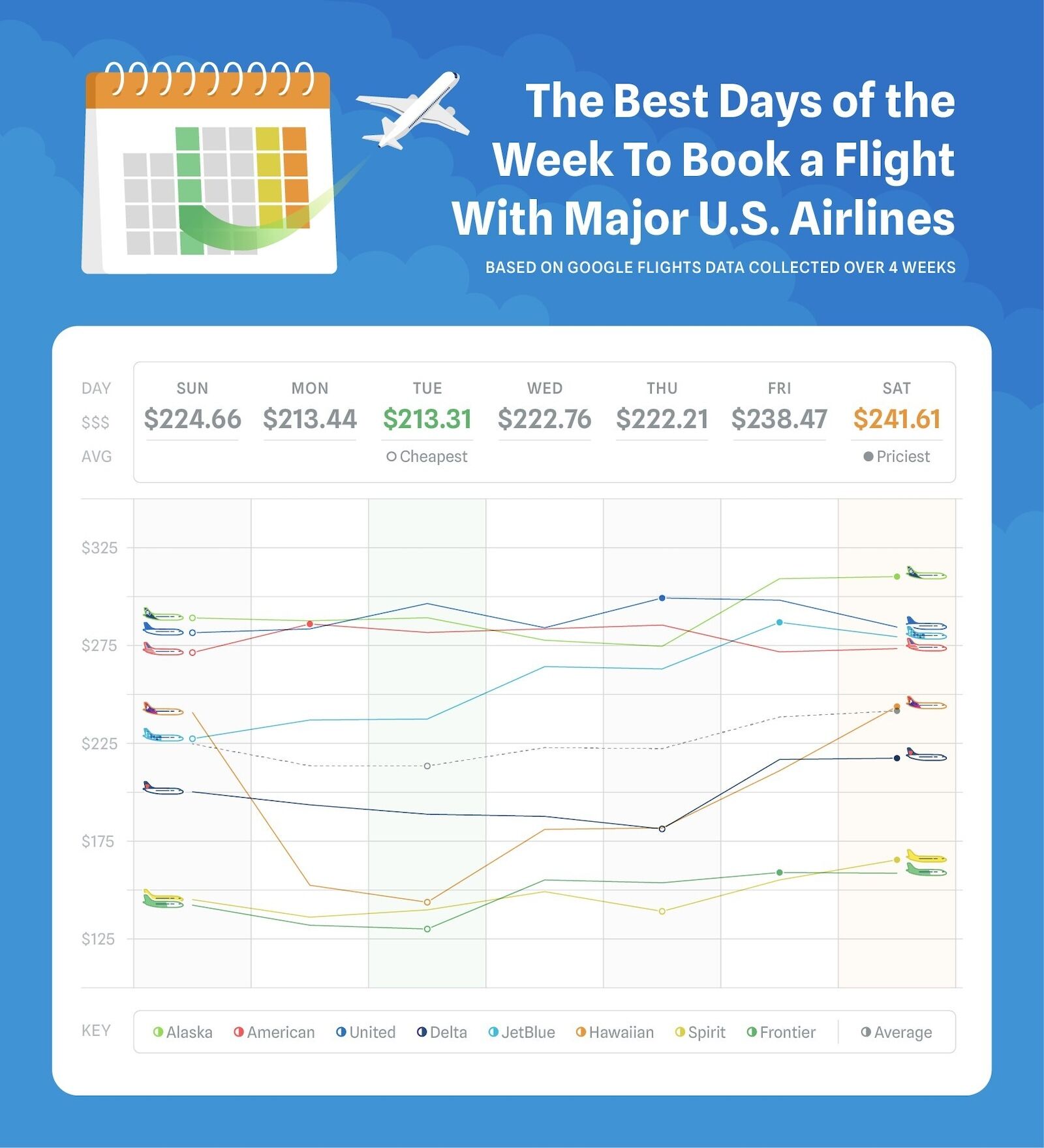
Historically, data aggregators have pointed toward Tuesday and Wednesday as the most advantageous days to finalize a booking. The rationale is rooted in corporate behavior and weekend consumer activity. Most travelers spend their weekends planning trips and booking flights, which keeps demand—and prices—high. By Tuesday, the surge of weekend bookings has subsided, and airlines often recalibrate their inventory to fill remaining seats for upcoming routes. For the disciplined saver, waiting until the mid-week lull can result in a 10% to 15% reduction in the base fare.
Strategic Timing: The Booking Window vs. The Travel Day
It is vital to distinguish between the day you book the flight and the day you actually fly. In the world of personal finance, the goal is to optimize both to achieve the lowest total cost of ownership for your trip.
The 21-Day Rule
From a business finance perspective, airlines categorize travelers into two groups: price-sensitive leisure travelers and time-sensitive business travelers. Business travelers often book last minute and are willing to pay a premium. To exploit this, airlines significantly hike prices within 21 days of departure. For the budget optimizer, the “sweet spot” for booking Spirit flights is generally between 28 and 60 days before departure. Booking too far in advance (more than five months) can sometimes be as expensive as booking too late, as the airline has not yet begun to discount inventory to fill the plane.
Flying on “Off-Peak” Days
While the day you book matters, the day you fly has a more profound impact on the final price. Spirit’s business model thrives on high volume. Flying on Tuesdays, Wednesdays, and Saturdays—days that are traditionally less popular for both business and leisure travel—allows you to access the lowest possible fare buckets. When you combine a mid-week booking strategy with a mid-week travel itinerary, you maximize your savings potential.
The “Airport Counter” Strategy: A Deep Dive into Fee Avoidance
One of the most overlooked financial hacks for Spirit Airlines involves the “Passenger Usage Fee.” Spirit, like many ULCCs, unbundles every aspect of the travel experience to keep the base fare low. However, one specific fee is legally required to be avoidable if the ticket is purchased in a certain way.

Saving on the Passenger Usage Fee
Spirit typically charges a “Passenger Usage Fee” for tickets booked online or over the phone, which can range from $15 to $23 per person, per direction. For a family of four on a round-trip flight, this fee alone can add nearly $200 to the total cost. Because of federal regulations regarding how taxes are applied to “non-transportation” fees, Spirit allows customers to avoid this charge by purchasing tickets directly at the airport terminal.
For the financially savvy traveler, if the airport is within a reasonable distance, making a trip to the ticket counter on a Tuesday or Wednesday (when agents are less busy) can result in an immediate “investment return” that far exceeds the cost of gas and parking. This is perhaps the most concrete way to ensure you are getting the absolute cheapest price possible, regardless of the day of the week.
Calculating the ROI of Travel Time
In any financial discussion, one must consider the opportunity cost. If it takes two hours and $10 in fuel to save $40 on a flight, your “hourly rate” for that task is $15. If it saves you $200, your hourly rate is $95. Evaluating the airport counter strategy through this lens allows you to make a data-driven decision based on your own valuation of time.
Analyzing the Total Cost of Travel
The base fare on Spirit is often deceptively low. To truly understand the impact on your personal balance sheet, you must calculate the “All-In” cost. This is the only way to accurately compare Spirit against a legacy carrier like Delta or United.
The Hidden Impact of Ancillaries
Spirit’s profit margins are heavily dependent on ancillary revenue—fees for bags, seat assignments, and even onboard water. To keep your travel budget intact, you must adopt a minimalist approach:
-
Baggage: Spirit charges more for a carry-on than a checked bag in many instances. However, a “personal item” (like a small backpack) is free. For a short trip, mastering the art of the personal item can save $60 to $120 round-trip.
-
Seat Selection: Spirit’s algorithm will assign you a seat for free at check-in. Unless you have a specific physical requirement, paying $15-$50 for a specific seat is a luxury expense that detracts from your travel savings.
-
The Big Front Seat: From a value-investing perspective, Spirit’s “Big Front Seat” is often cited as one of the best deals in the industry. It offers a first-class sized seat without the first-class service or price. If you require extra space, booking this upgrade separately is often cheaper than buying a business class ticket on another airline.
Membership Programs as Financial Tools
Spirit offers the “Spirit Saver$ Club,” a subscription-based model that provides access to lower fares and discounted baggage. For a frequent traveler, the annual fee (roughly $70) can be recouped in as little as one round-trip for two people. When evaluating this, treat it as a capital expense. Calculate your expected travel frequency over the next 12 months; if the projected savings exceed the membership cost plus the cost of capital, it is a sound financial move.
Navigating Seasonal Volatility
In personal finance, we often talk about “smoothing” expenses. Travel is inherently seasonal, and Spirit’s pricing reflects this volatility. To find the cheapest day to book, you must also consider the broader economic calendar.
Avoiding the “Holiday Tax”
During peak periods—Spring Break, Thanksgiving, and the December holidays—the “cheapest day” to book effectively disappears. Demand is so high that fare buckets are exhausted almost as soon as they are released. In these instances, the best financial strategy is “defensive booking”—securing a seat as soon as the schedule opens, which is usually several months in advance.
Shoulder Season Opportunities
The months of September, October, and late January are considered “shoulder seasons.” During these times, Spirit often runs aggressive promotions to maintain their load factors. This is when you will find the mythical $19 or $29 fares. By aligning your travel schedule with these periods of low demand, you can travel for a fraction of the cost, preserving your wealth for long-term investments rather than temporary transit.

Final Financial Considerations for Spirit Travelers
Ultimately, finding the cheapest day to book a Spirit flight is a combination of timing, location, and behavioral discipline. To optimize your travel budget:
-
Monitor Price Movements: Use financial tools and price trackers to identify the baseline for your specific route.
-
Execute Mid-Week: Aim to book on a Tuesday or Wednesday to capitalize on the post-weekend price corrections.
-
Leverage the Airport Counter: When the savings outweigh the opportunity cost of your time, buy in person to strip away the Passenger Usage Fee.
-
Audit the Extras: Always calculate the total cost including bags and fees before concluding that a Spirit flight is the best financial choice.
By treating flight booking as a strategic procurement process rather than a random purchase, you can significantly lower your cost of living while still enjoying the benefits of global mobility. In the world of money management, it is often the small, repeated savings—like $50 off a flight—that compound into significant long-term financial security.
aViewFromTheCave is a participant in the Amazon Services LLC Associates Program, an affiliate advertising program designed to provide a means for sites to earn advertising fees by advertising and linking to Amazon.com. Amazon, the Amazon logo, AmazonSupply, and the AmazonSupply logo are trademarks of Amazon.com, Inc. or its affiliates. As an Amazon Associate we earn affiliate commissions from qualifying purchases.