
For decades, the United States has been a premier destination for entrepreneurs looking to form Limited Liability Companies (LLCs) due to the flexibility and protection these structures offer. However, as the global financial landscape shifts toward greater transparency to combat money laundering and tax evasion, new regulatory requirements have emerged. The most significant of these is the Beneficial Ownership Information (BOI) report.
This requirement, stemming from the Corporate Transparency Act (CTA) enacted by Congress in 2021, represents a seismic shift in how small business owners interact with the federal government. For LLC owners, understanding the BOI report is no longer optional—it is a critical component of business finance and legal compliance. This article explores the nuances of the BOI report, who it affects, and how to navigate this new financial obligation.

The Fundamentals of Beneficial Ownership Information Reporting
To understand the BOI report, one must first understand the legislative environment that created it. For years, the U.S. was criticized for allowing “anonymous” shell companies to operate, which could potentially be used for illicit financial activities. The Corporate Transparency Act was designed to close these loopholes.
What is a BOI Report?
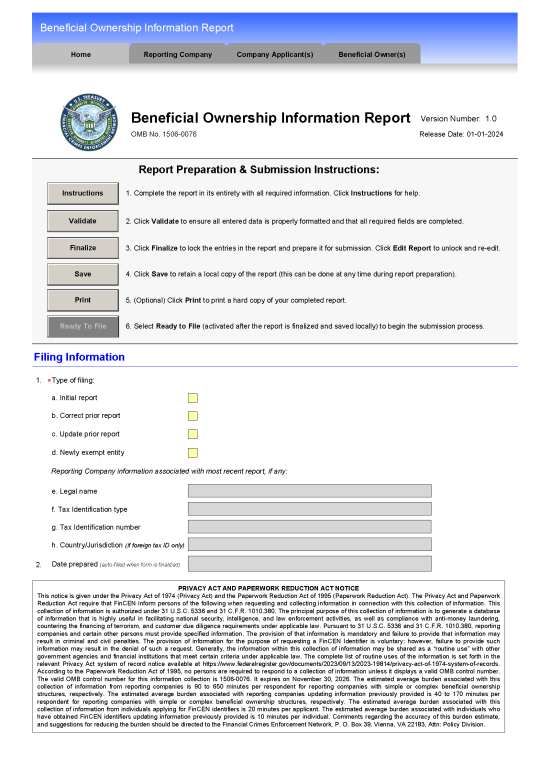
At its core, a BOI report is a document filed with the Financial Crimes Enforcement Network (FinCEN), a bureau of the U.S. Department of the Treasury. The report requires companies to disclose specific information about the individuals who ultimately own or control the business. Unlike many other business filings, this information is not public; it is stored in a secure, non-public database accessible only to authorized government agencies and financial institutions.
The Role of FinCEN in Business Finance
FinCEN’s primary mission is to safeguard the financial system from illicit use and promote national security. By collecting BOI data, FinCEN aims to provide law enforcement with the tools necessary to track the flow of money through entities that were previously opaque. For the average LLC owner, this means that the “privacy” often associated with certain states’ filing rules is now superseded by federal reporting requirements.
Why the US Government Mandated This Reporting
The primary driver behind the BOI mandate is the prevention of financial crimes such as money laundering, terrorist financing, and securities fraud. By identifying the real people behind corporate structures, the government can more effectively target bad actors without placing undue burdens on legitimate commerce. For the broader economy, this fosters a more transparent and stable financial environment, though it does introduce a new administrative layer for small business owners.
Who Needs to File? Determining Your LLC’s Eligibility
Not every entity is required to file a BOI report, but the vast majority of small and mid-sized LLCs fall under the “reporting company” definition. It is vital to determine your status early to avoid missing deadlines.
Defining “Reporting Companies”
The CTA defines two types of reporting companies: domestic and foreign. A domestic reporting company is any entity created by filing a document with a secretary of state or a similar office under the law of a state or Indian tribe. This includes LLCs, corporations, and limited partnerships. If you filed paperwork to start your business, you are likely a reporting company.
Domestic vs. Foreign Entities
A foreign reporting company is an entity formed under the law of a foreign country that has registered to do business in any U.S. state or tribal jurisdiction. In the context of business finance, this ensures that foreign investors operating within the U.S. are subject to the same transparency standards as domestic entrepreneurs, leveling the playing field for financial oversight.
Exemptions: Who Doesn’t Need to File?
There are 23 specific categories of entities exempt from the BOI reporting requirements. Most of these exemptions apply to entities that are already heavily regulated, such as publicly traded companies, banks, insurance companies, and non-profits.
Crucially, “large operating companies” are also exempt. To qualify as a large operating company, an entity must:
- Employ more than 20 full-time employees in the U.S.
- Have an operating office within the U.S.
- Have filed a federal income tax or information return in the U.S. for the previous year demonstrating more than $5 million in gross receipts or sales.
Because most LLCs do not meet these high thresholds, the burden of BOI reporting falls primarily on small businesses.
Identifying Beneficial Owners and Company Applicants
The most complex part of the BOI report is accurately identifying the individuals who must be reported. FinCEN identifies two categories of individuals: Beneficial Owners and Company Applicants.
What Qualifies as Substantial Control?
A “Beneficial Owner” is any individual who, directly or indirectly, exercises “substantial control” over a reporting company. This includes senior officers (such as a CEO, CFO, or General Counsel), individuals with the authority to appoint or remove officers, and key decision-makers who direct the company’s financial or operational path. Even if an individual doesn’t own a single share of the company, their influence over the business’s direction may require them to be listed on the report.
Ownership Interest Thresholds (The 25% Rule)
In addition to those with substantial control, any individual who owns or controls at least 25% of the “ownership interests” of a reporting company is considered a Beneficial Owner. This includes equity, stock, voting rights, or any other instrument used to establish ownership. For a simple multi-member LLC with four equal partners, all four would be considered beneficial owners.
The Role of the Company Applicant
For LLCs formed on or after January 1, 2024, the “Company Applicant” must also be reported. This is the individual who directly files the document that creates the entity, as well as the individual who is primarily responsible for directing or controlling that filing. For many entrepreneurs, this might be their attorney or a professional filing service. Existing companies (formed before 2024) do not need to report Company Applicant information.
The Filing Process and Financial Compliance
Filing the BOI report is a digital process handled through FinCEN’s secure portal. While there is no fee to file the report directly with the government, the cost of non-compliance can be devastating to a business’s finances.
Required Information for the Report
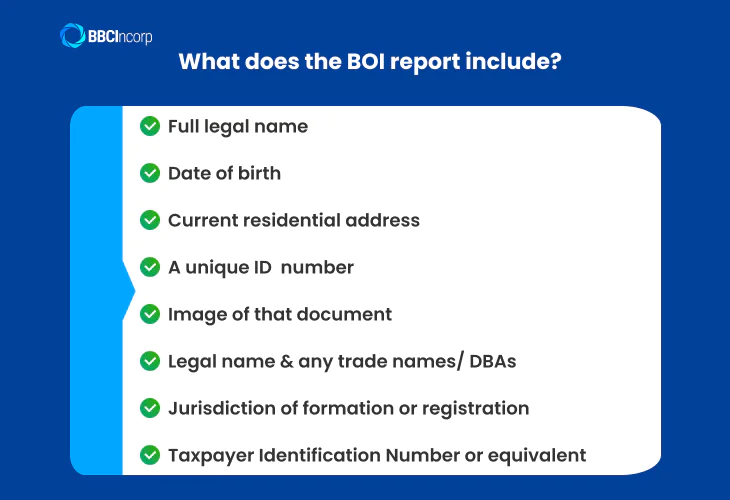
When filing, the LLC must provide its legal name, any “Doing Business As” (DBA) names, its physical address, and its Taxpayer Identification Number (TIN). For each Beneficial Owner and Company Applicant, the report must include:
- Full legal name
- Date of birth
- Current residential or business address
- A unique identifying number from an acceptable document (like a passport or driver’s license)
- An image of that identification document
Deadlines for New and Existing LLCs
The deadlines for filing depend on when your LLC was created:
- Existing Companies: LLCs created or registered before January 1, 2024, have until January 1, 2025, to file their initial report.
- New Companies (2024): LLCs created in 2024 have 90 calendar days from the date of their creation to file.
- New Companies (2025 and beyond): Starting in 2025, the window shrinks to 30 calendar days.
Penalties for Non-Compliance
The federal government takes BOI reporting seriously. Failing to report complete or updated beneficial ownership information can result in civil penalties of up to $500 for each day the violation continues. Furthermore, individuals who willfully provide false information or fail to report can face criminal penalties, including fines of up to $10,000 and imprisonment for up to two years. For any small business, these financial risks make timely compliance a top priority.
Integrating BOI Compliance into Your Business Strategy
Because the BOI report is not a “one-and-done” filing, business owners must integrate this requirement into their long-term financial and administrative workflows.
Maintaining Accurate Internal Records
Any change to the information previously reported must be updated with FinCEN within 30 days. This includes a change in the company’s address, a change in beneficial ownership (e.g., selling a portion of the LLC), or even a beneficial owner changing their legal name or residential address. Maintaining a rigorous internal record-keeping system is essential to ensure these 30-day windows are never missed.
Reporting Changes and Updates
Compliance is a dynamic process. If your LLC grows and eventually qualifies for the “large operating company” exemption, you must file an updated report to reflect your new exempt status. Conversely, if a manager with “substantial control” leaves the company, an update is required. Business owners should treat the BOI report with the same diligence as their tax filings or annual state reports.
The Long-term Impact on Small Business Finance
The BOI report is a landmark change in the American business landscape. While it adds a layer of bureaucracy, it also professionalizes the management of small LLCs. By forcing owners to clearly define roles of control and ownership, it can actually lead to better internal governance. From a financial perspective, being “BOI-compliant” will likely become a prerequisite for securing business loans, opening bank accounts, and entering into major contracts, as financial institutions look to verify the legitimacy of the entities they do business with.
In conclusion, the BOI report is a vital tool in the modern financial toolkit of an LLC owner. While the shift toward transparency may feel intrusive to some, the objective is a cleaner, more secure financial system. By understanding the requirements, identifying the correct individuals, and adhering to the strict filing deadlines, LLC owners can ensure their businesses remain in good standing and avoid the significant financial pitfalls of non-compliance.
aViewFromTheCave is a participant in the Amazon Services LLC Associates Program, an affiliate advertising program designed to provide a means for sites to earn advertising fees by advertising and linking to Amazon.com. Amazon, the Amazon logo, AmazonSupply, and the AmazonSupply logo are trademarks of Amazon.com, Inc. or its affiliates. As an Amazon Associate we earn affiliate commissions from qualifying purchases.