
From a personal finance and strategic budgeting perspective, determining the best month to go to Cancun is less about the weather and more about the optimization of “experience ROI.” For the disciplined traveler who views their vacation budget as a capital allocation, Cancun represents a complex market of fluctuating prices, dynamic demand, and seasonal risk-reward ratios. To find the optimal month, one must look past the postcards and analyze the economic cycles of the Mexican Caribbean.
Choosing the right time to visit is a masterclass in arbitrage. By understanding the intersection of the hospitality industry’s peak revenue periods and the inherent environmental risks of the region, a traveler can secure a five-star experience at a three-star price point. This guide breaks down the calendar year through the lens of financial efficiency, ensuring your investment in leisure yields the highest possible dividends.
The Economics of Cancun’s Tourism Market
The travel industry in the Quintana Roo region operates on a sophisticated model of dynamic pricing. During high-demand periods, the “convenience premium” can inflate costs by as much as 150% compared to the baseline. To identify the best month, we must first categorize the year into fiscal quarters of tourism.
Supply and Demand Cycles in the Mexican Caribbean
The primary driver of cost in Cancun is the seasonal influx of capital from North American and European markets. During the winter months, demand surges as travelers flee colder climates. From a financial standpoint, this is the “seller’s market.” Supply (hotel rooms and flight seats) remains fixed, while demand sky-rockets, allowing vendors to dictate aggressive pricing.
Conversely, the “buyer’s market” occurs during periods of perceived risk or lower desirability—specifically the peak of the Atlantic hurricane season and the humid summer months. For the value-conscious traveler, these windows offer significant leverage for negotiation and the utilization of “opaque” booking tools that offer deep discounts on unsold inventory.
High Season vs. Low Season: The Price Gap
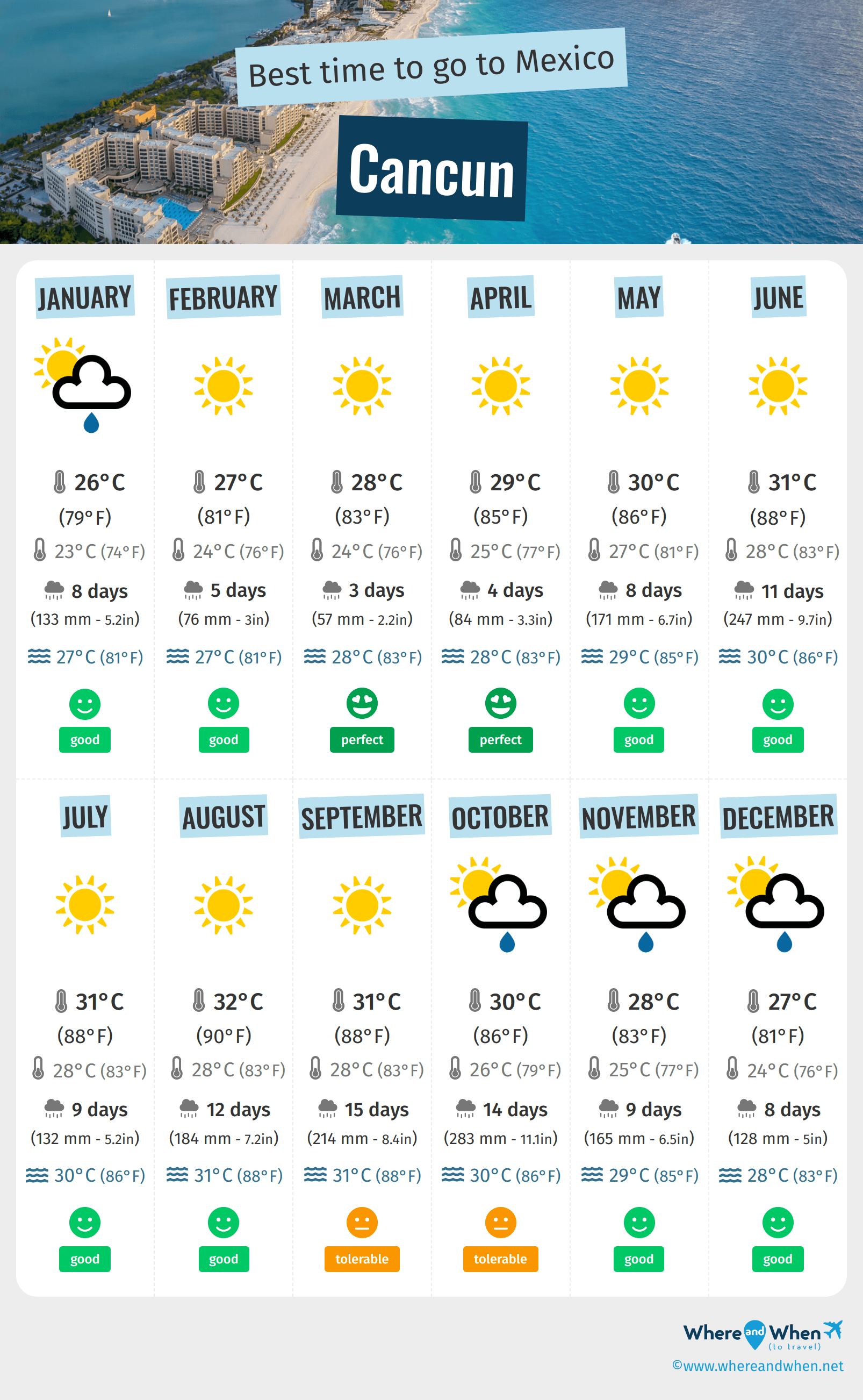
The high season, stretching from late December through April, commands the highest ADR (Average Daily Rate). If your goal is capital preservation, these months are the most difficult to justify. However, the low season (September and October) offers the lowest barrier to entry. The gap between these two extremes is where the “best” month is actually found—not at the bottom of the price curve, but at the point where price and utility intersect most favorably.
The “Sweet Spot” Months: Balancing Cost and Experience Capital
In financial planning, we often look for “asymmetric opportunities”—scenarios where the potential upside significantly outweighs the downside. In the context of Cancun, these opportunities are found in the “shoulder seasons.”
April and May: The Post-Spring Break Recovery
For many, May is the definitive “best month” to visit Cancun from a financial perspective. Once the Spring Break crowds dissipate and the Easter holiday (Semana Santa) concludes, the market experiences a sharp correction. Hotels that were at 95% occupancy suddenly find themselves at 60%, leading to a cascade of promotional offers.
During May, the weather remains stable before the onset of the heavy rainy season, yet the pricing models transition into the summer baseline. This allows a traveler to access premium beachfront properties at a fraction of their February cost. Furthermore, the decrease in human density enhances the “utility” of the vacation—shorter wait times at restaurants and less crowded excursions increase the overall value of your time.
November and Early December: The Pre-Holiday Lull
Another high-value window is the period between late October and the second week of December. As the hurricane season officially winds down, the risk profile of the trip decreases, but the massive holiday price hikes have not yet been implemented.
This is a strategic window for travelers using points and miles. Loyalty programs often have higher availability for “saver” level awards during this period. By booking in late November (excluding the U.S. Thanksgiving week), you can capture the ideal weather conditions of the winter months without paying the “holiday tax.”

Mitigating Financial Risk: Weather and Insurance Strategy
Every investment carries risk, and a trip to Cancun is no different. The primary risk factor is the Atlantic hurricane season, which runs from June 1st to November 30th. To truly find the best month, one must factor in the cost of risk mitigation.
The Hurricane Season and the Risk-Reward Ratio
Traveling in August or September offers the lowest possible rates, but the probability of trip interruption is at its peak. From a money-management perspective, this is a high-volatility play. While you might save $1,000 on a luxury resort, the total loss of a vacation due to a storm can result in a negative ROI that far outweighs the initial savings.
If you choose to book during these low-cost months, the inclusion of comprehensive travel insurance is non-negotiable. The cost of a “Cancel for Any Reason” (CFAR) policy typically ranges from 5% to 10% of the trip cost. Even with this added expense, a September trip is often cheaper than a January trip. The sophisticated traveler views insurance not as a sunk cost, but as a hedge against capital loss.
Understanding the “Sargassum Tax”
In recent years, a new financial variable has entered the equation: sargassum (seaweed). The influx of seaweed on Cancun’s beaches generally peaks during the warmer months (May through August). While this doesn’t affect hotel rates directly in the same way hurricanes do, it significantly impacts the “value” of a beach-focused vacation. If you are paying for a premium oceanfront view but cannot access the water, your cost-per-utilization increases. Choosing months like January or November reduces the risk of this environmental “tax” on your experience.
Maximizing ROI: Leveraging Loyalty Programs and Currency
The “best month” is also determined by how you fund the excursion. The mechanics of credit card points, airline miles, and foreign exchange rates can shift the ideal timing for your specific financial situation.
Points, Miles, and Arbitrage
If you are utilizing a “fixed-value” point system (where points have a set cent-per-point value), the best month is simply the one with the lowest cash price. However, if you are using “transferable” currencies (like Chase Ultimate Rewards or Amex Membership Rewards), the best month is whenever “Saver” level award space opens up.
Historically, airlines release more award seats during the off-peak months of May, June, and September. If you can eliminate the flight cost—typically 30% of a Cancun budget—through strategic point redemption, the “expensive” months become much more accessible, or the “cheap” months become nearly free.
The Impact of the Mexican Peso
While Cancun is a heavily dollarized economy, local excursions, dining off-resort, and transportation are often priced in Pesos. Monitoring the USD/MXN exchange rate is a vital part of the budget process. If the Peso is particularly strong, your purchasing power in Cancun diminishes. Conversely, a weak Peso makes the “off-season” even more attractive.
The best month for your wallet might be the one where your home currency has the most leverage. For those looking to maximize their side hustle income or business revenue, timing a trip during a favorable exchange rate cycle can lead to a 10-15% increase in total purchasing power.
Conclusion: The Definitive Fiscal Calendar for Cancun
When we synthesize the data—weighing the cost of airfare, the ADR of luxury resorts, the probability of weather-related loss, and the “value” of a crowd-free environment—a clear hierarchy emerges for the financially savvy traveler.
- The Efficiency Winner: May. This month offers the perfect equilibrium. The weather is excellent, the spring break surge has ended, and the hurricane risk is non-existent. It is the month of maximum “Experience ROI.”
- The Budget Winner: September. For those with a high risk tolerance and robust travel insurance, September offers the lowest barrier to entry. It is the best time for “luxury arbitrage,” allowing budget travelers to occupy space in five-star resorts.
- The Comfort Winner: November. For travelers who prioritize weather and are willing to pay a slight premium over the summer rates, the window between November 1st and December 15th avoids the peak holiday pricing while offering the best climate of the year.
Ultimately, the best month to go to Cancun is the one that aligns with your specific financial goals. Whether you are seeking to minimize cash outlay, maximize point value, or hedge against environmental volatility, a strategic approach to the calendar will ensure that your trip to the Mexican Caribbean is not just a vacation, but a well-executed financial move.
aViewFromTheCave is a participant in the Amazon Services LLC Associates Program, an affiliate advertising program designed to provide a means for sites to earn advertising fees by advertising and linking to Amazon.com. Amazon, the Amazon logo, AmazonSupply, and the AmazonSupply logo are trademarks of Amazon.com, Inc. or its affiliates. As an Amazon Associate we earn affiliate commissions from qualifying purchases.