
The question of how fast an aeroplane travels is more than a simple numerical value; it is a window into the sophisticated world of aerospace engineering, fluid dynamics, and cutting-edge digital avionics. While a passenger might see a static number on their seatback entertainment screen, that figure represents a delicate equilibrium between atmospheric physics and high-performance hardware. For most modern commercial jetliners, the average cruising speed ranges between 550 and 600 miles per hour (mph), or approximately 885 to 965 kilometers per hour (km/h). However, understanding the “how” and “why” behind these speeds requires an exploration of the technology that powers modern aviation.

The Mechanics of Velocity: Understanding Cruising Speeds in the Digital Age
To understand the average speed of an aeroplane, we must first distinguish between ground speed and airspeed. In the tech-heavy environment of a modern cockpit, pilots rely on various data points to maintain the safety and efficiency of the aircraft. The cruising speed of a commercial jet is typically measured in Mach numbers—the ratio of the aircraft’s speed to the speed of sound.
Mach Numbers and Subsonic Engineering
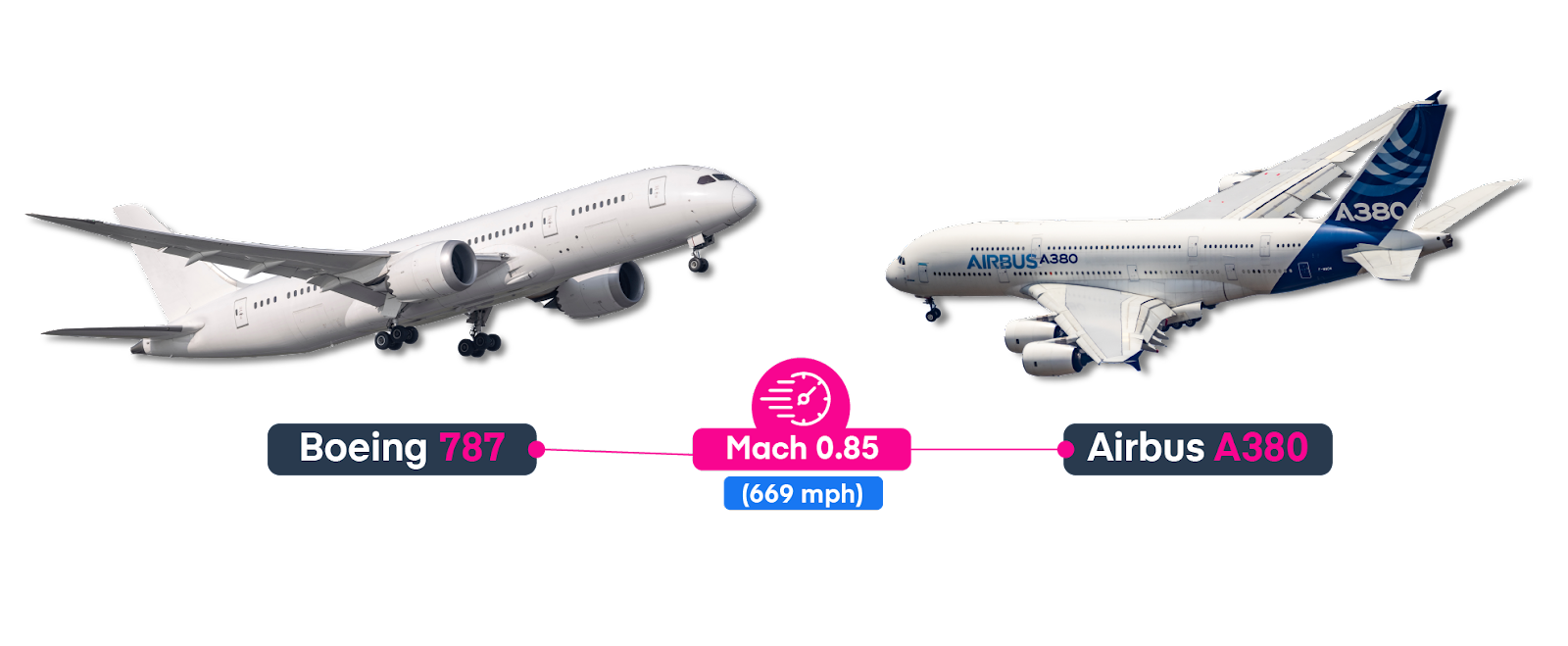
Most commercial airliners, such as the Boeing 787 Dreamliner or the Airbus A350, are engineered to fly at “high subsonic” speeds, generally between Mach 0.80 and Mach 0.85. Flying at this specific range is a technological choice dictated by the “transonic” regime. As an aircraft approaches the speed of sound (Mach 1), shockwaves begin to form over the wings, significantly increasing drag and fuel consumption.
Modern aerospace technology utilizes supercritical wing designs—a specific airfoil shape that delays the onset of these shockwaves. This allows planes to maintain higher speeds without the exponential increase in energy requirements that would occur with older wing profiles. By staying just below the sound barrier, manufacturers maximize the efficiency of the airframe, ensuring that the aircraft can travel at high velocities while remaining economically viable for the operator.
The Role of Turbofan Technology
The primary driver of an aeroplane’s speed is the high-bypass turbofan engine. Unlike the noisy, fuel-thirsty turbojets of the early Cold War era, modern turbofans are marvels of mechanical and thermal engineering. In these engines, a massive fan at the front pushes a small amount of air through the engine core for combustion, while the vast majority of the air “bypasses” the core entirely.
This bypass air provides the bulk of the thrust and is significantly more efficient at the altitudes where commercial jets cruise (typically between 30,000 and 40,000 feet). The integration of Full Authority Digital Engine Control (FADEC) systems allows the engine to automatically adjust its performance parameters in real-time. This digital oversight ensures that the engine provides the optimal amount of thrust to maintain a consistent average speed regardless of changes in air density or temperature, reducing the workload on the flight crew and increasing the longevity of the hardware.
Navigating the Skies: The Software and Avionics Behind Flight Efficiency
The speed of an aeroplane is rarely a constant “set it and forget it” variable. Instead, it is a dynamic value managed by sophisticated software systems that calculate the most efficient path through the sky.
Flight Management Systems (FMS) and Optimization
The “brain” of a modern aircraft is the Flight Management System (FMS). This specialized computer system automates a wide variety of in-flight tasks, including the calculation of the “Cost Index.” The Cost Index is a programmable value that represents the ratio between the cost of flight time and the cost of fuel.
If an airline needs to prioritize a quick arrival to maintain a tight schedule, the FMS will calculate a higher speed, even if it burns more fuel. Conversely, if fuel conservation is the priority, the FMS will throttle back the engines to an “economy” speed. This digital optimization means that the “average” speed of a flight is often an algorithmic compromise designed to maximize the airline’s operational efficiency. The FMS continuously processes data from pitot tubes (pressure sensors) and static ports to provide the crew with accurate Indicated Airspeed (IAS) and True Airspeed (TAS) readings, ensuring the aircraft stays within its safe structural limits.
Real-Time Data and Weather Integration
Speed is also heavily influenced by the environment. Modern aircraft are part of a massive, interconnected digital network. Through systems like ADS-B (Automatic Dependent Surveillance-Broadcast) and satellite-linked weather updates, pilots receive real-time data regarding the jet stream—high-altitude, fast-moving air currents.
When flying eastward across the Atlantic, an aeroplane might “hitch a ride” on the jet stream, resulting in a ground speed that far exceeds its airspeed. In some cases, commercial jets have recorded ground speeds of over 800 mph when pushed by a powerful tailwind. This is not because the engines are working harder, but because the medium through which the plane is moving is itself moving. Advanced meteorological software allows flight planners to map these currents, choosing routes that capitalize on tailwinds to boost speed or avoid headwinds that would slow the journey and increase fuel burn.
Factors Influencing Modern Aircraft Speed and Performance
While the engines provide the thrust, several technical and physical factors act as the ceiling for how fast an aeroplane can safely go. Aerospace technology is a constant battle against the laws of physics, specifically drag and heat.
Aerodynamics and Structural Integrity
The faster an aeroplane travels, the more stress is placed on its airframe. At high speeds, the friction between the air and the aircraft’s skin generates heat and mechanical stress. Modern aircraft utilize advanced composite materials, such as carbon-fiber-reinforced polymers, which offer a superior strength-to-weight ratio compared to traditional aluminum.
These materials allow for thinner, more aerodynamic wings that can withstand the vibrations and pressures associated with high-speed flight. Furthermore, the use of winglets—the vertical extensions at the tips of the wings—reduces induced drag. By smoothing out the vortices created at the wingtips, winglets allow the aircraft to maintain its average speed with less engine power, effectively increasing the aircraft’s range and speed potential.
The Impact of High-Altitude Physics
Aeroplanes fly at high altitudes not just to stay above the weather, but because the air is thinner. In the stratosphere, there is less air resistance, allowing the plane to travel faster for the same amount of fuel. However, there is a technical limit known as the “Coffin Corner.”
This is an altitude where the difference between the stall speed (the speed at which the plane is too slow to stay in the air) and the critical Mach number (the speed at which shockwaves damage the airframe) becomes extremely narrow. Modern avionics suites provide pilots with a visual “speed tape” that displays these limits in real-time. The technology ensures that the aeroplane remains in the “sweet spot” of the flight envelope, maintaining a high average speed while ensuring the safety of the structural components.
The Future of Speed: Hypersonic Tech and the Next Frontier
As we look toward the future, the average speed of an aeroplane is poised for a significant leap. After the retirement of the Concorde in 2003, commercial aviation focused on efficiency over raw velocity. However, a new wave of tech startups and established aerospace giants are revisiting high-speed travel.
Sustainable Aviation Fuel (SAF) and Engine Efficiency
The barrier to higher speeds has always been the environmental and financial cost of fuel. New developments in Sustainable Aviation Fuel (SAF) and next-generation “Open Fan” engine architectures aim to make high-speed flight more sustainable. By utilizing 3D-printed engine components and advanced ceramic matrix composites (CMCs) that can withstand higher temperatures, future engines will be able to produce more thrust with fewer emissions, potentially allowing for higher average cruising speeds without the traditional carbon footprint.

The Return of Supersonic Travel
Technologies like “quiet supersonic” flight are being tested by NASA and companies like Boom Supersonic. One of the major hurdles for the Concorde was the sonic boom, which prevented it from flying at top speed over land. New computational fluid dynamics (CFD) software allows engineers to shape the airframe in a way that dissipates shockwaves, turning a “boom” into a “thump.”
If these technologies reach the commercial market, the average speed of a long-haul flight could double, moving from the current 550-600 mph to over 1,100 mph (Mach 1.7). This would represent the most significant shift in aviation tech since the dawn of the Jet Age, fundamentally changing our global sense of distance.
In conclusion, the average speed of an aeroplane is a testament to the synergy between mechanical hardware and digital intelligence. From the precision of supercritical wings to the algorithmic calculations of the FMS, every mile per hour is the result of decades of technological refinement. As we continue to push the boundaries of materials science and propulsion, the speed at which we traverse the globe will only continue to evolve, driven by the relentless pace of aerospace innovation.
aViewFromTheCave is a participant in the Amazon Services LLC Associates Program, an affiliate advertising program designed to provide a means for sites to earn advertising fees by advertising and linking to Amazon.com. Amazon, the Amazon logo, AmazonSupply, and the AmazonSupply logo are trademarks of Amazon.com, Inc. or its affiliates. As an Amazon Associate we earn affiliate commissions from qualifying purchases.