
In the world of business finance, few ventures are as speculative, high-stakes, or capital-intensive as the production of a feature film. To the casual observer, a movie is a piece of art or entertainment; to the financier, it is a complex asset requiring meticulous capital allocation, risk management, and a diversified strategy for return on investment (ROI). When asking “what is the average budget for a movie,” one must look beyond a single number and instead examine the stratified financial tiers that define the modern cinematic landscape.

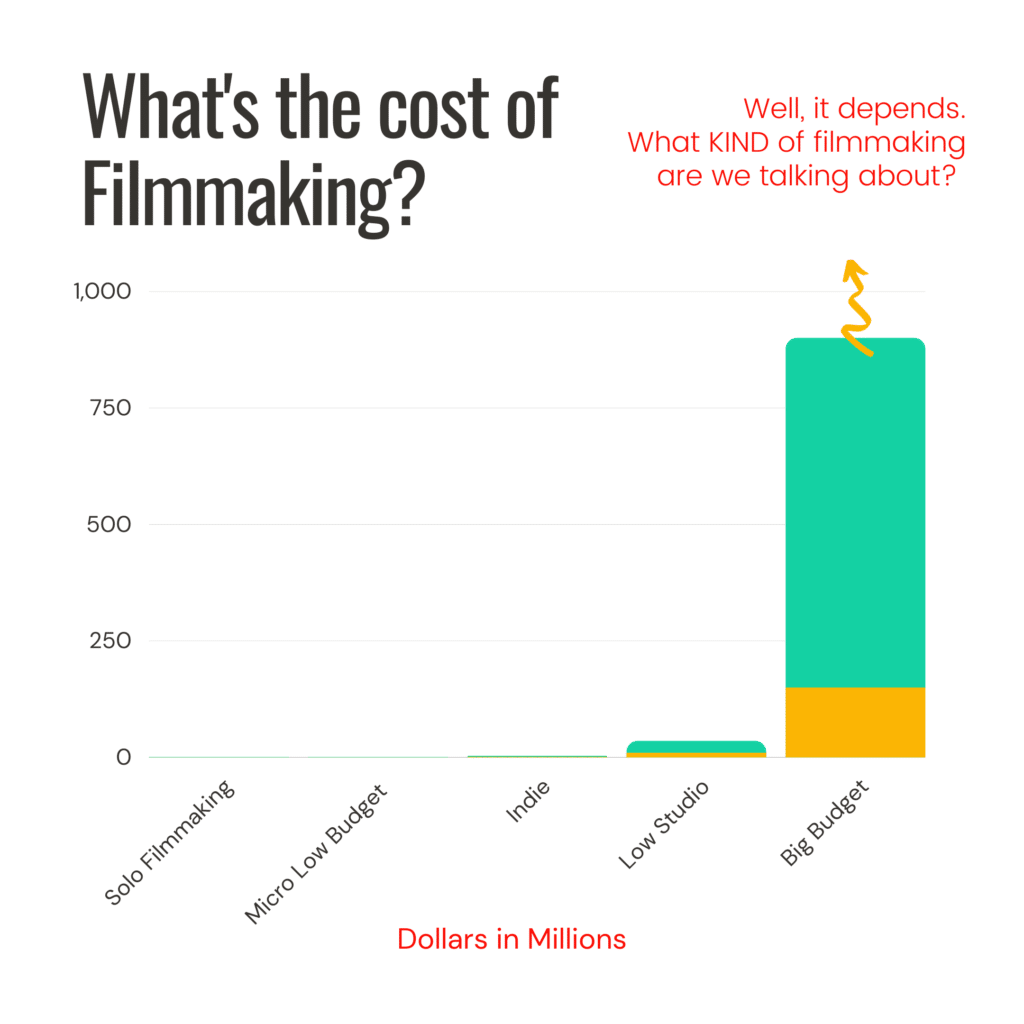
From $100,000 independent projects to $300 million global blockbusters, the “average” is a moving target influenced by inflation, technological shifts, and the evolving demands of global distribution. This article breaks down the financial architecture of film production, exploring where the capital is deployed and how studios calculate the cost of bringing a story to the screen.
The Financial Tiers of Film Production
To understand the average budget, we must first categorize films into their respective financial tiers. The industry does not operate on a monolith; instead, it functions through distinct “asset classes” that dictate how much capital is raised and the expected yield at the box office.
High-Budget Blockbusters (The $100M+ Club)
At the top of the pyramid sit the tentpole releases—films designed to support a studio’s entire fiscal year. The average budget for a major studio blockbuster currently ranges between $150 million and $250 million. These projects are characterized by heavy reliance on intellectual property (IP), extensive visual effects (VFX), and global A-list talent. For these films, the production budget is merely the “entry fee.” When accounting for the financial risk, studios often look for a 2.5x to 3x return on the production cost to achieve a breakeven point after accounting for marketing and theater revenue splits.
Mid-Range Studio Projects ($20M – $80M)
The mid-budget film was once the backbone of the industry but has faced significant financial pressure in recent years. These films—often dramas, comedies, or mid-tier action films—typically carry budgets between $20 million and $80 million. From a business finance perspective, these represent a moderate risk. They lack the “too big to fail” safety net of a massive franchise but possess enough production value to compete in multiplexes. In this tier, financial success is often driven by critical acclaim or a dedicated niche audience.
Independent and Low-Budget Ventures (Under $10M)
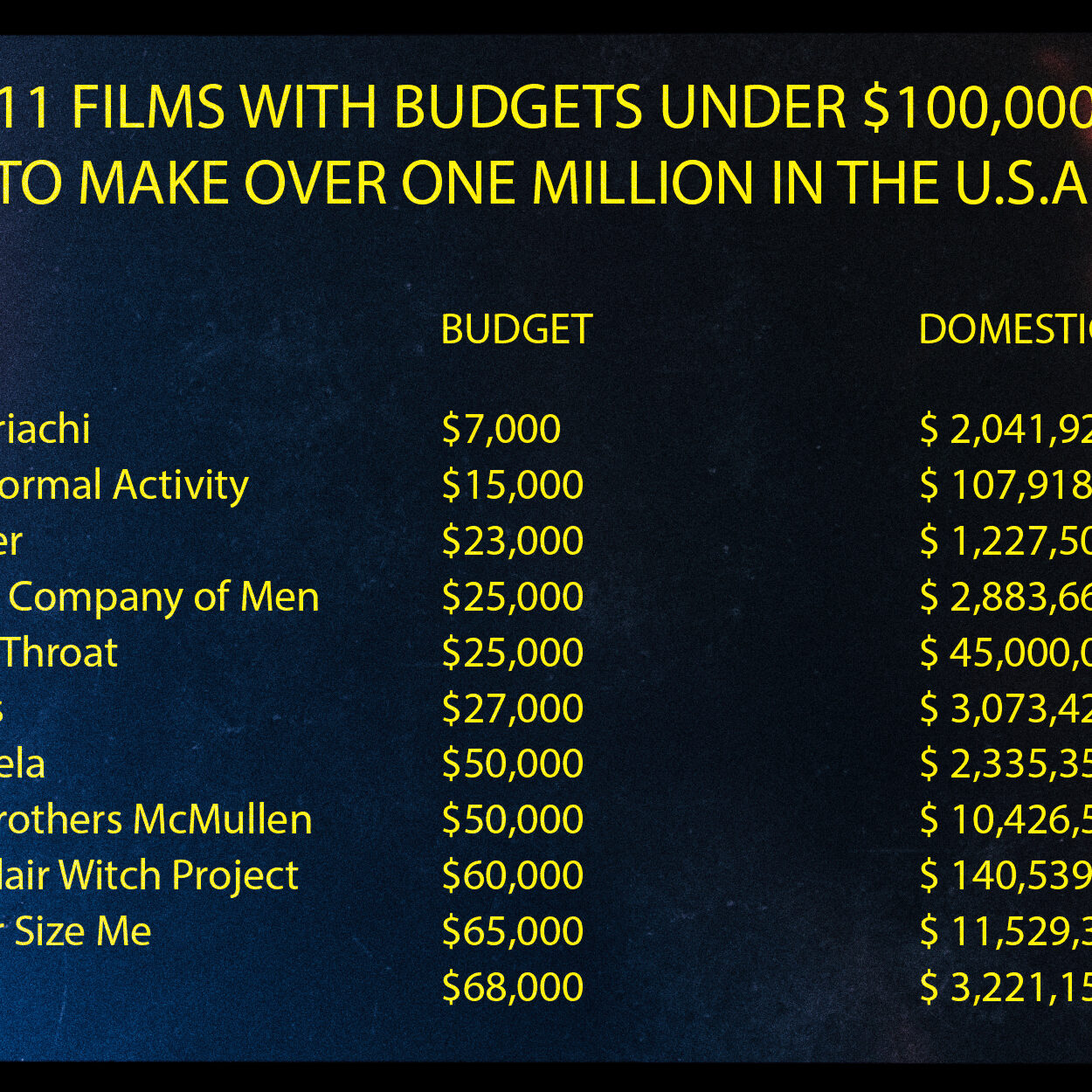
The independent sector operates on a different financial logic. An “average” indie budget can range from $1 million to $10 million, though many “micro-budget” films are produced for less than $500,000. In this category, the focus is on lean operations, tax incentives, and equity financing. Investors in this tier are often looking for the “breakout hit”—a film that costs $5 million but grosses $50 million, providing an ROI that outpaces traditional market investments.
The Breakdown of Production Costs: Where the Capital is Allocated
When a studio greenlights a $100 million budget, that capital is divided into two primary accounting categories: Above-the-Line (ATL) and Below-the-Line (BTL) costs. Understanding this split is essential for any financial analysis of the industry.
Above-the-Line Costs (Talent and Rights)
Above-the-line costs represent the initial investment in the creative “software” of the film. This includes the acquisition of the screenplay or underlying IP, and the salaries for the director, producers, and principal cast. For a major motion picture, ATL costs can consume 30% to 50% of the total budget. A lead actor may command a $20 million salary, or a “back-end” deal where they receive a percentage of the gross profits. From a financial management standpoint, these are fixed costs that must be paid regardless of the film’s eventual performance.
Below-the-Line Costs (Technical and Labor)
Below-the-line costs cover the “hardware” and logistics of the production. This includes the crew (cinematographers, sound engineers, grips, electrics), location fees, set construction, equipment rentals, and travel. BTL costs are highly variable and subject to the duration of the shoot. A delay in production—whether due to weather or scheduling—can burn through hundreds of thousands of dollars per day in BTL expenses. Efficient financial oversight in this area is what separates a profitable production from a fiscal disaster.
Post-Production and Visual Effects
In the modern era, post-production has become a significant line item, sometimes rivaling the cost of principal photography. For a Marvel-style blockbuster, the visual effects (VFX) budget alone can exceed $50 million. This involves contracting third-party VFX houses globally. Financial managers must track these costs across multiple time zones and currencies, making post-production a complex exercise in international business finance.
Hidden Costs: Marketing, Distribution, and P&A
A common misconception in film finance is that the “production budget” represents the total cost of the movie. In reality, the production budget is only part of the capital requirement. The other major component is P&A: Prints and Advertising.
The 50% Rule of Prints and Advertising
As a general rule of thumb in Hollywood accounting, the marketing budget for a major film is approximately 50% of its production budget. If a movie costs $200 million to make, the studio will likely spend an additional $100 million to market it globally. This capital is spent on television spots, digital advertising, billboards, and “junkets” (press tours). Because P&A costs are often funded separately or through lines of credit, they add a significant layer of debt that must be serviced before a film turns a profit.
Global Distribution Fees and Logistics
Distributing a film to thousands of theaters worldwide involves logistical costs and local taxes. Studios also have to navigate “exhibitor splits.” On average, a domestic theater keeps about 40% to 50% of the ticket price, while the studio receives the remainder. Internationally, especially in markets like China, the studio’s “rental” (their share of the box office) may be as low as 25%. This disparity is a crucial factor in how budgets are set; a film with high international appeal may justify a larger budget even if domestic projections are modest.
ROI and Risk Management in Movie Financing
Given the volatility of the box office, film financing relies heavily on risk mitigation tools. Very few films are financed purely with a studio’s cash on hand. Instead, a mix of financial instruments is used to spread the risk.
Tax Incentives and Rebates
One of the most powerful financial tools in the film industry is the government tax incentive. Many regions—such as Georgia (USA), the UK, and Canada—offer tax credits ranging from 20% to 30% of qualified local spending. For a $100 million film, a 30% tax credit effectively reduces the net capital outlay to $70 million. These credits can often be sold or leveraged to secure production loans, making them a cornerstone of the movie’s capital structure.
Pre-Sales and Negative Pickup Deals
Independent producers often use “pre-sales” to finance their budgets. This involves selling the distribution rights for various international territories (e.g., Germany, Japan, Brazil) before the movie is even filmed. The contracts from these sales are then used as collateral for bank loans. This shifts the financial risk from the producer to the international distributors. While this limits the producer’s “upside” if the film is a massive hit, it provides the necessary liquidity to complete production.
The Breakeven Point and Ancillary Revenue
The financial lifecycle of a movie extends far beyond its theatrical run. A film that “underperforms” at the box office can still become a profitable asset through ancillary streams. This includes licensing to streaming platforms (SVoD), television syndication, and physical media sales. For a budget-conscious investor, the goal is “recoupment”—the point at which all production and marketing costs are covered and the film begins to generate “net points” or pure profit.
Modern Shifts in Film Budgeting: Streaming and Inflation
The “average” budget is currently undergoing a significant shift due to the rise of streaming platforms like Netflix, Amazon Prime, and Apple TV+.
How Streaming Changes the Financial Landscape
Streaming services have disrupted traditional budgeting by removing the reliance on the box office. For a Netflix original, the “budget” is often higher because the platform pays the talent and producers an “upfront buyout” to compensate for the lack of back-end box office participation. This has led to an era of “budget inflation,” where films that might have cost $60 million for a theatrical release are being produced for $120 million by streamers to ensure high production value for their subscriber base.
Economic Pressures and Rising Production Costs
Like any other industry, filmmaking is sensitive to global economic trends. Inflation has driven up the cost of lumber (for sets), fuel (for transport), and labor. Additionally, the implementation of rigorous safety protocols and insurance requirements in the post-pandemic era has added a permanent 5% to 10% “safety tax” to most production budgets. Financial analysts must now build larger contingencies—often 10% of the total budget—to account for these unpredictable variables.
Conclusion: The Business of the Big Screen
The average budget for a movie is less of a static figure and more of a reflection of a project’s strategic goals. Whether it is a $200 million franchise investment designed to sell merchandise and theme park tickets, or a $5 million independent film designed for critical prestige and streaming licensing, the finance remains the foundation.
Successful film production requires a delicate balance of aggressive capital expenditure and conservative risk management. For the investors and studios behind the scenes, every dollar spent on screen is a calculated move in a global game of financial strategy, where the ultimate goal is to turn a creative vision into a sustainable, profit-generating asset. Understanding these budgets is the first step in understanding the true machinery of the entertainment industry.
aViewFromTheCave is a participant in the Amazon Services LLC Associates Program, an affiliate advertising program designed to provide a means for sites to earn advertising fees by advertising and linking to Amazon.com. Amazon, the Amazon logo, AmazonSupply, and the AmazonSupply logo are trademarks of Amazon.com, Inc. or its affiliates. As an Amazon Associate we earn affiliate commissions from qualifying purchases.