
The financial world is replete with indices, benchmarks, and metrics designed to make sense of complex market movements. Among these, the S&P 500 Index stands as a titan, not just in the United States but globally, serving as a critical barometer for the health of the economy and the performance of large-cap equities. For new investors, seasoned traders, and even casual observers, understanding the S&P 500 is fundamental to grasping the pulse of the market. It’s more than just a list of companies; it’s a meticulously constructed representation of the market’s dynamism, innovation, and economic power.

This article delves into the intricacies of the S&P 500 Index, exploring its composition, methodology, significance, and how investors can leverage its insights. We’ll uncover why it holds such a revered position, from its role as an economic indicator to its function as a foundation for countless investment products.
The Core of the S&P 500: A Market Barometer
At its heart, the S&P 500 is a stock market index that represents the performance of 500 of the largest publicly traded companies in the United States. Its primary purpose is to provide a broad and accurate reflection of the U.S. stock market and, by extension, the broader economy. When you hear financial news anchors discussing “the market,” they are very often referring to the S&P 500’s performance.
Defining the S&P 500: More Than Just a Number
The “S&P” in S&P 500 stands for Standard & Poor’s, a division of S&P Global, which maintains and publishes the index. Unlike other indices that might focus on specific sectors or a fixed number of companies, the S&P 500 is designed to capture a significant portion of the total market capitalization of U.S. equities, typically around 80% or more. This broad coverage makes it exceptionally representative. The “500” refers to the number of constituent companies, though it’s important to note that these aren’t necessarily the 500 largest companies by market cap; rather, they are selected based on a set of criteria designed to ensure representativeness, liquidity, and financial viability.
The S&P 500 is a market-capitalization-weighted index, meaning companies with larger market values have a greater impact on the index’s performance. For instance, a 1% change in Apple’s stock price (a multi-trillion-dollar company) will have a far more significant effect on the S&P 500’s overall movement than a 1% change in a smaller constituent company. This weighting scheme reflects the actual distribution of wealth and influence within the market.
A Brief History and Its Evolution
The S&P 500 wasn’t born overnight. Its roots trace back to 1923 when Standard Statistics Company (which later merged with Poor’s Publishing to form Standard & Poor’s) introduced its first stock market index, covering 233 companies. By 1926, it expanded to 90 stocks, published daily. The modern S&P 500 Index, encompassing 500 companies, was officially launched on March 4, 1957. This marked a significant milestone, providing a more robust and comprehensive measure of the U.S. equity market than its predecessors.
Over the decades, the S&P 500 has evolved, adapting to changes in market structure, technology, and economic paradigms. Its methodology has been refined to ensure it remains a relevant and accurate reflection of the market, incorporating factors like float adjustment (only counting shares available for public trading) and strict eligibility requirements. This continuous evolution is key to its enduring reliability and stature.
The Role of S&P Dow Jones Indices
The S&P 500 is managed by S&P Dow Jones Indices, a joint venture between S&P Global, CME Group, and News Corp. This entity is responsible for calculating, maintaining, and licensing a vast array of global indices, including the iconic Dow Jones Industrial Average. Their role in the S&P 500’s maintenance is crucial; they establish the rules for inclusion and exclusion, monitor market activity, and ensure the index accurately reflects its defined market segment. This independent oversight ensures transparency, objectivity, and consistency in the index’s operation, reinforcing its credibility within the financial community.
Unpacking the Methodology: How the Index is Built
The apparent simplicity of “500 companies” belies a sophisticated methodology designed to ensure the S&P 500 is truly representative and investable. It’s not a static list but a dynamic entity, meticulously curated by a committee.
Selection Criteria: Who Makes the Cut?
The S&P 500 Index Committee employs a set of strict criteria when considering companies for inclusion. These are not merely arbitrary rules but are designed to select companies that are influential, stable, and truly reflective of the broad U.S. economy:
- U.S. Company: The company must be a U.S. company.
- Market Capitalization: It must have an unadjusted market capitalization of at least $14.5 billion (this threshold changes periodically). While 500 companies are selected, they are drawn from a much larger pool of eligible firms.
- Liquidity: Shares must be highly liquid, meaning they are frequently traded, ensuring that the index is investable and its components can be easily bought and sold without significant price impact.
- Public Float: At least 50% of the company’s outstanding shares must be available for public trading (known as “public float”). This ensures that the index reflects the shares that are actually accessible to investors.
- Financial Viability: The company must have positive reported earnings in its most recent quarter, and the sum of its reported earnings over the previous four consecutive quarters must also be positive. This criterion ensures that only financially sound companies are included.
- GICS Classification: Companies are classified according to the Global Industry Classification Standard (GICS) to ensure sector balance and proper industry representation within the index.
The committee meets regularly to review and update the index, adding new companies that meet the criteria and removing those that no longer do (e.g., due to mergers, bankruptcies, or a sustained drop in market cap). This proactive management ensures the index remains relevant and reflective of the current market landscape.
Market-Capitalization Weighting: The Driving Force
As mentioned, the S&P 500 is market-capitalization-weighted. This means that a company’s weight in the index is proportional to its total market value. Companies with larger market caps, like Apple, Microsoft, Amazon, and Google (Alphabet), hold a greater percentage of the index and, therefore, exert a more substantial influence on its movements. For example, if Apple’s stock rises by 1%, it will push the S&P 500 up more than if a much smaller company with a 0.05% weighting rises by 1%.
This weighting method is often debated. Proponents argue it accurately reflects the “true” market picture, as larger companies naturally have a greater impact on the economy and investor portfolios. Critics, however, point out that it can lead to concentration risk, where the index becomes heavily reliant on the performance of a few mega-cap companies, potentially making it less diversified than it appears.
Quarterly Rebalancing and Maintenance: Keeping it Relevant
The S&P 500 is not a set-it-and-forget-it index. The S&P Dow Jones Indices committee continuously monitors the constituents and makes adjustments. While major additions and deletions are announced with lead time to minimize market disruption, several routine adjustments occur:
- Float Adjustments: Changes in a company’s share count available to the public (e.g., due to secondary offerings or share buybacks) necessitate adjustments to its weighting factor.
- Corporate Actions: Stock splits, dividends, mergers, acquisitions, and spin-offs all trigger adjustments to ensure the index accurately reflects these changes without causing artificial price movements.
- Periodic Reviews: On a quarterly basis, the committee formally reviews the index’s composition to ensure it continues to meet the eligibility criteria and remains representative. This is when new companies are typically added, and underperforming or ineligible ones are removed.
This rigorous maintenance schedule ensures the S&P 500 remains a dynamic and accurate reflection of the U.S. large-cap equity market, constantly evolving to mirror economic realities.
Why the S&P 500 Matters: Its Influence and Applications
The influence of the S&P 500 extends far beyond merely tracking stock prices. It is interwoven into the fabric of financial markets, serving multiple crucial roles for investors, economists, and policymakers alike.

A Bellwether for the U.S. Economy
Many economists and analysts view the S&P 500 as a leading indicator for the health of the U.S. economy. While it directly measures stock market performance, the constituent companies represent a vast swath of industries, from technology and finance to healthcare and consumer goods. Their collective earnings, revenue growth, and market valuations often reflect broader economic trends. A rising S&P 500 can signal investor confidence and economic expansion, while a sustained downturn might portend an economic slowdown or recession. However, it’s crucial to remember that the stock market is not the economy; it’s a forward-looking mechanism that often anticipates changes rather than perfectly reflecting the present.
The Standard for Performance Comparison
For portfolio managers, mutual fund companies, and individual investors, the S&P 500 is the gold standard benchmark for large-cap U.S. equity performance. If an actively managed large-cap mutual fund aims to “beat the market,” it’s almost certainly comparing its returns against the S&P 500. This benchmark allows investors to assess whether their investments or their fund managers are generating alpha (returns above the benchmark) or simply tracking the broader market. Without such a widely accepted and robust benchmark, comparing investment performance would be a far more subjective and challenging endeavor.
Fueling Passive Investment Strategies
Perhaps one of the most significant impacts of the S&P 500 is its role in the rise of passive investing. Instead of trying to pick individual stocks to outperform the market, millions of investors now choose to simply “buy the S&P 500.” This is primarily achieved through:
- Index Funds: Mutual funds designed to replicate the performance of the S&P 500 by holding all its constituent stocks in the same proportions.
- Exchange-Traded Funds (ETFs): Similar to index funds but trade on stock exchanges like individual stocks, offering greater flexibility and often lower expense ratios.
These passive investment vehicles have democratized access to broad market returns, allowing investors to achieve diversification and participate in the long-term growth of the U.S. economy without needing to conduct extensive research on individual companies. The efficiency and low cost of S&P 500 index funds and ETFs have revolutionized retail investing, making market participation accessible to a wider audience.
Investing in the S&P 500: Accessibility for Every Investor
Given its prominence, it’s natural for investors to want to gain exposure to the S&P 500. Fortunately, there are several straightforward and accessible ways to do so, catering to different preferences and investment styles.
ETFs and Mutual Funds: The Most Common Avenues
For most investors, the easiest and most cost-effective way to invest in the S&P 500 is through Exchange-Traded Funds (ETFs) or Index Mutual Funds.
- S&P 500 ETFs: These are funds that hold all 500 stocks in the S&P 500 in their correct weightings, tracking the index’s performance very closely. Popular examples include SPDR S&P 500 ETF Trust (SPY), iShares Core S&P 500 (IVV), and Vanguard S&P 500 ETF (VOO). ETFs trade like stocks, meaning you can buy and sell shares throughout the trading day. They typically have very low expense ratios, which means a small percentage of your investment goes towards management fees.
- S&P 500 Index Mutual Funds: These are traditional mutual funds that also aim to replicate the S&P 500. They are typically purchased directly from a fund provider (like Vanguard, Fidelity, or Charles Schwab) and are priced once per day at the close of the market. They also boast low expense ratios, making them an excellent choice for long-term investors.
Both options offer instant diversification across 500 large U.S. companies, eliminating the need to research and buy individual stocks.
Individual Stocks: Mirroring the Index
While less practical for individual investors aiming for pure S&P 500 exposure, it is theoretically possible to buy shares in all 500 constituent companies in the correct proportions. However, this would involve significant capital, numerous trades, and constant rebalancing, making it impractical for all but the largest institutional investors. For retail investors, ETFs and mutual funds are the superior approach for direct S&P 500 exposure.
Some investors might choose to buy a selection of the largest S&P 500 companies, believing they can replicate a significant portion of the index’s performance. While this might offer some correlation, it inherently introduces more specific company risk and will not perfectly track the broader index.
Robo-Advisors and Diversified Portfolios
Many robo-advisor platforms (like Betterment or Wealthfront) and even traditional brokerage firm platforms offer pre-built diversified portfolios that frequently include S&P 500 ETFs as a core component. These platforms automate investment decisions based on your risk tolerance and financial goals, often allocating a portion of your portfolio to broad market index funds like the S&P 500. This provides a hands-off approach for investors who want broad market exposure without actively managing their investments.
Understanding Risks and Rewards: A Balanced Perspective
Like any investment, the S&P 500 comes with its own set of potential rewards and inherent risks. Understanding both is crucial for making informed investment decisions.
Historical Performance: A Legacy of Growth
Historically, the S&P 500 has delivered robust long-term returns. Over several decades, its average annual return has been in the range of 10-12%, though past performance is not indicative of future results. This long-term upward trend reflects the innovative capacity of American corporations, sustained economic growth, and the ability of businesses to adapt and thrive. For investors with a long time horizon, investing in the S&P 500 has proven to be a powerful strategy for wealth creation. Compounding returns over decades can transform modest initial investments into significant sums.
Diversification Benefits vs. Concentration Risks
One of the primary advantages of investing in the S&P 500 is its inherent diversification. By holding 500 companies across various sectors, the impact of a single company’s poor performance is significantly mitigated. This reduces individual stock risk and provides exposure to the broader market’s growth.
However, as a market-cap-weighted index, the S&P 500 can also carry concentration risk. The largest companies, particularly in the tech sector in recent years, often account for a substantial portion of the index’s value. If these few dominant companies experience a significant downturn, their outsized influence can drag down the entire index, even if smaller companies are performing well. While diversified across 500 companies, the weighting scheme means it’s not equally diversified in terms of impact.
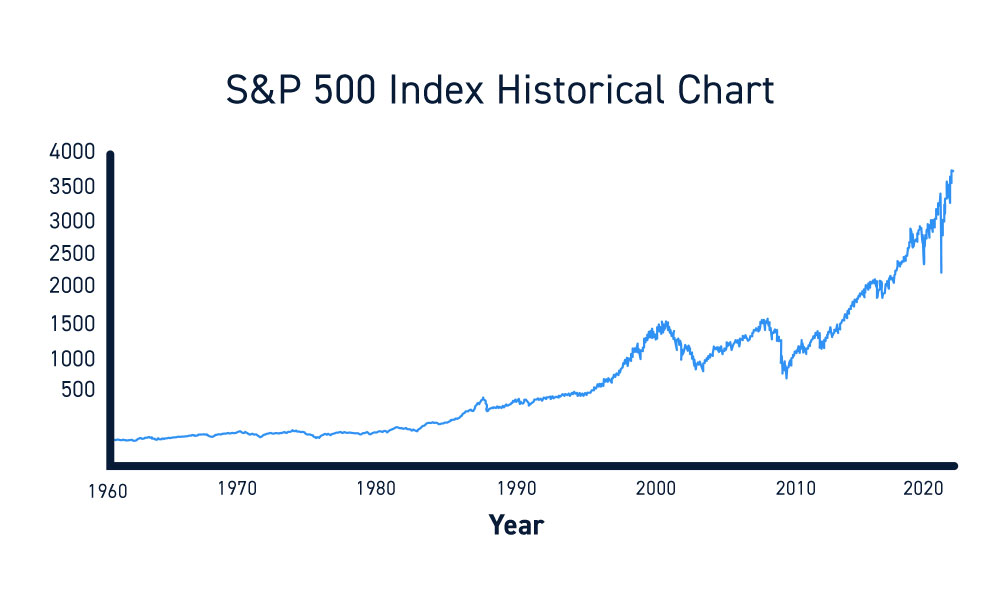
Market Volatility and Long-Term Horizon
The S&P 500, like all equity markets, is subject to volatility. There will be periods of significant downturns, corrections, and even bear markets. These fluctuations are a natural part of investing and can be unsettling for investors. The key to navigating this volatility is maintaining a long-term investment horizon. Historically, the S&P 500 has recovered from every major downturn, rewarding patient investors who remained invested through challenging times. Trying to time the market by buying and selling based on short-term movements is notoriously difficult and often leads to missing out on significant gains.
Investing in the S&P 500 is an endorsement of the long-term growth potential of the U.S. economy and its leading companies. It offers a professional, diversified, and historically rewarding approach to participating in the stock market, making it a cornerstone for many investment portfolios.
aViewFromTheCave is a participant in the Amazon Services LLC Associates Program, an affiliate advertising program designed to provide a means for sites to earn advertising fees by advertising and linking to Amazon.com. Amazon, the Amazon logo, AmazonSupply, and the AmazonSupply logo are trademarks of Amazon.com, Inc. or its affiliates. As an Amazon Associate we earn affiliate commissions from qualifying purchases.