
The world of finance often feels like a labyrinth of complex jargon and fluctuating numbers. At the heart of this ecosystem lie two terms frequently used interchangeably: the share market and the stock market. For anyone looking to secure their financial future, understanding these concepts is not just beneficial—it is essential. The stock market is the engine of global capitalism, a place where wealth is created, businesses are funded, and the economic pulse of a nation is measured.
In this comprehensive guide, we will demystify the mechanics of the market, explore the nuances between shares and stocks, and outline how an individual can transition from a passive observer to a confident investor.

Understanding the Fundamentals: Defining the Share and Stock Market
To the uninitiated, the stock market can seem like a chaotic digital bazaar. However, it is a highly regulated and structured environment designed to facilitate the exchange of ownership in publicly traded companies.
Shares vs. Stocks: Is There a Difference?
While often used as synonyms, there is a subtle technical distinction between “stocks” and “shares.” “Stock” is a generic term used to describe the ownership certificates of any company. If you say you own stock, you are speaking generally about your investment in the corporate sector. “Shares,” on the other hand, refer to a specific unit of ownership in a particular company. For example, you might own 50 shares of Apple stock. Essentially, “stock” refers to the concept of equity, while “shares” refer to the quantity of that equity.
The Role of Stock Exchanges
A stock market is an abstract concept representing the collection of all buyers and sellers of stocks. The actual physical or digital locations where these transactions occur are called Stock Exchanges. Major global examples include the New York Stock Exchange (NYSE), the Nasdaq, the National Stock Exchange (NSE) of India, and the London Stock Exchange (LSE). These exchanges act as a secondary market where existing shareholders can sell their stakes to other investors, ensuring liquidity in the financial system.
Primary vs. Secondary Markets
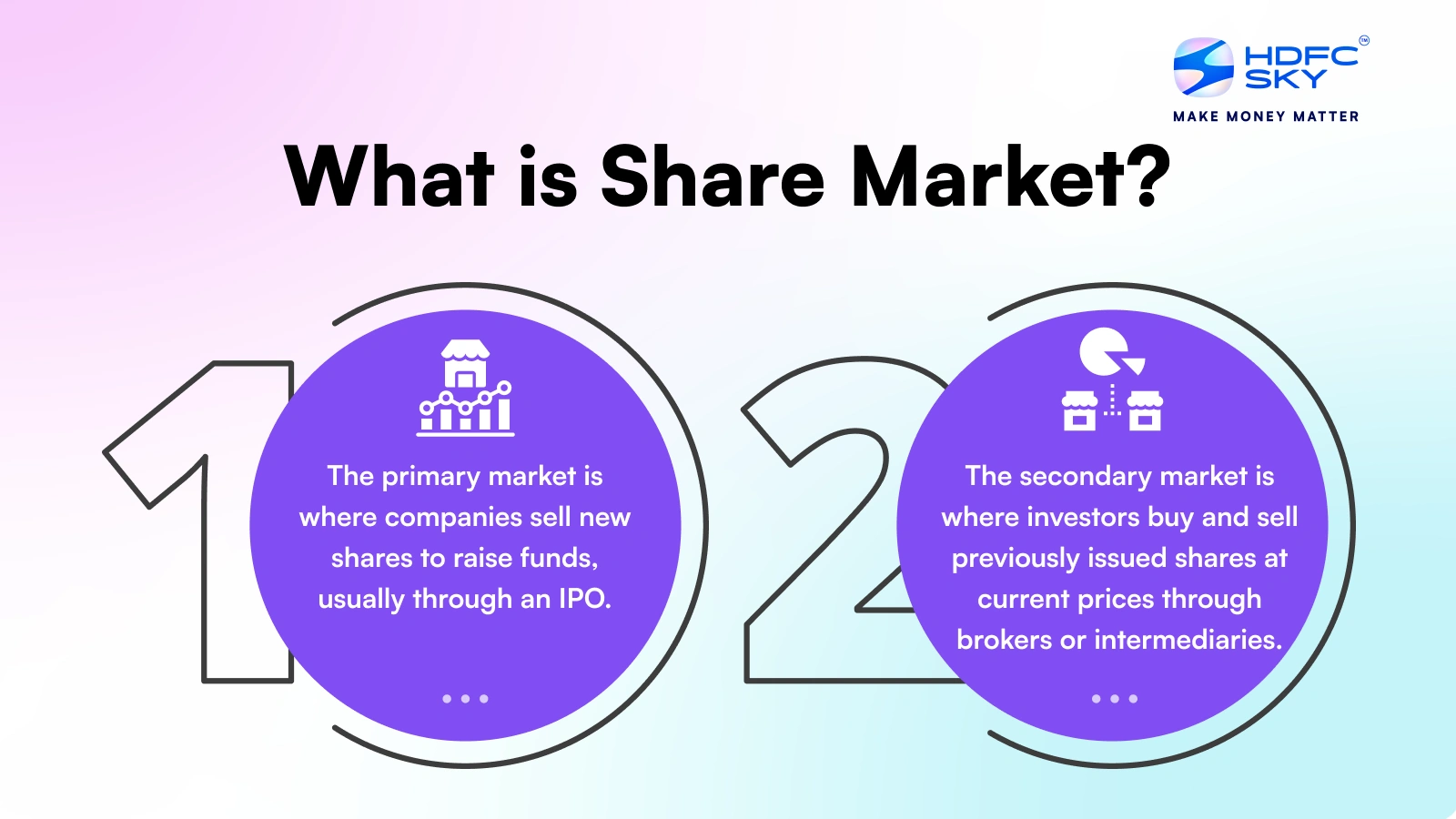
Understanding the market requires distinguishing between where stocks are born and where they live. The Primary Market is where a company issues new securities for the first time through an Initial Public Offering (IPO). This allows the company to raise capital directly from investors. The Secondary Market is what most people refer to as the “stock market.” Here, investors trade previously issued securities among themselves. In the secondary market, the money from a sale goes to the selling investor, not the company itself.
How the Stock Market Functions: Mechanics and Participants
The stock market functions through a complex interplay of technology, regulation, and human psychology. It operates on the basic principle of supply and demand, but the “product” being sold is the future earning potential of a business.
The Mechanism of IPOs (Initial Public Offerings)
When a private company reaches a certain stage of maturity, it may require massive amounts of capital to expand. Instead of taking on debt from a bank, it “goes public.” During an IPO, the company’s ownership is sliced into millions of tiny pieces (shares) and sold to the public. Once the IPO is complete, these shares begin trading on an exchange, and their price is determined by how much the market values the company’s future prospects.
Key Players: Bulls, Bears, Brokers, and Regulators
The market is populated by various entities that keep it functioning:
- Investors and Traders: Investors look for long-term growth, while traders seek to profit from short-term price movements.
- Bulls and Bears: A “Bull” market is one where prices are rising and optimism is high. A “Bear” market is characterized by falling prices and widespread pessimism.
- Brokers: These are intermediaries (often digital platforms today) that execute buy and sell orders on behalf of investors.
- Regulators: Organizations like the SEC (USA) or SEBI (India) act as the “market police,” ensuring that companies provide honest information and that no one is cheating the system through insider trading or fraud.
Price Determination: Supply, Demand, and Market Sentiment
What makes a stock price go up or down? At its simplest level, if more people want to buy a stock than sell it, the price rises. This demand is driven by several factors, including the company’s quarterly earnings reports, management changes, industry trends, and the broader economic climate. However, “market sentiment”—the collective emotion of investors—also plays a huge role. Fear can drive prices down even if a company is doing well, while greed can inflate prices far beyond their actual value.

Building Wealth: Why You Should Consider Investing
For many, the stock market is seen as a risky gamble. However, history has shown that equity investment is one of the most effective ways to build long-term wealth and outpace inflation.
Compounding and Long-Term Capital Appreciation
The most powerful force in the financial world is “compounding.” When you invest in stocks, your money earns returns. If you reinvest those returns, your original capital plus your earnings both grow. Over a period of 20 or 30 years, this creates an exponential growth curve. This “capital appreciation”—the increase in the share price over time—is the primary way investors build significant net worth.
Dividend Income and Passive Wealth
Beyond price appreciation, many established companies share a portion of their profits with shareholders in the form of dividends. This provides a steady stream of passive income. For a retiree or a long-term investor, a portfolio of high-quality dividend-paying stocks can function much like a rental property, providing regular cash flow without the need to sell the underlying asset.
Beating Inflation through Equity Investments
Inflation is the silent killer of wealth. If your money is sitting in a traditional savings account, it is likely losing purchasing power every year as the cost of goods rises. Historically, the stock market has provided average annual returns that significantly exceed the rate of inflation. By owning shares in companies, you are owning assets that have the power to raise their own prices in response to inflation, thereby protecting your financial value.
Risk Management and Investment Strategies
Investing in the share market is not without its perils. Market volatility is a natural occurrence, and without a solid strategy, investors can fall victim to emotional decision-making.
Diversification: The Golden Rule of Investing
The most effective way to manage risk is through diversification—the practice of spreading your investments across different companies, industries, and even asset classes. If you put all your money into a single tech company and that sector crashes, your portfolio will suffer. However, if you hold a mix of tech, healthcare, energy, and consumer goods, a downturn in one area is often offset by stability or growth in another.
Fundamental vs. Technical Analysis
Investors generally use two different schools of thought to pick stocks:
- Fundamental Analysis: This involves looking at the “health” of a company. Investors study balance sheets, income statements, profit margins, and the quality of management to determine if a stock is undervalued or overvalued.
- Technical Analysis: This focuses on patterns, charts, and historical price movements. Technical analysts believe that past price trends can predict future movements, focusing more on market psychology than the company’s actual business operations.
Setting Realistic Goals and Risk Tolerance
Before entering the market, it is vital to assess your “risk tolerance.” Can you stay calm if your portfolio drops 20% in a month? If the answer is no, you may prefer a more conservative approach, such as investing in Index Funds or Exchange-Traded Funds (ETFs), which track the performance of the entire market rather than individual stocks. Successful investing is a marathon, not a sprint; it requires a disciplined approach and a focus on long-term objectives rather than daily market noise.
Conclusion: Starting Your Financial Journey
The share market and stock market are more than just places to trade numbers; they are gateways to financial independence. By understanding the mechanics of how shares work, the role of exchanges, and the power of compounding, you transform from a consumer of the economy into an owner of it.
While the market will always have its ups and downs, the historical trajectory of the global economy has always been upward. For the diligent investor who prioritizes education, diversification, and patience, the stock market remains the premier tool for building a legacy of wealth. The best time to start was yesterday; the second best time is today. By taking a methodical, informed approach to the share market, you are not just buying stocks—you are investing in your future self.
aViewFromTheCave is a participant in the Amazon Services LLC Associates Program, an affiliate advertising program designed to provide a means for sites to earn advertising fees by advertising and linking to Amazon.com. Amazon, the Amazon logo, AmazonSupply, and the AmazonSupply logo are trademarks of Amazon.com, Inc. or its affiliates. As an Amazon Associate we earn affiliate commissions from qualifying purchases.