
In the rapidly evolving landscape of enterprise resource planning (ERP) and human capital management (HCM), the transition from traditional, siloed systems to integrated, cloud-native platforms has become a necessity. At the forefront of this digital transformation is SAP SuccessFactors. As a global leader in cloud-based Human Experience Management (HXM), SuccessFactors provides organizations with the tools to manage their workforce with precision, from recruitment and onboarding to payroll and performance management.
This guide explores the technical architecture, core modules, and the strategic technological importance of SAP SuccessFactors in the modern enterprise stack.

1. The Evolution of HR Technology: From HCM to HXM
To understand what SAP SuccessFactors is today, one must understand the shift in the technological paradigm of workforce management. Historically, Human Capital Management (HCM) software focused primarily on administrative efficiency—processing data, managing records, and ensuring compliance. However, with the rise of the “Experience Economy,” SAP rebranded and re-engineered its suite into Human Experience Management (HXM).
From On-Premise ERP to Cloud-Native SaaS
Before the acquisition of SuccessFactors in 2012, many organizations relied on SAP ERP HCM, an on-premise solution that required extensive hardware, manual updates, and significant IT overhead. SAP SuccessFactors represents a complete shift to a Software-as-a-Service (SaaS) model. This transition allows for continuous innovation, where updates are pushed automatically, ensuring that all global clients are on the same version of the software. The cloud-native approach eliminates the “version lock” that plagued older tech environments, allowing companies to scale their HR operations without investing in physical infrastructure.
The Philosophy of Human Experience Management (HXM)
HXM is the technical evolution of HCM. While HCM asks, “How many employees do we have?”, HXM uses data to ask, “How are our employees performing, and how do they feel about their work environment?” By integrating “O-data” (Operational data like headcount and turnover) with “X-data” (Experience data like employee engagement and sentiment), SuccessFactors provides a holistic view of the workforce. This is achieved through integrations with tools like Qualtrics, allowing leaders to visualize technical metrics alongside human sentiment.
2. Core Modules and Functional Architecture
SAP SuccessFactors is not a monolithic application; it is a modular suite designed to be implemented either as a full “Big Bang” deployment or through a phased approach. Each module addresses a specific technical requirement of the modern HR department.
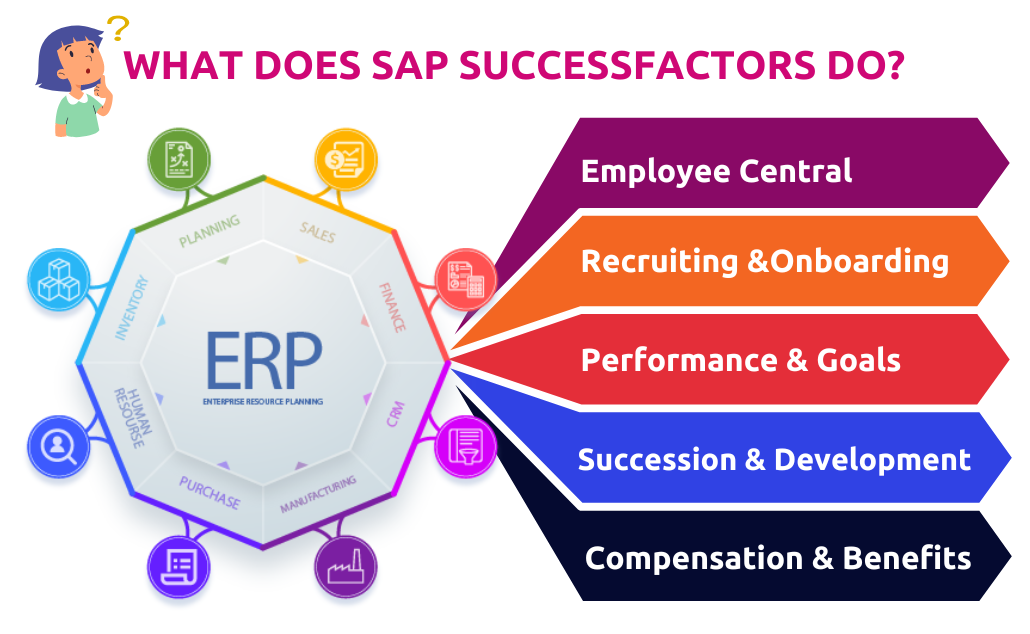
SAP SuccessFactors Employee Central: The Digital Core
Employee Central (EC) is the backbone of the entire suite. It is a multi-tenant, cloud-based HRIS (Human Resource Information System) that serves as the “source of truth” for all employee master data. Technically, EC is built to handle global complexity, supporting localized legal and regulatory requirements for over 100 countries. It automates core processes such as organizational management, time and attendance, and global benefits. Its real-time data processing ensures that any change in an employee’s status—such as a promotion or a transfer—is instantly reflected across all integrated modules.
The Talent Management Suite: Attract, Develop, and Retain
Beyond core HR, SuccessFactors offers a comprehensive Talent Management suite. This includes:
- Recruiting: A sophisticated Applicant Tracking System (ATS) that utilizes AI-driven job distribution and candidate relationship management (CRM) tools.
- Onboarding: A digital-first experience that integrates new hires into the company culture while automating the technical provisioning of assets and access.
- Performance & Goals: A framework for continuous performance management (CPM). Instead of once-a-year reviews, the software facilitates ongoing dialogue and real-time feedback loops.
- Compensation: A data-driven module that allows HR leaders to manage complex merit cycles, bonuses, and long-term incentives based on actual performance data retrieved from other modules.
Learning Management System (LMS) and Content Delivery
The SuccessFactors LMS is one of the most robust learning platforms in the enterprise market. It supports various technical standards for digital learning, including SCORM and AICC. From a tech perspective, the LMS utilizes machine learning to recommend content to users based on their roles, skill gaps, and career aspirations. It also provides comprehensive compliance tracking, which is essential for highly regulated industries such as healthcare, aerospace, and finance.
3. Technical Infrastructure and Integration Capabilities

One of the primary concerns for CTOs and IT Managers when adopting a new SaaS platform is how it integrates with the existing tech ecosystem. SAP SuccessFactors is built on the SAP Business Technology Platform (BTP), ensuring high availability and seamless connectivity.
Cloud-Native Architecture and Scalability
SuccessFactors operates on a multi-tenant architecture, meaning multiple customers share a single instance of the software and infrastructure while keeping their data strictly isolated and secure. This allows SAP to provide massive scalability; whether an organization has 500 or 500,000 employees, the platform maintains high performance. The user interface (UI) is built on SAP Fiori, providing a responsive, consumer-grade experience across desktops, tablets, and mobile devices.
Integration with SAP S/4HANA and Third-Party Systems
SuccessFactors is designed to be the “people side” of the intelligent enterprise. Through the SAP Integration Suite, it connects natively with SAP S/4HANA (the ERP core) to sync financial data and cost centers. Furthermore, it offers open APIs (OData and SOAP) that allow IT teams to build custom integrations with third-party software, such as payroll providers (e.g., ADP), benefits platforms, or specialized identity management tools like Microsoft Azure AD or Okta.
Security, Compliance, and Data Privacy
In the era of GDPR, CCPA, and other global data privacy laws, the technical security of HR data is paramount. SAP SuccessFactors employs a defense-in-depth security strategy. This includes data encryption at rest and in transit, multi-factor authentication (MFA), and robust role-based access control (RBAC). SAP also maintains global data centers, allowing companies to store data within specific geographic regions to meet strict data residency requirements.
4. The Impact of AI and Emerging Tech on SuccessFactors
The future of SAP SuccessFactors is deeply intertwined with Artificial Intelligence (AI) and Machine Learning (ML). SAP has aggressively integrated these technologies to move from reactive reporting to proactive workforce planning.
Generative AI and SAP Joule
SAP recently introduced Joule, a natural-language, generative AI copilot. Within SuccessFactors, Joule acts as a technical assistant for both employees and managers. For example, an employee can ask Joule to “summarize my performance feedback for the last year,” or a recruiter can use it to generate job descriptions based on specific skill requirements. This use of Large Language Models (LLMs) within a secure corporate environment represents the next frontier of HR tech efficiency.
People Analytics and Predictive Modeling
The SuccessFactors People Analytics module (powered by SAP Analytics Cloud) allows organizations to perform complex data modeling. By applying machine learning algorithms to historical data, the system can identify “flight risks”—employees likely to leave the company—or predict future skills gaps. This shifts HR from an administrative function to a strategic, data-driven department that can influence the long-term technological and operational roadmap of the business.
5. Deployment and the Future Roadmap
Implementing SAP SuccessFactors is a strategic technical project that requires careful planning. Unlike legacy software, the “Cloud Mindset” encourages organizations to stay as close to “Standard” as possible to ensure easy upgrades and maintainability.
Standard vs. Custom Implementation
While the platform is highly configurable, modern tech best practices suggest minimizing heavy customizations in favor of using the platform’s built-in extensibility. SAP BTP allows developers to build “side-by-side” extensions—custom applications that interact with SuccessFactors data without modifying the core code. This ensures that the system remains “clean” and ready for quarterly innovation updates.
The Future of the Intelligent Enterprise
As we move forward, SAP SuccessFactors will continue to evolve into a more “composable” HR suite. We are seeing a move toward the “Whole Self Model,” where the software tracks not just skills and job history, but also employee aspirations, well-being, and “power skills” like leadership and adaptability.
In conclusion, SAP SuccessFactors is far more than a simple payroll or record-keeping tool. It is a sophisticated, cloud-native ecosystem that leverages AI, big data, and a global infrastructure to manage the most valuable asset of any organization: its people. For the modern enterprise, it provides the technical foundation necessary to navigate the complexities of the digital-first workforce, ensuring that human experience remains at the heart of business success.
aViewFromTheCave is a participant in the Amazon Services LLC Associates Program, an affiliate advertising program designed to provide a means for sites to earn advertising fees by advertising and linking to Amazon.com. Amazon, the Amazon logo, AmazonSupply, and the AmazonSupply logo are trademarks of Amazon.com, Inc. or its affiliates. As an Amazon Associate we earn affiliate commissions from qualifying purchases.