
Gross Domestic Product (GDP) is arguably the most fundamental metric for assessing the health and size of an economy. It represents the total monetary value of all finished goods and services produced within a country’s borders in a specific time period, typically a year or a quarter. However, when economists, investors, and policymakers discuss the true state of an economy, they often refer to “Real GDP” rather than its counterpart, Nominal GDP. Understanding this distinction is not just an academic exercise; it is crucial for making informed financial decisions, analyzing market trends, and comprehending the genuine trajectory of economic growth.

Understanding Gross Domestic Product (GDP)
At its core, GDP provides a comprehensive snapshot of a nation’s economic output. It is the sum of consumption, investment, government spending, and net exports (exports minus imports). While seemingly straightforward, the raw figure, known as Nominal GDP, can sometimes paint a misleading picture due to the persistent factor of inflation.
Nominal GDP vs. Real GDP: A Crucial Distinction
Nominal GDP measures the value of goods and services at current market prices. This means it includes any inflation or deflation that occurred during the period being measured. If a country’s Nominal GDP increases from one year to the next, it’s not immediately clear whether that increase reflects genuine growth in production or simply higher prices for the same quantity of goods and services.
Real GDP, on the other hand, adjusts for price changes (inflation or deflation) to reflect the true volume of goods and services produced. By stripping out the effects of price fluctuations, Real GDP provides a more accurate and comparable measure of economic growth over time. It answers the crucial question: “Is the economy actually producing more, or are things just getting more expensive?” For investors, business owners, and financial analysts, this distinction is paramount for understanding underlying economic strength and potential.
The Components of GDP: What It Measures
To fully appreciate Real GDP, it’s helpful to break down its components, as each contributes to the overall economic picture:
- Consumption (C): This is typically the largest component, representing spending by households on goods and services, from groceries and rent to cars and healthcare. A robust increase in real consumption often signals strong consumer confidence and economic health.
- Investment (I): This includes business spending on capital goods (machinery, factories), residential construction, and changes in inventories. Real investment is a key driver of future productivity and economic expansion.
- Government Spending (G): This encompasses all government consumption and gross investment, such as infrastructure projects, defense, and public employee salaries. Changes in real government spending can significantly impact aggregate demand.
- Net Exports (NX): Calculated as a country’s total exports minus its total imports. A positive net export figure (trade surplus) adds to GDP, while a negative figure (trade deficit) subtracts from it. Analyzing real net exports reveals a country’s competitiveness in global markets.
By adjusting each of these components for inflation, Real GDP presents a clearer view of whether actual production in these areas has increased or decreased.
The Impact of Inflation: Why “Real” Matters
Inflation is the silent disruptor of economic measurement. When prices rise across the board, the same amount of money buys fewer goods and services. While a higher Nominal GDP might suggest a thriving economy, it could simply be a reflection of higher prices rather than increased production. This is where the concept of “real” becomes invaluable.
The Deflator: Adjusting for Price Changes
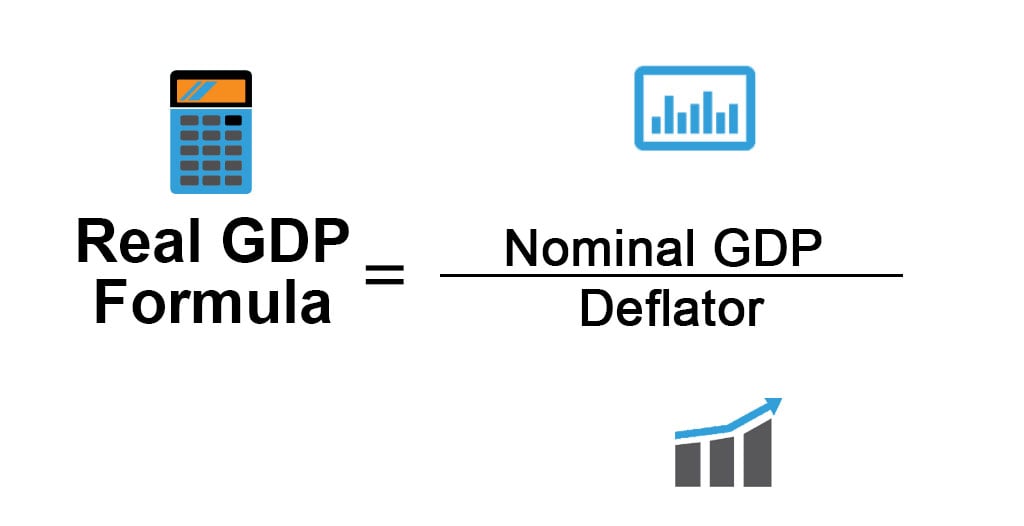
To convert Nominal GDP into Real GDP, economists use a price index called the GDP deflator. The GDP deflator measures the average level of prices of all new, domestically produced, final goods and services in an economy. Unlike the Consumer Price Index (CPI), which focuses on a basket of consumer goods and services, the GDP deflator is broader, encompassing everything that contributes to GDP.
The formula for the GDP deflator is:
GDP Deflator = (Nominal GDP / Real GDP) * 100
Conversely, to calculate Real GDP from Nominal GDP:
Real GDP = (Nominal GDP / GDP Deflator) * 100
By dividing Nominal GDP by the GDP deflator, the inflationary component is effectively removed, allowing for a comparison of economic output in constant dollars—as if prices had remained unchanged from a designated base year. This adjustment is critical for understanding actual purchasing power and productivity gains.
Avoiding the Money Illusion
The “money illusion” is a cognitive bias where people tend to think about money in nominal rather than real terms. For example, if your salary increases by 5% but inflation is 7%, you might feel richer due to the higher nominal pay, but in reality, your purchasing power has decreased. The concept of Real GDP helps economists and the public avoid this illusion by providing a clear, inflation-adjusted measure of economic performance. Without this adjustment, comparing economic output across different periods would be akin to comparing apples and oranges, as the value of money itself changes over time. For businesses planning investments or individuals making retirement decisions, understanding real economic growth is far more relevant than nominal figures.
Calculating Real GDP: The Mechanics
The process of calculating Real GDP involves selecting a base year and then using the prices from that base year to value the output of subsequent years. This ensures that any observed changes in GDP are solely due to changes in the quantity of goods and services produced, not changes in their prices.
Choosing a Base Year
A crucial first step in calculating Real GDP is to select a base year. The base year serves as a benchmark for prices. The GDP deflator for the base year is always 100. For any other year, the deflator indicates how much prices have changed relative to the base year. For instance, if the deflator is 105 in a given year, it means prices have risen by 5% since the base year. Statistical agencies periodically update the base year to ensure that the price structure used for comparison remains relevant to the current economy.
Formula and Application

Let’s illustrate the calculation with a simple example:
Suppose an economy produces only two goods: apples and bananas.
Year 1 (Base Year):
- Apples: 100 units at $1.00/unit = $100
- Bananas: 50 units at $2.00/unit = $100
- Nominal GDP (Year 1) = $100 + $100 = $200
- Real GDP (Year 1) = $200 (since it’s the base year, Nominal GDP = Real GDP)
- GDP Deflator (Year 1) = 100
Year 2:
- Apples: 110 units at $1.20/unit = $132
- Bananas: 55 units at $2.50/unit = $137.50
- Nominal GDP (Year 2) = $132 + $137.50 = $269.50
To calculate Real GDP for Year 2, we use Year 1 prices:
- Apples: 110 units at $1.00/unit (Year 1 price) = $110
- Bananas: 55 units at $2.00/unit (Year 1 price) = $110
- Real GDP (Year 2) = $110 + $110 = $220
Now we can also calculate the GDP Deflator for Year 2:
- GDP Deflator (Year 2) = (Nominal GDP Year 2 / Real GDP Year 2) * 100
- GDP Deflator (Year 2) = ($269.50 / $220) * 100 = 122.5
This simple example clearly shows that while Nominal GDP increased from $200 to $269.50 (a 34.75% increase), Real GDP only increased from $200 to $220 (a 10% increase). The difference is attributable to the 22.5% inflation captured by the GDP deflator. This calculation is vital for distinguishing genuine economic expansion from mere price hikes.
Why Real GDP is a Cornerstone of Economic Analysis
Real GDP is not just a statistical curiosity; it is a critical indicator used by a wide array of stakeholders to gauge economic performance and inform decisions. From central bankers setting monetary policy to individual investors planning portfolios, its insights are invaluable.
Gauging Economic Growth and Recession
The most prominent use of Real GDP is to measure economic growth. A sustained increase in Real GDP over quarters or years signals an expanding economy, suggesting increased production, higher employment, and potentially improved living standards. Conversely, a decrease in Real GDP for two consecutive quarters is the widely accepted technical definition of a recession. Understanding whether an economy is growing or contracting in real terms is essential for businesses planning expansion or contraction, and for consumers assessing job prospects and financial stability.
Informing Policy Decisions
Government policymakers and central banks heavily rely on Real GDP figures. Central banks, like the U.S. Federal Reserve, use Real GDP growth rates to guide decisions on interest rates and monetary policy. Rapid real growth might prompt concerns about inflation and lead to interest rate hikes, while sluggish or negative real growth could trigger measures to stimulate the economy, such as lowering rates or implementing quantitative easing. Fiscal policy decisions, pertaining to government spending and taxation, are also often made with Real GDP trends in mind, aiming to foster sustainable, non-inflationary growth.
A Tool for Investors and Businesses
For investors, Real GDP growth is a strong indicator of corporate earnings potential. A growing economy generally means higher demand for goods and services, leading to increased sales and profits for companies. Investors use Real GDP data to:
- Forecast market performance: Strong real growth often correlates with bullish stock markets.
- Identify sectoral trends: Understanding which sectors are contributing most to real growth can inform investment strategies.
- Assess country risk: For international investors, real GDP growth is a key factor in evaluating the economic stability and investment attractiveness of different nations.
Businesses, too, leverage Real GDP data for strategic planning, including decisions on capital expenditure, hiring, inventory management, and market expansion. An understanding of the real growth trajectory helps them forecast demand and allocate resources more effectively.
Limitations and Nuances of Real GDP
While Real GDP is indispensable, it is not without its limitations. It provides a macroscopic view, but it doesn’t capture every aspect of economic well-being or societal progress.
What Real GDP Doesn’t Capture
- Income inequality: A high Real GDP growth rate can mask significant disparities in income distribution within a country.
- Quality of life: It doesn’t account for factors like environmental quality, leisure time, education quality, or healthcare access, all of which contribute to overall well-being.
- Non-market activities: Volunteer work, household production (e.g., cooking meals at home), and illegal activities are not typically included, even though they contribute to welfare.
- Sustainability: Rapid Real GDP growth can sometimes come at the expense of environmental degradation or depletion of natural resources, which is not reflected in the metric itself.
- Innovation and product quality improvements: While it attempts to measure quantities, it’s challenging to fully capture the value of new technologies or significant quality improvements in existing goods without price increases.
The Broader Economic Picture
Because of these limitations, economists and policymakers often look at Real GDP in conjunction with other indicators to get a more holistic view of economic health. These include:
- Employment rates: To understand labor market dynamics.
- Inflation rates: To gauge price stability.
- Consumer confidence: To predict future consumption trends.
- Productivity growth: To assess the efficiency of an economy.
- Human Development Index (HDI): A broader measure of well-being that includes health, education, and living standards.
In conclusion, Real GDP stands as a cornerstone of economic analysis, providing the most accurate measure of an economy’s true output and growth by stripping away the distorting effects of inflation. While not a perfect measure of societal welfare, its insights into actual production and economic expansion are invaluable for financial markets, businesses, and government entities striving for stable and prosperous growth. Understanding “what is real GDP” is therefore fundamental to making sense of the intricate world of finance and economics.
aViewFromTheCave is a participant in the Amazon Services LLC Associates Program, an affiliate advertising program designed to provide a means for sites to earn advertising fees by advertising and linking to Amazon.com. Amazon, the Amazon logo, AmazonSupply, and the AmazonSupply logo are trademarks of Amazon.com, Inc. or its affiliates. As an Amazon Associate we earn affiliate commissions from qualifying purchases.