
In the landscape of software development, Python has emerged as a dominant force due to its readability and versatility. At the heart of this language—and indeed, any programming language—lies the concept of the “variable.” For those diving into the technical depths of Python, understanding variables is not merely about learning how to store a number; it is about understanding how the language manages memory, handles data structures, and facilitates complex software architecture.
In Python, a variable is more than a labeled box; it is a symbolic name that serves as a reference or pointer to an object. This distinction is crucial for developers who aim to write efficient, scalable, and bug-free code. This article provides a deep dive into the mechanics of Python variables, exploring their lifecycle, technical nuances, and the best practices that define professional software engineering.

1. Fundamental Concepts of Python Variables
To understand a Python variable, one must first look at how Python differs from statically-typed languages like C++ or Java. In those languages, a variable is often described as a container with a fixed type. In Python, variables are better understood as “tags” attached to objects.
The Mechanism of Assignment
In Python, the assignment operator (=) does not merely “put a value into a variable.” Instead, it creates an association between a name and an object in the system’s memory. For example, when you execute x = 100, Python creates an integer object with the value 100 in memory and then “binds” the name x to that object. If you later assign x = "Hello", Python does not change the integer into a string; it creates a new string object and points the name x toward it.
Naming Conventions and PEP 8 Standards
In professional software development, variable naming is a critical component of code maintainability. Python’s official style guide, PEP 8, dictates that variable names should be lowercase, with words separated by underscores (snake_case). Technical precision in naming—such as using user_account_balance instead of uab—ensures that the codebase remains readable for entire engineering teams.
Identity, Type, and Value
Every variable in Python points to an object that possesses three distinct properties:
- Identity: A unique identifier (the memory address).
- Type: The class of the object (e.g., integer, list, dictionary).
- Value: The actual data stored in the object.
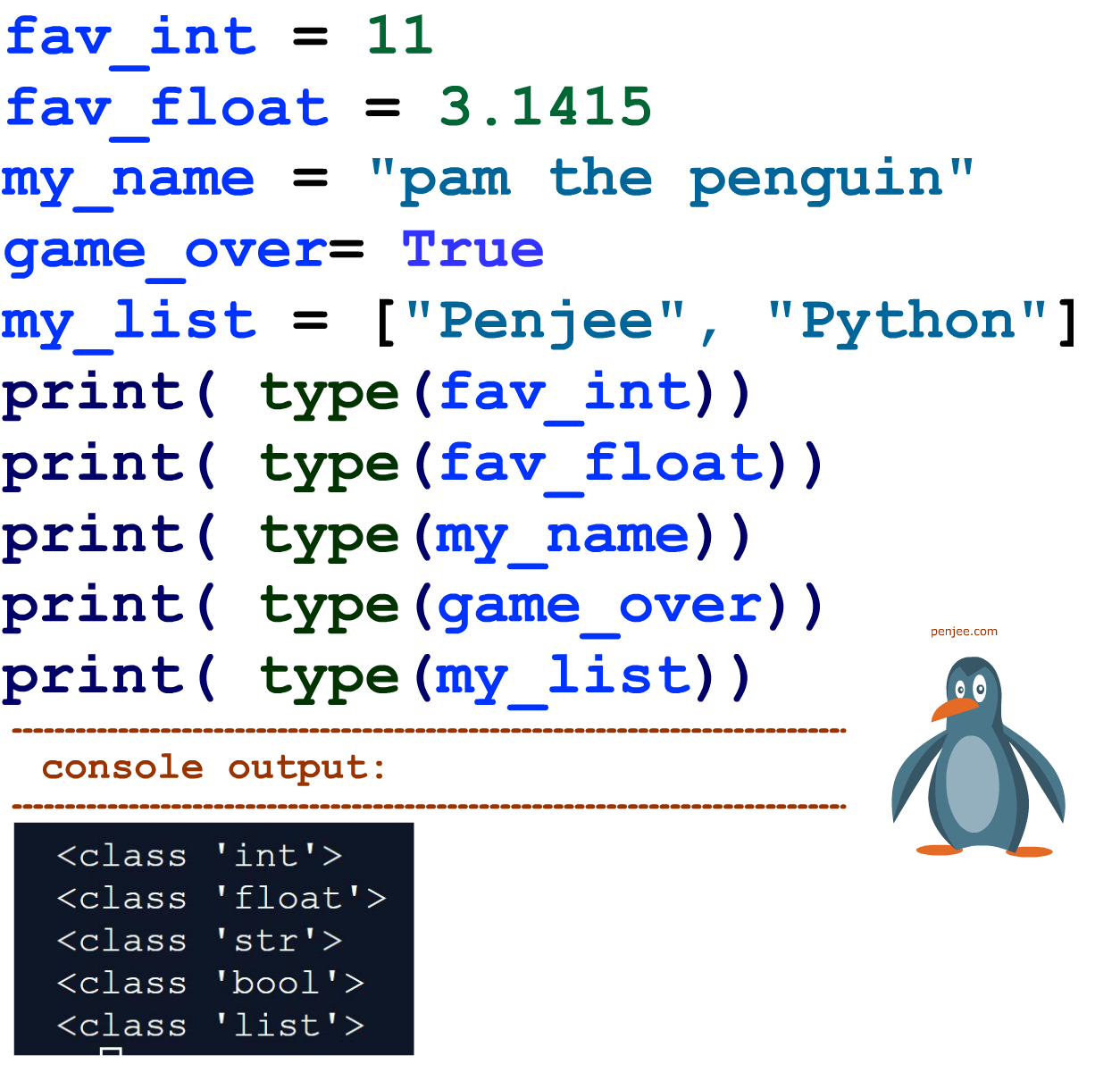
Using theid()andtype()functions allows developers to inspect these underlying technical properties, which is essential for debugging complex software systems.
2. Dynamic Typing and Data Structures
One of Python’s most powerful features is its dynamic typing system. Unlike static languages where you must declare int x, Python determines the type of a variable at runtime. This flexibility allows for rapid prototyping and reduces “boilerplate” code, though it requires a disciplined approach to manage.
The Dynamics of Re-assignment
Because Python is dynamically typed, a variable can change its type throughout the execution of a script. While this is technically possible, professional software architecture often discourages frequent type-switching for the same variable name, as it can lead to confusion and runtime errors. Modern Python development often incorporates “Type Hinting” (introduced in Python 3.5) to provide static-like clarity within a dynamic framework.
Standard Data Types and Memory Impact
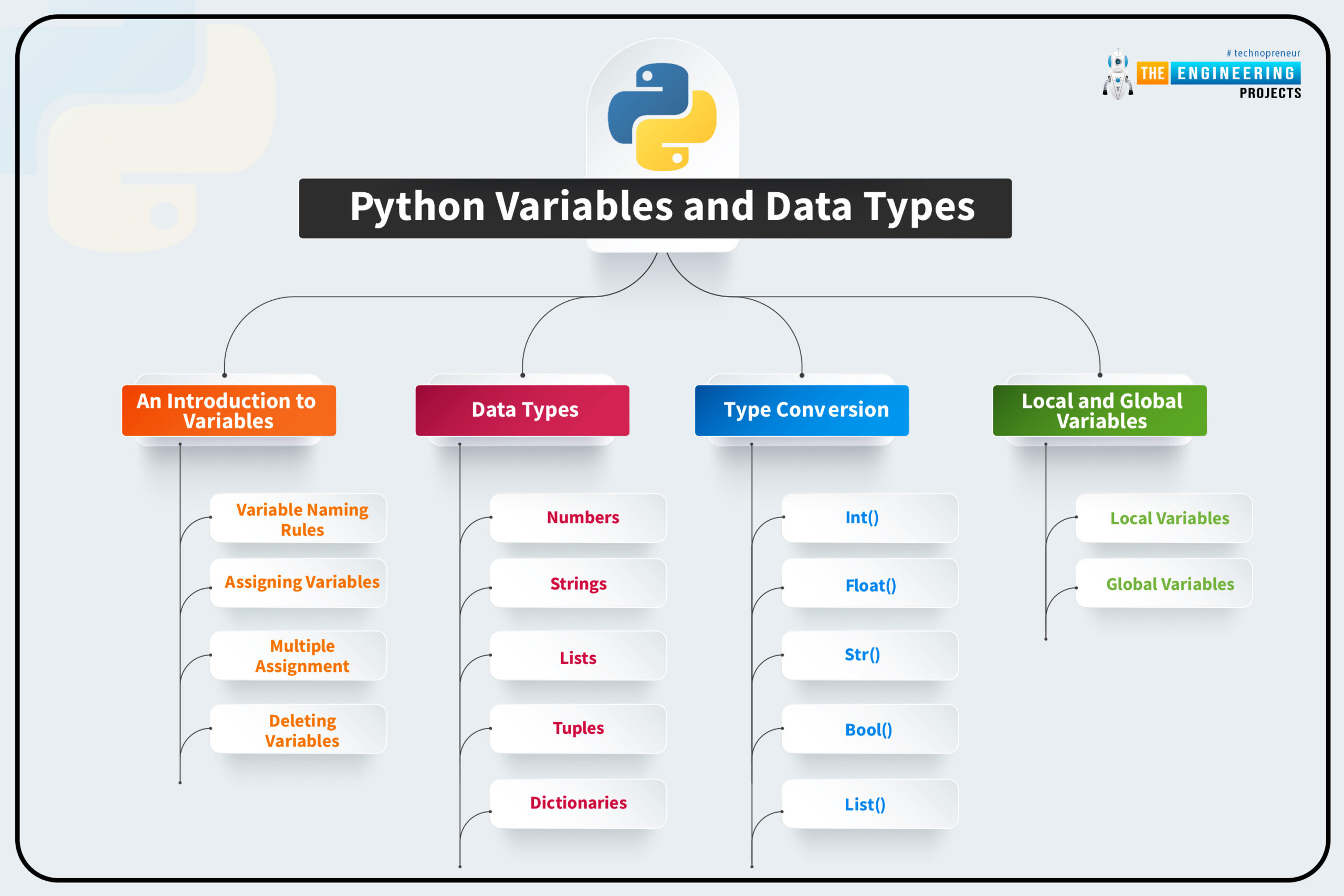
Python variables can reference various built-in data types, each with different memory footprints:
- Scalar Types:
int(integers),float(floating-point numbers),bool(Boolean values), andstr(strings). - Collection Types:
list(ordered, mutable),tuple(ordered, immutable),dict(key-value pairs), andset(unordered collections of unique items).
Understanding these types is vital for software performance. For instance, using a tuple instead of a list for fixed data sets can lead to minor performance gains and provides an added layer of digital security by ensuring the data cannot be modified accidentally.
Type Conversion and Casting
Software often requires data to be transformed. Python provides built-in functions like int(), str(), and list() to perform explicit type casting. This is particularly relevant when handling external inputs, such as data from an API or a user-facing app, where numerical data might initially arrive as a string.
3. Scope, Lifetime, and Memory Management
A critical aspect of software engineering is understanding where a variable “lives” and when it “dies.” This is known as variable scope and lifetime.
The LEGB Rule
Python follows the LEGB rule to resolve variable names. When a variable is called, Python searches in the following order:
- Local (L): Defined within a function or lambda.
- Enclosing (E): Defined within nested functions.
- Global (G): Defined at the top level of the script or module.
- Built-in (B): Reserved words within the Python language itself (like
lenorrange).
Global vs. Local Variables
A common pitfall in software development is the over-reliance on global variables. While accessible everywhere, they can make debugging difficult because any part of the program can modify them. Professional developers prefer local variables, which only exist while a function is executing. To modify a global variable within a local scope, the global keyword is required, though this is generally considered a “code smell” in clean architecture.
Garbage Collection and Memory Optimization
Python manages memory automatically through a process called Garbage Collection (GC). When an object no longer has any variables pointing to it (its reference count drops to zero), Python’s GC reclaims that memory. This automated system is part of why Python is so popular for high-level software tools; it allows developers to focus on logic rather than manual memory allocation and deallocation.
4. Advanced Variable Management and Mutability
As developers move toward building AI tools and complex apps, they must grapple with the nuances of object mutability—a concept that defines how variables behave when their values are altered.
Mutable vs. Immutable Objects
In Python, objects are either mutable (can be changed) or immutable (cannot be changed).
- Immutable: Strings, integers, and tuples. When you “change” a string, you are actually creating a new string object.
- Mutable: Lists, dictionaries, and sets. When you modify a list, you are changing the object in place.
This distinction is a frequent source of bugs. If two variables point to the same mutable list, modifying the list through one variable will change the value seen by the other. Understanding this “pass-by-object-reference” behavior is essential for digital security and data integrity.
Multiple Assignment and Unpacking
Python offers elegant syntax for handling multiple variables simultaneously. Techniques such as x, y, z = 1, 2, 3 or “unpacking” a list into variables (first, *rest = [1, 2, 3, 4]) allow for cleaner, more Pythonic code. This is particularly useful in data science and AI, where functions often return multiple values (like a status code and a data payload).
Constants in Python
While Python does not have a strict const keyword like other languages, the technical convention is to use all-capital letters (e.g., MAX_RETRY_ATTEMPTS = 5) to signal that a variable should not be changed. Following these conventions is a hallmark of a professional developer.
5. Best Practices for Professional Software Development
Writing code that works is the first step; writing code that lasts is the goal of professional engineering. How we handle variables directly impacts the sustainability of software.
Semantic Naming and Readability
Variables should describe the “what” and “why” of the data they hold. In an AI tool, a variable named weight_matrix is vastly superior to m1. Code is read far more often than it is written, and semantic naming reduces the cognitive load on developers maintaining the system.
Avoiding Shadowing
“Shadowing” occurs when a developer names a variable the same as a built-in function or a variable in a higher scope. For instance, naming a variable list or str overrides Python’s built-in constructors. This can cause catastrophic failures in software modules and should be avoided through the use of linting tools and code reviews.
Utilizing Type Hints for Scalability
For large-scale enterprise software, dynamic typing can become a liability. By using type hints—such as def process_data(users: list) -> int:—developers can use tools like MyPy to catch type errors before the code is even run. This bridges the gap between the flexibility of Python and the safety of static languages, making it a standard practice in modern Tech environments.
Conclusion
Variables are the fundamental units of data storage and manipulation in Python. From the simple assignment of an integer to the complex management of mutable objects across global and local scopes, the way a developer handles variables defines the efficiency and reliability of their software.
By mastering the technical nuances of Python variables—including memory references, the LEGB rule, and PEP 8 naming standards—developers can move beyond basic scripting and into the realm of professional software engineering. As AI tools and digital platforms become increasingly complex, the disciplined use of variables remains the bedrock of robust, secure, and high-performing technology.
aViewFromTheCave is a participant in the Amazon Services LLC Associates Program, an affiliate advertising program designed to provide a means for sites to earn advertising fees by advertising and linking to Amazon.com. Amazon, the Amazon logo, AmazonSupply, and the AmazonSupply logo are trademarks of Amazon.com, Inc. or its affiliates. As an Amazon Associate we earn affiliate commissions from qualifying purchases.