
In the dynamic world of software development, Python stands out for its readability, versatility, and powerful ecosystem. Among its many elegant features, the lambda function often sparks curiosity and debate. Often referred to as “anonymous functions,” Python lambdas are a compact way to create small, single-expression functions without a formal name. While they might seem like a niche feature at first glance, understanding lambda functions is crucial for any Python developer looking to write more concise, efficient, and sometimes more idiomatic code, particularly when working with higher-order functions or designing quick, inline operations. This article delves into the core concept of Python lambda functions, exploring their syntax, practical applications, advantages, limitations, and best practices, providing a comprehensive guide for both beginners and experienced programmers seeking to deepen their Python knowledge.

The Essence of Lambda Functions in Python
At its heart, a Python lambda function is nothing more than an unnamed, inline function. It’s a syntactic sugar for simple functions that you might only need once or for a very specific, limited purpose. Unlike traditional functions defined with the def keyword, lambda functions are constrained to a single expression, making them inherently concise.
Defining Anonymous Functions
The term “anonymous” refers to the fact that these functions are not bound to an identifier (a name) in the same way regular functions are. While you can assign a lambda function to a variable, doing so often defeats the purpose of its anonymity and conciseness, as a def defined function might be more readable in such cases. The primary utility of lambda functions arises when you need to pass a function as an argument to another function, such as map(), filter(), or sorted(), where a formal function definition would be overkill. They allow for creating on-the-fly functions exactly where they are needed, enhancing code brevity and sometimes clarity for simple operations.
Syntax and Basic Structure
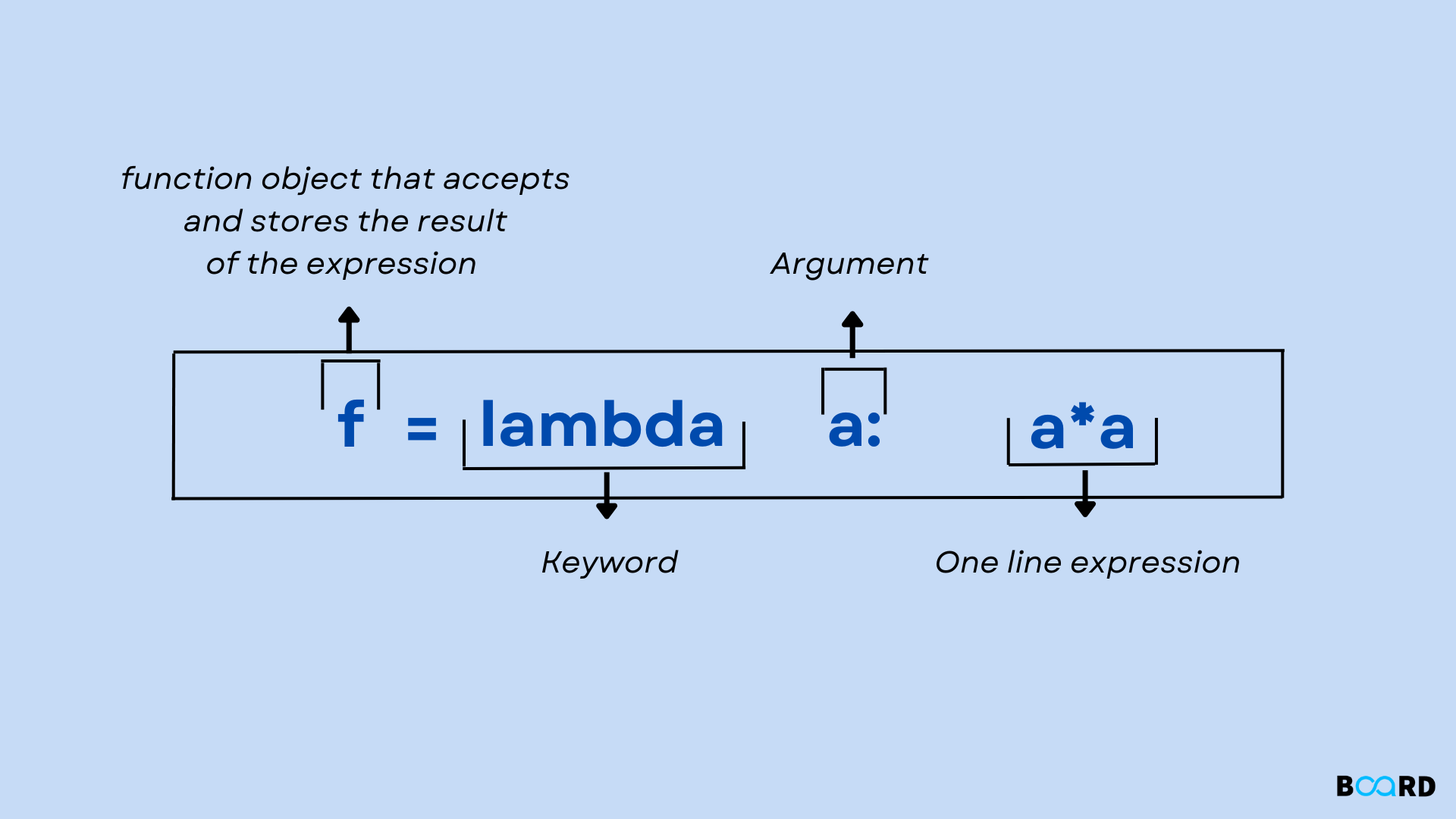
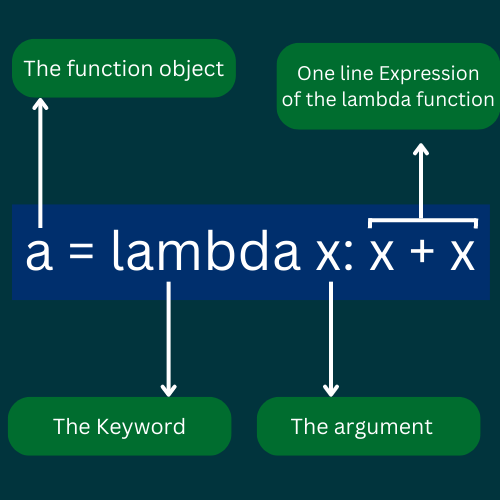
The syntax for a lambda function is straightforward and distinct:
lambda arguments: expression
Let’s break this down:
-
lambda: This keyword signals the creation of an anonymous function. -
arguments: These are the input parameters to the function, similar to the arguments in adeffunction. A lambda can take zero or more arguments. -
:: The colon separates the arguments from the function’s body. -
expression: This is the function’s body, which must be a single expression. The result of evaluating this expression is implicitly returned by the lambda function.
For example, lambda x, y: x + y is an anonymous function that takes two arguments, x and y, and returns their sum. In contrast, a regular function would be def add(x, y): return x + y. The conciseness is immediately apparent.
Key Characteristics: Single Expression, No Statements
The most defining characteristic of lambda functions is their restriction to a single expression. This is a deliberate design choice that limits their complexity and scope. You cannot include multiple statements like if, for, while, or return (explicitly) within a lambda function’s body. The expression itself implies a return value. This constraint forces developers to use lambda functions for what they are best suited for: simple, atomic operations. If your logic requires more than a single expression, a traditional def function is the appropriate choice, ensuring better readability and maintainability. This limitation is a feature, not a bug, guiding developers towards more organized and understandable code when complexity increases.
Why Use Lambda Functions? Practical Applications and Advantages
While their single-expression nature might seem restrictive, lambda functions excel in specific scenarios, offering distinct advantages in terms of code conciseness and expressiveness. Understanding these practical applications is key to leveraging their power effectively.
Conciseness and Readability for Simple Operations
For trivial functions that perform a single, straightforward operation, lambda functions can significantly reduce boilerplate code. Instead of defining a full function with def, a name, and a return statement, you can express the logic inline. This often makes the code more direct and easier to grasp at a glance, especially when the function’s purpose is immediately obvious from its context. For instance, transforming a list of numbers by squaring each element can be elegantly done with map(lambda x: x*x, numbers). Here, the squaring logic is integrated directly where it’s applied, avoiding the need for an external helper function definition. This brevity contributes to cleaner code for focused tasks.
Integration with Higher-Order Functions (map, filter, sorted)
One of the most common and powerful use cases for lambda functions is their synergy with Python’s higher-order functions. These are functions that take other functions as arguments or return them as results. map(), filter(), and sorted() are prime examples:
-
map(function, iterable): Applies a function to every item of an iterable and returns an iterator of the results. A lambda function is perfect for defining the transformation logic on the fly. Example:list(map(lambda x: x.upper(), ['apple', 'banana']))will yield['APPLE', 'BANANA']. -
filter(function, iterable): Constructs an iterator from elements of an iterable for which a function returns true. Again, a lambda provides a concise predicate. Example:list(filter(lambda x: x % 2 == 0, [1, 2, 3, 4, 5]))will yield[2, 4]. -
sorted(iterable, key=function): Returns a new sorted list from the items in iterable. Thekeyargument specifies a function to be called on each list element prior to making comparisons. Lambdas are frequently used here to define custom sorting criteria. Example:sorted(data, key=lambda item: item['price'])to sort a list of dictionaries by price.
These combinations lead to highly readable and Pythonic solutions for common data manipulation tasks.
Event Handling and Callbacks
In GUI programming (e.g., with Tkinter, PyQt) or web frameworks, you often need to attach small functions (callbacks) to events like button clicks or form submissions. Lambda functions are ideal for these scenarios when the callback logic is simple and doesn’t warrant a standalone function definition. Instead of button = tk.Button(root, text="Click Me", command=my_function), you can write button = tk.Button(root, text="Click Me", command=lambda: print("Button clicked!")). This keeps the event binding and its associated action co-located, improving locality of reference for simple actions.
Quick Utility Functions
Sometimes, you need a temporary helper function within a larger block of code that is used only once or twice. Instead of cluttering your global or class scope with a def-defined function, a lambda function can serve as a quick, throwaway utility. This can be particularly useful in list comprehensions, generator expressions, or within complex function arguments where a mini-function enhances the expressiveness of the overall statement without demanding formal declaration. While not always the most readable for complex logic, for truly trivial helpers, they offer an elegant shortcut.
Lambda vs. Regular Functions: When to Choose Which
While lambda functions offer conciseness, they are not a replacement for traditional def-defined functions. Understanding their respective strengths and limitations is key to making informed choices that prioritize code clarity and maintainability.
Scoping Differences and Closures
Both lambda and def functions can form closures, meaning they can “remember” the values of variables from their enclosing lexical scope, even if that scope has finished execution. However, the single-expression nature of lambda functions often makes complex closure scenarios less common or harder to read compared to def functions. For instance, creating a list of functions where each function captures a different value from an outer loop is possible with lambdas, but careful attention must be paid to how variables are bound (e.g., using default arguments to capture the loop variable’s value at each iteration). Regular functions, with their explicit structure, tend to handle more intricate closures with greater clarity.
Limitations of Lambda Functions (Complexity, Docstrings, Type Hints)
The primary limitation of lambda functions is their single-expression body. This design choice fundamentally restricts their ability to contain multiple statements, loops, conditional blocks, or complex error handling (try-except). If your logic requires any of these, a def function is the unambiguous choice.
Furthermore, lambda functions lack several features that contribute to the robustness and maintainability of regular functions:
-
No Docstrings: You cannot attach a docstring to a lambda function. Docstrings are vital for explaining what a function does, its arguments, and what it returns, making code self-documenting.
-
No Type Hints: While you can technically annotate parameters in a lambda if assigned to a variable, it’s not idiomatic and doesn’t seamlessly integrate with static analysis tools in the same way
deffunctions do. Type hints are crucial for ensuring type safety and improving code understanding in larger projects. -
No
if/elsestatements: While Python’s ternary operatorvalue_if_true if condition else value_if_falsecan be used within a lambda’s single expression, actualif/elsestatements are forbidden.
These limitations make lambda functions unsuitable for any piece of logic that needs to be thoroughly documented, type-checked, or involves multiple steps.
Performance Considerations (Myth vs. Reality)
A common misconception is that lambda functions are inherently faster or slower than regular functions. In reality, the performance difference, if any, is negligible for typical use cases. Both lambda and def create function objects. The overhead involved in function calls generally outweighs any minor differences in how they are defined. The choice between lambda and def should primarily be driven by readability, maintainability, and the complexity of the function’s logic, not by perceived performance gains. Optimizing for micro-differences in function definition is a premature optimization in almost all practical scenarios.
Best Practices for Readability and Maintainability
The golden rule for using lambda functions is: “Keep it simple.”
-
Use for truly anonymous, simple operations: If the function’s logic is complex or requires more than one expression, use
def. -
Prefer
deffor reusable functions: If a function might be needed in multiple places or contexts, give it a name withdef. -
Avoid assigning lambdas to variables: While possible (e.g.,
add = lambda x, y: x + y), it usually diminishes readability compared todef add(x, y): return x + y, and also sacrifices documentation capabilities. -
Prioritize clarity: If a lambda makes your code harder to understand, switch to a
deffunction. Verbosity is often preferable to cryptic conciseness, especially in collaborative projects.
By adhering to these best practices, developers can harness the succinctness of lambda functions without sacrificing the overall readability and maintainability of their Python codebases.
Advanced Concepts and Common Pitfalls
While lambda functions are meant for simplicity, there are nuances and potential traps that developers should be aware of, especially when they intersect with Python’s scoping rules and mutable objects.
Default Arguments and Variable Capture
One subtle but important aspect of lambda functions, especially when created within a loop or nested scopes, is how they capture variables from their enclosing environment. Python’s default argument values are evaluated once when the function is defined, not when it’s called. This can be used to capture the current value of a loop variable within a lambda. For example:
actions = []

for i in range(5):

    # This lambda captures the *current* value of i when defined

    # If not using default arg, 'i' would be the final loop value (4) for all lambdas

    actions.append(lambda x, i=i: x + i)


print([action(10) for action in actions])

# Expected output: [10, 11, 12, 13, 14]
Without i=i as a default argument, all lambda functions in actions would refer to the last value of i (which would be 4 after the loop finishes), leading to unexpected behavior. This pattern highlights the need for careful consideration when creating closures with lambdas, especially in loops.
Immutability and Side Effects
As lambda functions are restricted to a single expression, they are generally intended to be pure functions that compute a value without causing side effects (i.e., modifying external state). While it’s technically possible to include an expression that has side effects (e.g., calling a method that modifies an object), it goes against the spirit of lambdas. Using lambdas for operations that cause side effects can make code harder to reason about and debug. It’s best practice to keep lambda functions purely functional, focusing on transformation and calculation rather than state manipulation. For tasks involving side effects, a def function provides clearer boundaries and intentions.
Debugging Lambda Functions
Debugging lambda functions can be slightly more challenging than debugging named functions. When an error occurs within a lambda, the traceback might show <lambda> as the function name, which offers less specific context than a named function would. This can make it harder to pinpoint the exact location and cause of an issue, especially in a stack of complex calls. Tools like pdb can still step through lambda functions, but the lack of a descriptive name can add a minor hurdle. This is another reason why complex logic should reside in named functions, where debugging is more straightforward.
Avoiding Overuse: When Lambdas Become Detrimental
The availability of lambda functions can sometimes tempt developers to use them excessively, leading to “lambda soup” — code that is overly condensed and difficult to parse. While concise, a poorly structured lambda can obscure intent and create maintenance nightmares. Consider this example:
list(filter(lambda x: len(x) > 3 and x.startswith('A') and 'b' not in x, my_list))
While functional, this lambda packs a lot of logic into a single line, making it less readable than defining a dedicated named function def is_valid_item(x): .... If a lambda requires multiple logical operators or becomes visually complex, it’s a strong indicator that a def function is the better, more readable choice. The goal of clean code is not just brevity, but clarity.
Beyond the Basics: Real-World Examples and Future Implications
Having understood the core mechanics and best practices, it’s worth exploring how lambda functions manifest in more complex scenarios and their evolving role in modern Python development. Their integration points extend beyond simple list manipulations into diverse domains.
Data Processing and Transformation
In data science and analytics, particularly with libraries like Pandas, lambda functions are frequently employed for quick, column-wise transformations or filtering operations. The .apply() method of a Pandas Series or DataFrame often takes a function as an argument, and a lambda is a perfect fit for defining a custom operation inline:
import pandas as pd


df = pd.DataFrame({'A': [1, 2, 3], 'B': [4, 5, 6]})

# Apply a lambda to square each element in column 'A'

df['A_squared'] = df['A'].apply(lambda x: x**2)

# Filter rows based on a condition involving multiple columns

filtered_df = df[df.apply(lambda row: row['A'] + row['B'] > 7, axis=1)]
This pattern allows for highly expressive and concise data manipulations without needing to define numerous helper functions. Similarly, in contexts requiring dynamic sorting or grouping, lambdas provide the flexibility to specify criteria on the fly.
GUI Programming with Lambdas
Beyond simple button clicks, lambda functions can be used for more intricate event handling in GUI frameworks. For example, creating dynamic menus where each menu item performs a slightly different action based on a parameter:
import tkinter as tk


root = tk.Tk()

menu = tk.Menu(root)

root.config(menu=menu)


for i in range(5):

    # Each menu item prints a different message based on 'i'

    menu.add_command(label=f"Option {i}", command=lambda idx=i: print(f"Selected option {idx}"))


root.mainloop()
Here, the lambda closure pattern (using idx=i) is essential to capture the correct value of i for each menu item, ensuring that selecting “Option 0” prints “Selected option 0,” not “Selected option 4” for all options.
Functional Programming Paradigms
While Python is primarily an object-oriented language, it also supports functional programming constructs. Lambda functions, along with higher-order functions like map, filter, and reduce (from functools), are cornerstones of adopting a more functional style in Python. This approach emphasizes immutability, pure functions, and the transformation of data, leading to code that can be easier to reason about and test in certain contexts. Learning to combine lambdas with these functional tools can unlock new ways of thinking about problem-solving in Python.
The Evolving Role in Modern Python Development
As Python continues to evolve, the role of lambda functions largely remains consistent: a tool for quick, anonymous, single-expression functions. The growth of type hinting and static analysis tools further reinforces the idea that complex logic should reside in def-defined functions for better maintainability and readability. However, in frameworks and libraries that embrace a functional style (e.g., certain data processing pipelines, asynchronous programming constructs), lambdas continue to be valuable for their conciseness. Their existence encourages developers to differentiate between simple, inline operations and more complex, reusable logic, contributing to a more nuanced and thoughtful approach to function design in Python.
In conclusion, Python’s lambda functions are a powerful, albeit specialized, tool in a developer’s arsenal. When used judiciously for concise, single-expression operations, particularly with higher-order functions or event handling, they contribute to cleaner, more expressive code. However, their limitations—lack of statements, docstrings, and type hints—mean they are not a universal substitute for def-defined functions. Mastering lambda involves understanding not just what it does, but more importantly, when and why to use it, ensuring that brevity never comes at the cost of clarity or maintainability in the ever-evolving landscape of technology.