
In the landscape of modern personal finance, few decisions carry as much weight as the pursuit of higher education. While most people view a degree through the lens of academia, the savvy investor views it as an asset class. Specifically, the “professional degree” stands out as a unique financial instrument designed to yield high returns through specialized practice. Unlike a general undergraduate degree or a research-oriented doctorate, a professional degree is a targeted investment in specialized human capital.
To understand what a professional degree is, one must look past the classroom and toward the balance sheet. It is a credential that prepares a student for a specific career path, often one that is regulated by a licensing board. In the context of wealth building and business finance, this degree represents the “barrier to entry” for some of the highest-paying sectors in the global economy.

Defining the Professional Degree: More Than Just an Advanced Education
At its core, a professional degree is a post-secondary qualification designed to prepare students for work in a particular profession. However, from a financial and strategic perspective, it is much more: it is a certification of specialized labor value. These degrees are typically required by law or industry regulation for anyone wishing to practice in fields like law, medicine, or architecture.
Professional Degree vs. Academic Graduate Degree
The primary distinction between a professional degree and an academic graduate degree (like a Master of Arts or a Ph.D.) lies in the “terminal output.” An academic degree focuses on research, theory, and the expansion of human knowledge within a specific field. Financially, the ROI on an academic degree is often indirect, leading to careers in academia or research.
In contrast, a professional degree is focused on application and “licensure-readiness.” You don’t get a Juris Doctor (JD) to study the history of law; you get it to practice law and bill hours. From a money management perspective, the professional degree is a “practical asset”—it provides the immediate legal right to perform high-value services that the general public cannot.
Common Examples: Law, Medicine, and Business
The most recognizable professional degrees include:
- Medical Degrees (MD/DO): The quintessential high-cost, high-reward investment.
- Legal Degrees (JD): A prerequisite for entry into the legal services industry.
- Business Degrees (MBA): While not always required for licensure, the MBA functions as a professional credential that accelerates entry into high-level corporate finance and management roles.
- Specialized Health Degrees: Such as Pharmacy (PharmD), Veterinary Medicine (DVM), and Dentistry (DDS).
Each of these represents a specific “niche” in the labor market where supply is strictly controlled by educational requirements, ensuring a higher floor for potential earnings.
The Financial Landscape: Evaluating the Cost of Professional Education
When analyzing a professional degree through the lens of personal finance, one must conduct a rigorous cost-benefit analysis. These degrees are notorious for their high price tags, often requiring significant capital outlay or the accumulation of substantial debt.
Tuition and Opportunity Cost
The “sticker price” of a professional degree is only the beginning. In the realm of business finance, we must account for the total cost of acquisition. This includes tuition, fees, and books, but more importantly, it includes the opportunity cost.
Opportunity cost is the income you forego during the years you are studying instead of working. If a prospective lawyer spends three years in law school instead of earning a $60,000 salary, the “real cost” of that degree includes that $180,000 in lost wages. When you add a $150,000 tuition bill, the total investment exceeds $330,000. Understanding this total figure is essential for anyone treating their education as a financial move.
Financing Your Future: Debt Management and Scholarships
Because of the high costs, most professional degrees are financed through “leverage”—specifically, student loans. From a money-management standpoint, this is a form of “good debt,” provided the eventual income exceeds the cost of servicing the debt.
Strategic students look for ways to minimize this leverage. This includes:
- Employer Sponsorship: Many corporations will fund an MBA if the employee commits to a certain number of years of service, effectively providing a 100% ROI on the degree.
- Grants and Fellowships: These are “non-dilutive” ways to fund your education, preserving your future cash flow.
- Income-Driven Repayment (IDR) Plans: For those entering lower-paying public service roles (like public defenders), these plans can mitigate the financial burden, though they require careful long-term tax planning.
Calculating the ROI: Is the Professional Degree Worth the Price Tag?
In any business venture, the Return on Investment (ROI) is the ultimate metric. For a professional degree, the ROI is calculated by comparing the “salary premium” (the extra money you earn because of the degree) against the total cost of the degree over a 20- to 30-year career.
Lifetime Earning Potential and Salary Floors
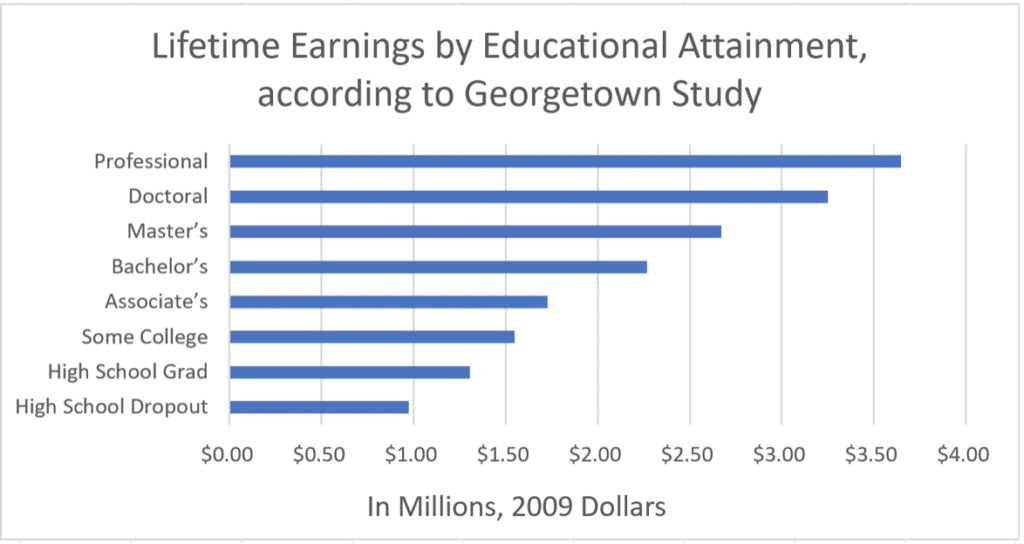
The most significant financial advantage of a professional degree is the “salary floor.” In professions like medicine or specialized engineering, the entry-level salary is significantly higher than the national median. According to various financial surveys, holders of professional degrees earn, on average, millions more over their lifetimes than those with only a bachelor’s degree.
This “alpha”—the excess return on your labor—is what justifies the initial debt. For example, if a specialized medical degree costs $250,000 but increases your annual earning potential from $70,000 to $270,000, the “payback period” on that investment is remarkably short, often less than five to seven years post-residency.
Market Demand and Job Security in Specialized Fields
Another “money” aspect of the professional degree is risk mitigation. Professional degrees often lead to “recession-resistant” careers. People always need doctors, regardless of the stock market’s performance. Businesses always need legal counsel during restructuring or bankruptcy. This job security acts as a hedge against economic volatility, providing a steady cash flow that allows for consistent long-term investing in other assets, like real estate or the stock market.
Strategic Alternatives: When to Pivot Toward Skill-Based Credentials
While the professional degree has long been the gold standard for high-income earners, the modern economy is introducing new ways to build wealth. For those focused on “Online Income” or “Side Hustles,” a traditional professional degree may not always be the most efficient path to financial independence.
Micro-Credentials and Digital Certifications
In the tech and finance sectors, “micro-credentials” are becoming powerful financial assets. A certification in Google Analytics, AWS Architecture, or Chartered Financial Analyst (CFA) levels can sometimes yield a higher “ROI per hour studied” than a full degree.
For an entrepreneur or a freelancer, these certifications allow for a “lean” approach to education. Instead of spending $100,000 on a degree, a professional might spend $5,000 on high-end certifications and coaching, allowing them to start generating high-ticket online income much sooner. This “speed to market” is a critical factor in business finance that traditional degrees often ignore.
Building Wealth Without the Six-Figure Debt
The ultimate goal of a professional degree is financial freedom and career mastery. However, it is important to remember that the degree is a tool, not the goal itself. In the current “passion economy,” many individuals are finding that building a personal brand or a scalable online business can generate higher net worth than a traditional professional career.
If the goal is “Money”—specifically, maximizing net worth—one must weigh the prestige of a professional degree against the scalability of a business. A surgeon can only bill for the hours they are in the operating room (linear income), whereas a business owner can generate passive income that isn’t tied to a specific credential.

Conclusion: The Professional Degree as a Financial Foundation
A professional degree is a powerful engine for wealth creation. It offers a structured, proven path to a high-income career, providing the “human capital” necessary to fund a lifetime of investing and financial security. By viewing the degree as a strategic business move rather than just a rite of passage, you can make more informed decisions about your debt, your time, and your ultimate earning potential.
Whether you choose to pursue the traditional path of a JD or MD, or you opt for the modern route of specialized digital certifications, the underlying principle remains the same: education is an investment. Treat it with the same scrutiny you would a stock market trade or a real estate purchase, and your professional degree will serve as the cornerstone of your financial success.
aViewFromTheCave is a participant in the Amazon Services LLC Associates Program, an affiliate advertising program designed to provide a means for sites to earn advertising fees by advertising and linking to Amazon.com. Amazon, the Amazon logo, AmazonSupply, and the AmazonSupply logo are trademarks of Amazon.com, Inc. or its affiliates. As an Amazon Associate we earn affiliate commissions from qualifying purchases.