
For decades, the question “What is on TV?” was answered by a printed grid in a local newspaper or a slow-scrolling preview channel. Today, the answer is no longer a simple list of scheduled broadcasts; it is a complex intersection of cloud computing, artificial intelligence, high-performance hardware, and sophisticated software stacks. As we move deeper into the decade, “What is on TV” is defined less by the content itself and more by the technology that delivers, optimizes, and personalizes it.
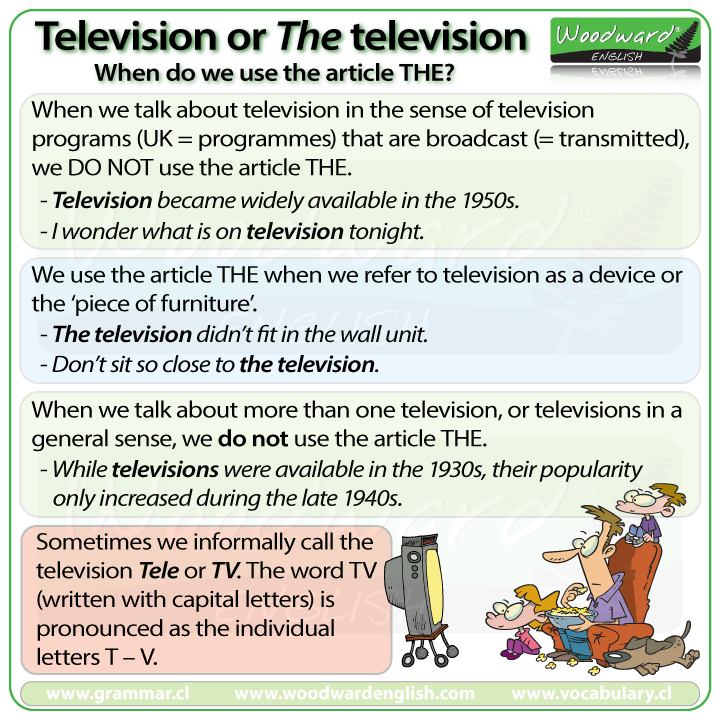
The television has transformed from a passive receiver of radio waves into the most powerful computational hub in the modern living room. This article explores the technological landscape of contemporary television, from the silicon powering the displays to the algorithms governing our viewing habits.

The Hardware Renaissance: Beyond the Traditional Display
At the most fundamental level, what we see on TV is dictated by the physical limitations and capabilities of the panel. The hardware revolution has moved past mere resolution increases—4K is now the baseline, and 8K is the horizon—focusing instead on pixel-level control and processing power.
The Battle of the Panels: OLED vs. Mini-LED
The visual fidelity of modern television is currently defined by two competing technologies: Organic Light Emitting Diodes (OLED) and Mini-LED. OLED technology allows for self-emissive pixels, meaning each individual pixel can be turned off completely to achieve “perfect blacks.” This provides an infinite contrast ratio, which is essential for High Dynamic Range (HDR) content.
Conversely, Mini-LED technology represents the pinnacle of Liquid Crystal Display (LCD) evolution. By using thousands of microscopic LEDs as a backlight, divided into hundreds or thousands of local dimming zones, Mini-LED displays can achieve brightness levels far exceeding OLED. This tech-driven “brightness war” ensures that whether a user is watching in a dark home theater or a sunlit living room, the “what” on the screen remains vibrant and legible.
The Rise of Cognitive Processors
What is often overlooked in the hardware discussion is the System on a Chip (SoC). Modern TVs are essentially massive smartphones optimized for video. Companies like Sony, Samsung, and LG have developed proprietary “cognitive” or “neural” processors. These chips use machine learning to analyze the incoming signal in real-time, identifying faces, focal points, and background noise to optimize upscaling and motion smoothing. The tech determines “what is on TV” by reconstructing lower-resolution content into a near-4K experience, ensuring that even legacy media looks contemporary on modern glass.
The Software Stack: Operating Systems and the User Experience
The interface is the gateway to content. In the current tech landscape, the Smart TV Operating System (OS) is the battlefield where Google, Amazon, Roku, and proprietary builders like Samsung (Tizen) and LG (webOS) compete for dominance.
The Dominance of Proprietary Platforms
For many years, the software on a TV was an afterthought. Today, the OS is a critical differentiator. Tizen and webOS have led the way in creating “pointer-based” or “tile-based” interfaces that prioritize speed and app switching. These platforms are built on Linux kernels and are designed to handle high-bandwidth streaming while simultaneously managing background tasks like smart home notifications. The efficiency of the software stack dictates the fluidity of the user experience; a lagging interface can ruin the perception of even the most expensive hardware.
Aggregation vs. Fragmentation: The UX Challenge
The primary technological challenge in modern TV software is fragmentation. With content spread across dozens of streaming services (Netflix, Disney+, Hulu, etc.), the “What is on TV” question becomes a search problem. Google TV and Apple TV (tvOS) have addressed this through “Deep Linking” and unified search APIs. These technologies crawl the metadata of third-party apps to present a single, unified “Up Next” row. This layer of software abstraction is what allows a user to bypass individual apps and interact with their entire library from a single dashboard.
AI-Driven Curation: The Engine Behind “What to Watch”
Perhaps the most significant technological shift in television is the move from linear programming to algorithmic curation. In the past, a programming director decided the schedule. Now, a recommendation engine powered by Big Data and Artificial Intelligence makes that call.
Machine Learning and Predictive Analytics
When you open a streaming app on your TV, the interface you see is unique to you. This is the result of sophisticated recommendation algorithms—collaborative filtering and content-based filtering. These systems analyze your viewing history, the time of day you watch, the duration of your sessions, and even the point at which you stop watching a specific title.
These AI models process billions of data points across their entire user base to predict what will keep you engaged. “What is on TV” is no longer a static choice; it is a dynamic prediction generated in milliseconds by servers in the cloud, pushed to your screen via high-speed Content Delivery Networks (CDNs).
The End of Linear Programming
The technology of “Fast Channels” (Free Ad-supported Streaming TV) is reviving the feel of linear television but through a digital lens. Platforms like Pluto TV or Samsung TV Plus use cloud-based playout technology to simulate traditional broadcast channels. This tech allows for “virtual” channels that can be spun up or down based on trending topics, effectively merging the “always-on” nature of old-school TV with the efficiency of internet streaming.
The Connected Hub: Gaming and Smart Home Integration
The modern television is no longer just a screen for movies; it has become the central command center for the digital home. This expansion of utility is driven by advances in connectivity and low-latency processing.
Cloud Gaming: The TV as a Console
One of the most significant tech trends is the integration of cloud gaming directly into the TV’s OS. With platforms like Xbox Cloud Gaming and NVIDIA GeForce Now, the hardware requirements for high-end gaming are shifted from a local console to a remote server. The TV’s role is to manage the low-latency decoding of the video stream and provide a Bluetooth interface for controllers. This tech turns the TV into a high-performance gaming rig without the need for additional hardware, fundamentally changing the definition of what can be “on” the screen.
IoT and the Interactive Dashboard
Modern TVs serve as the primary “Dashboard” for the Internet of Things (IoT). Through protocols like Matter and Thread, or platforms like Apple HomeKit and Amazon Alexa, the TV can display real-time feeds from doorbell cameras, control smart lighting, or show the status of household appliances. The technology of the “Overlay” allows these notifications to appear without interrupting the primary viewing experience, positioning the TV as the literal and metaphorical center of the smart home ecosystem.
Privacy and Security in the Age of Connected Media
As televisions become more like computers, they inherit the security and privacy challenges of the digital age. “What is on TV” now includes a two-way street of data exchange that requires robust digital security measures.
Automated Content Recognition (ACR) and Data Tracking
Most modern smart TVs utilize a technology called Automated Content Recognition (ACR). ACR samples pixels or audio snippets from whatever is playing on the screen—regardless of the source—to identify the content. This data is used for targeted advertising and to refine recommendation engines. From a tech perspective, this involves complex fingerprinting algorithms that must run efficiently in the background without consuming excessive CPU cycles or interfering with playback.
Hardening the Smart Home Perimeter
Because the TV is connected to the home network and often features microphones for voice control and cameras for video calls, it has become a target for cyber threats. TV manufacturers are now implementing hardware-level security, such as “Secure Boot” and encrypted storage for user credentials. Ensuring the digital security of the TV is paramount, as a compromised TV could serve as a gateway to the rest of a user’s local network. Regular firmware updates over-the-air (OTA) have become the standard for patching vulnerabilities, mirroring the security lifecycle of smartphones and PCs.

Conclusion
The question “What is on TV?” has evolved from a query about scheduling into a showcase of the world’s most advanced consumer technology. We are currently in an era where the hardware is reaching the limits of human perception, and the software is becoming increasingly “invisible” through AI-driven automation.
As we look forward, the integration of 5G connectivity, more powerful edge computing, and the refinement of AI will continue to blur the lines between traditional viewing, interactive gaming, and smart home management. The TV is no longer just a box in the corner; it is a sophisticated, AI-powered window into a personalized digital universe. Whether it is a 4K HDR stream, a cloud-hosted video game, or a smart home alert, the technology behind the screen ensures that the answer to “What is on TV” is more diverse and engaging than ever before.
aViewFromTheCave is a participant in the Amazon Services LLC Associates Program, an affiliate advertising program designed to provide a means for sites to earn advertising fees by advertising and linking to Amazon.com. Amazon, the Amazon logo, AmazonSupply, and the AmazonSupply logo are trademarks of Amazon.com, Inc. or its affiliates. As an Amazon Associate we earn affiliate commissions from qualifying purchases.