
The world of mathematics, often perceived as a realm of abstract symbols and complex equations, actually holds profound connections to the practicalities of our daily lives, influencing everything from the technology we use to the brands we trust and the financial decisions we make. While the term “odd function” might sound exclusively academic, understanding its core principles can offer surprising insights when viewed through the lens of technology, branding, and finance. This article will delve into what an odd function is, exploring its mathematical definition and then branching out to explore its indirect relevance and conceptual parallels within the digital, corporate, and economic landscapes.

The Mathematical Foundation: Symmetry and Negation
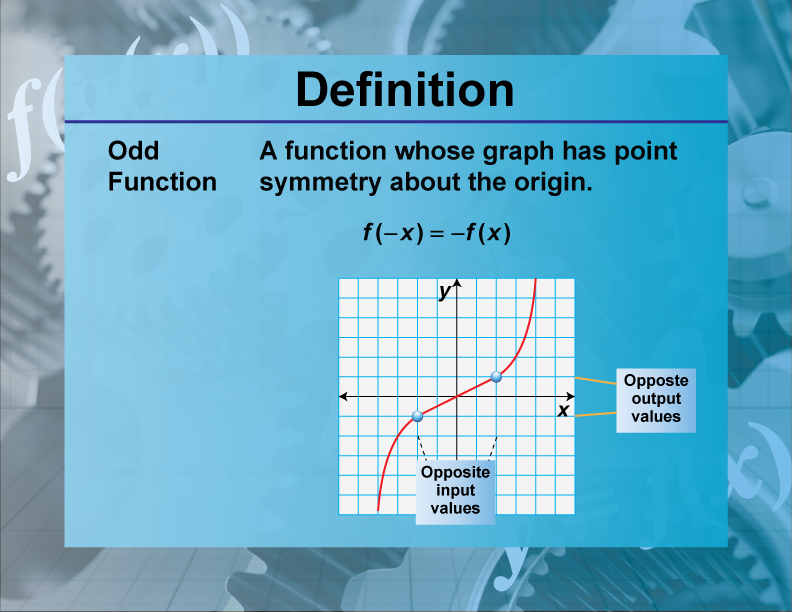
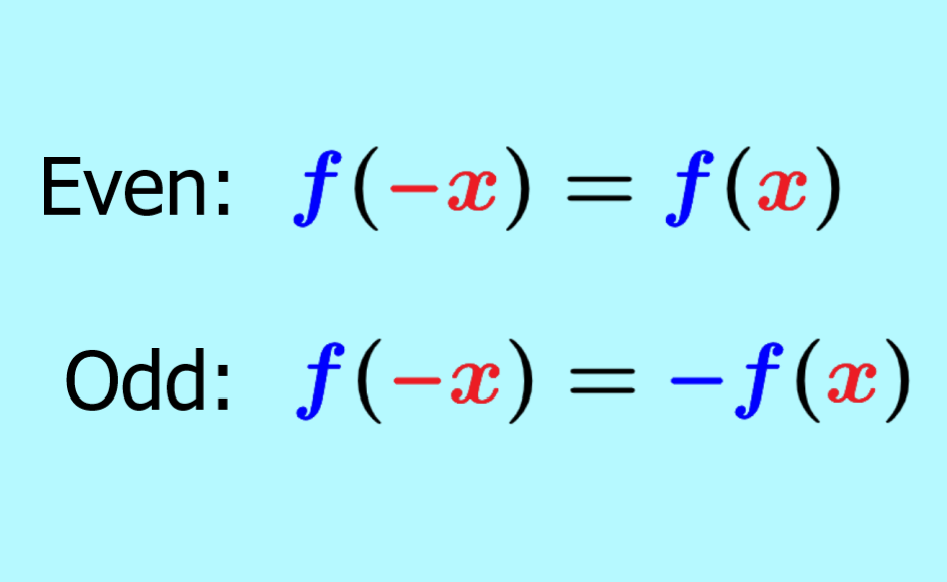
At its heart, an odd function is defined by a specific type of symmetry. In mathematical terms, a function $f(x)$ is considered odd if, for every value of $x$ in its domain, the following equation holds true:
$$f(-x) = -f(x)$$
Let’s break this down. The domain of a function refers to all possible input values (the $x$ values) for which the function is defined. When we talk about $f(-x)$, we are substituting the negative of an input value into the function. Then, $-f(x)$ represents the negative of the output value of the original input $x$.
In essence, an odd function exhibits point symmetry about the origin. If you were to plot an odd function on a graph, and then rotate the graph 180 degrees around the origin (the point where the x-axis and y-axis intersect), the graph would look exactly the same. This means that for any point $(x, y)$ on the graph, the point $(-x, -y)$ is also on the graph.
Consider some familiar examples of odd functions:
- $f(x) = x$: For any $x$, substituting $-x$ gives $-x$. The negative of the original output $f(x)$ is indeed $-x$. So, $f(-x) = -x = -(x) = -f(x)$.
- $f(x) = x^3$: If we input $-x$, we get $(-x)^3 = -x^3$. This is equal to $-(x^3)$, which is $-f(x)$.
- $f(x) = sin(x)$: The sine function is a classic example of an odd function. $sin(-x) = -sin(x)$.
Contrast this with an even function, which satisfies the condition $f(-x) = f(x)$. Even functions exhibit symmetry about the y-axis. Examples include $f(x) = x^2$ and $f(x) = cos(x)$.
The concept of odd functions, while purely mathematical, introduces us to the idea of reciprocity and balanced opposition. An input’s negative counterpart leads to an output’s negative counterpart, creating a predictable and mirrored relationship. This fundamental notion of opposite inputs yielding opposite outputs, or a consistent and predictable relationship under inversion, can be found echoed in various aspects of technology, branding, and finance.
Odd Functions in the Digital Realm: Algorithms, Data, and User Experience
While you won’t find code directly implementing the $f(-x) = -f(x)$ equation in most applications, the principle of symmetrical relationships and predictable responses to opposing inputs is deeply embedded in the design and functionality of many technological systems.
Algorithms and Data Transformations
Many algorithms are built upon principles of inverse operations or symmetrical data handling. Consider data normalization or scaling techniques. Often, you’ll apply transformations to bring data into a specific range, and to revert back to the original scale, you apply an inverse transformation. If the process of scaling involves a linear transformation, the inverse operation will often mirror the original in a way that conceptually aligns with the odd function’s symmetry.
Think about how image filters work. Applying a “sharpen” filter might enhance edges. If there were a corresponding “unsharpen” or “blur” filter designed to perfectly reverse the sharpening effect, one could argue for a conceptual odd function relationship: the inverse of sharpening is blurring, and applying both in sequence returns the image to its original state.
In machine learning, especially in areas like signal processing or time-series analysis, understanding how transformations affect data is crucial. Algorithms might be designed to handle positive and negative deviations from a baseline in a symmetrical manner. For instance, if a model predicts a positive deviation from a forecast, it might also be designed to predict a corresponding negative deviation with equal magnitude but opposite sign for a symmetrical under-prediction. This ensures that the overall system remains balanced and doesn’t consistently bias towards one type of error.
User Interface and User Experience (UI/UX)
The principles of symmetry and predictable response are also critical in UI/UX design. While not a direct mathematical function, the intuitive understanding of how controls should behave can be related to the concept of odd functions.
For example, consider a slider control. Moving the slider to the right might increase a value (e.g., volume, brightness), while moving it to the left decreases it. The midpoint of the slider typically represents a neutral or baseline state. The actions of moving left and right are opposing inputs, and the resulting changes in the value are also opposing. If the slider has a linear response, moving it twice as far to the right results in twice the increase in value. Similarly, moving it twice as far to the left results in twice the decrease. This inverse relationship between direction of input and direction of output, with a symmetrical midpoint, conceptually mirrors the odd function’s symmetry around the origin.
Another example could be undo/redo functionality. Performing an “undo” action reverses the previous action. Ideally, performing “redo” after “undo” should reapply the undone action. This pairing of inverse operations is fundamental to maintaining a predictable and controllable user experience. The input is the user’s command, and the output is the state change of the application. The “undo” operation negates the effect of the “redo” operation, and vice versa, demonstrating a symmetrical, oppositional relationship.
Cybersecurity and Digital Security
In cybersecurity, the concept of defense and offense can be seen through a lens of opposing forces. While not a direct mathematical function, understanding how systems respond to malicious inputs (attacks) versus benign inputs is paramount. Security protocols aim to neutralize or mitigate negative impacts. If a system is designed to symmetrically handle and neutralize both a “positive” threat (e.g., a virus attempting to encrypt data) and its conceptual “negative” counterpart (e.g., a rogue process attempting to decrypt sensitive data without authorization), there’s an underlying principle of balanced defense against opposing actions.
The idea of hashing algorithms, which are fundamental to data integrity and password security, also involves one-way transformations. While not an odd function, the concept of transforming input into a fixed-size output, and the expectation of unique outputs for unique inputs, speaks to deterministic relationships. However, in scenarios where data integrity is paramount, any manipulation or corruption of data (an “input change”) should ideally lead to a drastically different hash (an “output change”), making the system robust against subtle alterations, much like how an odd function’s symmetry is sensitive to the sign of the input.
Brand Identity and Marketing: Symmetry in Perception and Value
The principles of symmetry, balance, and predictable response to opposing stimuli are not confined to mathematics and technology; they are foundational to building strong brands and executing effective marketing strategies.
Brand Consistency and Reputation Management
A brand’s identity is built on a consistent message and a reliable experience. When consumers interact with a brand, they expect a certain outcome based on their inputs (e.g., purchasing a product, engaging with customer service, seeing an advertisement). If a brand consistently delivers a positive experience, this builds trust and positive association. Conversely, consistently negative experiences erode this trust.
This can be conceptually linked to the odd function’s symmetry. Imagine a brand promise as the positive value $f(x)$. If a customer has a positive interaction (input $x$), they experience the positive value $f(x)$. If, however, the brand fails to deliver or creates a negative experience (input $-x$), the expected outcome is a negative experience, $-f(x)$. A well-managed brand ensures that the magnitude of both positive and negative experiences is consistent and predictable, maintaining a kind of equilibrium. If a brand overpromises and underdelivers, it’s like having $f(-x) neq -f(x)$, creating an unbalanced and untrustworthy perception.
Reputation management is essentially about controlling the narrative and ensuring that public perception aligns with the desired brand image. When negative news or a product recall occurs, the brand’s response is crucial. A well-handled crisis, where the brand acknowledges the issue and takes corrective action, can mitigate the negative impact. This corrective action aims to “negate” the negative effect, bringing the brand back towards a neutral or even positive state, reflecting a symmetrical response to a negative input.
Marketing Campaigns and Consumer Psychology
Marketing campaigns often rely on creating a desired emotional response or behavioral change in consumers. Consider a campaign that aims to create a sense of urgency or excitement around a product launch. The input is the marketing message and the stimuli, and the output is the consumer’s feeling or action. If the campaign successfully creates excitement (positive output), a subsequent campaign aiming to capitalize on this excitement might involve an “offering” that complements the initial excitement. The relationship between the initial stimulus and the subsequent offer, if well-designed, can exhibit a complementary symmetry.
Furthermore, the concept of “loss aversion” in behavioral economics, which suggests that people feel the pain of a loss more strongly than the pleasure of an equivalent gain, can be viewed through the lens of asymmetrical responses to opposing stimuli. While not strictly an odd function, it highlights how the human psyche doesn’t always respond symmetrically to positive and negative inputs. However, understanding this asymmetry allows marketers to design campaigns that either leverage it or aim to create a more balanced perception.
For instance, a “buy one, get one free” offer can be seen as an attempt to create a perceived gain that balances out the perceived cost. The positive input (purchasing one item) leads to a perceived positive output (getting another item for “free”), creating a symmetrical value proposition.
Financial Markets and Personal Finance: Balancing Risk and Return
The world of finance is inherently about managing opposing forces: risk and return, growth and volatility, investment and expenditure. While direct mathematical applications of odd functions are rare, the underlying principles of symmetrical relationships, predictable responses to opposing conditions, and the pursuit of balance are crucial.
Risk and Return in Investing
In investing, the fundamental trade-off is between risk and potential return. Higher potential returns often come with higher risk. If we consider “risk” as an input and “potential return” as an output, we might look for a balanced relationship. Ideally, taking on more risk ($x$) should lead to a proportional increase in potential return ($f(x)$), but also, conversely, taking on less risk ($-x$) should lead to a proportional decrease in potential return ($-f(x)$).
However, financial markets are rarely perfectly symmetrical. The concept of asymmetric risk is prevalent – where the downside potential can far outweigh the upside potential, or vice versa. Understanding these asymmetries is critical for making informed investment decisions. An investor aims to find investments where the potential return justifies the risk, seeking a favorable relationship that might not strictly be an odd function but still adheres to principles of calculated balance.
The idea of hedging in finance also embodies a form of symmetrical balancing. When an investor takes a position in one asset, they might take an opposing position in another asset to mitigate potential losses. This is like introducing a “negative” factor to offset a “positive” (or negative) fluctuation, aiming to stabilize the overall portfolio value.
Personal Finance: Income, Expenses, and Savings
On a personal finance level, the concept of an odd function can be conceptually applied to the relationship between income and expenses, and their impact on savings.
Let “income” be your primary input. If your income increases ($x$), your ability to save or spend increases ($f(x)$). If your income decreases ($-x$), your ability to save or spend decreases ($-f(x)$). A balanced financial life aims to ensure that the outflow (expenses) is less than the inflow (income), leading to a positive net result (savings).
Consider a budget. If you decide to allocate an additional $100 to entertainment (an “expenditure input”), your savings will decrease by $100 (a “negative output”). If you then decide to cut back on entertainment by $100 (a “negative expenditure input”), your savings will increase by $100 (a “positive output”). This direct, one-to-one inverse relationship between discretionary spending adjustments and their impact on savings is a clear illustration of the symmetrical, oppositional principle that underlies odd functions.
The idea of compound interest also involves predictable growth, though it’s more akin to exponential functions. However, the symmetrical nature of how interest accrues (both positive on gains and potentially negative on debt) highlights the importance of understanding the direction and magnitude of financial flows.
Conclusion: Beyond the Equation
While the mathematical definition of an odd function— $f(-x) = -f(x)$ —might seem confined to textbooks, its underlying principle of symmetrical opposition and predictable inversion resonates across diverse fields. In technology, it influences algorithm design, UI/UX intuitiveness, and robust security measures. In branding, it shapes consistent perception, effective marketing, and reliable reputation management. And in finance, it informs the delicate balance of risk and return, and the fundamental principles of personal financial management.
Understanding “what is an odd function” allows us to appreciate how mathematical concepts, even abstract ones, can provide frameworks for comprehending and navigating the complexities of the modern world. The pursuit of balance, the understanding of inverse relationships, and the expectation of predictable responses to opposing inputs are not just mathematical ideals, but practical necessities in our technologically driven, brand-conscious, and financially interconnected lives. By looking for these conceptual parallels, we can gain a deeper appreciation for the interconnectedness of knowledge and the elegant simplicity that can underlie seemingly complex phenomena.
aViewFromTheCave is a participant in the Amazon Services LLC Associates Program, an affiliate advertising program designed to provide a means for sites to earn advertising fees by advertising and linking to Amazon.com. Amazon, the Amazon logo, AmazonSupply, and the AmazonSupply logo are trademarks of Amazon.com, Inc. or its affiliates. As an Amazon Associate we earn affiliate commissions from qualifying purchases.