
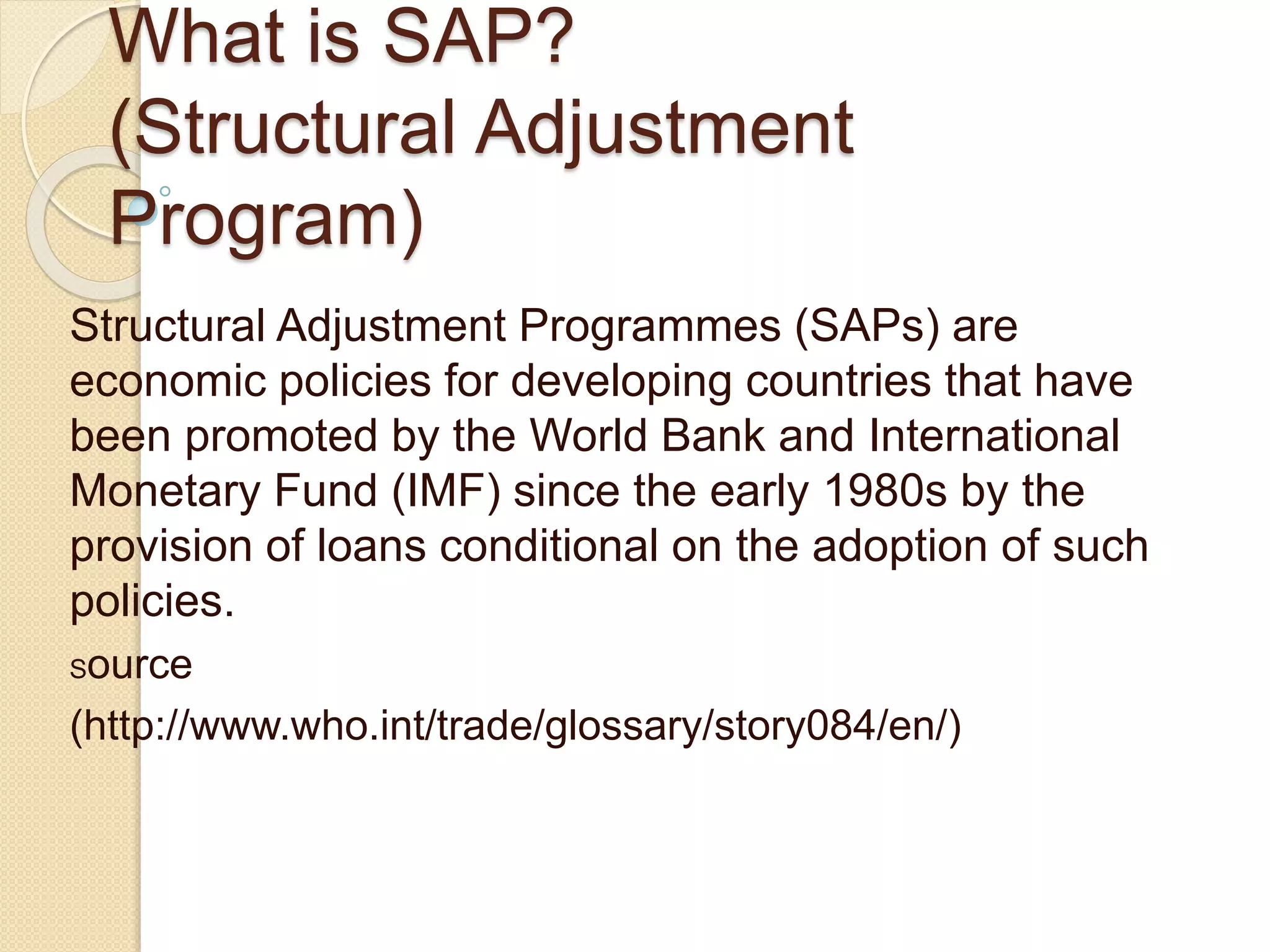
In the landscape of international finance and development economics, few concepts have generated as much debate and controversy as the Structural Adjustment Program (SAP). Originating in the late 20th century, these programs represent a set of economic policy reforms imposed by international financial institutions, primarily the International Monetary Fund (IMF) and the World Bank, on countries experiencing economic crises, particularly those grappling with severe balance of payments issues or unsustainable debt. Far from being mere technical fixes, SAPs embody a philosophy of market liberalization and fiscal austerity, aiming to reshape the fundamental economic structures of borrowing nations. Understanding SAPs requires delving into their genesis, their intended economic rationale, their often profound socio-economic consequences, and their evolving role in global financial governance.
The Genesis and Core Principles of Structural Adjustment
The concept of structural adjustment did not emerge in a vacuum but as a response to a series of global economic challenges that intensified in the 1970s and 1980s. Developing countries, particularly those in Latin America and Africa, accumulated massive external debts, often exacerbated by oil price shocks, volatile commodity markets, and easy access to petrodollars. When global interest rates rose sharply in the early 1980s, many nations found themselves unable to service their debts, triggering a widespread debt crisis. It was against this backdrop that the IMF and World Bank, institutions designed to promote global monetary cooperation and development, stepped in as lenders of last resort, attaching stringent conditions to their financial assistance.
Origins and the Bretton Woods Institutions
The IMF and World Bank, established at the Bretton Woods Conference in 1944, were originally conceived to stabilize the international monetary system and fund post-war reconstruction and development. By the 1980s, their mandate expanded to include crisis management, particularly through conditional lending. The rationale was that simply providing funds without addressing underlying economic weaknesses would be akin to pouring water into a leaky bucket. Therefore, financial assistance became contingent on a recipient country’s commitment to implement a package of policy reforms – the Structural Adjustment Program – designed to correct macroeconomic imbalances and foster long-term growth.
Key Pillars of Adjustment
The policy prescriptions embedded within SAPs typically focused on a uniform set of market-oriented reforms, often summarized as the “Washington Consensus.” These included:
- Fiscal Discipline: Governments were mandated to reduce budget deficits, primarily through cuts in public spending, often targeting subsidies on essential goods (food, fuel) and social services (health, education). Tax reforms, aimed at broadening the tax base and increasing revenue, were also common.
- Monetary Restraint: Policies focused on controlling inflation through tight monetary policy, including raising interest rates and curbing the money supply. Exchange rate reforms, often involving devaluation, were implemented to make exports more competitive and reduce imports.
- Trade Liberalization: Tariffs and non-tariff barriers to trade were reduced or eliminated, opening domestic markets to international competition. The goal was to foster efficiency, stimulate exports, and integrate the economy into the global trading system.
- Financial Liberalization: Domestic financial markets were deregulated, interest rates were freed from government control, and restrictions on capital flows were often eased. This aimed to improve resource allocation and attract foreign investment.
- Privatization: State-owned enterprises (SOEs) across various sectors (utilities, telecommunications, banking, mining) were sold off to private domestic or foreign investors. The argument was that private ownership would lead to greater efficiency, innovation, and reduced drain on government budgets.
- Deregulation: Governments were encouraged to reduce their intervention in the economy, minimizing licensing requirements, price controls, and other bureaucratic hurdles perceived as stifling private sector activity.
The Economic Rationale and Intended Outcomes
From the perspective of their architects, SAPs were designed to be transformative, moving developing economies from state-led models to more market-driven ones. The core belief was that economic openness, fiscal prudence, and a robust private sector would unlock a country’s potential for sustainable, export-led growth.
Stabilizing Macroeconomic Conditions
A primary immediate objective of SAPs was to stabilize a country’s macroeconomic environment. This involved tackling soaring inflation, reducing chronic budget deficits, and correcting unsustainable balance of payments deficits. By tightening fiscal and monetary policy, controlling government borrowing, and devaluing overvalued currencies, SAPs aimed to restore confidence among investors, both domestic and international, and pave the way for a more predictable economic environment. The idea was to create the conditions necessary for market forces to operate effectively, ensuring that a country could live within its means and manage its external financial obligations.
Fostering Sustainable Growth
Beyond stabilization, SAPs were predicated on the notion that market-oriented reforms would lay the groundwork for long-term sustainable economic growth. By removing distortions, promoting competition, and attracting foreign direct investment (FDI), these programs sought to enhance efficiency across various sectors. Privatization was expected to improve the performance of previously inefficient state enterprises, while trade liberalization was meant to encourage export-oriented industries and integrate the country more deeply into global value chains. The theory was that exposure to international markets would spur innovation, technology transfer, and greater productivity, leading to higher living standards.
Attracting Foreign Investment
A critical component of the SAP strategy was to make borrowing countries more attractive destinations for foreign capital. Financial liberalization, coupled with a stable macroeconomic environment and a commitment to market-friendly policies, was intended to signal to international investors that the country was a safe and profitable place to deploy capital. Increased FDI was seen as a vital source of financing for development, bringing not only capital but also technology, management expertise, and access to new markets, thereby stimulating economic activity and job creation without adding to public debt.
Controversies, Criticisms, and Socio-Economic Impact

Despite their ambitious goals, Structural Adjustment Programs became a lightning rod for criticism, particularly from civil society organizations, academics, and many developing country governments. The uniform, “one-size-fits-all” approach often failed to account for unique local contexts, leading to significant unintended and often detrimental socio-economic consequences.
Austerity and Social Costs
Perhaps the most significant criticism revolved around the severe austerity measures. Cuts in public spending, particularly on education, healthcare, and social safety nets, had a direct and often devastating impact on the poor and vulnerable. The removal of subsidies on basic necessities like food and fuel led to price increases, eroding purchasing power and increasing poverty. User fees for public services meant that many, especially in rural areas, lost access to essential services, leading to declines in health and educational outcomes. This often sparked social unrest and protests, highlighting the human cost of purely economic adjustments.
Loss of National Sovereignty
Many critics argued that the conditionality attached to SAPs amounted to a significant erosion of national sovereignty. Developing countries, desperate for loans, were often compelled to adopt policies dictated by external institutions, irrespective of domestic political preferences or development priorities. This was seen as undermining democratic processes and the ability of national governments to chart their own economic destiny, leading to accusations of neo-colonialism. The “ownership” of economic policies often felt external rather than internal.
Uneven Economic Outcomes
While some countries experienced periods of economic stabilization or growth under SAPs, the overall track record was mixed, and often disappointing. Many economies struggled to achieve sustained growth, and some experienced de-industrialization as nascent domestic industries, unable to compete with cheaper imports post-liberalization, collapsed. The focus on raw material exports, often a feature of SAPs, also left many countries vulnerable to volatile global commodity prices, hindering diversification efforts. Critics argued that the rapid opening of markets without sufficient institutional strengthening or protective measures often led to vulnerability rather than resilience.
Environmental Concerns
The drive for export-led growth, particularly in resource-rich nations, sometimes came at a significant environmental cost. Deregulation and the push for increased production in sectors like mining, logging, and agriculture, often led to unsustainable exploitation of natural resources, deforestation, pollution, and a loss of biodiversity, as environmental safeguards were either weakened or poorly enforced in the pursuit of economic returns.
Evolution and Post-Adjustment Approaches
The widespread criticism and the mixed results of early SAPs led to a significant re-evaluation by the IMF, World Bank, and the international development community. There has been an evolution towards more nuanced, flexible, and country-specific approaches, acknowledging that purely economic adjustments without social considerations are unsustainable.
Shifting Paradigms
From the late 1990s onwards, there was a discernible shift in the development paradigm. The “Washington Consensus” began to yield to a broader understanding that good governance, institutional quality, social equity, and environmental sustainability were just as crucial for development as macroeconomic stability. Institutions started to incorporate elements like social safety nets, targeted poverty reduction programs, and greater emphasis on “country ownership” of reform agendas. This led to frameworks like the Poverty Reduction Strategy Papers (PRSPs), which aimed to ensure that economic reforms were integrated into broader, nationally-driven poverty reduction strategies, allowing for greater stakeholder participation.
Debt Relief Initiatives
The recognition that many heavily indebted poor countries (HIPCs) were trapped in a cycle of debt, partly exacerbated by previous structural adjustment lending, led to significant international debt relief initiatives. The HIPC Initiative, launched in 1996 and enhanced in 1999, provided comprehensive debt relief to qualifying countries, aiming to free up resources for poverty reduction and social spending rather than debt servicing. This marked a crucial acknowledgment that debt sustainability was paramount for long-term development.

Current Landscape of Development Finance
Today, the lending practices of institutions like the IMF and World Bank are more complex and diversified. While conditionality remains a feature of financial assistance, there is a greater emphasis on tailored programs, capacity building, and supporting reforms that address issues like climate change, gender equality, and inclusive growth. The focus has expanded beyond purely macroeconomic stabilization to encompass broader structural reforms that promote resilience, sustainable development, and a more equitable distribution of benefits. The lessons learned from the SAP era continue to inform contemporary debates on global financial architecture and responsible development finance.
In conclusion, Structural Adjustment Programs represent a pivotal, albeit controversial, chapter in the history of international finance and development. Born out of a need to address profound economic crises, they sought to transform developing economies through a package of market-oriented reforms. While proponents pointed to their role in stabilizing economies and promoting efficiency, critics highlighted their severe social costs, impact on sovereignty, and often uneven economic outcomes. The legacy of SAPs is complex, a testament to the intricate relationship between global finance, national policy, and the well-being of populations, continuing to shape discussions on how best to foster sustainable and inclusive economic development worldwide.
aViewFromTheCave is a participant in the Amazon Services LLC Associates Program, an affiliate advertising program designed to provide a means for sites to earn advertising fees by advertising and linking to Amazon.com. Amazon, the Amazon logo, AmazonSupply, and the AmazonSupply logo are trademarks of Amazon.com, Inc. or its affiliates. As an Amazon Associate we earn affiliate commissions from qualifying purchases.