
In the rapidly evolving landscape of digital security, the transition from traditional analog systems to sophisticated network-based solutions has redefined how we monitor and protect our physical spaces. At the heart of this revolution is the Network Video Recorder (NVR). Unlike its predecessors, the NVR represents a shift toward high-bandwidth, intelligent, and scalable surveillance technology. To understand what an NVR security system is, one must look beyond the box itself and examine the ecosystem of IP cameras, data protocols, and software integrations that make modern high-definition monitoring possible.
The Technical Architecture of an NVR System
A Network Video Recorder is a specialized computer system that records video footage in a digital format to a hard disk drive, USB flash drive, SD memory card, or other mass storage device. However, the defining characteristic of an NVR is not just the storage, but how it handles data.
How Network Video Recorders Function
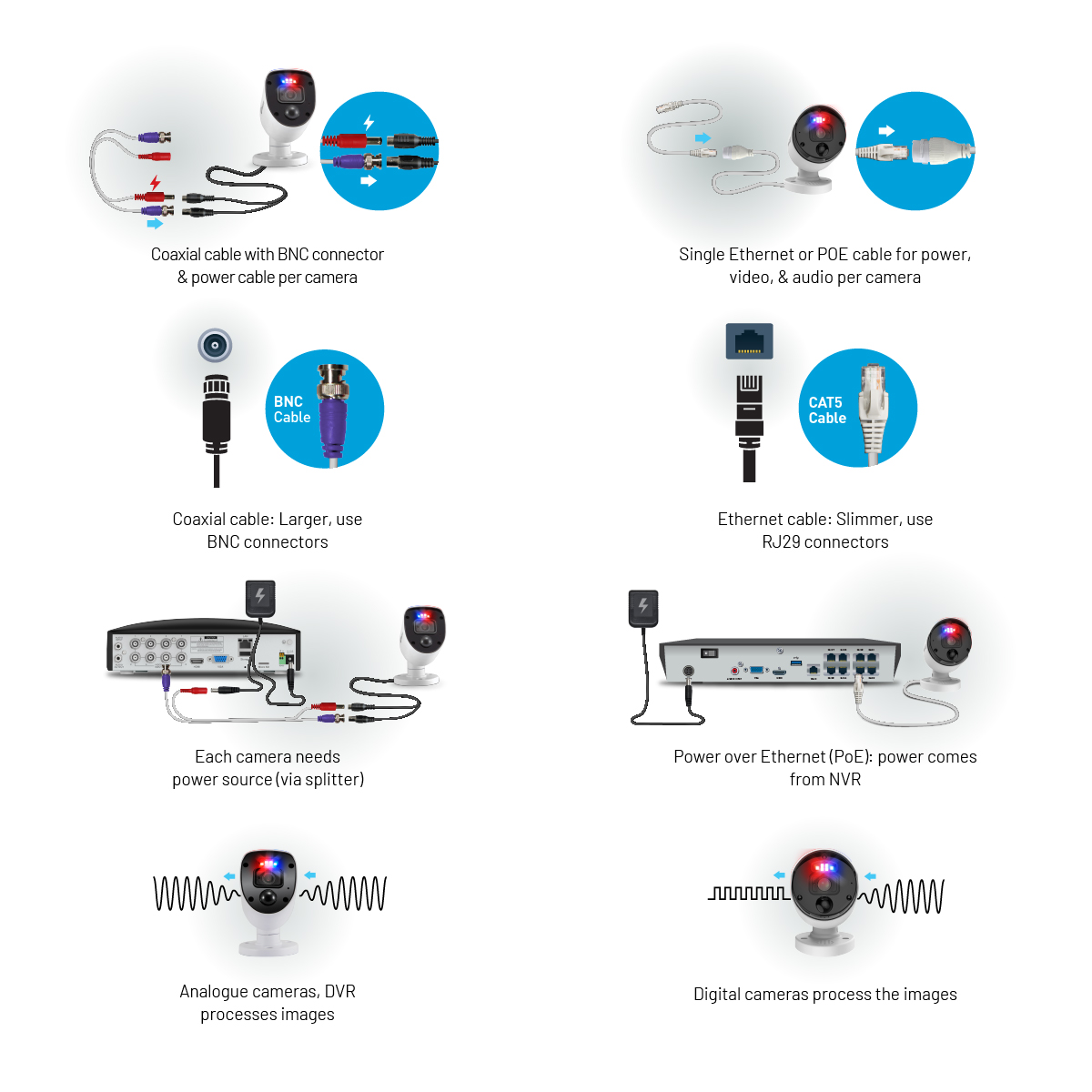
In an NVR system, the video is processed at the “edge”—meaning the camera itself handles the encoding and compression. The camera captures the image, converts it into a digital signal, and transmits it via an Ethernet cable (typically Cat5e or Cat6) to the NVR. Because the video is already digitized when it reaches the recorder, the NVR’s primary role is to store the data and provide a user interface for viewing and management. This is fundamentally different from older systems where the recorder had to perform the heavy lifting of converting raw analog signals into digital files.
The Key Components of an NVR Ecosystem
A functional NVR setup consists of several critical tech components:
- IP (Internet Protocol) Cameras: These are essentially small computers with lenses. they capture high-resolution footage and have their own IP addresses on a network.
- Ethernet Cables: These cables serve a dual purpose in most modern NVR systems, carrying both the data signal and the power required to run the camera.
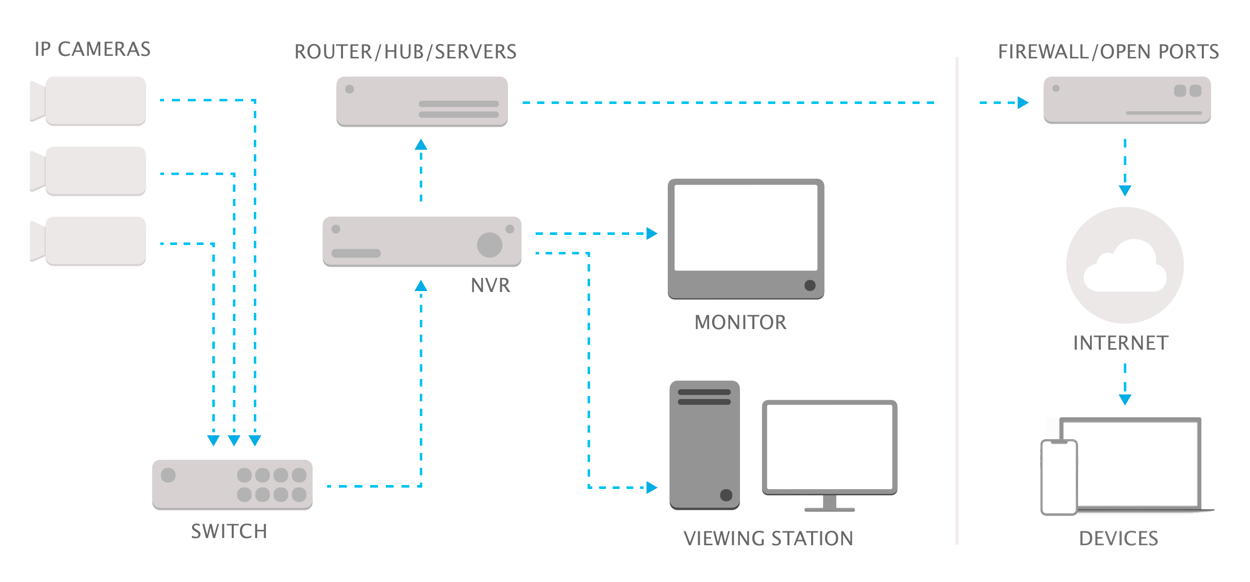
- The NVR Unit: The “brain” of the operation, containing the CPU, surveillance-grade hard drives (HDDs), and the Network Interface Card (NIC).
- PoE Switch: Often built directly into the back of the NVR, a Power over Ethernet (PoE) switch allows multiple cameras to connect to the network through a single hub, simplifying cable management.
NVR vs. DVR: Navigating the Technical Divide
To truly grasp the capabilities of an NVR, it is helpful to contrast it with the Digital Video Recorder (DVR). While the names sound similar, the underlying technology creates a vast performance gap between the two.
Analog vs. IP Camera Transmission
DVR systems are paired with analog cameras. These cameras transmit raw, uncompressed electronic signals through coaxial cables to the recorder. This results in signal degradation over long distances and limits the resolution to roughly 1080p or lower in most consumer setups. In contrast, NVR systems use IP cameras that transmit digital data packets. Because the data is digital, there is zero loss in quality regardless of whether the camera is 10 feet or 300 feet away from the recorder, provided the network infrastructure is sound.
Processing Power at the Edge vs. the Base
The most significant technical distinction lies in where the video processing occurs. In a DVR system, the recorder houses an AD (analog-to-digital) encoder chip that processes every frame from every camera. This creates a bottleneck; if you have 16 high-resolution cameras, the DVR’s processor must work overtime to encode all those streams simultaneously.
With an NVR, the “intelligence” is distributed. Each IP camera has its own processing chipset. By the time the video reaches the NVR, it is already encoded in formats like H.264 or the more efficient H.265 (High-Efficiency Video Coding). This distributed processing allows NVR systems to handle much higher resolutions—reaching 4K, 8K, and beyond—without taxing the central unit’s resources.
Advanced Features and Technical Advantages
As a staple of modern digital security, NVR systems offer a suite of technical advantages that go far beyond simple video recording. These features are designed to optimize bandwidth, maximize storage, and ensure the highest possible image clarity.
High-Definition Resolution and Bandwidth Management
Because IP cameras are not limited by the broadcast standards of analog video, they can capture incredibly high-detail images. This is vital for forensic applications, such as identifying license plates or facial features from a distance. However, high resolution requires high bandwidth.
Modern NVRs manage this through “Dual Streaming” technology. The system records a high-resolution “Main Stream” to the hard drive for evidence while simultaneously generating a lower-resolution “Sub Stream” for remote viewing on mobile apps or web browsers. This ensures that a user can check their cameras from a smartphone without needing a massive high-speed data connection, all while the system maintains a pristine 4K record locally.
Power over Ethernet (PoE) and Simplified Scalability
One of the most praised technical aspects of NVR systems is the integration of PoE (standards IEEE 802.3af and 802.3at). In older systems, every camera required two cables: one for video and one for power. NVRs utilize PoE, which sends electrical power over the same twisted-pair Ethernet cable used for data. This reduces hardware costs, simplifies installation, and allows for much greater flexibility in camera placement. If a network needs to expand, a user can simply add a PoE switch to the network and plug in additional cameras, which the NVR will automatically discover via its software protocol.
The Role of AI and Software in Modern NVRs
We are currently in the era of “Smart Surveillance,” where the NVR is no longer just a passive recording device but an active analytical tool powered by Artificial Intelligence (AI) and Machine Learning (ML).
Intelligent Video Analytics (IVA)
Modern NVR software incorporates Intelligent Video Analytics. Gone are the days of basic motion detection that was triggered by a passing cloud or a blowing leaf. Today’s NVRs use sophisticated algorithms to differentiate between humans, vehicles, and animals.
- Line Crossing: Users can draw a virtual line on the screen; if a person crosses it in a specific direction, the NVR triggers an alert.
- Object Abandonment: The software can detect if a package has been left in a restricted area for a certain amount of time.
- Facial Recognition and LPR: High-end NVRs can compare faces against a database or read license plates (License Plate Recognition) in real-time to grant or deny access to a facility.
Cloud Integration and Remote Monitoring Capabilities
While the NVR provides a localized, secure storage point, it is increasingly integrated with cloud services. This hybrid approach offers the best of both worlds: the speed and reliability of local storage with the accessibility and redundancy of the cloud. Modern NVRs utilize P2P (Peer-to-Peer) technology for remote access, eliminating the need for complex “Port Forwarding” in router settings. This allows users to access their NVR securely through encrypted tunnels, ensuring that their private data remains private while being accessible from anywhere in the world.
Implementation and Future Trends
As we look toward the future of NVR technology, the focus is shifting toward even higher efficiency and deeper integration with the “Internet of Things” (IoT).
Designing a Robust Network Infrastructure for Surveillance
For an NVR system to perform at its peak, the underlying network must be robust. A common technical hurdle is “Network Congestion.” A 4K camera running at 20 frames per second can consume 8-10 Mbps of bandwidth. Multiply that by 16 cameras, and you are looking at a constant 160 Mbps load.
Professional NVR installations often utilize Virtual Local Area Networks (VLANs) to isolate the security traffic from the regular office or home internet traffic. This prevents the surveillance system from slowing down the Wi-Fi and ensures that the video stream remains uninterrupted. Furthermore, the use of surveillance-grade hard drives is non-negotiable; unlike standard PC drives, these are designed for 24/7 write cycles and can withstand the heat and vibration of constant data logging.

The Future: 8K, 5G, and Decentralized Storage
The next frontier for NVR systems involves the integration of 5G connectivity for “Edge NVRs” in remote locations where wired internet is unavailable. We are also seeing the rise of 8K resolution, which provides four times the detail of 4K, allowing for digital zooming without pixelation.
Furthermore, “Serverless NVR” or decentralized storage is becoming a trend. In this setup, the IP camera records directly to an onboard high-capacity SD card or a decentralized cloud, while a software management system (VMS) acts as a virtual NVR to aggregate the footage. However, for the foreseeable future, the physical NVR unit remains the gold standard for users who prioritize total control over their data, maximum storage capacity, and the highest possible security.
In conclusion, an NVR security system is a powerful, network-centric solution that leverages the best of modern computing and digital imaging. By shifting the processing power to the cameras and utilizing the flexibility of IP networking, NVRs provide a level of clarity, intelligence, and scalability that was once the exclusive domain of high-budget government installations. For anyone looking to implement a serious surveillance strategy, understanding the technical nuances of the NVR is the first step toward a more secure digital future.
aViewFromTheCave is a participant in the Amazon Services LLC Associates Program, an affiliate advertising program designed to provide a means for sites to earn advertising fees by advertising and linking to Amazon.com. Amazon, the Amazon logo, AmazonSupply, and the AmazonSupply logo are trademarks of Amazon.com, Inc. or its affiliates. As an Amazon Associate we earn affiliate commissions from qualifying purchases.