
In the annals of television history, few acronyms command as much recognition, or sometimes confusion, as NTSC. For decades, it was the bedrock upon which television broadcasting in North America, Japan, and many other parts of the world was built. NTSC, an abbreviation for the National Television System Committee, refers to the analog color television system first implemented in the United States in 1953. More than just a technical specification, NTSC represented a monumental leap forward, transitioning the world from monochromatic screens to the vibrant, full-color displays we now take for granted. Understanding NTSC is not merely an academic exercise in nostalgia; it’s a deep dive into the foundational technologies that shaped an entire era of media consumption and production, whose echoes are still felt in modern video standards and digital conversions.
The Dawn of Color Television: A Historical Perspective
The journey to color television was fraught with technical hurdles, competitive pressures, and regulatory debates. Before NTSC, television was a novelty, but a monochromatic one. Viewers could tune into broadcasts, but the world presented to them was rendered in shades of grey, lacking the richness and realism that color promised.
The Need for a Standard: Early Television Challenges
Early television development in the late 1940s and early 1950s saw various companies experimenting with different color broadcasting methods. However, the lack of a unified standard created significant problems. Compatibility was a major concern: a system developed by one company might not work with receivers from another, and the nascent industry risked fragmentation. Furthermore, any new color system had to be “backward compatible” with the millions of existing black-and-white television sets already in homes. This meant that a color broadcast should still be viewable (albeit in monochrome) on older sets, a critical requirement for widespread adoption without forcing consumers into immediate, costly upgrades.
Formation of the National Television System Committee
Recognizing the urgent need for standardization, the Federal Communications Commission (FCC) in the United States commissioned the National Television System Committee (NTSC) in 1940. Initially, the committee focused on establishing standards for black-and-white television. After World War II, as color television research intensified, the NTSC reconvened in 1950 with the explicit goal of developing an industry-wide standard for color broadcasting. The task was monumental: balancing technical performance, economic viability, and backward compatibility. After extensive research, experimentation, and refinement, the NTSC proposed a new standard that ingeniously encoded color information into the existing monochrome signal.
NTSC’s Introduction and Adoption
In December 1953, the FCC officially adopted the NTSC standard for color television broadcasting. The first commercial NTSC color broadcast occurred on January 1, 1954, with NBC’s telecast of the Tournament of Roses Parade. While initial adoption was slow due to the high cost of color televisions, by the mid-1960s, NTSC had become the dominant color television standard across the United States. Its success paved the way for a boom in television content, from live sports to sitcoms, all rendered in the vibrant hues that captivated audiences for decades.
Understanding NTSC: Technical Specifications and Key Features
At its core, NTSC is an analog composite video standard. “Composite” means that all video components—luminance (brightness), chrominance (color), and synchronization signals—are combined into a single signal for transmission. This ingenious design allowed for backward compatibility, but also introduced certain quirks.
Frame Rate and Interlacing: 30 fps (or 29.97 fps) and 525 Lines
One of the defining characteristics of NTSC is its refresh rate and resolution. NTSC specifies a frame rate of approximately 30 frames per second (actually 29.97 fps, a slight adjustment made to avoid interference with the audio carrier). Each frame is composed of 525 horizontal scan lines. To conserve bandwidth and reduce flicker, NTSC employs a technique called “interlacing.” Instead of drawing all 525 lines sequentially for each frame, an NTSC display draws two “fields” per frame. The first field draws odd-numbered lines (1, 3, 5…), and the second field draws even-numbered lines (2, 4, 6…). Each field is broadcast at 60 fields per second (59.94 Hz), effectively giving the illusion of smooth motion to the human eye while only transmitting half the information at a given moment compared to a progressive scan system.
Color Encoding: YIQ and Quadrature Amplitude Modulation (QAM)
The true genius of NTSC lies in its color encoding. It separates the video signal into luminance (Y) and chrominance (I and Q) components. The Y signal carries the brightness information, which is essentially the black-and-white image, ensuring backward compatibility. The I (in-phase) and Q (quadrature) signals carry the color information. These two color difference signals are modulated onto a subcarrier frequency using a technique called Quadrature Amplitude Modulation (QAM). The phase of the subcarrier signal determines the hue, while its amplitude determines the saturation (intensity) of the color. A critical aspect is the “color burst” signal, a short sample of the unmodulated color subcarrier sent after each horizontal synchronization pulse, which serves as a reference for the television receiver to accurately decode the color information.
Audio Carrier and Bandwidth
NTSC also defined the standard for the accompanying audio. Sound information is transmitted using Frequency Modulation (FM) at a separate carrier frequency, typically 4.5 MHz above the video carrier. The total bandwidth allocated for an NTSC channel was 6 MHz, a crucial consideration for broadcasting infrastructure and spectrum allocation. This 6 MHz channel accommodates the video signal (including luminance, chrominance, and sync), the audio signal, and a small guard band to prevent interference with adjacent channels.
The “NTSC Tint” and Color Fidelity
While revolutionary, NTSC wasn’t without its quirks. One common complaint, especially in its early days, was the “NTSC tint” problem. Due to the phase-sensitive nature of its color encoding, slight distortions in transmission or reception could cause noticeable shifts in color hue. This led to the common (and somewhat humorous) industry phrase, “Never The Same Color,” referring to the perceived instability of NTSC colors compared to other standards like PAL. While modern NTSC equipment and digital processing largely mitigated these issues, the reputation for requiring frequent “tweak the tint” adjustments lingered.
NTSC in Practice: Its Global Footprint and Regional Variations
NTSC’s influence was extensive, but not universal. Its adoption created a global divide in television standards that persisted for decades, necessitating format conversions for international media exchange.
Geographical Adoption: North America, Japan, etc.
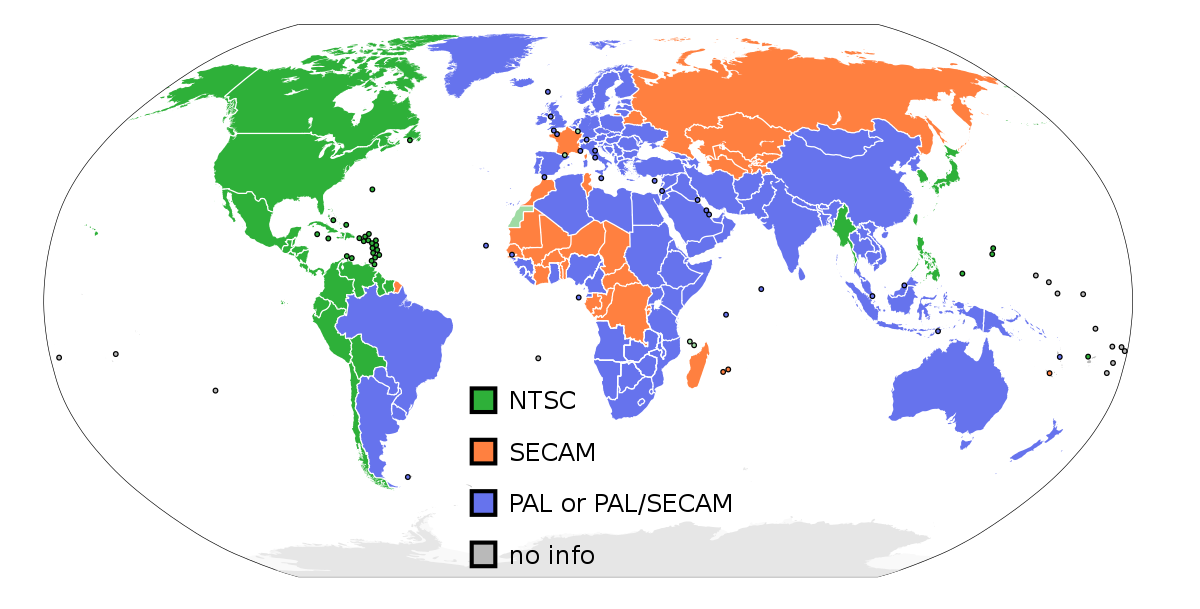
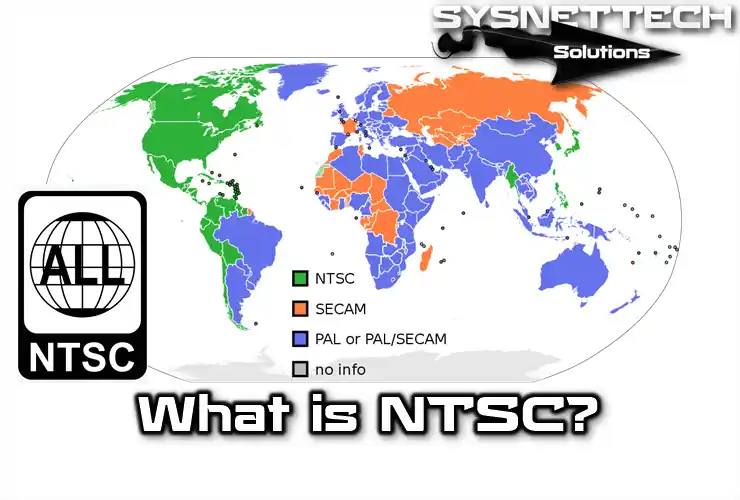
The NTSC standard became firmly entrenched across North America (United States, Canada, Mexico), Japan, South Korea, Taiwan, the Philippines, parts of Central and South America, and a scattering of Pacific island nations. In these regions, televisions, VCRs, DVD players, and eventually early digital converters were all designed to operate within the NTSC framework. This uniformity within these territories fostered a robust media ecosystem.

Comparison with PAL and SECAM: A Global Standard Divide
However, much of the rest of the world adopted different standards: PAL (Phase Alternating Line) predominantly in Europe, Australia, and large parts of Asia and Africa; and SECAM (Séquentiel couleur à mémoire), primarily in France, Eastern Europe, and Russia. These systems, while also analog color standards, differed significantly in their frame rates, line counts, and color encoding methods. PAL, for instance, used 625 lines and 25 frames per second, and a different method to correct color phase errors, often resulting in more stable colors than early NTSC. SECAM, meanwhile, used a sequential color transmission method that was particularly robust against color distortions but more complex for editing. This global triumvirate of standards—NTSC, PAL, and SECAM—meant that a video tape recorded in one system could not be directly played on a device designed for another without a costly and often quality-degrading conversion process.
NTSC-J and Other Regional Implementations
Even within the NTSC family, there were minor regional variations. NTSC-J, used in Japan, is a notable example. While largely compatible with the American NTSC system, NTSC-J uses slightly different black levels (setup levels). American NTSC typically has a “pedestal” or setup level where black is represented at 7.5 IRE units (Institute of Radio Engineers units) above the blanking level, whereas NTSC-J sets black at 0 IRE, meaning it’s truly “blacker than black” in comparison. These subtle differences, while often unnoticed by the casual viewer, were significant for video professionals and could cause minor shifts in brightness or contrast when content crossed these regional boundaries.
The Legacy and Decline of NTSC
For over half a century, NTSC reigned supreme in its territories. However, like all technologies, it eventually faced obsolescence as digital innovation promised superior quality and efficiency.
Advantages and Limitations of the Analog System
NTSC’s primary advantage was its pioneering role in delivering color television and its ingenious backward compatibility. It was robust enough to transmit television signals over vast distances and served as a stable platform for the growth of the broadcasting industry. However, as an analog composite system, it inherent limitations. The combining of luminance and chrominance signals could lead to “dot crawl” (where fine patterns appear to crawl along edges) and other artifacts. Analog signals were also susceptible to noise, ghosting, and degradation over distance or through repeated copying. The fixed resolution of 525 lines and interlacing, while effective for its time, eventually proved insufficient for the demands of larger screens and sharper images.
The Rise of Digital Television: ATSC and DVB
The late 20th century saw the rapid advancement of digital video compression and transmission technologies. Digital television offered numerous benefits: vastly superior image and sound quality, resistance to noise, efficient use of bandwidth (allowing for more channels or higher definition), and new interactive services. In the United States, the Advanced Television Systems Committee (ATSC) developed a new set of digital standards, culminating in the ATSC Digital Television Standard. Similarly, Europe adopted DVB-T (Digital Video Broadcasting – Terrestrial) and other DVB variants. These digital standards were designed to replace the aging analog systems, providing a clear path to high-definition (HD) and eventually ultra-high-definition (UHD) television.
The Digital Transition and Analog Sunset
The move from NTSC to digital television marked a monumental shift in broadcasting. Governments around the world mandated an “analog sunset,” a deadline after which analog broadcasts would cease. In the United States, full-power analog television broadcasting officially ended on June 12, 2009. This transition required consumers to either purchase new digital-ready televisions or use converter boxes to receive digital signals on their old NTSC sets. While disruptive for some, the digital transition ushered in an era of clearer pictures, better sound, and a plethora of new content possibilities.
NTSC’s Enduring Influence in Video Production and Archiving
Even after its official retirement from broadcasting, NTSC’s legacy persists. Millions of hours of content, from classic films to archival news footage, were originally shot, edited, and stored in NTSC format. This vast library of analog media continues to be a rich source for restoration, re-releases, and historical study. Understanding NTSC’s characteristics is vital for anyone involved in video archiving, digital preservation, or the conversion of older media into modern formats.
Modern Relevance and Troubleshooting for NTSC Content
While NTSC broadcasts are largely a thing of the past, the standard remains relevant in niche areas and in the process of dealing with legacy content.
Converting NTSC to Digital Formats
One of the most common encounters with NTSC today is in the realm of conversion. Old VHS tapes, Betamax cassettes, or camcorder footage recorded in NTSC format need to be digitized for preservation and modern viewing. This process involves specialized hardware (like video capture cards) and software to convert the analog NTSC signal into digital files (e.g., MP4, AVI). Proper conversion ensures that the unique aspects of NTSC, such as its interlaced nature and color space, are correctly handled to avoid artifacts like combing or incorrect colors in the digitized version.
Emulation and Compatibility in Modern Devices
Modern televisions, media players, and streaming devices are primarily designed for digital signals (e.g., HDMI, DisplayPort). However, many are still capable of interpreting and displaying NTSC signals, often through composite or S-Video inputs, or via internal software emulation when playing older digital files that originated from NTSC sources. Game consoles from the NTSC era (e.g., NES, SNES, PlayStation 1, Nintendo 64) relied on the NTSC standard for their video output. Retro gaming enthusiasts often use original NTSC consoles and displays, or specialized upscalers that convert the NTSC signal to a digital format (like HDMI) while maintaining the correct aspect ratio and refresh rate for modern displays.
NTSC in Gaming and Archival Media
The NTSC standard also left its mark on the world of video games. NTSC regions often received games with higher frame rates (30/60 fps) compared to their PAL counterparts (25/50 fps), which sometimes led to faster or smoother gameplay experiences. This difference continues to be a point of discussion and preference among retro gamers. Furthermore, professional video editing suites and archival systems still need to understand and process NTSC specifications to properly handle historical footage. Libraries, museums, and broadcasters frequently undertake projects to digitize their vast collections of NTSC media, requiring deep technical knowledge of the standard.
Why Understanding NTSC Still Matters
In an increasingly digital and globalized world, understanding NTSC provides crucial context for how we arrived at our current state of high-definition, internet-delivered video. It highlights the challenges of technological transitions, the compromises required for innovation, and the enduring nature of legacy media. For professionals in media production, broadcasting, historical preservation, or even just curious tech enthusiasts, NTSC is more than an outdated acronym; it’s a window into the rich history of video technology and a testament to the ingenuity that once brought color to the world.
aViewFromTheCave is a participant in the Amazon Services LLC Associates Program, an affiliate advertising program designed to provide a means for sites to earn advertising fees by advertising and linking to Amazon.com. Amazon, the Amazon logo, AmazonSupply, and the AmazonSupply logo are trademarks of Amazon.com, Inc. or its affiliates. As an Amazon Associate we earn affiliate commissions from qualifying purchases.