
As the global transition toward renewable energy accelerates, homeowners and business owners are increasingly looking at solar energy not just as an environmental choice, but as a sophisticated financial investment. Central to the economic viability of solar power is a billing mechanism known as Net Energy Metering (NEM). However, for many utility customers, the “NEM charges” section of their monthly statement remains a source of confusion. Understanding these charges is essential for calculating the return on investment (ROI) for solar hardware and managing long-term household or corporate energy costs.
Net Energy Metering is essentially a financial arrangement between a utility provider and a customer who generates their own electricity. It allows for a bidirectional flow of energy and capital. When your solar panels produce more electricity than your property consumes, the excess is sent back to the power grid. In exchange, the utility provides a credit on your bill. When your panels aren’t producing enough—such as at night—you pull electricity from the grid, using those earned credits to offset the cost.
The Mechanics of Net Energy Metering
To understand NEM charges, one must first understand how the grid functions as a “virtual battery.” For most residential solar owners, the energy produced during the peak of the day often exceeds the home’s immediate demand. Without a physical battery on-site, that excess energy would be wasted.
How the Financial Credit System Works
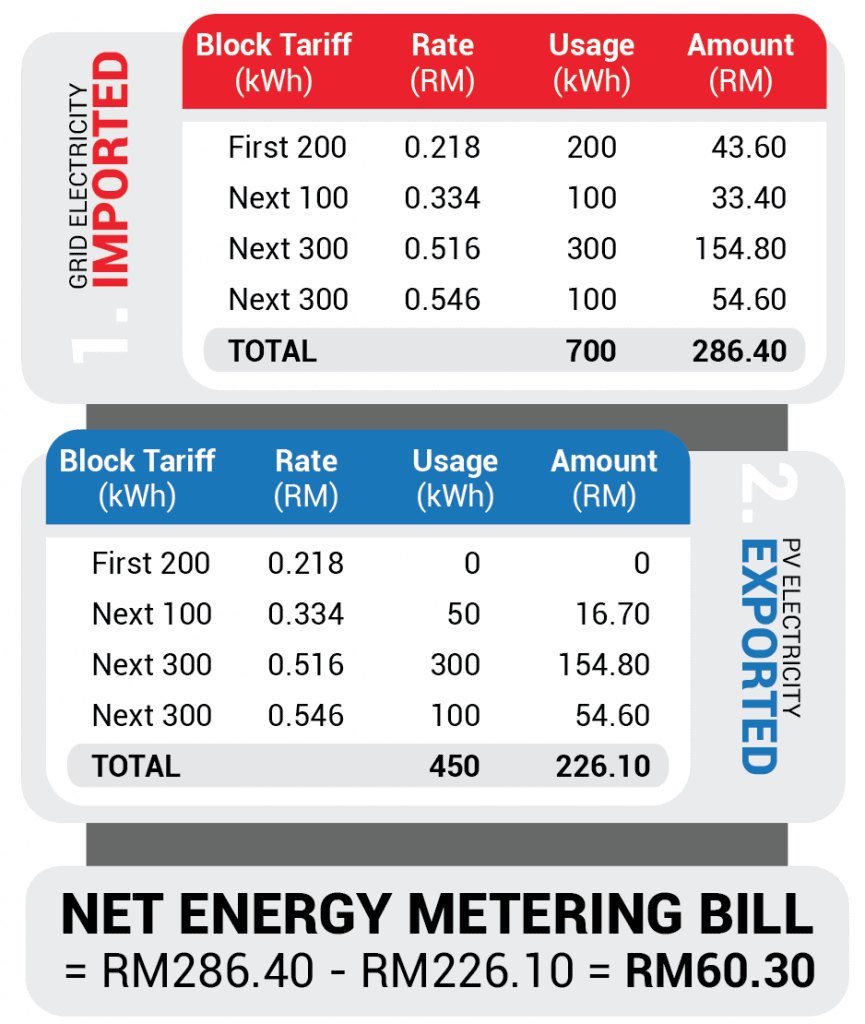
In a standard NEM agreement, your utility meter tracks the energy in both directions. At the end of a billing cycle, the utility calculates the “net” consumption. If you generated 800 kWh and consumed 1,000 kWh, you are only billed for the net difference of 200 kWh.
From a financial perspective, this is a significant advantage because, in many traditional NEM structures (like NEM 1.0 or 2.0), the utility credits the exported energy at the full retail rate. This means every kilowatt-hour you send to the grid is worth exactly the same as a kilowatt-hour you buy from the grid, effectively allowing you to “bank” the value of your midday production for use during expensive evening hours.
Bi-directional Metering
The hardware facilitating this financial exchange is the bi-directional meter. Unlike traditional meters that only move forward, these meters can run in reverse. The “NEM charges” on your bill are the result of the data collected by this meter, reconciled against the current tariff rates set by your utility commission.
Breaking Down NEM Charges on Your Statement
Even if your solar system produces 100% of the electricity you use over a year, your utility bill will rarely be $0. This is due to various fixed and volumetric charges that are built into the NEM framework. Understanding these specific line items is vital for accurate financial planning.
Fixed Monthly Charges vs. Volumetric Charges
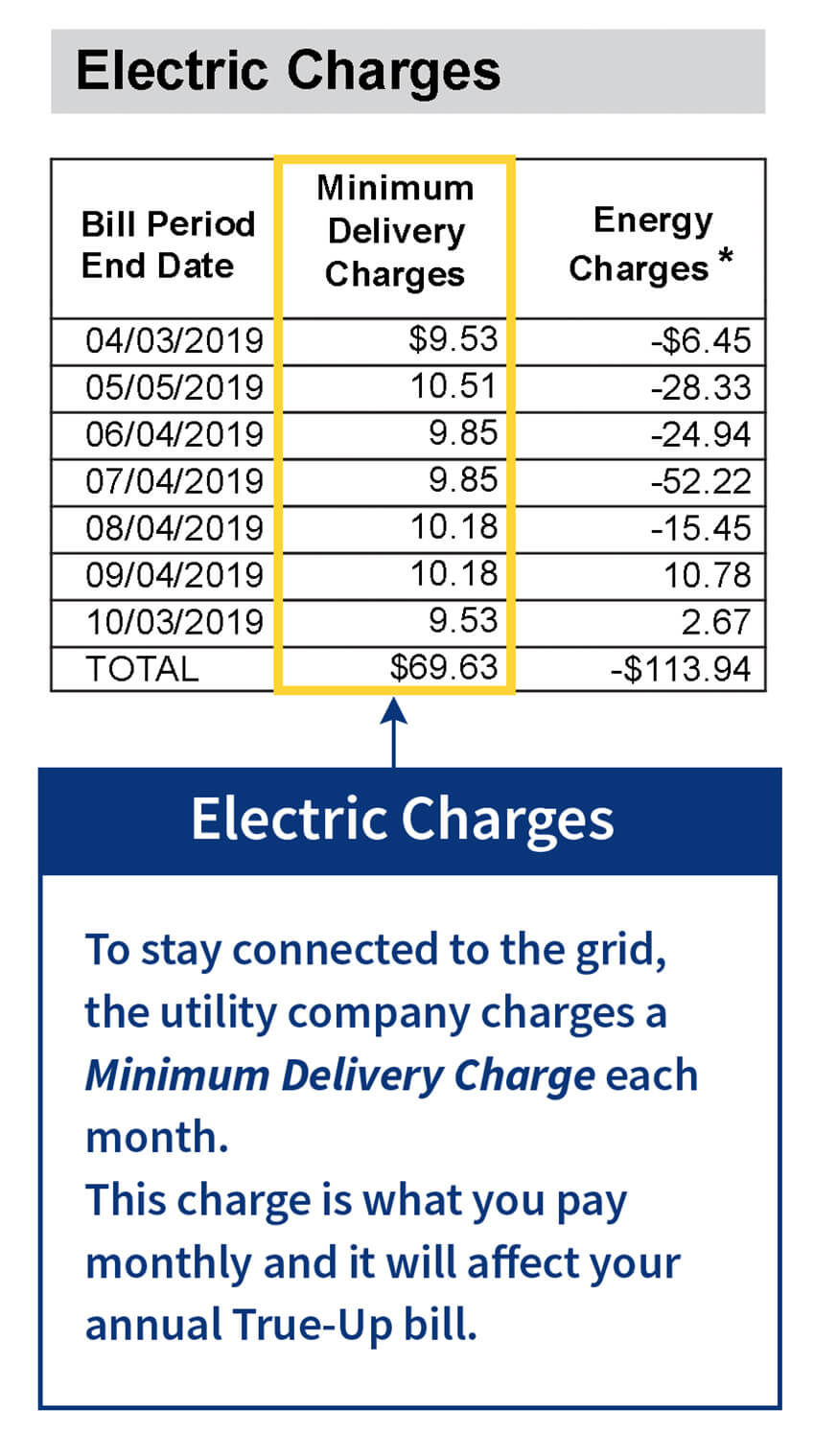
Utility bills generally consist of two types of costs: fixed and volumetric. Fixed charges are the “cost of admission” to be connected to the grid. These cover administrative costs, meter maintenance, and emergency repair services. Regardless of how much solar energy you produce, these fixed charges (often labeled as “Customer Charges” or “Service Fees”) will appear on your bill every month.
Volumetric charges, on the other hand, are based on usage. Under NEM, these are the charges you are actively trying to offset. If your net usage is negative (meaning you produced more than you used), the volumetric portion of your bill may show a credit.
Non-Bypassable Charges (NBCs)
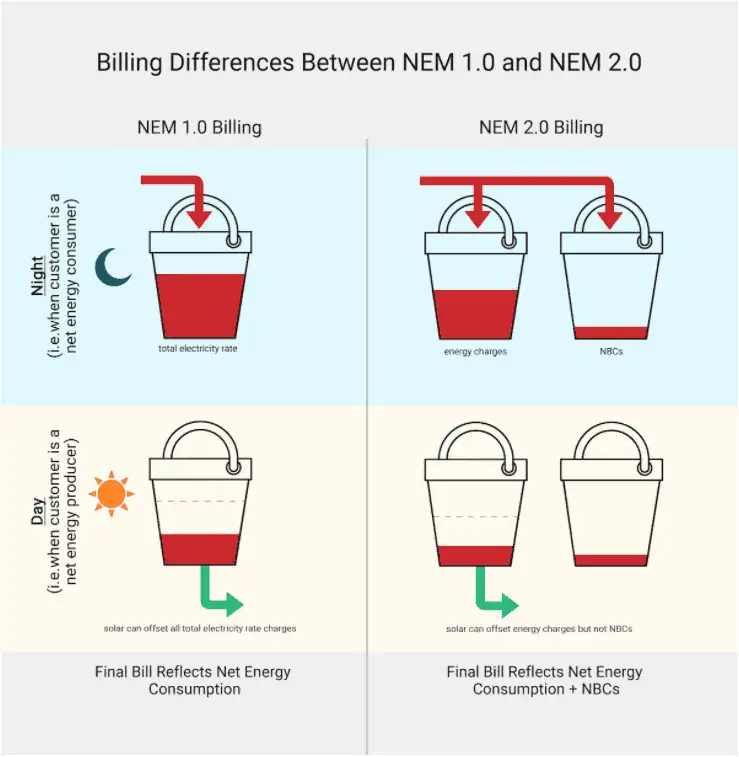
One of the most common “NEM charges” that solar owners notice is the Non-Bypassable Charge (NBC). Introduced in later iterations of net metering policies (notably NEM 2.0 in California), NBCs are small per-kWh fees that support public purpose programs. These include low-income home energy assistance, nuclear decommissioning, and energy efficiency initiatives.
The critical financial distinction of NBCs is that they cannot be offset by solar credits. Even if you have a massive credit balance from your solar production, you must pay NBCs on every kilowatt-hour of electricity you pull from the grid. This is why a solar owner might see a bill for $10 to $20 even when they are a “net-zero” energy producer.
Minimum Bills and Baseline Allowances
Many utilities implement a “minimum bill” policy. This ensures that every customer contributes a baseline amount to the maintenance of the electrical infrastructure. If your solar production reduces your volumetric charges to near zero, the minimum bill requirement may kick in, replacing the standard calculation with a set floor price.
The Financial Evolution: NEM 2.0 vs. NEM 3.0
The landscape of NEM charges has shifted dramatically in recent years, moving from a simple 1-to-1 credit system toward more complex “Net Billing” structures. The most prominent example of this evolution is the transition from NEM 2.0 to NEM 3.0 (officially known as the Net Billing Tariff) in jurisdictions like California.
The Shift in Export Rates
The primary difference between these versions lies in the “Export Rate”—the price the utility pays you for your excess solar energy. Under NEM 2.0, the export rate was roughly equal to the retail rate (e.g., $0.30 per kWh). Under NEM 3.0, the export rate is decoupled from the retail rate and is instead based on the “Avoided Cost Calculator.”
This calculator determines the value of the energy based on what it would have cost the utility to buy that energy elsewhere at that specific hour. Consequently, the value of exported solar energy has dropped by approximately 75% in many regions. This change significantly increases the “NEM charges” a user faces if they rely on the grid for evening power while selling their daytime surplus.
Impact on Payback Periods and ROI
For a solar investor, the shift from NEM 2.0 to NEM 3.0 changes the math of the investment. Under older NEM rules, a residential solar system might pay for itself in 5 to 7 years. Under the newer Net Billing structures, that payback period can stretch to 10 years or more if the system is not optimized. This makes the “NEM charges” section of the bill the most important variable in determining the financial success of a solar project.
The Role of Battery Storage in Financial Mitigation
The rise of higher NEM charges and lower export credits has made on-site battery storage a financial necessity rather than a luxury. By storing excess daytime energy in a battery instead of exporting it to the grid at a low rate, homeowners can use that energy themselves during the evening when grid prices are highest. This strategy, known as “self-consumption,” is the most effective way to minimize NEM charges under modern utility rules.
Maximizing the Value of Your Solar Investment
To keep NEM charges as low as possible, solar owners must move beyond a “set it and forget it” mentality and adopt a more active approach to energy management.
Time-of-Use (TOU) Rates
Most NEM agreements require customers to switch to a Time-of-Use rate plan. Under TOU, electricity is much more expensive during “peak” hours (usually 4:00 PM to 9:00 PM) and cheaper during “off-peak” hours.
The financial strategy here is twofold:
- Load Shifting: Run heavy appliances (dishwashers, dryers, EV chargers) during the day when your solar panels are producing, rather than during peak evening hours.
- Peak Shaving: Use a battery to power your home during the 4:00 PM to 9:00 PM window to avoid the highest volumetric charges on the grid.
Strategies to Reduce Net Charges
Beyond hardware, financial health in a solar-equipped home involves monitoring the “True-Up” statement. Most NEM programs operate on an annual cycle. Throughout the year, you receive monthly statements showing your credits and charges, but you don’t actually settle the bill until the end of the 12th month. This “True-Up” can result in a significant bill if a homeowner hasn’t been tracking their net consumption versus production throughout the year.
The Long-Term Economic Outlook of NEM
As we look toward the future of personal and business finance, the structure of NEM charges will likely continue to evolve. Utilities argue that as more people go solar, the “fixed costs” of the grid are being shifted onto non-solar customers, many of whom are lower-income renters. This argument is driving the push toward higher fixed charges and lower export credits.
Policy Changes and Grid Infrastructure Costs
Investors in solar should stay informed about “fixed charge” proposals currently moving through various state legislatures. Some proposals suggest income-based fixed charges, which would add a set monthly fee to bills regardless of solar production. This would represent a fundamental shift in how NEM charges are calculated, moving away from volumetric savings and toward a “service-fee” model.
Is Solar Still a Sound Financial Asset?
Despite the increase in NEM-related charges and the reduction in export values, solar energy remains one of the most effective ways to hedge against rising utility inflation. Average utility rates have historically risen by 3-5% annually. By locking in a solar system, you are essentially pre-purchasing 25 years of electricity at a fixed cost. Even with “Non-Bypassable Charges” and lower export credits, the avoided cost of purchasing expensive grid power during peak hours ensures that solar remains a robust financial tool for those who understand the mechanics of their utility bill.
In conclusion, understanding NEM charges is the difference between a solar system that merely “helps the environment” and one that functions as a high-yield financial asset. By mastering the nuances of NBCs, export rates, and TOU windows, consumers can navigate the complexities of modern energy billing and secure their financial future in an increasingly electric world.
aViewFromTheCave is a participant in the Amazon Services LLC Associates Program, an affiliate advertising program designed to provide a means for sites to earn advertising fees by advertising and linking to Amazon.com. Amazon, the Amazon logo, AmazonSupply, and the AmazonSupply logo are trademarks of Amazon.com, Inc. or its affiliates. As an Amazon Associate we earn affiliate commissions from qualifying purchases.