
Australia, a vibrant nation known for its stunning landscapes, unique wildlife, and friendly populace, boasts a sophisticated financial system underpinned by its own distinctive currency. While the fundamental concept of money remains universal – a medium of exchange, a store of value, and a unit of account – the specific names, forms, and colloquialisms associated with it can vary significantly from one country to another. For anyone new to Australia, whether a tourist, an expat, or simply curious, understanding what money is officially called, how it looks, and the informal terms used by locals is essential for navigating daily life and comprehending the local culture.
This comprehensive guide will delve into the intricacies of Australian currency, exploring its official designation, its physical manifestations, the intriguing world of Australian money slang, and how modern transactions are conducted in the digital age. By the end, you’ll have a clear, insightful, and engaging understanding of “money down under.”
The Official Currency of Australia: The Australian Dollar
At the heart of Australia’s financial system is its official legal tender: the Australian Dollar. Often abbreviated as AUD and symbolised most commonly as ‘$’ or ‘A$’, the Australian Dollar is a major world currency, actively traded on international foreign exchange markets. Its stability and the robust Australian economy contribute to its standing as one of the most significant currencies globally, often ranking among the top ten most traded.
A Brief History of the Australian Dollar
Before 1966, Australia used the Australian Pound, a currency system directly linked to the British Pound Sterling, featuring pounds, shillings, and pence. The transition to decimal currency was a significant national event, bringing Australia in line with many other countries and simplifying financial transactions. On 14 February 1966, the Australian Dollar was introduced, with ten shillings becoming one dollar, and one pound becoming two dollars. This bold move, accompanied by a public information campaign featuring a cartoon character called “Dollar Bill,” marked a new era for Australia’s economic independence and efficiency.
Understanding Fiat Currency
The Australian Dollar, like most modern global currencies, is a fiat currency. This means its value is not derived from any physical commodity, such as gold or silver, but rather from government decree and the trust and confidence placed in it by its users. The Reserve Bank of Australia (RBA) is the central bank responsible for issuing currency and managing monetary policy, ensuring the stability and integrity of the Australian Dollar. Its value is influenced by factors such as interest rates, inflation, economic growth, and the global demand for Australian exports.
Symbol and ISO Code
Globally, the Australian Dollar is officially identified by its ISO 4217 currency code: AUD. Within Australia, the ‘$’ symbol is universally used to denote dollars, often clarified as ‘A$’ when there’s a need to distinguish it from other dollar-denominated currencies (like the US Dollar or Canadian Dollar). For instance, an item might be priced at “$25.00,” implicitly meaning 25 Australian Dollars.
Exploring Australian Banknotes and Coins
The physical form of Australian money is not only functional but also a canvas reflecting the nation’s history, culture, and unique environment. Australia was a pioneer in adopting polymer banknotes, a technological innovation that has significantly impacted currency design and security worldwide.
Innovative Polymer Banknotes
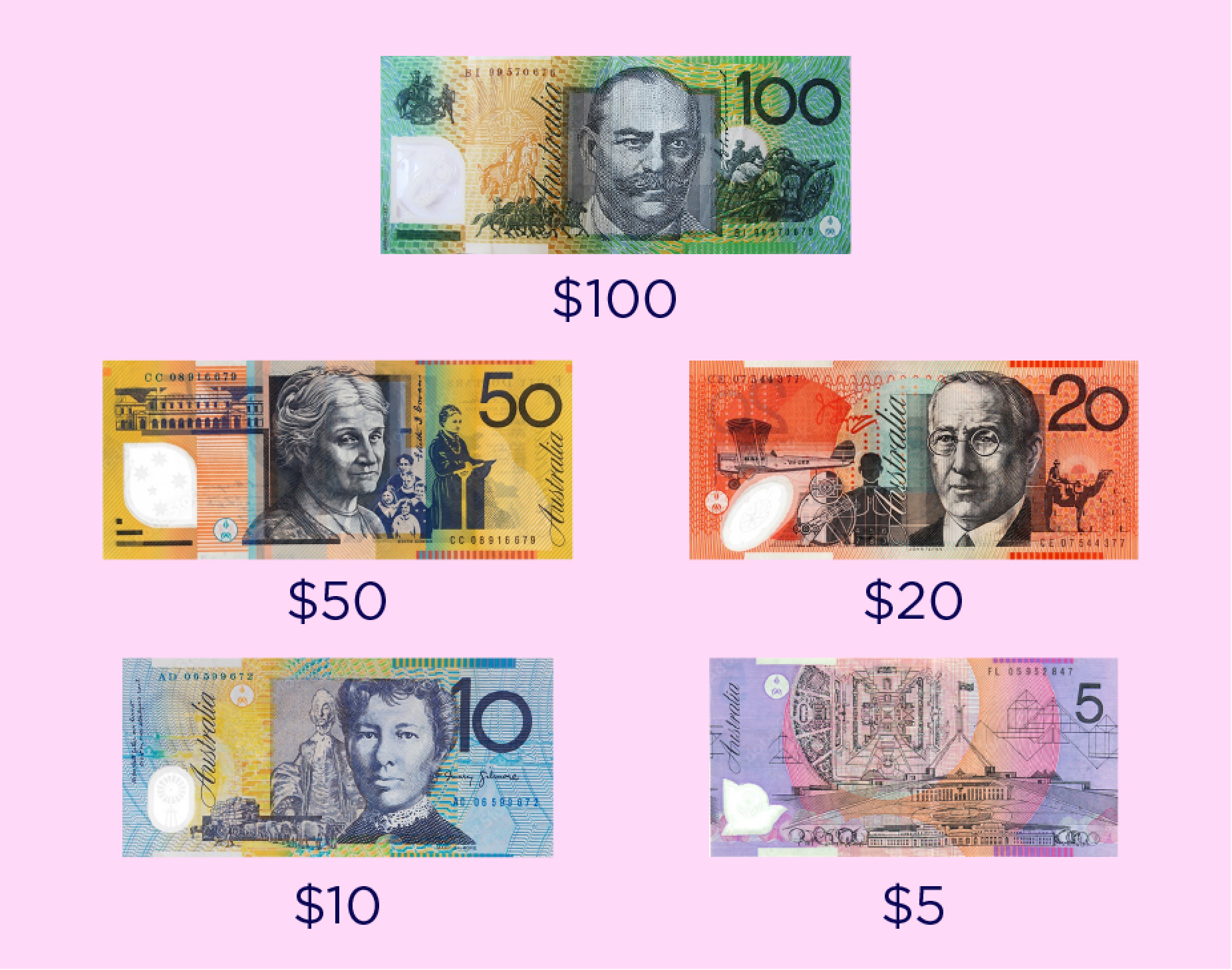
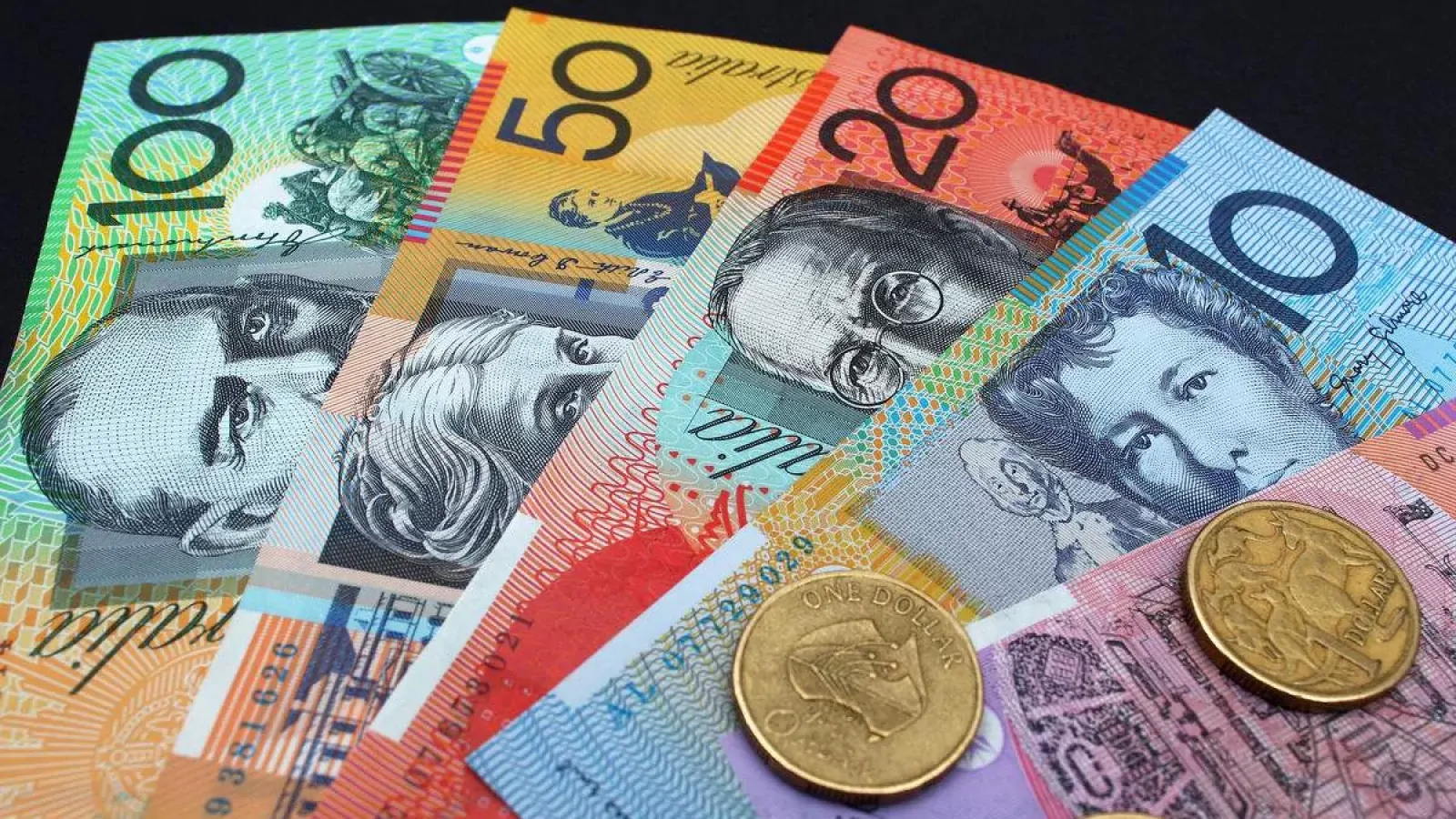
Australian banknotes are renowned globally for their durability, security features, and vibrant designs. Unlike traditional paper-based currencies, Australian notes are made from a special polymer plastic, which makes them far more resilient to wear and tear, resistant to water, and incredibly difficult to counterfeit.
- Denominations: Australian banknotes come in five denominations: $5, $10, $20, $50, and $100.
- Design and Features: Each denomination features a prominent Australian historical figure and native flora and fauna. For example:
- $5 Note: Features Queen Elizabeth II (front) and Parliament House (back), though a new King Charles III design is anticipated. The current series also features the Prickly Moses Wattle and Eastern Spinebill.
- $10 Note: Celebrates poets Banjo Paterson and Mary Gilmore, alongside a Brolga and the Sulphur-crested Cockatoo.
- $20 Note: Depicts Mary Reibey, a successful businesswoman, and Reverend John Flynn, founder of the Royal Flying Doctor Service, with a platypus and a spinifex pigeon.
- $50 Note: Showcases Aboriginal writer and inventor David Unaipon and Edith Cowan, Australia’s first female parliamentarian, with an Acacia humifusa and a Black Swan.
- $100 Note: Features opera singer Dame Nellie Melba and General Sir John Monash, a distinguished military commander, with the Australian Masked Owl and Golden Wattle.
- Security Features: The polymer material allows for advanced security features, including a clear window with a holographic image, colour-changing elements, and intricate micro-printing, making them among the most secure currencies in the world.
Distinctive Coins
Australian coins, minted by the Royal Australian Mint, complement the banknotes and are an integral part of daily transactions.
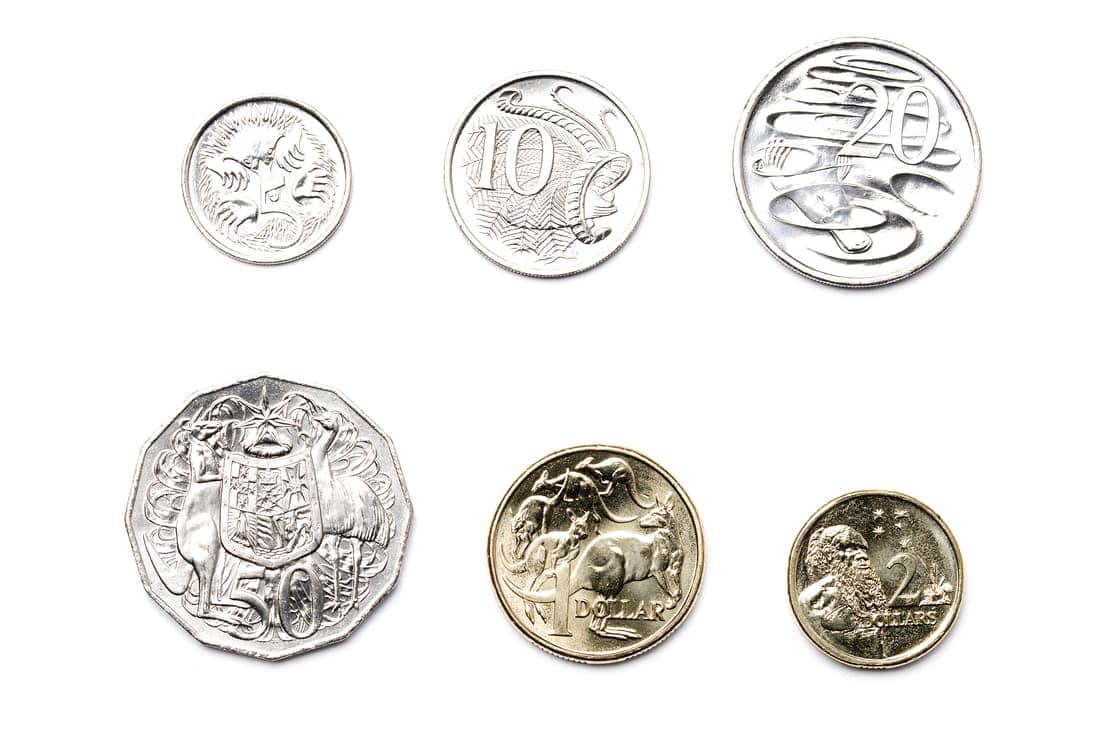
- Denominations: There are six standard denominations of Australian coins: 5 cents (5c), 10 cents (10c), 20 cents (20c), 50 cents (50c), 1 dollar ($1), and 2 dollars ($2).
- Common Features: The obverse (heads side) of all Australian coins typically features an effigy of the reigning monarch (currently Queen Elizabeth II, though King Charles III designs are in production). The reverse (tails side) displays distinctive Australian fauna or emblems:
- 5c: Echidna
- 10c: Lyrebird
- 20c: Platypus
- 50c: Coat of Arms (though numerous commemorative 50c coins exist with varying designs)
- $1: Five Kangaroos
- $2: Aboriginal Elder (often referred to as ‘Gubbi Gubbi Man’)
- No 1-cent or 2-cent coins: These denominations were withdrawn from circulation in 1992 due to their diminishing value and the cost of production. Cash transactions are now rounded to the nearest 5 cents (up or down). Electronic transactions, however, maintain exact cent values.
Beyond the Formal: Everyday Slang and Colloquialisms for Money Down Under
Australians are known for their love of slang, and money is no exception. While the official names are always understood, a rich tapestry of informal terms and phrases adds colour to conversations about finance. Understanding these colloquialisms can provide deeper insight into the Australian way of speaking and thinking about money.
General Terms for Money
Just like in many English-speaking countries, general slang terms for money are common:
- Dough / Moolah / Scratch / Bread: Generic terms for money in general.
- Cash: Physical banknotes and coins.
- Bucks: A common informal term for dollars, e.g., “It cost me 20 bucks.” This term is widely understood and used across various English-speaking nations.
Specific Denominations and Their Nicknames
Some Australian banknotes have particularly distinctive nicknames, often stemming from their colour or design:
- Fiver: A $5 note.
- Tenner: A $10 note.
- Pineapple: A $50 note. This nickname is popular due to the yellow/gold colour of the note, which vaguely resembles a pineapple, or perhaps from the early polymer series’ slightly rough texture.
- Blue Swimmer: A $100 note. This term refers to the predominant blue colour of the note, combined with the “swimmer” part potentially alluding to its smooth, plastic nature or just adding a touch of Australian marine life flavour. (While less universally known than “Pineapple,” it does exist).
- Quid: While officially a term for the British Pound Sterling, “quid” is occasionally used loosely by some Australians to refer to a dollar, particularly in informal contexts, e.g., “Can you lend me a few quid?” – though “bucks” is far more common.
Terms for Financial Status
Australians also have specific ways to describe wealth or the lack thereof:
- Loaded / Flush / Rolling in it: To be very rich or have a lot of money.
- Skint / Broke / Hard up: To have very little or no money.
- Struggling / Doing it tough: Experiencing financial hardship.
Common Phrases Involving Money
- To splash some cash / To splurge: To spend money lavishly or freely.
- Tight-fisted / Stingy: Someone who is reluctant to spend money.
- Dosh: Another informal term for money, particularly spare cash.
- To go halves: To split the cost of something equally.
- On the never-never: To buy something on an instalment plan or hire purchase, paying for it over a long period.
These informal terms are woven into the fabric of everyday Australian conversation, reflecting a relaxed yet expressive approach to language.
The Digital Age of Australian Money: Modern Transactions
While physical cash and coins are still in circulation and retain legal tender status, Australia has embraced digital payment methods with enthusiasm. The country is one of the global leaders in cashless transactions, reflecting a national preference for convenience and technological adoption.
Tap-and-Go Payments
The prevalence of “tap-and-go” technology (branded as PayWave by Visa and PayPass by Mastercard) has fundamentally transformed everyday transactions. Australians routinely use their debit or credit cards by simply tapping them on a payment terminal for small purchases, eliminating the need for PINs for transactions under a certain limit (typically $100). This speed and ease have contributed significantly to the decline in cash usage.
Mobile Payments and Digital Wallets
Following the tap-and-go trend, mobile payment solutions like Apple Pay, Google Pay, and Samsung Pay have become widespread. These digital wallets allow users to link their bank cards to their smartphones or smartwatches, enabling them to make payments with a tap of their device. This further reduces the reliance on carrying physical cards or cash.
Online Banking and BPAY
Online banking platforms provided by Australian financial institutions offer a comprehensive suite of services, including managing accounts, transferring funds, and paying bills. BPAY, an electronic bill payment system, is a uniquely Australian innovation that allows customers to pay bills directly from their bank accounts via phone or internet banking, using a biller code and customer reference number. It’s a highly efficient and widely used system for managing household and business expenses.
Real-Time Payments: The New Payments Platform (NPP)
Australia’s New Payments Platform (NPP), launched in 2018, enables real-time, 24/7 interbank payments. This means money can be sent and received almost instantly, even between different banks, a significant improvement over traditional payment systems that often had delays. The NPP also supports ‘PayID’, which allows users to make payments using an easy-to-remember identifier (like a phone number or email address) instead of a BSB and account number.
Cryptocurrency and the Australian Financial Landscape
While the Australian Dollar remains the undisputed legal tender, Australia has also seen significant interest and adoption in cryptocurrencies like Bitcoin and Ethereum. The Australian government and financial regulators have been actively engaging with the crypto space, developing frameworks for digital assets and considering the implications for the broader financial system. While not “money” in the traditional sense within Australia, cryptocurrencies represent an evolving aspect of the broader financial ecosystem.
The shift towards digital payments has been so profound that some smaller businesses occasionally operate on a cashless basis, and many Australians now carry very little, if any, physical cash.
Managing Money in Australia: Practical Financial Tips
Understanding what money is called and how it’s used is just the beginning. Effectively managing your finances in Australia involves practical considerations, whether you’re a resident, a newcomer, or just visiting.
Budgeting and Saving Strategies
For personal finance, effective budgeting is key. Tools ranging from simple spreadsheets to sophisticated budgeting apps can help track income and expenses. Australians often use various strategies to save for specific goals, from a deposit on a home (a significant investment in Australia) to retirement savings through ‘superannuation’ (a mandatory employer contribution to a retirement fund).
Understanding Exchange Rates for Visitors and Immigrants
For those arriving in Australia with foreign currency, understanding exchange rates is crucial. The Australian Dollar’s value fluctuates against major currencies. It’s advisable to check current rates, use reputable currency exchange services or ATMs, and be aware of potential fees. Many Australian banks offer multi-currency accounts or travel cards that can lock in exchange rates, offering convenience and potentially saving money.
Banking Services and Choosing a Bank
Australia has a competitive banking sector, dominated by the “Big Four” banks (Commonwealth Bank, Westpac, ANZ, and National Australia Bank) but also featuring numerous smaller banks, credit unions, and digital-only banks. Services typically include transaction accounts, savings accounts, credit cards, loans, and investment products. When choosing a bank, consider factors like fees, ATM access, online banking features, customer service, and interest rates on savings.
Investment Options for Australians
Australians have diverse avenues for investment. Beyond superannuation, which is the primary long-term retirement savings vehicle, popular options include:
- Property: Real estate, particularly residential property, is a significant investment for many Australians.
- Shares: Investing in the Australian stock market (ASX) or international markets.
- Managed Funds: Professionally managed portfolios of assets.
- Fixed Income: Bonds and term deposits offering lower risk returns.
- Ethical Investments: Growing in popularity, focusing on companies with strong environmental, social, and governance (ESG) performance.
Understanding these options is vital for long-term financial planning and wealth creation in Australia.
Conclusion
From the official designation of the Australian Dollar to the vibrant slang of “Pineapples” and “Blue Swimmers,” and the widespread adoption of digital payment technologies, the concept of money in Australia is rich and multifaceted. It reflects a nation that values both tradition and innovation, a robust economy, and a unique cultural identity. Whether you’re handling the polymer notes, tapping your phone for a payment, or hearing a local refer to “a few bucks,” you’re engaging with a financial system that is both modern and distinctly Australian. Mastering its nuances is not just about transactions; it’s about connecting with the rhythm of life down under.
aViewFromTheCave is a participant in the Amazon Services LLC Associates Program, an affiliate advertising program designed to provide a means for sites to earn advertising fees by advertising and linking to Amazon.com. Amazon, the Amazon logo, AmazonSupply, and the AmazonSupply logo are trademarks of Amazon.com, Inc. or its affiliates. As an Amazon Associate we earn affiliate commissions from qualifying purchases.