
In the modern corporate ecosystem, information is the most valuable currency. However, information is only as useful as its retrieval and accuracy. This brings us to the concept of “minutes of meetings”—a term that, while sounding archaic, has undergone a radical digital transformation. Traditionally, minutes were handwritten summaries of discussions and decisions. Today, in the high-tech landscape, they represent a sophisticated data management practice. They are the official, permanent record of a meeting’s proceedings, serving as a legal safeguard, a project management tool, and a source of truth for organizational intelligence.

As organizations transition toward remote-first environments and asynchronous communication, the “how” and “why” of meeting minutes have shifted. We are no longer just capturing words; we are leveraging Natural Language Processing (NLP), cloud-based synchronization, and integrated project management ecosystems to ensure that every decision is actionable and every insight is archived.
The Evolution of Documentation: From Manual Shorthand to AI Synthesis
The history of meeting minutes is a journey through the evolution of recording technology. Historically, a designated secretary would use shorthand to capture the essence of a conversation. This was prone to human error, subjective bias, and significant delays in distribution. In the tech-centric world of today, the “minutes” have evolved into dynamic, searchable, and automated digital assets.
The Shift to Automated Transcription
The first major tech leap in this niche was the introduction of high-fidelity digital recording. However, audio files were difficult to scan. The emergence of Speech-to-Text technology changed this. Today, platforms utilize advanced Natural Language Processing (NLP) to distinguish between different speakers (diarization), filter out ambient noise, and provide a near-instantaneous transcript of the proceedings.
Smart Summarization and “Actionable Data”
The true tech innovation lies in AI-driven summarization. Rather than a 50-page transcript, modern tools use Large Language Models (LLMs) to identify key themes, sentiment, and specific tasks. This turns a passive document into a set of data points that can be fed directly into a company’s broader digital workflow.
The Digital Tech Stack: Software and AI Tools for Meeting Efficiency
To understand “what minutes of meetings are” in 2024, one must look at the software used to generate them. The modern professional doesn’t use a blank Word document; they use a stack of integrated tools designed to streamline the lifecycle of a meeting.
AI Meeting Assistants
Tools like Otter.ai, Fireflies.ai, and Grain have revolutionized the capturing process. These “AI bots” join Zoom, Microsoft Teams, or Google Meet calls as silent participants. They record, transcribe, and—most importantly—extract “action items.” By identifying phrases like “I will handle that” or “Let’s set a deadline for Tuesday,” these tools automatically populate the minutes with high-priority tasks.
Collaborative Documentation Platforms
Notion, Coda, and Microsoft Loop represent the next tier of the tech stack. These platforms allow for real-time collaborative minute-taking. Multiple users can edit the document simultaneously, embed live data from other apps (like Jira tickets or Figma designs), and use “mention” tags to assign responsibilities directly within the text. This turns the minutes into a living document rather than a static PDF.
Integration with Project Management Software
Modern minutes are ineffective if they exist in a vacuum. The current tech trend involves the seamless export of minutes into project management tools like Asana, Monday.com, or Trello. Through API integrations or automation platforms like Zapier and Make, a decision recorded in the minutes can automatically trigger a new task in a developer’s sprint or a marketer’s content calendar.
Digital Security and Data Governance in Corporate Record-Keeping
When we define meeting minutes in a tech context, we must address the security implications of these records. Minutes often contain sensitive intellectual property, financial forecasts, and strategic pivots. In a world of increasing cyber threats, how these digital minutes are stored and protected is a critical technical concern.

Encryption and Access Control
Digital minutes should never be stored in unsecured formats. Professional-grade tools utilize AES-256 encryption for data at rest and TLS for data in transit. Furthermore, sophisticated Role-Based Access Control (RBAC) ensures that only authorized personnel can view specific “minutes.” For example, a board of directors’ meeting record requires a higher level of encryption and more restricted access than a weekly creative brainstorm.
Compliance and Auditability
For companies in regulated industries (FinTech, HealthTech, etc.), meeting minutes serve as a vital component of compliance. Tech solutions now offer “audit trails”—a digital log of who viewed the minutes, what changes were made, and when they were approved. This digital footprint is essential for SOC 2 Type II compliance and other international security standards.
The Privacy of AI Training
A burgeoning concern in the tech world is whether the data captured in meeting minutes is being used to train third-party AI models. Leading enterprise tools now offer “Opt-Out” clauses or private cloud deployments, ensuring that a company’s internal strategic discussions remain private and are not fed back into a public LLM.
Best Practices for Implementing Tech-Driven Minutes in Remote Environments
Understanding the definition of meeting minutes is only the beginning; the technical implementation determines the ROI of the practice. In a remote or hybrid setting, the digital minute becomes the “single source of truth” (SSOT) that bridges the gap between time zones and departments.
Standardizing Digital Templates
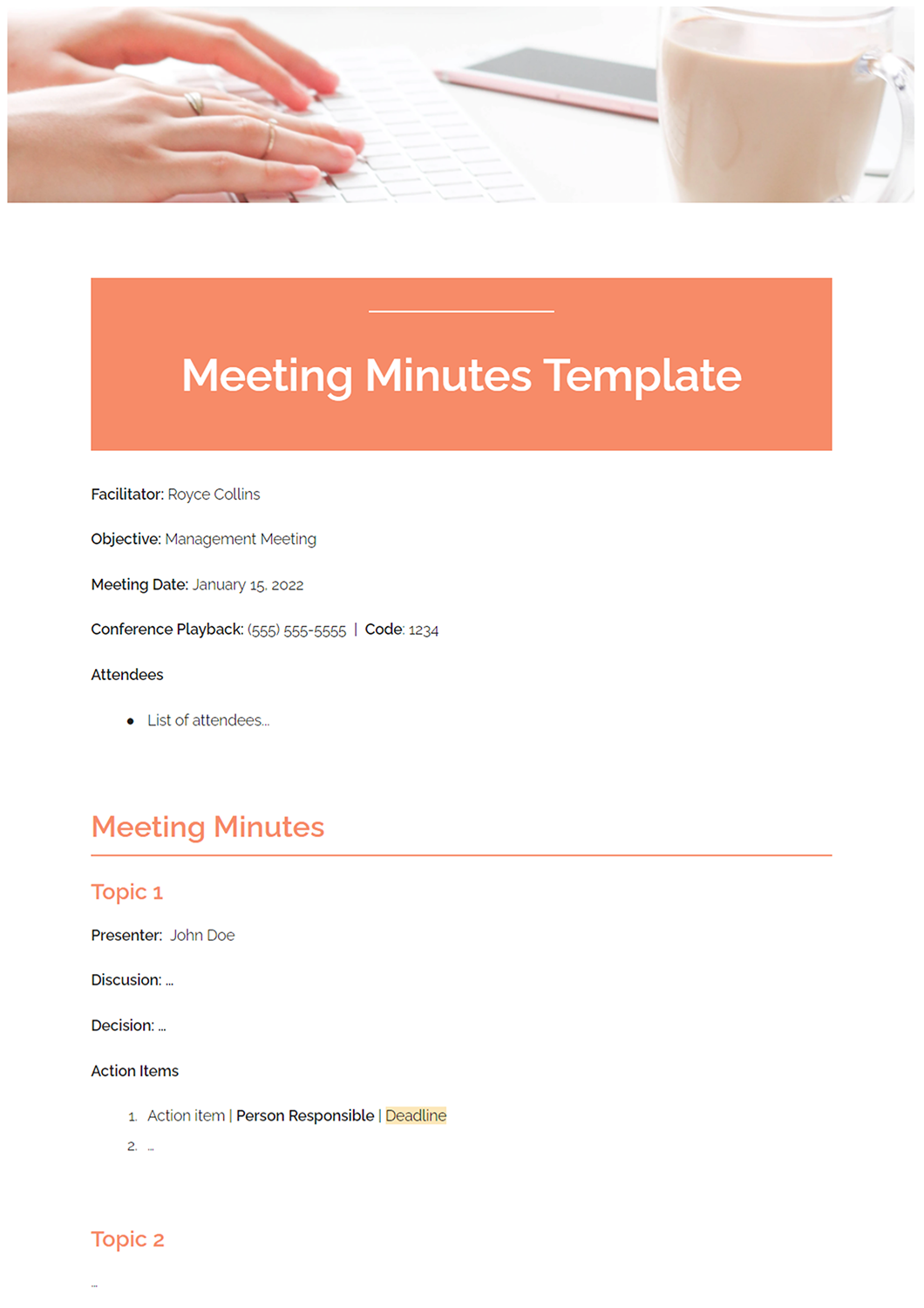
Consistency is key to data retrieval. Organizations should implement standardized digital templates within their documentation software. These templates should include metadata fields: Date, Attendees (automatically synced from calendar invites), Agenda, Discussion Points, Decisions, and Action Items. Having a uniform structure allows for better “Global Search” functionality across the company’s entire knowledge base.
The Role of the “Digital Facilitator”
Even with AI, the human element remains important. The modern secretary is more of a “Digital Facilitator.” This person monitors the AI transcription for errors, ensures that the “record” button was pressed, and tags the appropriate stakeholders in the collaborative document. They act as the quality control for the automated output.
Version Control and Final Approval
One of the greatest technical risks is “version sprawl,” where multiple versions of the minutes circulate. Cloud-based tools solve this via version history. The technical workflow should conclude with a digital signature or an “Approval” status within the app (using tools like DocuSign or internal Slack approvals), signifying that the record is finalized and legally binding for the organization.
The Future of Meeting Minutes: Predictive Analytics and Beyond
As we look toward the future, the definition of meeting minutes will likely expand into the realm of predictive analytics. Imagine a system where the “minutes” of the last six months of meetings are analyzed by an AI to identify patterns of project delays or to predict resource shortages.
Knowledge Graphs and Semantic Search
Future iterations of meeting minutes will likely be part of a “Knowledge Graph.” Instead of searching for a specific date, an employee could ask an internal AI, “What was decided about the API migration three months ago?” The AI would pull the relevant segments from various meeting minutes, providing a synthesized answer.
Virtual Reality (VR) and Spatial Minutes
In the niche of “Metaverse” or spatial computing, meeting minutes could become immersive. Rather than reading a summary, a stakeholder could “replay” a 3D spatial recording of a whiteboarding session, seeing exactly how a technical architecture was drawn out in a virtual space.
Conclusion
What is “minutes of meetings”? In the current technological era, they are far more than a summary of a conversation. They are a sophisticated synthesis of AI-driven transcription, collaborative cloud documentation, and secure data management. By leveraging the right tech stack—from NLP-powered assistants to encrypted storage solutions—organizations can transform their meetings from fleeting conversations into permanent, actionable, and searchable corporate assets.
In a world where speed and clarity are competitive advantages, mastering the digital minute is not just an administrative task; it is a fundamental pillar of modern technical infrastructure. As we move further into the age of automation, the organizations that treat their meeting minutes as structured data will be the ones that iterate faster, remain compliant, and maintain a clear, unshakeable vision of their strategic goals.
aViewFromTheCave is a participant in the Amazon Services LLC Associates Program, an affiliate advertising program designed to provide a means for sites to earn advertising fees by advertising and linking to Amazon.com. Amazon, the Amazon logo, AmazonSupply, and the AmazonSupply logo are trademarks of Amazon.com, Inc. or its affiliates. As an Amazon Associate we earn affiliate commissions from qualifying purchases.