
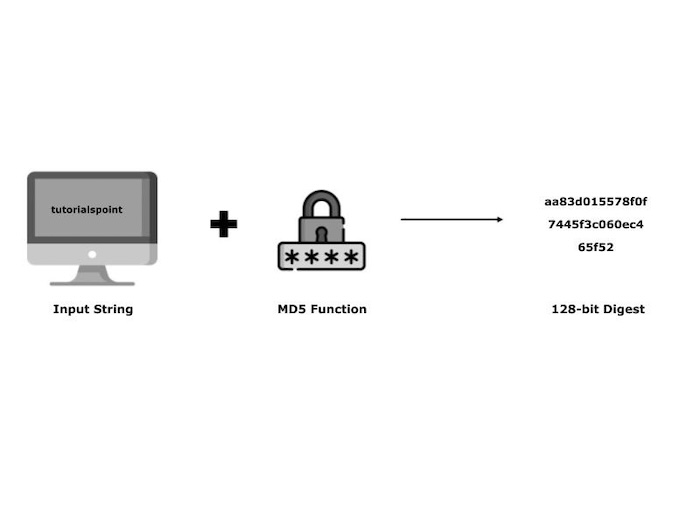
In the vast and intricate landscape of digital technology, where data traverses global networks at lightning speed and security is paramount, understanding the foundational tools that underpin our digital interactions is crucial. One such tool, a cornerstone of early digital security, is MD5, or Message-Digest Algorithm 5. While its prominence has waned in the face of more advanced threats, MD5 remains a pivotal concept for anyone seeking to grasp the fundamentals of data integrity, digital security, and the evolution of cryptographic hashing. At its heart, MD5 is a cryptographic hash function, designed to take an input (or ‘message’) of any length and return a fixed-size output, known as a ‘hash value’ or ‘message digest’. This seemingly simple operation has profound implications for how we verify data, secure information, and build trust in digital systems.
The Core Concept: Understanding Cryptographic Hashing
To truly understand MD5, one must first grasp the broader concept of cryptographic hashing. It’s a fundamental operation in computer science and cryptography, serving as a building block for many security protocols.
What is a Hash Function?
A hash function is essentially a mathematical algorithm that maps data of arbitrary size to a fixed-size value, often referred to as a hash value, hash code, digest, or simply a hash. This process is one-way, meaning it’s computationally infeasible to reverse the process and reconstruct the original input from its hash value alone. Think of it like a sophisticated shredder: once the document is shredded (hashed), you can’t easily reassemble the original document from the shreds (hash).
The “Fingerprint” Analogy
Perhaps the most intuitive way to describe a cryptographic hash is as a “digital fingerprint” for data. Just as no two people (ideally) have the same fingerprint, a good cryptographic hash function aims to produce a unique hash for every unique input. Even a tiny alteration to the input data – changing a single character, pixel, or bit – will result in a dramatically different hash value. This property, known as the “avalanche effect,” is critical for its security applications. If you download a software file and generate its MD5 hash, you can compare it to the hash provided by the software vendor. If they match, you can be reasonably confident that the file you downloaded is identical to the one the vendor published and hasn’t been tampered with during transit.
Key Characteristics of Cryptographic Hashes
For a hash function to be considered cryptographically secure, it generally needs to exhibit several key characteristics:
-
Determinism: The same input will always produce the same output hash.
-
Quick Computation: It must be fast to compute the hash value for any given input.
-
Pre-image Resistance (One-Way Property): It should be computationally infeasible to reverse the hash function to find the input that produced a given hash output.
-
Second Pre-image Resistance (Weak Collision Resistance): It should be computationally infeasible to find a different input that produces the same hash as a given input.
-
Collision Resistance (Strong Collision Resistance): It should be computationally infeasible to find any two different inputs that produce the same hash output. This is the property that MD5 notably struggles with in modern contexts.
MD5 in Detail: How it Works
MD5 was developed by Ronald Rivest in 1991, succeeding earlier hash algorithms like MD4. It quickly became widely adopted due to its efficiency and the perceived strength of its cryptographic properties at the time.
The MD5 Algorithm: A Step-by-Step Overview (Simplified)
While the full mathematical details are complex, the MD5 algorithm operates through a series of steps:
-
Padding: The input message is padded so that its length (in bits) is 64 bits less than a multiple of 512. This ensures a consistent block size for processing.
-
Append Length: A 64-bit representation of the original message length is appended to the padded message.
-
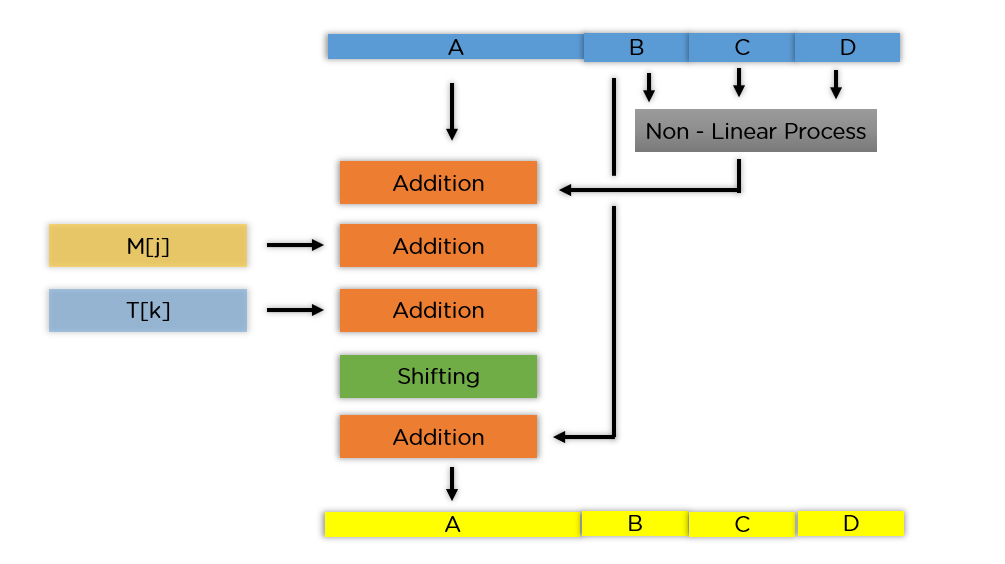
Initialize MD Buffer: A 128-bit state variable, consisting of four 32-bit words (A, B, C, D), is initialized with specific constant values. These are the intermediate hash values that will be updated throughout the process.
-
Process Message in 512-bit Blocks: The padded and appended message is processed in 512-bit chunks. Each 512-bit block goes through four main rounds.
-
Four Rounds of Operations: Each round consists of 16 similar operations, using non-linear functions, left rotations, and additions of various constants and the message block. The results from each operation update the values of A, B, C, and D.
-
Output: After all 512-bit blocks have been processed, the final concatenation of the four 32-bit words (A, B, C, D) forms the 128-bit MD5 hash value.
Fixed-Size Output: The 128-bit Hash
Regardless of whether the input message is a single character, a novel, or a terabyte-sized database, the MD5 algorithm will always produce a 128-bit (16-byte) hash value. This fixed length is often represented as a 32-character hexadecimal string (since each byte can be represented by two hexadecimal characters). For example, the MD5 hash of the string “hello world” is 5d41402abc4b2a76b9719d911017c592. Even adding a single exclamation mark “hello world!” results in a vastly different hash: 60b725b870632a9a5a413d07f300b14b. This property makes it efficient for storage and comparison.
One-Way Functionality
As mentioned, MD5 is designed as a one-way function. This means that while it’s easy to compute the hash from the original data, it’s computationally infeasible to reverse the process—to find the original data given only the hash. This characteristic is crucial for applications like password storage, where the goal is to verify a password without storing it in a recoverable format.
Common Applications of MD5
Before its vulnerabilities became widely known, MD5 was a workhorse in digital security, powering various applications where data integrity and verification were key.
Data Integrity Verification
This was, and to some extent still is, MD5’s most common and robust application. When you download a file from the internet, the provider might offer an MD5 checksum. You can compute the MD5 hash of your downloaded file and compare it to the published checksum. If they match, it signifies that the file has not been corrupted during download and hasn’t been maliciously altered. This is particularly useful for large files or downloads over unreliable networks. While more secure hashes like SHA-256 are now preferred for critical applications, MD5 can still provide a quick, though less secure, check.
Storing Passwords Securely (Historical Context and Current Best Practices)
Historically, MD5 was frequently used to store user passwords in databases. Instead of storing plain-text passwords, which would be a severe security risk if the database were compromised, websites would store the MD5 hash of the password. When a user attempted to log in, their entered password would be hashed, and the resulting hash would be compared to the stored hash. If they matched, access was granted.

However, this practice is now considered insecure due to MD5’s susceptibility to collision attacks and rainbow table attacks. Modern best practices dictate the use of stronger, purpose-built password hashing algorithms like bcrypt, scrypt, or Argon2. These algorithms are specifically designed to be slow and incorporate “salting” (adding a random string to the password before hashing) to mitigate various attacks.
Digital Signatures and Certificates
While MD5 itself is not a digital signature, it played a role in their creation. Digital signatures involve hashing a document and then encrypting that hash with a private key. The encrypted hash serves as the signature. Recipients can decrypt the signature with the public key, re-hash the document themselves, and compare the two hashes. If they match, it verifies the document’s authenticity and integrity. MD5 was once used as the hashing algorithm within this process, though its use for this purpose has been largely deprecated due to security concerns.
Duplicate File Detection
MD5 can be a handy tool for identifying duplicate files on a system. By computing the MD5 hash for every file, you can quickly spot files with identical hashes, indicating they are likely identical in content. This is much faster than byte-by-byte comparison for large numbers of files and can help in cleaning up storage or ensuring data consistency.
The Evolution of Cryptography: Why MD5 is Considered Broken
Despite its widespread use and initial perceived strength, MD5 has been progressively revealed to have significant cryptographic weaknesses, leading to its deprecation for security-critical applications.
Collision Attacks: The Achilles’ Heel
The most significant flaw in MD5 is its vulnerability to “collision attacks.” A collision occurs when two different inputs produce the exact same hash output. While finding collisions for a cryptographically strong hash function should be computationally infeasible, researchers demonstrated practical methods to generate MD5 collisions.
The first theoretical collision was found in 2004, and by 2007, researchers at the Chaos Computer Club publicly demonstrated how to create two different executable files with the same MD5 hash. This breakthrough shattered the trust in MD5 for applications where collision resistance is paramount, such as digital signatures and certificate authentication. If an attacker can create two different documents (one benign, one malicious) that share the same MD5 hash, they can potentially trick systems into verifying the malicious document as if it were the benign one, undermining the integrity of the digital signature.
Practical Implications of MD5 Vulnerabilities
The discovery of MD5 collision vulnerabilities has profound practical implications:
-
Compromised Digital Signatures: An attacker could forge a digital certificate, signing a malicious piece of software with the same MD5 hash as a legitimate one, making it appear authentic.
-
Password Cracking (Rainbow Tables): Although MD5 is one-way, attackers can pre-compute MD5 hashes for millions of common passwords and store them in “rainbow tables.” If they gain access to a database of MD5 password hashes, they can quickly look up the original passwords.
-
Data Tampering: While MD5 still works for basic integrity checks, its collision vulnerability means a sophisticated attacker could potentially create a modified file that has the same MD5 hash as an original, making it impossible to detect the tampering using only MD5.
Moving Beyond MD5: SHA-256, SHA-3, and Other Modern Alternatives
Recognizing the critical vulnerabilities of MD5, the cryptographic community has largely moved on to more robust hashing algorithms. The most prominent successor is the SHA (Secure Hash Algorithm) family, particularly SHA-256 and SHA-512 (which produce 256-bit and 512-bit hashes, respectively, making collisions much harder to find). More recently, SHA-3 (Keccak) was standardized, offering a completely different design and enhanced security. For password hashing, as mentioned, specialized algorithms like bcrypt, scrypt, and Argon2 are the industry standard due to their intentional slowness and salting capabilities.
Best Practices and Future Outlook
Understanding the history and vulnerabilities of MD5 is not just an academic exercise; it’s essential for applying best practices in digital security today.
When (Not) to Use MD5
Do not use MD5 for:
-
Digital signatures or certificates: Replaced by SHA-256/SHA-3.
-
Password storage: Replaced by bcrypt, scrypt, Argon2.
-
Any application where collision resistance is critical for security: This includes verifying software updates or guaranteeing the authenticity of documents.
You might still encounter or use MD5 for:
-
Simple file integrity checks where the threat model is low: For example, checking if a downloaded file corrupted during transfer (but not for verifying authenticity against a malicious actor).
-
Duplicate file detection: As long as you understand it’s not a security guarantee.
-
Non-cryptographic applications: Where a deterministic hash for data partitioning or lookup tables is needed, and security is not a concern.
The Importance of Strong Hashing Algorithms
The journey from MD5 to SHA-256 and beyond underscores a fundamental principle in digital security: cryptography is a constantly evolving field. As computational power increases and new attack methods are discovered, cryptographic algorithms must be continually scrutinized and, if found wanting, replaced with stronger alternatives. Relying on outdated or broken algorithms like MD5 for security-critical functions is akin to leaving your front door unlocked in a bustling city.
Continuous Evolution in Digital Security
The story of MD5 is a cautionary tale and a testament to the dynamic nature of cybersecurity. It highlights the constant cat-and-mouse game between cryptographers and attackers. The proactive adoption of modern, robust cryptographic primitives is not just good practice, but a necessity to safeguard data, ensure trust, and maintain the integrity of our increasingly digital world. While MD5 once served valiantly, its time as a reliable cryptographic tool for security-critical applications has passed, paving the way for a new generation of stronger, more resilient hashing algorithms.
aViewFromTheCave is a participant in the Amazon Services LLC Associates Program, an affiliate advertising program designed to provide a means for sites to earn advertising fees by advertising and linking to Amazon.com. Amazon, the Amazon logo, AmazonSupply, and the AmazonSupply logo are trademarks of Amazon.com, Inc. or its affiliates. As an Amazon Associate we earn affiliate commissions from qualifying purchases.