
Amyotrophic Lateral Sclerosis (ALS), widely known as Lou Gehrig’s disease, is a progressive neurodegenerative condition that affects nerve cells in the brain and spinal cord. While the biological complexities of the disease remain a significant challenge for the medical community, the technology sector has stepped in to redefine the quality of life for those living with the diagnosis. In the modern era, “What is Lou Gehrig’s disease?” is a question answered not just by biology, but by the rapid advancement of assistive technology, artificial intelligence, and neural engineering.

The convergence of hardware and software has transformed a diagnosis that once meant total isolation into a new frontier for human-computer interaction. From the eyes of a tech enthusiast or developer, ALS represents the ultimate challenge in accessibility: how to maintain human agency when the physical interface—the body—begins to fail.
Digital Voice Preservation: How AI and Synthesis are Saving Identities
One of the most devastating aspects of ALS is the eventual loss of speech, known as dysarthria. For decades, the “robotic” voice popularized by early speech-generating devices was the only option for patients. However, current technology has evolved to prioritize the preservation of a person’s unique vocal identity.
The Rise of Voice Banking and AI Cloning
Voice banking is a process where individuals record a set of phrases while their speech is still clear. Tech companies like ElevenLabs, Acapela Group, and ModelTalker have leveraged deep learning algorithms to create highly accurate synthetic clones of a user’s voice. Unlike the static soundboards of the past, these AI-driven models can convey emotion, inflection, and nuance.
The software utilizes Neural Text-to-Speech (TTS) engines that analyze the phonetic components of a user’s original recordings. Once the digital “voice print” is created, the user can type text into a specialized app, which then outputs the audio in their own voice. This tech is moving toward “message banking” as well, where specific cultural expressions, jokes, and intimate phrases are recorded to maintain the user’s personality within their digital avatar.
Real-Time Speech Reconstruction
For those who have already begun to lose their speech clarity, AI-powered speech recognition tools like Google’s Project Relate and Voiceitt are breaking barriers. These apps use non-standard speech recognition models trained on thousands of hours of impaired speech data. They act as a real-time interpreter, translating difficult-to-understand vocalizations into clear, synthesized speech or text. This bridge between human intent and digital output is a prime example of how machine learning can restore a fundamental human right: the ability to be understood.
The Breakthrough of Brain-Computer Interfaces (BCI)
When physical movement, including eye movement, becomes limited, the tech world looks toward the ultimate source of intent—the brain. Brain-Computer Interfaces (BCIs) represent the pinnacle of neuro-technology, allowing users to control digital devices using nothing but their thoughts.
Invasive vs. Non-Invasive Solutions
The BCI landscape is currently divided into two primary approaches. Companies like Neuralink and Synchron are leading the charge in invasive or “minimally invasive” implants. Synchron, for instance, has developed the Stentrode, which is inserted through the jugular vein and moved into the motor cortex without the need for open-brain surgery. This device picks up electrical signals from the brain and transmits them to a receiver that translates those signals into “clicks” on a computer screen.
On the other hand, non-invasive BCIs use Electroencephalography (EEG) caps to read brain waves through the scalp. While the signal is noisier than implanted sensors, advancements in signal processing and noise-reduction software have made these more viable for home use. For a person with ALS, this means the ability to send emails, browse the web, and even participate in the digital economy long after they have lost the ability to use a mouse or keyboard.
Software Translation Layers
The hardware is only half the battle. The software must interpret a user’s neural “intent.” If a user thinks about moving their right hand, the BCI software must recognize that specific pattern and map it to a cursor movement. Developers are currently working on high-speed “mental typing” software that allows users to select letters based on specific neural triggers, significantly increasing the words-per-minute (WPM) rate for non-verbal communicators.
Smart Environments and IoT: Reclaiming Independence Through Connectivity
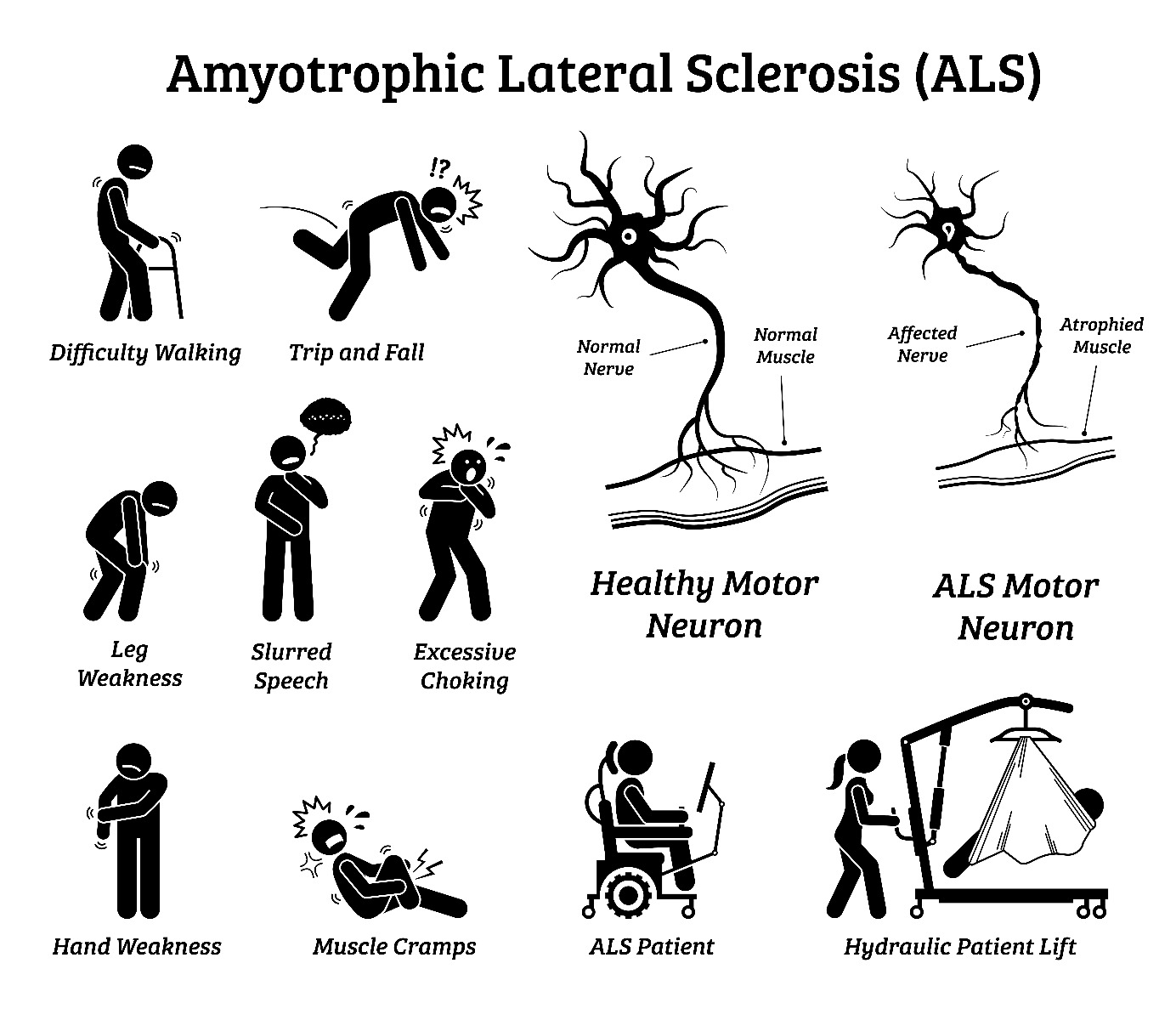
For a person living with ALS, the environment can become a series of physical obstacles. The Internet of Things (IoT) has turned the home from a static space into a responsive, voice-and-gaze-controlled ecosystem.
Eye-Tracking and Home Automation
Gaze-tracking technology, such as the systems developed by Tobii Dynavox, allows users to control a computer cursor by looking at different parts of the screen. When integrated with smart home protocols like Matter or Zigbee, this eye-tracking interface becomes a remote control for the entire house.
A user can look at an icon on their screen to:
- Adjust the thermostat.
- Dim or brighten Philips Hue lighting.
- Open automated blinds or doors.
- Operate a smart TV or streaming service.
The integration of these disparate systems into a single, cohesive dashboard is a major focus for UX/UI designers in the accessibility space. The goal is to reduce “cognitive load”—making it as easy to turn off a light with one’s eyes as it is with a physical switch.
Assistive Robotics and Exoskeletons
Beyond the screen, robotics are beginning to assist with physical tasks. Smart wheelchairs integrated with obstacle-avoidance sensors (similar to Tesla’s Autopilot) allow for safer navigation. Furthermore, research into soft robotic exoskeletons—suits made of flexible materials powered by pneumatic actuators—is providing hope for maintaining limb function longer. These “wearable robots” use sensors to detect the user’s smallest muscle movements and provide the mechanical force necessary to complete the motion, such as lifting a glass of water.
Data-Driven Diagnostics: Using Machine Learning to Decode the Disease
Technology isn’t just helping patients live with the disease; it is being used to find a cure. The “Big Data” revolution is uniquely suited to tackling a condition as complex as ALS, where the progression and symptoms vary wildly from person to person.
Predictive Modeling and Biomarkers
Machine learning algorithms are now being used to analyze massive datasets from clinical trials. By identifying patterns that human researchers might miss, AI can predict how the disease will progress in a specific individual. This allows for “precision medicine,” where treatments are tailored to the patient’s specific genetic and symptomatic profile.
Companies are also developing “digital biomarkers.” By tracking subtle changes in a person’s typing speed, gait (via smartphone sensors), or vocal frequency over time, AI can detect the onset of ALS months or even years before a traditional clinical diagnosis. Early detection is crucial for the efficacy of current neuroprotective drugs, and tech-driven diagnostics are the key to moving the needle.
Accelerating Drug Discovery
The traditional drug discovery pipeline takes over a decade. AI platforms like IBM Watson and specialized biotech startups are using “in-silico” modeling to simulate how different chemical compounds interact with the biological pathways of ALS. This allows researchers to skip thousands of failed lab experiments and jump straight to the most promising candidates. In 2016, the ALS Association even funded a project that used AI to identify five new genes linked to the disease, a feat that would have taken years of manual research.
Ethical Frontiers and the Future of Neural Security
As we bridge the gap between the human brain and the digital world, new challenges in cybersecurity and ethics emerge. When a person’s primary mode of communication and environmental control is a BCI or an AI voice, the security of that data becomes a matter of physical safety and personal autonomy.
Neural Privacy
The data collected by BCIs—brain waves and intent—is the most intimate data a human can generate. The tech industry is currently debating how this “neuro-data” should be protected. If a company owns the platform through which a person thinks and speaks, who owns the data? Ensuring that neural signatures are encrypted and cannot be harvested for advertising or behavioral profiling is a critical mission for digital rights advocates.

The Right to Disconnect
As assistive tech becomes more integrated, the boundary between the person and the machine blurs. Engineers are now focusing on the “right to disconnect,” ensuring that users have total control over their interfaces. In an era where AI can predict what we are going to say, maintaining the “human in the loop” is essential. The tech must remain a tool for the user, not a system that speaks for them without their explicit consent.
The question of “what is Lou Gehrig’s disease” in the 21st century finds its answer in the resilience of the human spirit combined with the brilliance of technological innovation. We are moving toward a future where a diagnosis of ALS no longer means a loss of voice or agency, but a transition to a different, tech-augmented way of interacting with the world. Through AI, BCI, and IoT, the tech industry is ensuring that the mind remains free, even when the body is constrained.
aViewFromTheCave is a participant in the Amazon Services LLC Associates Program, an affiliate advertising program designed to provide a means for sites to earn advertising fees by advertising and linking to Amazon.com. Amazon, the Amazon logo, AmazonSupply, and the AmazonSupply logo are trademarks of Amazon.com, Inc. or its affiliates. As an Amazon Associate we earn affiliate commissions from qualifying purchases.