
In the realm of pure mathematics, the Isosceles Triangle Theorem is a foundational pillar of Euclidean geometry. It states, quite simply, that if two sides of a triangle are equal, then the angles opposite those sides are also equal. While this might seem like an elementary concept relegated to high school textbooks, its transition into the world of technology has been transformative. In modern tech—ranging from 3D rendering engines and GPS navigation to computer vision and structural software engineering—this theorem serves as a fundamental logic gate for spatial computation.
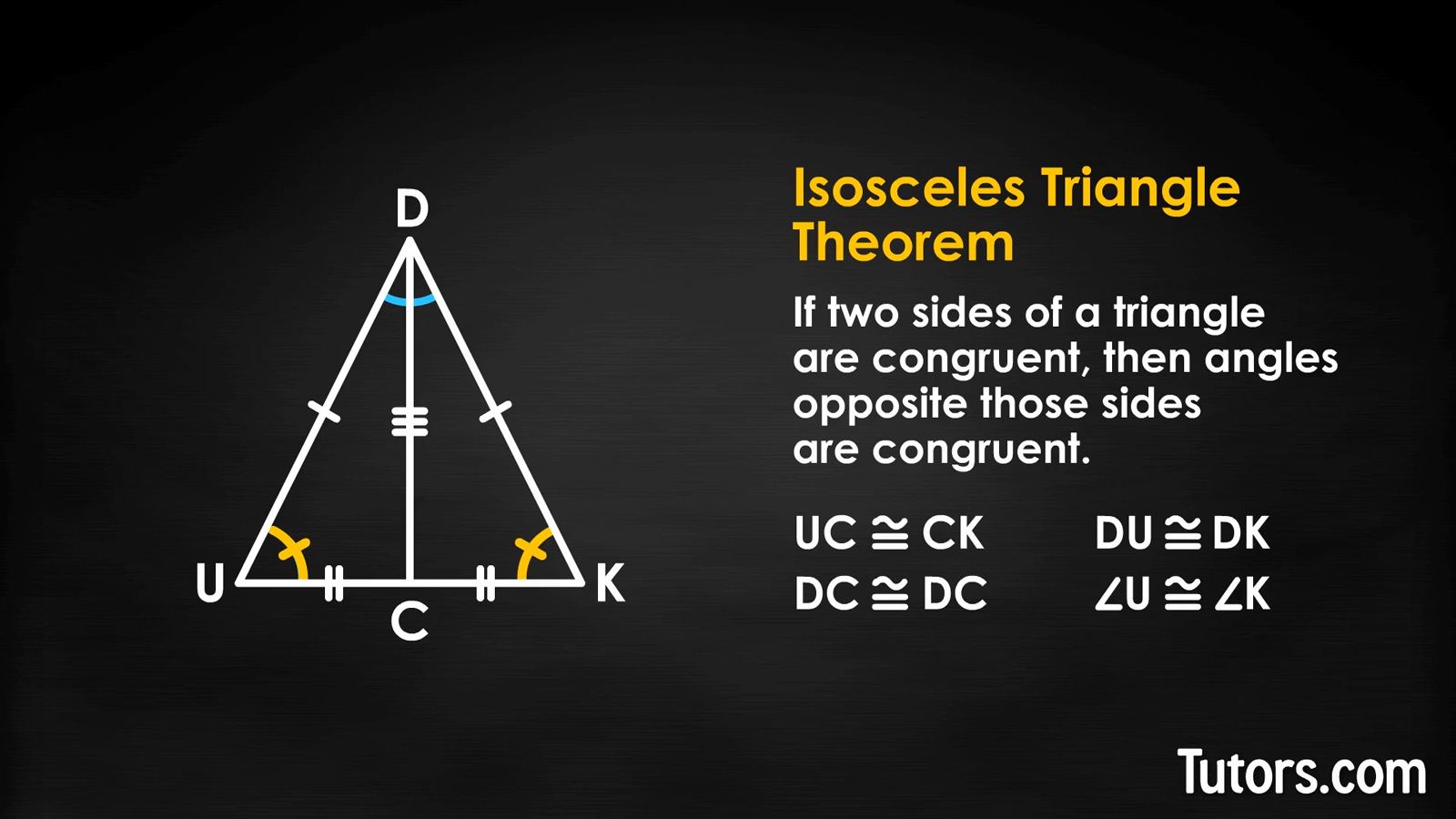
Understanding the Isosceles Triangle Theorem within a technical framework requires moving beyond paper-and-pencil proofs. For developers, data scientists, and engineers, this theorem is a tool for optimization, a method for ensuring symmetry in UI/UX design, and a vital component in the algorithms that allow machines to perceive depth and distance.
Foundations of the Theorem in Digital Architecture
At its core, the Isosceles Triangle Theorem provides a predictable mathematical symmetry that software developers leverage to reduce computational load. In programming, especially when dealing with vector mathematics or physics engines, predictability is the key to performance.
Geometric Logic in Code
When a software program needs to calculate the properties of a shape, reducing the number of variables is essential. Because the Isosceles Triangle Theorem establishes a fixed relationship between sides and angles, an algorithm only needs two pieces of data—the length of the congruent sides and the included angle, or one side and one base angle—to define the entire spatial state of the object. In high-frequency trading platforms or real-time physics simulations, these minor reductions in variable processing save precious milliseconds of CPU time.
Symmetry and Computational Efficiency
Symmetry is not just an aesthetic choice; it is a computational shortcut. Many algorithms used in data compression and image processing rely on the “Mirroring Principle” derived from the properties of isosceles triangles. By recognizing a symmetrical geometric pattern, a system can store half the data and mirror it across an axis to reconstruct the whole. This is a direct application of the theorem’s requirement that the altitude drawn to the base of an isosceles triangle bisects both the base and the vertex angle, creating two identical right-angled triangles.
Applications in Computer Graphics and 3D Modeling
The most visible application of the Isosceles Triangle Theorem is in the field of Computer-Generated Imagery (CGI) and 3D modeling. Every complex character in a video game or architectural walkthrough is composed of a “mesh”—a network of thousands, or even millions, of triangles.
Rendering Pipelines and Vertex Shaders
In the rendering pipeline, the GPU (Graphics Processing Unit) processes triangles as the primary primitive. While any triangle can be rendered, isosceles triangles are particularly useful in the creation of regular polygons and the tessellation of curved surfaces. When a 3D modeler creates a sphere, the software often uses isosceles-based segments to ensure the surface is smooth and mathematically consistent. Because the theorem guarantees equal base angles, shaders can calculate light reflection and shadow diffusion more uniformly across these surfaces, preventing the “jagged” look associated with poor geometric optimization.
Mesh Optimization and Level of Detail (LOD)
Modern game engines like Unreal Engine 5 or Unity utilize Level of Detail (LOD) systems to maintain high frame rates. When an object is far from the camera, the engine simplifies its geometry. This simplification often involves “collapsing” complex polygons into simpler isosceles structures. By maintaining the symmetry of the isosceles form, the engine ensures that the object’s silhouette remains balanced even as its polygon count drops, preventing visual glitches or “popping” that occurs when geometry is handled haphazardly.
Stability in Physics Engines
In the world of digital physics—simulating how a car crashes or how water flows—the Isosceles Triangle Theorem provides a “stable state.” Equilateral triangles (a specific subset of isosceles triangles) and standard isosceles triangles are more structurally stable in a simulation than scalene triangles, which can lead to “slivers” or “degenerate triangles” that cause physics engines to crash. Developers prioritize isosceles-like configurations in their meshes to ensure that collision detection remains accurate and that the digital environment behaves according to the laws of motion.

Navigational Algorithms and Geospatial Tech
If you have ever used a smartphone to find your location, you have relied on the practical application of the Isosceles Triangle Theorem. Geospatial technology is built upon the concepts of triangulation and trilateration.
Signal Processing and Triangulation Logic
GPS systems work by measuring the time it takes for a signal to travel from a satellite to your device. When your phone is roughly equidistant between two cell towers or satellites, the geometry formed is an isosceles triangle. The theorem allows the software to quickly verify the positioning by comparing the received signal strength and the angle of arrival. If the angles don’t match the expected symmetry relative to the distance, the software knows there is signal interference or multipath error, allowing it to discard inaccurate data points.
Pathfinding in Robotics and Autonomous Vehicles
Autonomous drones and self-driving cars use LiDAR (Light Detection and Ranging) to map their surroundings. As a drone scans a room, it creates triangles between its sensor, a point on a wall, and a subsequent point. When the drone detects a flat surface, the sensors often form isosceles triangles with the detected plane. The theorem allows the onboard AI to calculate the drone’s “tilt” or “roll” instantly; if the base angles of the triangle formed by the sensors are not equal, the AI knows the drone is not parallel to the surface and can make micro-adjustments to its flight path.
UI/UX Design and Visual Hierarchy
In the tech industry, the “look and feel” of a product is just as important as the code. Graphic designers and UI (User Interface) engineers use the principles of the Isosceles Triangle Theorem to create visual balance and direct user attention.
The Golden Ratio and Isosceles Proportions
Many iconic tech logos and website layouts are built on the “Golden Triangle,” which is an isosceles triangle where the ratio of the side to the base is the golden ratio (1.618). This specific geometric application is used to create interfaces that feel “natural” to the human eye. By utilizing the symmetry dictated by the theorem, designers can create a sense of stability and trust.
Balancing Visual Weight in App Interfaces
When a designer places a call-to-action (CTA) button at the bottom of a screen and two primary icons at the top, they are creating an invisible isosceles triangle. This layout provides a balanced visual weight. Because the human brain subconsciously recognizes the symmetry of the isosceles form, it can navigate the interface more intuitively. Tech giants like Apple and Google have internalized these geometric rules into their “Human Interface Guidelines” and “Material Design” frameworks, ensuring that every pixel serves a structural purpose.
Future Trends: AI and Procedural Generation
As we move into an era dominated by Artificial Intelligence and procedurally generated content, the Isosceles Triangle Theorem is finding new life.
Generating Environments using Geometric Rules
Procedural generation is the process of using algorithms to create massive digital worlds, such as those found in No Man’s Sky or Minecraft. These algorithms don’t manually place every rock or tree; instead, they use geometric rules to grow terrain. The Isosceles Triangle Theorem is used to define “slopes” and “peaks.” By setting the base angles, an algorithm can determine if a mountain is steep or shallow, ensuring that the generated landscape is both aesthetically pleasing and traversable by the game’s physics engine.
Machine Learning and Spatial Data
In Machine Learning (ML), specifically in the field of “k-Nearest Neighbors” (k-NN) algorithms and spatial clustering, the distance between data points is everything. When ML models are trained to recognize patterns in images or 3D scans, they often use triangular logic to calculate the proximity of features. The Isosceles Triangle Theorem acts as a benchmark for “near-symmetry,” helping models identify when two features (like the eyes on a human face in facial recognition software) are correctly aligned. If the triangle formed by the eyes and the tip of the nose deviates too far from an isosceles structure, the AI can flag the image as being at an angle or obscured.
The Isosceles Triangle Theorem is far more than an ancient mathematical curiosity. In the modern tech landscape, it is a vital engine of efficiency. It allows our GPUs to render breathtaking worlds, our GPS to find our way home, and our devices to understand the 3D space around them. By bridging the gap between abstract geometry and functional code, this theorem remains one of the most important “hidden” tools in a technologist’s arsenal.
aViewFromTheCave is a participant in the Amazon Services LLC Associates Program, an affiliate advertising program designed to provide a means for sites to earn advertising fees by advertising and linking to Amazon.com. Amazon, the Amazon logo, AmazonSupply, and the AmazonSupply logo are trademarks of Amazon.com, Inc. or its affiliates. As an Amazon Associate we earn affiliate commissions from qualifying purchases.