
In the rapidly evolving landscape of modern technology, the “vector” has transitioned from a purely mathematical abstraction to a cornerstone of digital infrastructure. From the high-performance graphics that power immersive gaming experiences to the complex neural networks driving generative AI, understanding the components of a vector is essential for any technologist, developer, or data scientist. Whether we are discussing the low-level memory management of a C++ application or the high-dimensional embeddings within a Large Language Model (LLM), the vector serves as the fundamental unit of data representation.
To understand the components of a vector within the tech niche, we must look beyond the simple arrows of high school physics and explore how these structures are built, stored, and manipulated across various technological domains.
The Architectural Anatomy: Data Structures and Memory
In the world of software engineering, a vector is often synonymous with a dynamic array. Unlike a standard array, which has a fixed size determined at compile-time, a vector is a sequence container that can grow or shrink in size. This flexibility is what makes it a staple of modern programming languages.
Storage and Capacity
The primary components of a software-based vector are its size, capacity, and the underlying heap-allocated memory. The “size” refers to the number of elements currently held within the vector, while the “capacity” refers to the total amount of space allocated in memory. This distinction is crucial for performance optimization. When a vector exceeds its capacity, the system must reallocate a larger block of memory and move all existing components to the new location. Efficient tech stacks minimize these reallocations to maintain high-speed execution.
Element Contiguity
A defining characteristic of a vector’s components is their contiguous placement in memory. Because every element is stored right next to its neighbor, processors can utilize “spatial locality.” This allows modern CPUs to fetch data into the cache more effectively, drastically reducing latency. In high-frequency trading platforms or real-time rendering engines, this contiguous nature is the component that enables millisecond-level responsiveness.
Iterators and Accessors
The components that allow developers to interact with a vector are known as accessors and iterators. These software components provide the logic for traversing the data structure. Random access is a hallmark of the vector; because the components are indexed and stored contiguously, a program can jump to any specific “component” of the vector in O(1) time complexity, meaning the time required is constant regardless of the vector’s size.
The High-Dimensional Component: Vector Embeddings in AI
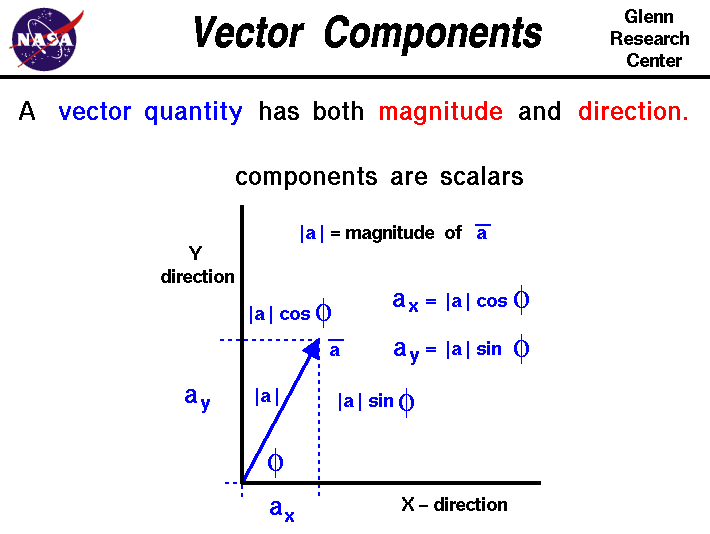
If software engineering views the vector as a container, Artificial Intelligence views it as a “coordinate” in an abstract space. In the realm of AI and Machine Learning, the components of a vector are the individual numerical values (often called dimensions) that represent features of data.
Dimensionality as a Feature Set
In an AI model, a “vector embedding” translates a piece of unstructured data—like a word, an image, or a sound—into a list of numbers. For example, a word might be represented as a vector with 1,536 dimensions. Each component (each of those 1,536 numbers) represents a specific, learned attribute of that word. One component might correlate with “gender,” another with “royalty,” and another with “tense.” Together, these components define the “semantic position” of the data point.
Magnitude and Directional Components
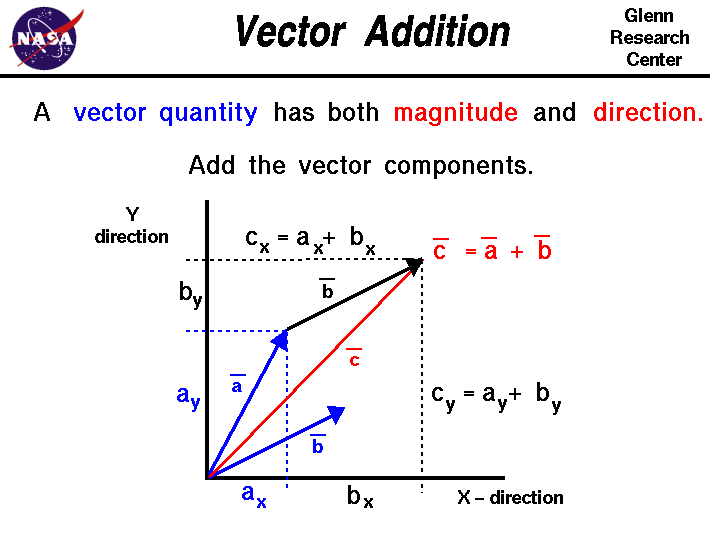
When AI models compare two pieces of data, they aren’t looking at the numbers in isolation; they are looking at the vector’s magnitude and direction. In a process called Cosine Similarity, the components of two vectors are compared to determine the angle between them. If the components are similar, the vectors point in roughly the same direction, indicating that the concepts are related. This is the tech that powers everything from Netflix recommendations to the “understanding” capabilities of ChatGPT.
Dense vs. Sparse Components
Not all vectors in tech are created equal. “Dense vectors” are those where most components are non-zero, commonly used in deep learning to capture nuanced relationships. “Sparse vectors,” on the other hand, contain mostly zeros. These are often used in traditional search engine algorithms (like BM25) where each component represents the presence or absence of a specific keyword. Modern AI tools are increasingly using “Hybrid Search,” which combines the components of both dense and sparse vectors to provide more accurate information retrieval.
The Engine of Retrieval: Vector Databases
The rise of AI has necessitated a new category of technology: the Vector Database. Companies like Pinecone, Milvus, and Weaviate have built entire businesses around managing the components of vectors at scale.

Vector Indexing Components
A vector database does not store vectors like a traditional relational database stores rows and columns. Instead, it uses specialized components called “indices.” Common indexing strategies include HNSW (Hierarchical Navigable Small World) graphs or IVF (Inverted File Index). These components allow the database to navigate through millions of high-dimensional vectors to find the ones most similar to a query vector without checking every single record.
Metadata and Payloads
While the numerical components (the embeddings) are the stars of the show, a functional vector in a database often includes “metadata components.” These are the associated pieces of information—such as a source URL, a timestamp, or a text snippet—that are retrieved alongside the vector. In the context of Retrieval-Augmented Generation (RAG), the vector components act as the “address” or “GPS coordinates,” while the metadata serves as the actual information delivered to the AI model to generate a response.
Distance Metrics
Every vector database relies on a mathematical component to measure proximity. Whether it is Euclidean Distance (measuring the literal gap between points), Manhattan Distance, or Inner Product, the choice of distance metric changes how the components of the vector are weighted. This choice is a critical component of the technical architecture, as it dictates the accuracy and speed of the search results.
Hardware Acceleration: Processing Vector Components
Modern technology’s reliance on vectors has reached the hardware level. To process the millions of components within these structures, we have moved beyond general-purpose processing to specialized vector-optimized hardware.
SIMD: Single Instruction, Multiple Data
A major trend in digital security and high-performance computing is the use of SIMD. This hardware component allows a CPU to perform the same operation on multiple vector components simultaneously. Instead of adding two numbers, the processor can add two “vectors” of numbers in one clock cycle. This is foundational for modern encryption algorithms and digital signal processing.
GPUs and Tensor Cores
Graphics Processing Units (GPUs) are essentially massive vector processing machines. They are designed to handle the components of vectors (representing pixels, light, and geometry) in parallel. The “Tensor Cores” found in modern NVIDIA cards are specialized hardware components designed specifically to perform the matrix-vector multiplications that power AI. Without the ability to process these components in parallel, the current AI revolution would be computationally impossible.
Edge Computing and Vector Quantization
As tech moves toward “Edge AI” (running models on smartphones or IoT devices), the components of a vector must be optimized for size. This is done through “Quantization.” By reducing the precision of each component—for instance, changing a 32-bit floating-point number to an 8-bit integer—developers can shrink the model’s memory footprint. This allows the core components of powerful AI to live on local hardware, enhancing digital security and user privacy by keeping data off the cloud.
Vectors in Digital Security and Cryptography
In the niche of digital security, vectors take on a more structural role. Here, the components of a vector are often used to represent states or keys within an encrypted system.
Initialization Vectors (IVs)
In cryptography, an Initialization Vector is a component used to ensure that the same plaintext does not produce the same ciphertext every time it is encrypted. This “IV” is a vector of random or pseudo-random numbers that provides the starting state for the algorithm. Without this component, encrypted data would be vulnerable to pattern-based attacks.
Threat Vectors and Attack Surfaces
While less mathematical, the term “vector” in digital security also refers to the path an attacker takes to compromise a system. The “components” of a threat vector might include a phishing email, a vulnerability in a software library, or an unsecured API endpoint. Understanding these components is the first step in building a robust security posture, allowing organizations to map out and defend every possible entry point.
Biometric Vectors
Modern security tools often use biometric data—like facial recognition or fingerprint scanning. This data is converted into a vector of numerical components. When you unlock your phone with your face, the device compares the live vector components of your facial features against a stored “template vector.” If the components align within a certain threshold of similarity, access is granted. This process is a perfect intersection of hardware, AI, and digital security.
The Future: Neural Symbolic Integration and Beyond
As we look toward the future of technology trends, the way we define and use the components of a vector will continue to evolve. We are seeing a shift toward “Neural Symbolic AI,” where the raw numerical components of vectors are integrated with logical, symbol-based reasoning. This aims to give AI models not just the ability to find “similar” things via vector math, but to understand the underlying rules that govern them.
The vector is no longer just a line on a graph; it is the fundamental language of the digital age. Whether it is the capacity and size of a software container, the high-dimensional coordinates of a language model, or the parallel-processed components of a GPU workload, vectors are the silent architects of our technological world. By mastering these components, developers and tech leaders can build faster, smarter, and more secure systems that push the boundaries of what is possible in the digital realm.
aViewFromTheCave is a participant in the Amazon Services LLC Associates Program, an affiliate advertising program designed to provide a means for sites to earn advertising fees by advertising and linking to Amazon.com. Amazon, the Amazon logo, AmazonSupply, and the AmazonSupply logo are trademarks of Amazon.com, Inc. or its affiliates. As an Amazon Associate we earn affiliate commissions from qualifying purchases.