
Buying a car is a significant financial decision for most individuals and families. While the car’s sticker price often grabs the initial attention, a crucial element that profoundly impacts the total cost of your vehicle over time is the interest rate on your car loan. Understanding what an interest rate is, how it’s calculated, and the factors influencing it can empower you to make smarter financial choices, potentially saving you thousands of dollars over the life of your loan. This article will demystify car loan interest rates, equipping you with the knowledge to navigate the financing process with confidence.
Understanding Car Loan Interest Rates
At its core, an interest rate is the cost of borrowing money. When you take out a loan to purchase a car, the lender (a bank, credit union, or dealership) provides you with the funds, and in return, they charge you a percentage of the principal loan amount as interest. This interest is their compensation for the risk they take and the service they provide.
Definition of Interest Rate
The interest rate is expressed as a percentage of the principal balance borrowed and is typically annualized. For a car loan, it dictates how much extra money you’ll pay above the actual purchase price of the vehicle. For instance, if you borrow $20,000 at a 5% interest rate, you’ll be paying 5% of the outstanding balance each year, alongside your principal repayment.
How Interest Rates Work in Car Loans
Car loans are typically installment loans, meaning you pay back a fixed amount each month over a set period (the loan term). Each monthly payment consists of two parts: a portion that goes towards reducing your principal balance and a portion that covers the accrued interest. In the initial stages of a loan, a larger percentage of your payment often goes towards interest, gradually shifting towards principal as the loan matures. This is due to the amortization schedule, which calculates interest on the remaining loan balance. The higher your interest rate, the more of your monthly payment will be allocated to interest, and consequently, the longer it will take to pay down the principal or the higher your monthly payment will be for the same loan term.
APR vs. Interest Rate: What’s the Difference?
While often used interchangeably, the Annual Percentage Rate (APR) and the interest rate are distinct but related concepts. The interest rate is simply the cost of borrowing the principal amount. The APR, however, is a broader measure of the total cost of borrowing, expressed as a yearly rate. It includes not only the interest rate but also any additional fees associated with the loan, such as origination fees, document fees, or other charges from the lender.
For car loans, the APR is often the more comprehensive figure to compare between lenders, as it gives you a truer picture of the total annual cost of the loan. A loan might have a lower advertised interest rate but a higher APR due to substantial fees, making it less attractive than a loan with a slightly higher interest rate but no additional fees. Always ask for and compare the APR when shopping for a car loan.
Factors Influencing Your Car Loan Interest Rate
The interest rate you’re offered on a car loan is not arbitrary; it’s the result of various factors that lenders assess to determine the risk associated with lending you money. Understanding these factors can help you position yourself to secure a more favorable rate.
Credit Score and History
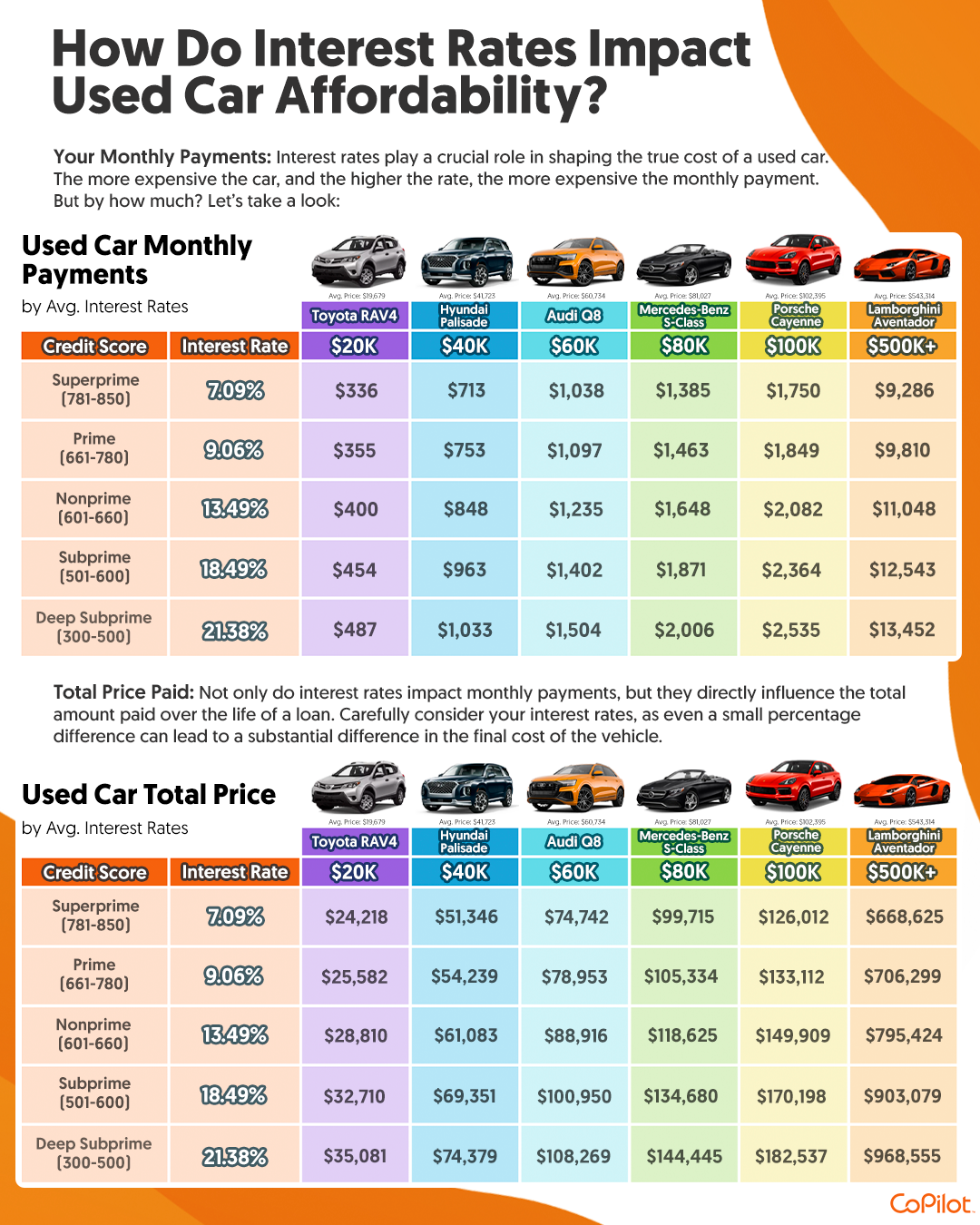
This is arguably the most significant factor. Your credit score (e.g., FICO or VantageScore) is a three-digit number that summarizes your creditworthiness, reflecting your payment history, outstanding debts, length of credit history, new credit, and credit mix. A higher credit score (generally 700+) indicates a lower risk to lenders, often qualifying you for the lowest interest rates. Conversely, a lower credit score suggests a higher risk, leading to higher interest rates to compensate the lender for that perceived risk. Your credit history, which details past loan repayments and defaults, is also scrutinized.
Loan Term Length
The duration over which you agree to repay the loan also plays a crucial role. Shorter loan terms (e.g., 36 or 48 months) typically come with lower interest rates because the lender’s money is tied up for a shorter period, reducing their exposure to risk. While shorter terms mean higher monthly payments, they often result in paying significantly less interest over the life of the loan. Longer terms (e.g., 72 or 84 months) result in lower monthly payments but usually carry higher interest rates and lead to a much larger total interest paid.
Down Payment Amount
A larger down payment reduces the amount you need to borrow, which can lower your interest rate. Lenders view a substantial down payment as a sign of financial stability and a reduced risk, as you have more equity in the vehicle from the outset. It also means the loan-to-value (LTV) ratio is lower, which is favorable to lenders. A zero-down payment, while tempting, often results in higher interest rates and a greater total cost.
Debt-to-Income Ratio
Your debt-to-income (DTI) ratio is the percentage of your gross monthly income that goes towards paying your monthly debt payments. Lenders use this to assess your ability to manage additional debt. A lower DTI (typically below 36%) indicates you have more disposable income to cover your car payments, making you a less risky borrower and potentially qualifying you for better rates.
Vehicle Age and Type
The age and type of the vehicle you’re financing can also influence the interest rate. New cars generally command lower interest rates than used cars because they are considered less risky collateral. They typically have a predictable value and are less prone to immediate mechanical issues. Used cars, especially older models, may come with higher rates due to higher depreciation risks and potential for mechanical problems. Luxury or specialized vehicles might also have different rate structures.
Current Market Conditions (Federal Reserve Rates, Economic Climate)
Beyond your personal financial profile, broader economic factors influence interest rates. The Federal Reserve’s federal funds rate decisions impact the prime lending rate, which banks use as a basis for their loans. When the Fed raises rates, borrowing costs generally increase across the board, including for car loans. Conversely, a loosening monetary policy can lead to lower rates. The overall economic climate, inflation rates, and consumer demand for loans also play a role in how lenders price their offerings.
Types of Car Loan Interest Rates
While the concept of interest rate remains the same, how it’s applied over the loan term can vary, primarily categorized into fixed and variable rates.
Fixed-Rate Loans
The vast majority of car loans are fixed-rate loans. This means the interest rate remains constant for the entire duration of the loan term. Your monthly payment for principal and interest will not change, providing predictability and stability to your budget. This is generally preferred by consumers because it eliminates the uncertainty of fluctuating payments, making financial planning easier.

Variable-Rate Loans (and why they’re less common for cars)
In a variable-rate loan, the interest rate can change periodically based on a benchmark index (e.g., the prime rate). While common for mortgages or credit cards, variable-rate car loans are much less prevalent. This is primarily because car loans typically have shorter terms than mortgages, and the stability of fixed payments is highly valued by both borrowers and lenders in this market. For a borrower, a variable rate introduces the risk of higher monthly payments if interest rates rise, making budgeting more challenging.
New vs. Used Car Rates
As touched upon earlier, there is often a distinction between interest rates offered for new versus used vehicles. Lenders generally view new cars as less risky assets due to their higher initial value, warranty coverage, and slower depreciation in the immediate term. Consequently, new car loans typically come with lower interest rates. Used cars, conversely, often carry slightly higher interest rates to account for their potentially faster depreciation, higher mileage, and increased risk of mechanical issues. The age of the used car also plays a significant role, with older models usually incurring higher rates.
How to Secure the Best Car Loan Interest Rate
Getting the lowest possible interest rate can save you a substantial amount of money over the life of your car loan. Here’s how to maximize your chances:
Improve Your Credit Score
Before you even start car shopping, check your credit report and score. If your score is not in the “excellent” range, take steps to improve it. Pay bills on time, reduce existing debt, correct any errors on your credit report, and avoid opening new credit accounts just before applying for a car loan. Even a 50-point increase in your score can translate into significantly lower interest rates.
Shop Around for Lenders (Banks, Credit Unions, Dealerships, Online Lenders)
Don’t settle for the first loan offer, especially from a dealership. Dealerships often mark up interest rates as a profit center. Explore financing options from multiple sources:
- Banks: Traditional banks offer competitive rates, especially if you’re an existing customer.
- Credit Unions: Often known for offering some of the lowest interest rates due to their member-focused structure.
- Online Lenders: Many online platforms specialize in car loans and can provide quick quotes and competitive rates.
By getting multiple offers, you create leverage and can choose the best terms available.
Make a Larger Down Payment
As discussed, a larger down payment reduces the loan amount and your loan-to-value ratio, making you a more attractive borrower. Aim for at least 10-20% of the car’s purchase price if possible. This not only lowers your interest rate but also reduces your monthly payments and the total interest paid.
Shorten Your Loan Term
While a longer loan term means lower monthly payments, it almost always comes with a higher interest rate and a greater total interest cost. If your budget allows, opt for the shortest loan term you can comfortably afford. This strategy minimizes the amount of interest you pay over time.
Get Pre-Approved
Getting pre-approved for a loan before stepping into a dealership is a powerful negotiating tool. It gives you a firm offer of credit (including the interest rate) from an independent lender. With pre-approval in hand, you can focus on negotiating the car’s price separately, knowing you already have your financing secured. This separates the car price negotiation from the financing negotiation, which can be advantageous.
Negotiate the Price of the Car Separately
When you have pre-approval, you can walk into the dealership as a cash buyer, in effect. This allows you to negotiate the car’s purchase price independently of the financing. Once you’ve agreed on a price, you can compare the dealership’s financing offer against your pre-approval. Sometimes, dealerships might offer special incentives or lower rates to compete with your pre-approved loan, but only if they know you have another option.
Calculating and Managing Your Car Loan
Understanding the financial implications of your car loan beyond just the monthly payment is crucial for effective money management.
Impact of Interest on Total Loan Cost
The total amount of interest paid over the life of a car loan can be surprisingly high, especially with longer terms and higher interest rates. For example, a $30,000 loan at 5% over 60 months will cost you approximately $3,969 in interest, for a total of $33,969. The same loan at 8% over 72 months would cost approximately $9,376 in interest, for a total of $39,376. These figures clearly illustrate how interest rates and loan terms significantly impact the overall cost of your vehicle.
Using Online Calculators
Before committing to a loan, utilize online car loan calculators. These tools allow you to input different loan amounts, interest rates, and terms to see estimated monthly payments and total interest paid. This helps you compare various scenarios and determine what fits best within your budget and financial goals. Many financial websites, bank sites, and even car manufacturer sites offer these calculators.
Strategies for Early Repayment
If you have a fixed-rate loan and no prepayment penalties (which are rare for car loans, but always worth confirming), paying off your car loan early can save you a considerable amount in interest. Strategies include:
- Making extra payments whenever possible: Even small, irregular extra payments can chip away at the principal.
- Adding a bit extra to each monthly payment: Rounding up your payment or adding a fixed amount each month can shorten the loan term.
- Making bi-weekly payments: Instead of 12 monthly payments, make 26 half-payments throughout the year. This effectively adds one extra full payment per year, significantly reducing the loan term and total interest.
- Using windfalls: Apply bonuses, tax refunds, or other unexpected income directly to the principal balance.

Refinancing Your Car Loan
If your credit score has improved since you took out your original loan, or if market interest rates have dropped, you might consider refinancing your car loan. Refinancing involves taking out a new loan to pay off your existing car loan, ideally at a lower interest rate or with more favorable terms. This can reduce your monthly payment, lower the total interest paid, or both. It’s particularly beneficial if you initially had a high interest rate due to a lower credit score that has since improved.
Understanding “what is interest rate on a car” is fundamental to responsible vehicle ownership. By being informed about the factors that influence your rate, actively shopping for the best terms, and strategically managing your loan, you can drive away with not just your dream car, but also a financially sound decision.
aViewFromTheCave is a participant in the Amazon Services LLC Associates Program, an affiliate advertising program designed to provide a means for sites to earn advertising fees by advertising and linking to Amazon.com. Amazon, the Amazon logo, AmazonSupply, and the AmazonSupply logo are trademarks of Amazon.com, Inc. or its affiliates. As an Amazon Associate we earn affiliate commissions from qualifying purchases.