
In the landscape of modern software engineering, Object-Oriented Programming (OOP) stands as the dominant paradigm for building complex, scalable, and maintainable systems. At the heart of this paradigm lie four fundamental pillars: encapsulation, abstraction, polymorphism, and inheritance. Among these, inheritance is perhaps the most transformative, providing a mechanism that allows developers to create new classes built upon the foundations of existing ones.
Inheritance is not merely a technical convenience; it is a conceptual framework that mirrors the hierarchical relationships we see in the real world. By allowing a “child” class to acquire the properties and behaviors of a “parent” class, inheritance facilitates code reusability, reduces redundancy, and establishes a clear logical structure within a codebase. For developers looking to master software design, a deep understanding of inheritance is non-negotiable.
The Core Mechanics: Base Classes and Derived Classes
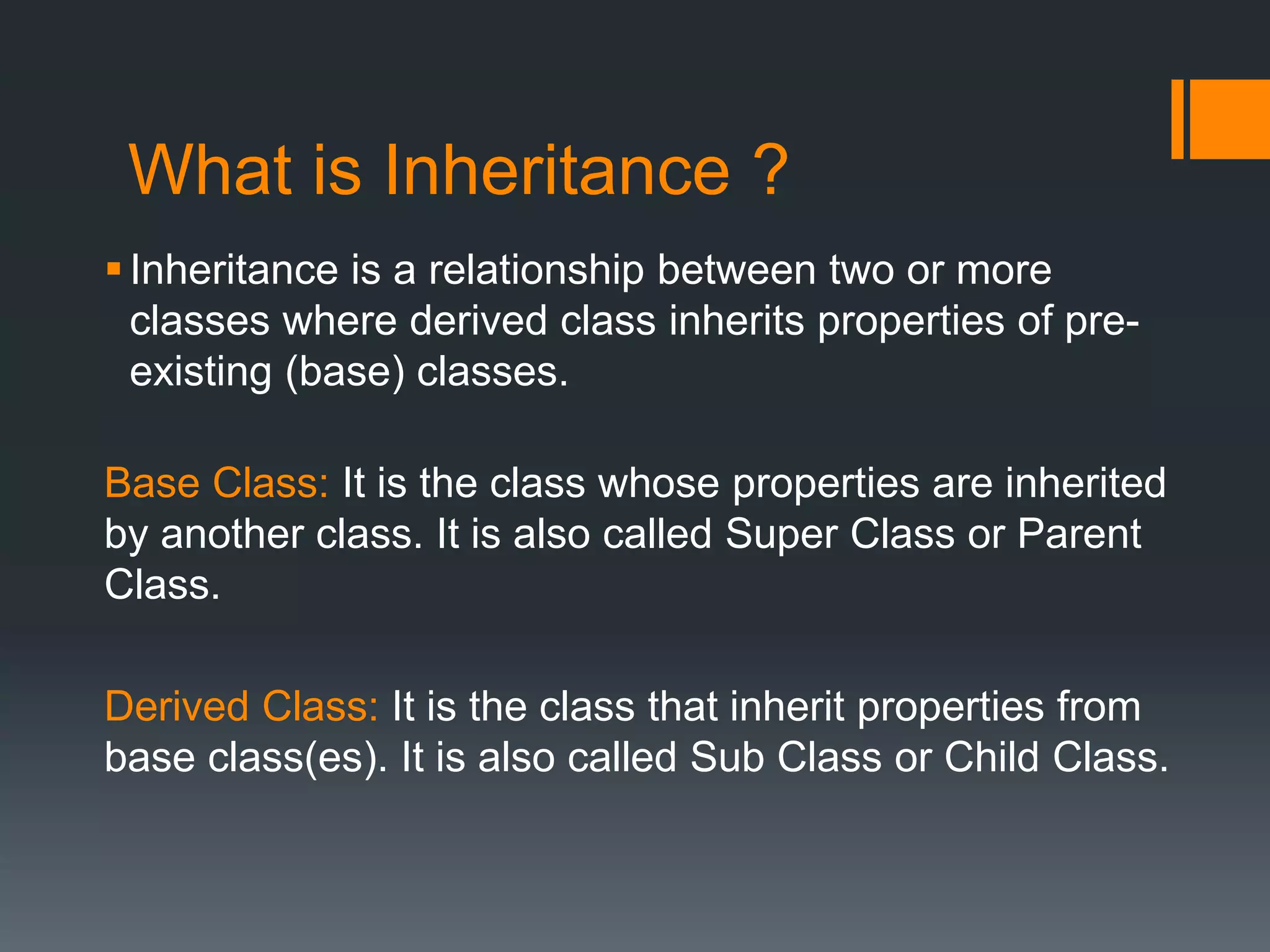
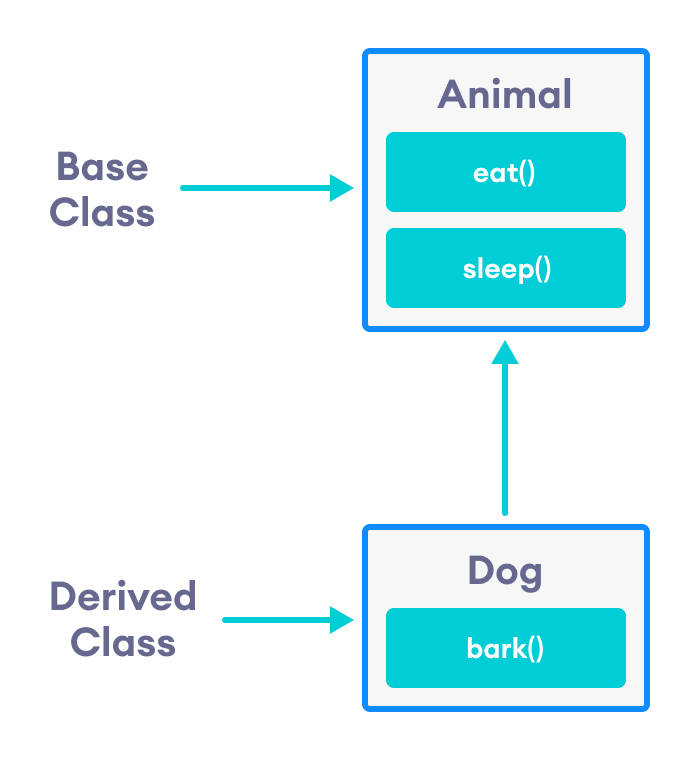
At its simplest, inheritance is a relationship between two classes. The class whose properties and methods are being inherited is referred to as the base class, parent class, or superclass. The class that inherits these features is known as the derived class, child class, or subclass.
The fundamental logic behind this relationship is the “is-a” relationship. For example, if we have a base class called Vehicle, a derived class might be Car. Since a car is a vehicle, it logically inherits characteristics common to all vehicles, such as a maximum speed, a fuel type, and the ability to move. However, the Car class can also have its own unique properties, such as a trunk capacity or a specific number of doors, which are not necessarily shared by all vehicles (like motorcycles or boats).
The “Is-A” Relationship vs. The “Has-A” Relationship
Distinguishing between inheritance and composition is a hallmark of an experienced developer. While inheritance represents an “is-a” relationship, composition represents a “has-a” relationship. For instance, a Car is a Vehicle (inheritance), but a Car has an Engine (composition). Understanding this distinction prevents the misuse of inheritance in scenarios where the classes do not share a hierarchical bond.
Code Reusability and the DRY Principle
The primary motivation for using inheritance is the “Don’t Repeat Yourself” (DRY) principle. Without inheritance, if you were building an application for a zoo, you might find yourself writing the same code for eat(), sleep(), and breathe() methods for every single animal class (Lion, Tiger, Bear). By using inheritance, you can define these common behaviors once in an Animal base class and have every specific animal class inherit them. This centralizes the logic, making the code easier to update and debug.
Exploring the Different Types of Inheritance
Not all inheritance structures are created equal. Depending on the programming language and the architectural needs of the software, inheritance can take several forms.
Single Inheritance
Single inheritance is the most straightforward form, where a subclass inherits from exactly one superclass. This creates a simple, linear hierarchy. It is easy to manage and is the standard form of inheritance in languages like Java and C#. While simple, it is incredibly powerful for creating clear taxonomies of data.
Multilevel Inheritance
In multilevel inheritance, a derived class acts as a base class for another class. For example, a Grandchild class inherits from a Child class, which in turn inherits from a Parent class. This allows for increasingly specific layers of abstraction. In a software system for a library, you might have Media -> Book -> HardcoverBook. Each level adds more specialized attributes.
Hierarchical Inheritance
Hierarchical inheritance occurs when multiple subclasses inherit from a single base class. This is common in UI frameworks, where a base Component class might be inherited by Button, TextBox, and Slider. All these elements share common traits like position and color, but they function differently.
Multiple Inheritance
Multiple inheritance allows a single subclass to inherit features from more than one parent class. While powerful, it is also controversial. It can lead to the “Diamond Problem,” where a subclass inherits from two parents that both inherit from a single grandparent. If the parents have overridden a method from the grandparent, the compiler may not know which version the grandchild should use. Because of this complexity, languages like Java and C# do not allow multiple inheritance of classes, though they allow it through interfaces.
Hybrid Inheritance
Hybrid inheritance is a combination of two or more of the types mentioned above. This is often seen in large-scale enterprise applications where the data models are complex and require multifaceted relationships.
Access Modifiers and the Scope of Inheritance
One of the nuances of inheritance is that a child class does not always have access to every part of its parent class. This is where access modifiers—keywords that define the visibility of class members—come into play.
Public Access
Members declared as public in the base class are accessible by the derived class and any other part of the program. This is the most permissive level of access.
Protected Access
The protected modifier is specifically designed with inheritance in mind. A protected member is not accessible to the general public or other unrelated classes, but it is accessible to derived classes. This allows a parent class to share “family secrets” with its children while keeping them hidden from the rest of the world.
Private Access
Members declared as private are strictly off-limits to derived classes. Even though the child class technically contains these members, it cannot access or modify them directly. To interact with private members of a parent class, a child class must use public or protected “getter” and “setter” methods provided by the parent.
Method Overriding and the Role of Polymorphism
Inheritance would be limited if child classes were forced to behave exactly like their parents. To address this, OOP provides Method Overriding. This allows a subclass to provide a specific implementation of a method that is already defined in its superclass.
Customizing Behavior
Consider a base class Shape with a method calculateArea(). A Circle subclass and a Square subclass would both inherit this method, but the mathematical formula for calculating the area is different for each. By overriding calculateArea(), the Circle class can implement πr² while the Square class implements side * side.
The super Keyword
In many instances, a child class doesn’t want to completely replace a parent’s behavior, but rather augment it. Using the super (in Java/Python) or base (in C#) keyword allows the derived class to call the parent’s version of a method before or after adding its own specific logic. This ensures that the foundational work done by the parent class is not lost.
Abstract Classes and Interfaces
Sometimes, a base class is so general that it doesn’t make sense to create an instance of it. This is known as an Abstract Class. An abstract class serves as a blueprint for other classes but cannot be instantiated itself. It can contain “abstract methods”—methods that have no body and must be overridden by any non-abstract subclass. This enforces a contract, ensuring that all children follow a specific structure.
Best Practices: Inheritance vs. Composition
While inheritance is a potent tool, it is often overused by novice developers, leading to “fragile base class” syndrome. This occurs when a change to a parent class inadvertently breaks functionality in dozens of descendant classes. To build robust software, one must adhere to certain best practices.
Favor Composition Over Inheritance
Modern design patterns often suggest that developers should “favor composition over inheritance.” Composition allows you to build complex objects by combining simpler ones, rather than relying on a rigid hierarchy. This leads to more flexible code because relationships can be changed at runtime, whereas inheritance relationships are fixed at compile time.
The Liskov Substitution Principle (LSP)
A key rule in the SOLID principles of software design is the Liskov Substitution Principle. It states that objects of a superclass should be replaceable with objects of its subclasses without breaking the application. If a Penguin class inherits from a Bird class, but the Bird class has a fly() method that the Penguin cannot perform, the inheritance hierarchy is flawed. In such cases, the hierarchy should be refactored to ensure logical consistency.
Keeping Hierarchies Shallow
Deep inheritance trees (where a class is a child of a child of a child…) can become incredibly difficult to navigate and maintain. As a general rule, if your inheritance hierarchy is more than three or four levels deep, it may be time to reconsider your architecture. Shallow hierarchies are easier to test, document, and understand.
Conclusion: The Strategic Value of Inheritance
Inheritance remains a cornerstone of the technology industry’s approach to software construction. By enabling the creation of hierarchical relationships and promoting code reuse, it allows teams to build massive systems that remain organized and logical. From the low-level structures of operating systems to the high-level frameworks used to build modern web applications, inheritance provides the scaffolding that makes complex logic manageable.
However, the true power of inheritance lies in its disciplined application. When used correctly, it creates elegant, intuitive codebases that are a joy to maintain. When misused, it can create a tangled web of dependencies. As AI and automated coding tools continue to evolve, the fundamental architectural decisions—like how to structure inheritance—remain the domain of the skilled software engineer, ensuring that systems are not just functional, but built to last.
aViewFromTheCave is a participant in the Amazon Services LLC Associates Program, an affiliate advertising program designed to provide a means for sites to earn advertising fees by advertising and linking to Amazon.com. Amazon, the Amazon logo, AmazonSupply, and the AmazonSupply logo are trademarks of Amazon.com, Inc. or its affiliates. As an Amazon Associate we earn affiliate commissions from qualifying purchases.