
When financial news anchors announce that “the market is up,” they are almost always referring to one specific number: the Dow Jones Industrial Average (DJIA). Often simply called “the Dow,” this index is the heartbeat of Wall Street, serving as a pulse-check for the health of the American economy. But for many individual investors, the Dow remains a bit of a mystery. Is it a list of tech companies? Is it a measure of all stocks?
In reality, the Dow is a curated collection of 30 “blue-chip” companies—reputable, stable, and industry-leading giants that represent the broad landscape of U.S. commerce. Understanding what is in the Dow, how those companies are chosen, and why the index is calculated differently than almost every other financial benchmark is essential for any serious investor.
Understanding the DNA of the Dow Jones Industrial Average
To understand what is currently in the Dow, one must first understand what the Dow is meant to be. Founded in 1896 by Charles Dow and Edward Jones, the index was originally designed to track the performance of the industrial sector. At its inception, it contained only 12 companies, most of which were involved in railroads, cotton, gas, and tobacco. Today, the “Industrial” part of the name is largely a historical vestige; the modern index spans technology, healthcare, finance, and consumer goods.
The History and Purpose of the DJIA
The Dow was created as a way to simplify the chaos of the stock market for the average person. Charles Dow believed that by tracking the most important companies in the economy, he could provide a snapshot of general business health. If the Dow was rising, the economy was likely expanding.
Over the last 130 years, the index has evolved from a simple average of stock prices into a sophisticated benchmark. While it only tracks 30 companies—a tiny fraction of the thousands of stocks traded on the New York Stock Exchange (NYSE) and the Nasdaq—those 30 companies are so massive that their performance often mirrors the direction of the entire market.
How a Price-Weighted Index Differs from Market Cap
Perhaps the most unique aspect of what is in the Dow is how it is calculated. Most modern indices, like the S&P 500, are “market-cap weighted,” meaning larger companies have a bigger impact on the index’s movement. The Dow, however, is “price-weighted.”
In a price-weighted index, the stock price per share determines the influence of a company. A company with a stock price of $200 will have double the impact on the Dow’s movement as a company with a stock price of $100, regardless of the actual size of the company. To keep the index consistent when stocks split or companies are replaced, the Dow uses a “Dow Divisor”—a mathematical constant that adjusts the total sum of the prices.
The Components: Who Makes the Cut?
The Dow is not a permanent list. It is a living document of the American economy. To be included in the Dow, a company must be incorporated in the U.S., listed on the NYSE or Nasdaq, and be a leader in its respective industry. Because there are only 30 slots, the competition to be a “Dow component” is fierce.
The Sector Breakdown: Diversification Across the U.S. Economy
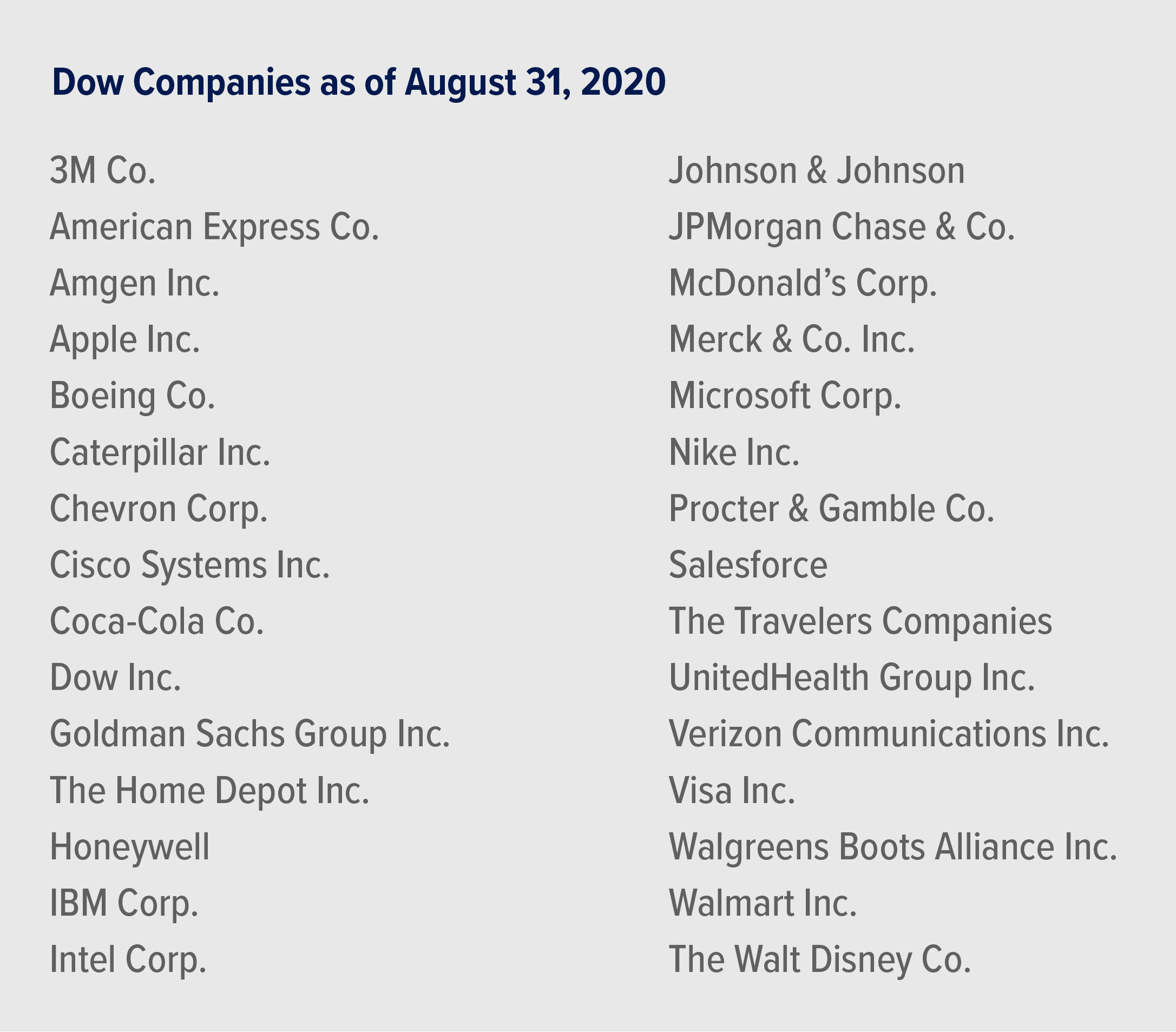
The Dow is meticulously balanced to ensure it isn’t too heavily weighted toward a single industry. If you look at what is in the Dow today, you will find a cross-section of the economy:
- Information Technology: This includes giants like Microsoft and Apple. These companies represent the modern backbone of global commerce.
- Financials: Legacy institutions like Goldman Sachs, JPMorgan Chase, and Visa provide insight into the health of the banking and credit sectors.
- Healthcare: With companies like UnitedHealth Group and Johnson & Johnson, the Dow tracks the massive healthcare spending that defines the U.S. demographic shift.
- Consumer Staples and Discretionary: From Walmart and Coca-Cola to Amazon and McDonald’s, these components track how everyday Americans are spending their paychecks.
- Industrials: Keeping to its roots, the index includes Boeing, Caterpillar, and Honeywell.
Identifying the “Blue-Chip” Standard
The term “blue-chip” comes from poker, where blue chips have the highest value. In the context of the Dow, a blue-chip company is one that has a reputation for quality, reliability, and the ability to operate profitably in both good times and bad.
Most companies in the Dow are household names. They are often “dividend aristocrats” or “dividend kings,” meaning they have a long history of paying out profits to shareholders. When you buy the Dow, you aren’t betting on a speculative startup; you are betting on the established pillars of the global economy.
The Selection Process: How the Dow Evolves
Unlike the S&P 500, which uses a strict formulaic approach based on market capitalization, the Dow is managed by a committee. The Averages Committee at S&P Dow Jones Indices meets regularly to determine which companies should stay and which should go.

The Role of the Averages Committee
There are no rigid rules for inclusion in the Dow. Instead, the committee looks for companies with an excellent reputation, sustained growth, and interest to a large number of investors. They also strive to maintain a balance that reflects the current makeup of the U.S. gross domestic product (GDP).
If a company’s stock price becomes too high (making it too influential in the price-weighted index) or too low (making it irrelevant), or if its industry is in secular decline, the committee may decide to swap it out for a more relevant player.
Recent Shifts: Tech Dominance and Modern Replacements
In recent years, the Dow has undergone significant changes to better reflect the digital economy. One of the most notable shifts occurred in early 2024, when Amazon replaced Walgreens Boots Alliance. This move signaled a shift away from traditional retail pharmacy toward e-commerce and cloud computing.
More recently, the inclusion of Nvidia—the leader in Artificial Intelligence chips—to replace Intel marked a watershed moment. It confirmed that the Dow is no longer just about “smoke-stack” industries like steel and oil, but about the silicon and software driving the next industrial revolution. These changes ensure that the Dow remains a forward-looking indicator rather than a museum of 20th-century business.
Why the Dow Matters to Your Portfolio
While many professional traders prefer the S&P 500 because it is more diversified, the Dow remains a critical tool for personal finance and portfolio management. Because it tracks only 30 stocks, it is easier for individual investors to analyze and understand.
Using the Dow as an Economic Barometer
The Dow is often the first indicator of “investor sentiment.” Because the 30 companies are so intertwined with global trade, the index is highly sensitive to geopolitical events, interest rate changes, and trade reports. If the Dow is trending upward, it usually suggests that large-cap corporate America is seeing strong earnings and a favorable regulatory environment. For the long-term investor, the Dow provides a “macro” view that helps in making decisions about asset allocation.
Investment Strategies: How to Trade the Dow
You cannot “buy” the Dow Jones Industrial Average directly because it is an index, not a stock. However, there are several ways to gain exposure to it:
- Index ETFs: The most popular way is through the SPDR Dow Jones Industrial Average ETF Trust (ticker: DIA), often called “Diamonds.” This fund holds all 30 stocks in the index in the same proportions.
- The “Dogs of the Dow” Strategy: This is a popular value-investing strategy where an investor buys the 10 companies in the Dow with the highest dividend yields at the beginning of the year. The theory is that these companies are temporarily undervalued and will see a price correction (and high income) over the next 12 months.
- Individual Stock Picking: Some investors use the Dow as a “shopping list.” Since these 30 companies have already been vetted by a committee for their stability and leadership, they represent a safer starting point for a personal portfolio than the broader market.
The Limitations and Future of the Index
No index is perfect, and the Dow has its share of critics. As the financial world becomes more data-driven, some argue that the Dow’s methodology is an artifact of a bygone era.
Criticisms of the Price-Weighting Model
The primary criticism of the Dow is its price-weighted nature. Because a company’s weight is determined by its share price, a $500 stock has 10 times the influence of a $50 stock, even if the $50 company is actually larger in terms of total market value.
For example, if Goldman Sachs (which typically has a high share price) moves by 5%, it will move the Dow much more than if Coca-Cola (which typically has a lower share price) moves by 5%. Critics argue this is an arbitrary way to measure the economy, as stock prices are often influenced by splits and buybacks rather than fundamental business value.
Staying Relevant in a Digital Age
Despite these criticisms, the Dow remains the most recognizable brand in finance. Its longevity is its greatest strength; it provides a continuous data set that stretches back over a century, allowing economists to compare today’s market to the Great Depression, the post-war boom, and the dot-com bubble.
As we move deeper into the age of AI and green energy, the Dow will continue to transform. We can expect to see more service-oriented and technology-driven companies enter the fold, while legacy industrial or energy companies that fail to innovate may find themselves removed.
Conclusion: The Dow as a Financial Compass
“What is in the Dow” is a question that changes with the times, but the answer always points toward the leaders of the American economy. From the massive cloud infrastructures of Microsoft to the global logistics of Walmart, the 30 components of the Dow Jones Industrial Average represent the pinnacle of corporate success.
For the individual investor, the Dow is more than just a number on a screen. it is a curated collection of the world’s most resilient businesses. By understanding how these 30 powerhouses interact, how they are weighted, and why they are chosen, you can gain a clearer perspective on the health of your own investments and the broader financial world. Whether you invest through ETFs or use the index as a benchmark for your own stock picks, the Dow remains an indispensable compass in the complex landscape of modern finance.
aViewFromTheCave is a participant in the Amazon Services LLC Associates Program, an affiliate advertising program designed to provide a means for sites to earn advertising fees by advertising and linking to Amazon.com. Amazon, the Amazon logo, AmazonSupply, and the AmazonSupply logo are trademarks of Amazon.com, Inc. or its affiliates. As an Amazon Associate we earn affiliate commissions from qualifying purchases.