
Understanding your total compensation goes beyond your base salary. Many employees receive various benefits from their employers, some of which hold a taxable value even if no cash changes hands. This concept is central to “imputed income,” and one of its most common manifestations involves Group Term Life (GTL) insurance. For individuals navigating their personal finances and tax obligations, grasping what imputed income GTL entails is crucial for accurate financial planning and tax compliance.
Decoding Imputed Income
Imputed income, in its simplest form, is the fair market value of a non-cash benefit or service that an employee receives from their employer, which the Internal Revenue Service (IRS) considers taxable income. Despite not being paid in cash, these benefits add to an employee’s gross income and are subject to federal income tax, Social Security, and Medicare taxes. The core idea is to account for the economic value provided by the employer, treating it as if the employee had received cash and then used that cash to purchase the benefit themselves.
The Core Concept
Imagine your employer providing a perk that would ordinarily cost you money if you had to pay for it out-of-pocket. The IRS sees this as an economic gain. While it might feel like a free benefit, the government often views it as a form of compensation that should be taxed. Imputed income is not unique to GTL; it can arise from various employer-provided benefits such as tuition reimbursement, personal use of a company car, or even certain moving expenses. The key differentiator is that it’s a non-cash benefit that adds to your taxable income without adding to your take-home pay directly. This means you are paying taxes on income you never physically received, which can sometimes come as a surprise if you’re not aware of the rules.
Why it Matters to You
For employees, understanding imputed income is vital for several reasons. Firstly, it directly impacts your total taxable income, which in turn affects your tax liability. A higher taxable income can push you into a higher tax bracket or reduce the effectiveness of certain tax credits and deductions. Secondly, it explains why your gross income on your W-2 might be higher than your actual cash earnings. This discrepancy can be confusing if you’re only tracking your direct deposits. Finally, an awareness of imputed income helps you make informed decisions about your benefits package. Knowing the true cost, including tax implications, of an employer-provided benefit allows you to better evaluate its value to you and plan your budget accordingly. For employers, accurate calculation and reporting of imputed income are critical for compliance with IRS regulations and avoiding penalties.
Group Term Life Insurance (GTL) and the $50,000 Threshold
One of the most common scenarios where imputed income comes into play is with employer-provided Group Term Life (GTL) insurance. Many companies offer GTL coverage as a standard benefit, often providing a multiple of an employee’s salary or a flat amount. While this is a valuable benefit, the IRS has specific rules governing its taxability, particularly when the coverage exceeds a certain threshold.
Understanding Employer-Provided GTL
Group Term Life insurance is a type of life insurance policy offered by an employer to a group of employees. It’s typically provided at a lower cost than individual policies, if not entirely free to the employee, and often doesn’t require a medical exam. The “term” aspect means it provides coverage for a specific period, and if the employee leaves the company, the coverage usually terminates or becomes convertible to an individual policy at a potentially higher rate. Employers offer GTL as an attractive employee benefit, providing a financial safety net for employees’ beneficiaries in the event of their death. It’s a key component of many compensation packages, designed to attract and retain talent.
The IRS Rule: Section 79
The critical detail for GTL and imputed income is found in Section 79 of the Internal Revenue Code. This section states that the cost of employer-provided group term life insurance coverage up to $50,000 is generally excludable from an employee’s gross income. In other words, if your employer provides you with $50,000 or less in GTL coverage, you don’t have to pay taxes on the value of that coverage. It’s a completely tax-free benefit.
However, if your employer provides more than $50,000 in GTL coverage, the cost of the coverage above that $50,000 threshold is considered taxable imputed income. The IRS believes that any coverage exceeding this amount provides a significant personal benefit to the employee, and therefore its value should be recognized as income. This imputed income is then subject to federal income tax, Social Security (FICA), and Medicare taxes, even though you never actually receive the money. This rule applies regardless of whether the employee contributes to the cost of the insurance; it’s based purely on the amount of employer-paid coverage exceeding $50,000.
Calculating Imputed Income for GTL
The calculation of imputed income for GTL is not based on the actual premium your employer pays to the insurance company. Instead, the IRS provides a standardized method using what’s known as the Uniform Premium Table. This ensures consistency across all employers and employees.
The IRS Uniform Premium Table
The IRS Uniform Premium Table (often referred to as Table I) provides a monthly cost per $1,000 of coverage, based on the employee’s age. These rates are generally lower than what an individual would pay for private life insurance, but they serve as the official basis for calculating the taxable imputed income. The rates increase with age, reflecting the higher risk associated with insuring older individuals.
Here’s a simplified look at how the table works (actual rates can vary and are updated periodically by the IRS):
| Age Bracket | Monthly Cost per $1,000 of Coverage |
|---|---|
| Under 25 | $0.05 |
| 25 to 29 | $0.06 |
| 30 to 34 | $0.08 |
| 35 to 39 | $0.09 |
| 40 to 44 | $0.10 |
| 45 to 49 | $0.15 |
| 50 to 54 | $0.23 |
| 55 to 59 | $0.43 |
| 60 to 64 | $0.66 |
| 65 to 69 | $1.27 |
| 70 and over | $2.06 |
(Note: These are illustrative rates; always refer to the latest IRS publications for current Table I rates.)
A Practical Example
Let’s illustrate with an example:
- An employee is 47 years old.
- Their employer provides $150,000 in Group Term Life insurance coverage.
- From the table above, the monthly cost per $1,000 for a 47-year-old (age bracket 45-49) is $0.15.

Step 1: Determine the taxable coverage amount.
Taxable coverage = Total GTL coverage – $50,000 exclusion
Taxable coverage = $150,000 – $50,000 = $100,000
Step 2: Calculate the monthly imputed income.
Monthly imputed income = (Taxable coverage / $1,000) * Monthly cost per $1,000
Monthly imputed income = ($100,000 / $1,000) * $0.15 = 100 * $0.15 = $15.00
Step 3: Calculate the annual imputed income.
Annual imputed income = Monthly imputed income * 12
Annual imputed income = $15.00 * 12 = $180.00
In this example, $180 would be added to the employee’s gross income for the year, subject to applicable taxes, even though they never received this cash directly.
What is NOT Imputed
It’s important to distinguish what doesn’t fall under the imputed income rules for GTL.
- Coverage up to $50,000: As discussed, the first $50,000 of employer-provided GTL is tax-free.
- Employee-paid premiums: If an employee pays for additional life insurance coverage beyond what the employer provides, those premiums are generally paid with after-tax dollars and are not subject to imputed income rules.
- Certain beneficiaries: If the sole beneficiary of the GTL policy is the employer, or a qualified charity, the value of the coverage is typically not considered imputed income to the employee. This is because the employee does not derive a personal economic benefit in such cases.
- Dependent GTL: While employer-provided GTL for dependents may also be subject to imputed income rules, it has separate thresholds and calculations, typically involving a small amount ($2,000 to $4,000) that is generally excluded from income.
Tax Implications and Financial Planning
The calculation of imputed income for GTL is just the first step; understanding its impact on your taxes and overall financial strategy is equally important. This non-cash income has real consequences for your paycheck and your annual tax return.
Reporting on Your W-2
Your employer is responsible for calculating the imputed income from your GTL coverage (and other applicable benefits) and reporting it correctly. This amount will typically appear on your Form W-2, Wage and Tax Statement, in Box 1 (Wages, tips, other compensation), Box 3 (Social Security wages), and Box 5 (Medicare wages). It’s crucial for employers to accurately track and report these amounts throughout the year, as errors can lead to tax penalties for both the employer and the employee. For employees, seeing a higher amount in Box 1 than their actual cash wages is often the first indicator that they have imputed income. It’s a good practice to reconcile your pay stubs with your W-2 to ensure accuracy.
Impact on Gross Income and Taxes
The most direct impact of imputed income is on your gross income. By increasing your reported gross income, it can effectively raise your taxable income, potentially pushing you into a higher income tax bracket. This means a larger portion of your actual cash earnings could be taxed at a higher rate. Furthermore, imputed income for GTL is also subject to Social Security and Medicare taxes (FICA). Your employer will withhold these taxes from your paycheck, which reduces your net take-home pay, even though you haven’t received the cash equivalent of the imputed income. Understanding this mechanism helps you avoid surprises when reviewing your pay stubs and planning your budget, as your net pay is reduced by taxes on income you don’t physically receive.
Strategic Considerations for Employees and Employers
For Employees:
- Review Your Benefits: Periodically evaluate the GTL coverage offered by your employer. If you have substantial coverage above $50,000, understand the tax implications.
- Budgeting: Be aware that your net pay will be slightly lower due to taxes on imputed income. Factor this into your personal budgeting.
- Tax Planning: If you anticipate a significant amount of imputed income, consider adjusting your W-4 withholdings to avoid underpayment penalties or a large tax bill at year-end.
- Alternative Coverage: Compare the value and cost of your employer’s GTL (including imputed income taxes) against private term life insurance policies. Sometimes, purchasing supplemental private coverage might be more tax-efficient, especially for high earners with substantial employer-provided GTL.
For Employers:
- Compliance: Meticulously follow IRS guidelines for calculating and reporting imputed income on Form W-2.
- Communication: Clearly communicate to employees about their GTL benefits, the $50,000 threshold, and the concept of imputed income. Transparency helps employees understand their pay and benefits better.
- Benefit Design: When structuring GTL plans, employers might consider the imputed income burden on employees, especially for higher coverage amounts, and weigh it against the benefit’s attractiveness.
Beyond GTL: Other Forms of Imputed Income
While Group Term Life insurance is a prominent example, imputed income extends to various other employer-provided benefits. A comprehensive understanding of this concept means recognizing its broader applicability.
Employer-Provided Benefits
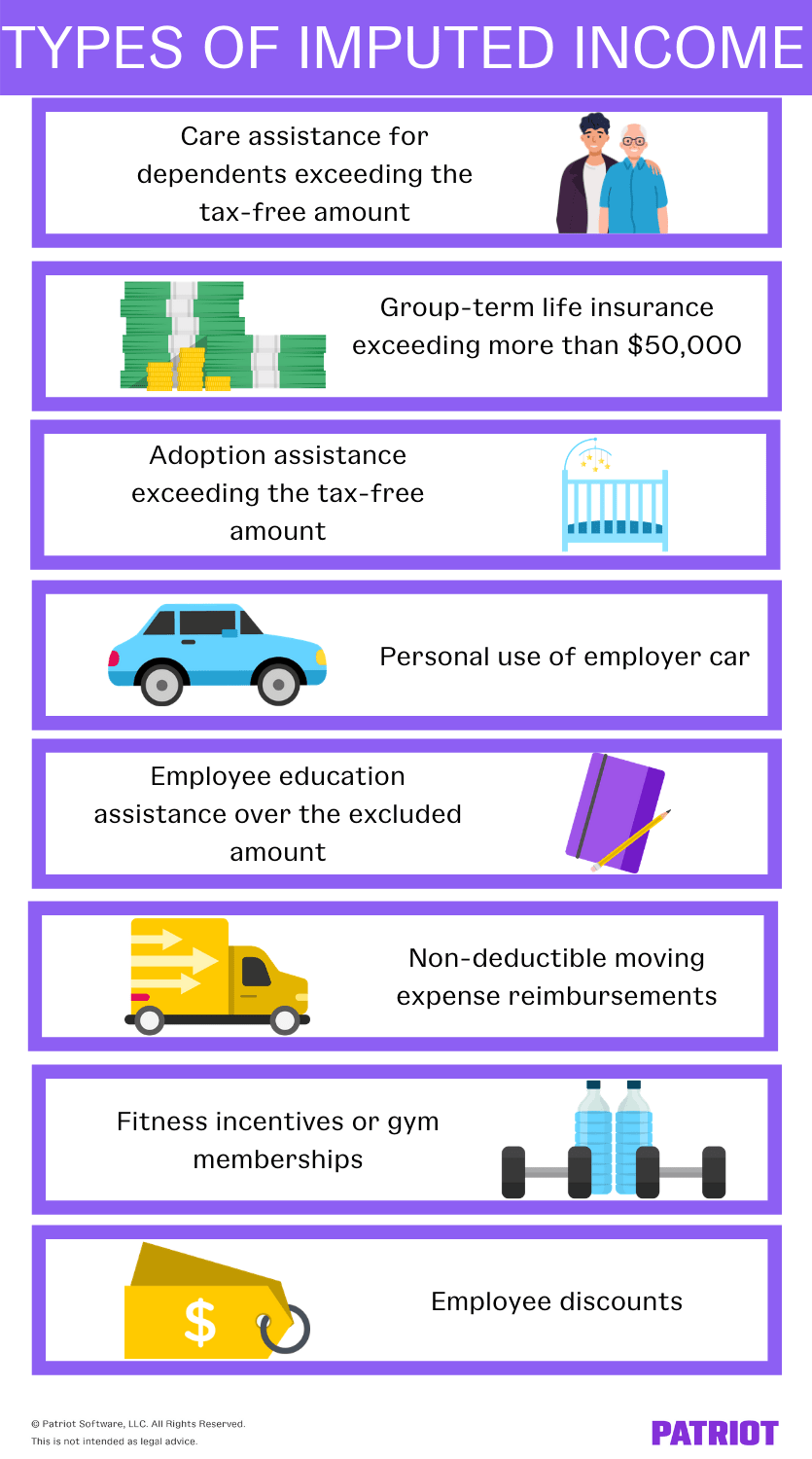
Many benefits employers offer, if not explicitly excluded by tax law, can create imputed income. These include:
- Personal Use of a Company Car: If an employee uses a company car for personal travel, the value of that personal use is typically imputed as income.
- Educational Assistance (above limits): While employers can offer up to a certain amount (e.g., $5,250 annually) in tax-free educational assistance, any amount exceeding this limit becomes imputed income.
- Dependent Care Assistance (above limits): Similar to educational assistance, benefits for dependent care exceeding a specified annual limit (e.g., $5,000) are treated as imputed income.
- Employee Discounts: Highly discounted goods or services, if they exceed certain IRS limits, can result in imputed income.
- Non-Cash Prizes and Awards: Gifts or awards from an employer that are not considered de minimis (insignificant) or qualified achievement awards are often taxable as imputed income.
- Moving Expenses: Unless directly related to the benefit of the employer (e.g., a job transfer) and meeting specific IRS criteria, employer-paid moving expenses can be imputed income.
- Health Savings Account (HSA) Contributions (for non-eligible individuals): If an employer contributes to an HSA for an employee who is not eligible for an HSA, those contributions are generally imputed income.
- Parking and Transit Benefits (above limits): While certain commuter benefits are tax-free up to a monthly limit, anything beyond that limit is imputed income.
The key takeaway is that if an employer provides a non-cash benefit that saves the employee money they would otherwise spend, and that benefit isn’t specifically excluded from income by tax law, it’s a strong candidate for imputed income.

Related-Party Transactions
Beyond the employer-employee relationship, the concept of imputed income can also arise in related-party transactions, particularly concerning interest-free or below-market rate loans. If, for instance, a shareholder or family member provides a loan to a related party at no interest or an interest rate below the Applicable Federal Rate (AFR) set by the IRS, the difference between the actual interest paid (or zero) and the interest that would have been paid at the AFR can be “imputed” as income to the borrower, and sometimes as a gift from the lender. This is to prevent tax avoidance through non-commercial transactions between related parties. While less common in day-to-day employment, it highlights the broader principle of taxing the economic benefit derived from non-cash or non-market-rate arrangements.
Navigating the nuances of imputed income, especially concerning GTL, is an essential part of responsible personal financial management. By understanding how these non-cash benefits affect your tax liability, you can better plan your finances and ensure compliance.
aViewFromTheCave is a participant in the Amazon Services LLC Associates Program, an affiliate advertising program designed to provide a means for sites to earn advertising fees by advertising and linking to Amazon.com. Amazon, the Amazon logo, AmazonSupply, and the AmazonSupply logo are trademarks of Amazon.com, Inc. or its affiliates. As an Amazon Associate we earn affiliate commissions from qualifying purchases.