
The world of employment involves a significant amount of administrative detail, and one of the most critical pieces of documentation for anyone hired to work in the United States is the Form I-9, Employment Eligibility Verification. While the title “What is I-9 Paperwork?” might sound straightforward, the reality is that understanding and correctly completing this form is crucial for both employers and employees to ensure legal compliance and a smooth onboarding process. This guide will delve into the intricacies of the Form I-9, exploring its purpose, who needs it, how it works, and its implications within the broader landscape of technology, brand, and money that businesses navigate daily.

Understanding the Foundation: Purpose and Requirements of the Form I-9
At its core, the Form I-9 is a document mandated by the U.S. government to verify the identity and employment authorization of individuals hired for employment in the United States. Its primary purpose is to prevent unauthorized employment of foreign nationals and to ensure that all workers are legally permitted to work in the country. This is not a form for immigration status itself, but rather a verification that the individual presenting themselves for employment meets the legal requirements to be hired.
The Immigration Reform and Control Act of 1986 (IRCA) established the requirement for employers to verify the employment eligibility of all individuals they hire. This includes U.S. citizens, permanent residents, and individuals authorized to work in the U.S. for a specific period, such as those with temporary work visas. The Form I-9 is the standard method for fulfilling this legal obligation.
Who Needs to Complete the Form I-9?
The responsibility for completing the Form I-9 falls on two parties: the employee and the employer.
-
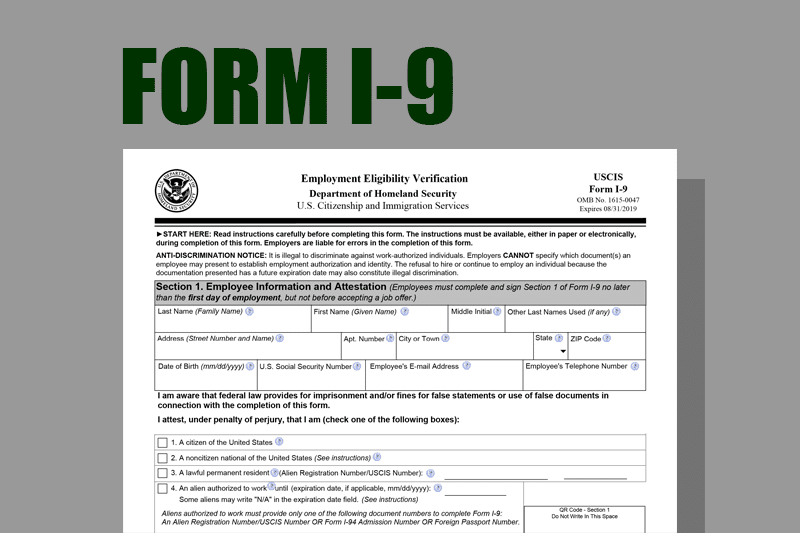
The Employee: Every individual hired for employment in the U.S. must complete Section 1 of the Form I-9. This section requires the employee to provide personal information, attest to their citizenship or immigration status, and present original documentation to prove both their identity and employment authorization. The employee must complete this section no later than their first day of employment.
-
The Employer: The employer is responsible for examining the original documentation presented by the employee and completing Section 2 of the Form I-9. This section involves reviewing the documents to ensure they appear genuine and relate to the person presenting them. The employer must complete Section 2 within three business days of the employee’s first day of employment. Employers are explicitly prohibited from specifying which documents an employee may present; the employee chooses from the lists provided on the form.
It’s important to note that the Form I-9 is required for all hires, regardless of whether the position is full-time, part-time, or temporary. The only exceptions are for individuals who are hired for casual domestic employment on a sporadic, irregular, or intermittent basis, or those who are providing contract or temporary services through a staffing agency (in which case the staffing agency is responsible for the I-9).
The Criticality of Documentation: Lists A, B, and C
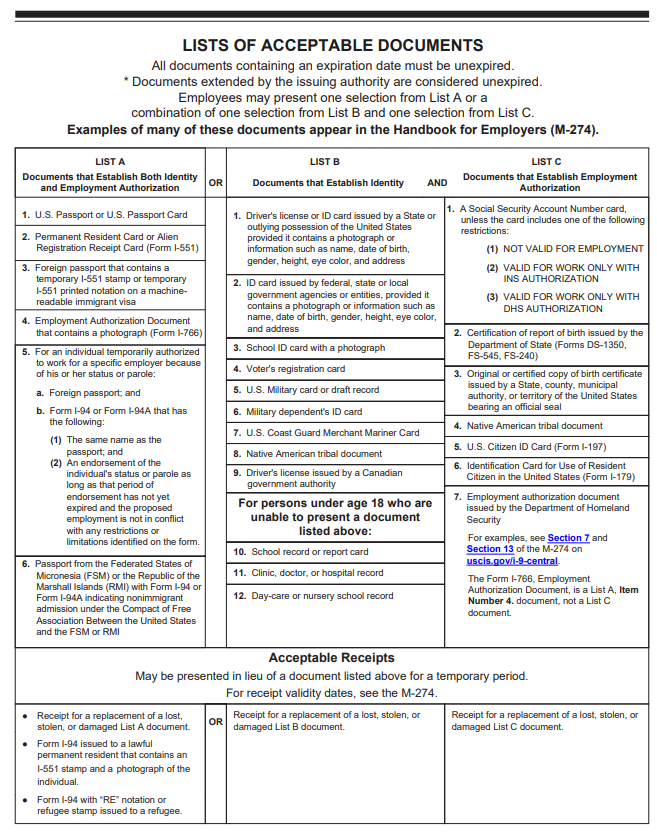
The backbone of the Form I-9 process lies in the acceptable documentation that employees can present. The U.S. Citizenship and Immigration Services (USCIS) provides specific lists of acceptable documents. Employees must present one document from List A (which establishes both identity and employment authorization) or a combination of one document from List B (establishing identity) and one document from List C (establishing employment authorization).
-
List A: Documents that Establish Both Identity and Employment Authorization: Examples include a U.S. passport, a Permanent Resident Card (Green Card), or an Employment Authorization Document (EAD).
-
List B: Documents that Establish Identity: Examples include a driver’s license, a state-issued identification card, or a U.S. military card.
-
List C: Documents that Establish Employment Authorization: Examples include a Social Security card or a birth certificate issued by a U.S. state, county, or municipality.
The employer’s role is to carefully examine these documents. They must ensure that the documents are reasonably genuine and appear on their face to be valid. This is a crucial step in the employer’s due diligence. Employers are not expected to be document experts, but they must exercise reasonable care in their examination.
Navigating the I-9 Process in the Digital Age and Beyond
The landscape of work has been dramatically reshaped by technology, and this inevitably impacts how HR processes, including the Form I-9, are handled. The traditional paper-based system is giving way to more efficient digital solutions.
Technology’s Role in I-9 Compliance
The rise of Human Resources Information Systems (HRIS) and dedicated onboarding software has revolutionized the I-9 process. These platforms offer several advantages:
-
Digital Completion and Storage: Employees can often complete Section 1 of the Form I-9 electronically before their first day. Employers can then use these systems to digitally capture or upload completed forms and store them securely. This eliminates the need for physical filing and reduces the risk of lost or misplaced documents.
-
Automated Reminders and Audits: HRIS can be programmed to send automatic reminders for I-9 completion deadlines, ensuring that employers remain compliant. They can also facilitate internal audits to identify any potential issues or missing information before a government audit occurs.
-
Remote Employee Onboarding: With the increase in remote work, technologies that enable remote I-9 verification are becoming increasingly vital. While direct examination of original documents is still the gold standard, USCIS has provided guidance on remote verification options, often involving authorized representatives or video conferencing. Companies must stay abreast of these evolving guidelines to ensure compliance for their distributed workforce.
-
Integration with Other HR Functions: Digital I-9 solutions can often integrate with payroll systems, timekeeping software, and other HR functions. This creates a more seamless and efficient overall HR operation, reducing data duplication and potential errors.
From a Tech perspective, the efficient and secure management of I-9 paperwork is a key component of a robust HR technology stack. Investing in user-friendly and compliant software can save time, reduce risk, and improve the overall employee experience during onboarding.
Brand Implications of I-9 Management
The way a company handles its hiring and onboarding processes, including the I-9 verification, has a significant impact on its Brand reputation.
-
Positive Employee Experience: A smooth, efficient, and transparent I-9 process contributes to a positive first impression for new hires. This reflects well on the company’s professionalism and attention to detail, fostering a sense of trust and confidence from day one. Conversely, a cumbersome or confusing I-9 process can create stress and frustration, negatively impacting an employee’s initial perception of the organization.
-
Legal Compliance and Reputation: Non-compliance with I-9 regulations can lead to significant penalties, including fines and legal repercussions. Such issues can tarnish a company’s reputation, making it less attractive to potential employees, customers, and investors. A strong commitment to legal compliance, including meticulous I-9 management, signals a responsible and well-governed organization.
-
Diversity and Inclusion: Ensuring that the I-9 process is fair and equitable for all individuals, regardless of their background or immigration status, is a crucial aspect of a company’s commitment to diversity and inclusion. Providing clear instructions and accessible support for completing the form helps to create an inclusive environment.
A company’s Brand is built on trust and reliability. Consistent and compliant handling of essential HR documentation like the I-9 reinforces this brand promise.
Financial and Legal Ramifications: The Money Aspect of I-9 Compliance
The financial and legal implications of the Form I-9 are substantial and can significantly impact a business’s bottom line.
Financial Penalties for Non-Compliance
The U.S. government takes I-9 compliance very seriously. Employers who fail to properly complete or retain Form I-9s, or who knowingly hire unauthorized workers, face significant financial penalties. These penalties are tiered based on the nature of the violation and the number of instances. Fines can range from hundreds to thousands of dollars per violation.
- Failure to Produce Form I-9: If an employer is audited and cannot produce a properly completed Form I-9 for an employee, they can be fined.
- Substantive Violations: These are errors or omissions in the form that are not technical or grammatical in nature, such as failing to attest to or improperly completing the employer’s section.
- Technical or Grammatical Violations: While generally less severe, these can still result in fines if not corrected promptly.
- Knowingly Hiring Unauthorized Workers: This is the most serious offense and carries the highest penalties.
Beyond direct fines, non-compliance can also lead to additional costs, including legal fees for defense, and the disruption of business operations if government investigations are involved.
Financial Management and Resource Allocation
Effective I-9 management requires proper Money allocation for several key areas:
- Investment in Technology: As discussed, investing in robust HRIS or onboarding software that supports digital I-9 completion and storage can prevent costly errors and streamline processes.
- Training for HR and Management: Ensuring that HR staff and hiring managers are adequately trained on I-9 requirements and best practices is crucial. The cost of this training is a small investment compared to the potential fines for non-compliance.
- Legal Counsel: For complex situations or during an audit, consulting with immigration attorneys is often necessary. Budgeting for such expertise can be a wise financial decision.
- Time Investment: The time spent by HR personnel and hiring managers on I-9 related tasks, while seemingly an operational cost, is a direct financial investment in compliance. Efficient systems minimize this investment.
From a Money perspective, proactive and diligent I-9 management is not just a legal necessity but a sound financial strategy. It protects the business from significant financial liabilities and contributes to operational efficiency.
Ongoing Responsibilities and Best Practices for I-9 Management
The Form I-9 process doesn’t end once Section 2 is completed. Employers have ongoing responsibilities and should adopt best practices to maintain compliance.
Retention Requirements
Employers must retain completed Form I-9s for as long as an employee is employed, and for at least three years after the date of hire, whichever is longer. Once an employee’s employment is terminated, employers must retain the Form I-9 for at least three years after the date of termination. This long-term retention is critical for audit purposes.
Reverification and Rehires
- Reverification: For employees whose authorization to work in the U.S. is temporary, employers are required to reverify their employment authorization by completing Section 3 of the Form I-9 before their work authorization expires. This often involves examining new documents, such as an updated Employment Authorization Document or a new visa.
- Rehires: When an employee who has previously completed a Form I-9 is rehired within three years of their original hire date, the employer can update the existing Form I-9 rather than completing a new one. This involves completing Section 3 of the original form. However, if the employee is rehired more than three years after their original hire date, or if the employer has not retained the original Form I-9, a new Form I-9 must be completed.
Audit Preparedness and Best Practices
- Regular Audits: Conduct periodic internal audits of your I-9 forms to identify any errors or omissions before a government audit.
- Clear Policies and Procedures: Develop and communicate clear policies and procedures for I-9 completion and retention to all relevant personnel.
- Training: Provide ongoing training for HR staff and hiring managers on current I-9 regulations and best practices.
- Stay Updated: USCIS periodically updates the Form I-9 and its instructions. It is crucial to stay informed about these changes and to use the most current version of the form.
- Secure Storage: Implement secure storage methods for both paper and electronic I-9 forms to protect sensitive employee information.
By adhering to these best practices, businesses can ensure a robust and compliant I-9 management system, safeguarding themselves from legal repercussions and contributing to a well-run and reputable organization. The Form I-9, while a bureaucratic necessity, is a fundamental element of responsible employment practices in the United States, impacting the technological infrastructure, brand perception, and financial health of businesses across all sectors.
aViewFromTheCave is a participant in the Amazon Services LLC Associates Program, an affiliate advertising program designed to provide a means for sites to earn advertising fees by advertising and linking to Amazon.com. Amazon, the Amazon logo, AmazonSupply, and the AmazonSupply logo are trademarks of Amazon.com, Inc. or its affiliates. As an Amazon Associate we earn affiliate commissions from qualifying purchases.