
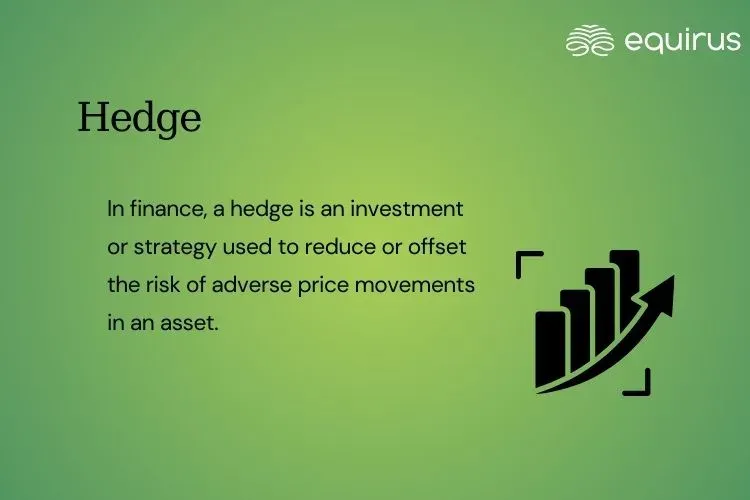
The term “hedge” in finance refers to an investment positioned to reduce the risk of adverse price movements in an asset. It’s fundamentally a risk management strategy, a form of financial insurance designed to protect against potential losses rather than to generate direct profits. In a world characterized by market volatility, geopolitical shifts, and economic uncertainties, understanding hedging is crucial for individuals managing personal portfolios, businesses navigating global markets, and institutional investors safeguarding large sums of capital.
Understanding the Core Concept of Hedging
At its heart, hedging is about offsetting potential losses. Imagine a farmer who plants crops. He faces the risk that by harvest time, prices for his produce might drop significantly, impacting his income. To “hedge” this risk, he might enter into a contract today to sell his future harvest at a predetermined price. This locks in a certain level of income, protecting him from price declines, even if it means foregoing potential profits if prices skyrocket.

The Analogy of Financial Insurance
Think of hedging as analogous to buying insurance. When you insure your car or house, you pay a premium to protect yourself against a specific, negative event. You don’t buy insurance hoping your car will be stolen or your house will burn down; you buy it to mitigate the financial impact if those events occur. Similarly, a hedge is a cost incurred to protect an existing asset or future cash flow from an unwanted price fluctuation. The “premium” might be the cost of an options contract, the administrative fees for a swap, or the opportunity cost of limiting upside potential.
Risk Mitigation, Not Profit Maximization
A critical distinction for hedging is its primary objective: risk mitigation, not speculative profit. While some sophisticated traders might use hedging instruments in speculative ways, true hedging is a defensive strategy. Its goal is to stabilize returns, protect profit margins, or preserve capital, allowing entities to focus on their core business or investment strategies without being overly exposed to uncontrollable market variables. This means that a perfectly executed hedge might result in slightly lower overall returns if the market moves favorably, as the “cost” of the hedge eats into potential gains. However, this trade-off is often deemed worthwhile for the certainty and protection it provides.
Common Risks Hedging Aims to Address
Hedging is employed to mitigate various types of financial risks, including:
- Market Price Risk: Fluctuations in the price of commodities (oil, gold, agricultural products), stocks, or bonds.
- Interest Rate Risk: Changes in interest rates that can affect the value of debt, loans, or investments.
- Currency Exchange Rate Risk: Volatility in the value of one currency against another, critical for international businesses and investors.
- Credit Risk: The risk that a borrower will default on their obligations.
- Commodity Price Risk: Specific to businesses that buy or sell raw materials.
Common Hedging Strategies and Instruments
To implement a hedge, financial markets offer a diverse array of instruments. These are typically derivative products, meaning their value is “derived” from an underlying asset or index.
Forward Contracts and Futures
Both forward and futures contracts involve an agreement to buy or sell an asset at a predetermined price on a future date.
- Forward Contracts: These are customized, over-the-counter (OTC) agreements between two parties. They are flexible but carry counterparty risk (the risk that the other party might default). A company expecting to receive a large payment in a foreign currency in three months might enter into a forward contract to sell that currency at a fixed exchange rate today, eliminating currency risk.
- Futures Contracts: Standardized, exchange-traded agreements. They are highly liquid and backed by clearinghouses, which reduce counterparty risk. Futures are common for commodities, interest rates, and stock indices. An airline might buy oil futures to lock in fuel costs, hedging against future price increases.
Options (Puts and Calls)
Options give the holder the right, but not the obligation, to buy or sell an underlying asset at a specified price (the strike price) on or before a certain date.
- Call Options: Grant the right to buy an asset. An investor holding a stock might buy a put option to protect against a drop in its price.
- Put Options: Grant the right to sell an asset. If an investor owns shares of Company X and is concerned about a short-term price decline, they could buy a put option on Company X shares. If the share price falls below the strike price, they can exercise the put, selling their shares at the higher strike price, thereby limiting their loss. If the price goes up, they simply let the put expire, losing only the premium paid.
Swaps
A swap is a derivative contract through which two parties exchange financial instruments, cash flows, or payments for a specified period. The most common types are interest rate swaps (exchanging fixed-rate interest payments for floating-rate payments, or vice-versa) and currency swaps. A company with a variable-rate loan might enter into an interest rate swap to exchange their variable payments for fixed payments with another party, hedging against rising interest rates.
Diversification and Asset Allocation (as a Simpler Form of Hedging)
While not derivatives, diversification and strategic asset allocation are fundamental forms of risk management that share the spirit of hedging. By spreading investments across various asset classes (stocks, bonds, real estate), industries, and geographies, investors reduce the impact of a poor performance in any single area. This “hedges” against concentrated risk and smooths out portfolio returns over time, acting as a broad, preventative measure against volatility.
Who Uses Hedging and Why?

Hedging is a versatile tool employed by a wide range of financial participants, each with specific motivations.
Corporations and Business Finance
Businesses often face significant exposure to market fluctuations.
- Commodity-Dependent Businesses: Manufacturers rely on raw materials like oil, metals, or agricultural products. A food company might hedge the price of wheat to stabilize its production costs and profit margins.
- Exporters and Importers: Companies engaged in international trade are exposed to currency risk. An exporter receiving payments in a foreign currency will hedge if they fear the foreign currency will depreciate against their home currency before they convert it.
- Companies with Debt: Businesses with variable-rate loans or bond issuances might use interest rate swaps to lock in their borrowing costs, providing predictability for financial planning.
Investors and Portfolio Management
Both institutional and individual investors use hedging to protect their portfolios.
- Institutional Investors: Pension funds, mutual funds, and endowments manage vast sums and prioritize capital preservation. They might use options or futures to hedge against a broad market downturn or specific sector risks within their equity portfolios.
- Individual Investors: While less common for everyday investors due to complexity and cost, sophisticated individuals might use options to protect a large stock holding during periods of anticipated volatility or to hedge currency exposure for international investments. Diversification remains the most accessible form of “hedging” for most retail investors.
International Trade and Currency Risk
For any entity operating across borders, currency exchange rate volatility is a significant concern. A multinational corporation needs to manage its revenues, expenses, and asset values across different currencies. Hedging instruments like forward contracts or currency options allow these entities to lock in exchange rates for future transactions, providing certainty in financial reporting and operational planning.
The Benefits and Drawbacks of Hedging
Like any financial strategy, hedging comes with a set of advantages and disadvantages that must be carefully weighed.
Advantages: Stability, Predictability, and Protection
- Risk Reduction: The primary benefit is the mitigation of financial risk from adverse price movements in assets, commodities, interest rates, or currencies.
- Enhanced Financial Stability: By locking in costs or revenues, businesses and investors gain greater predictability in their cash flows and earnings, aiding in budgeting and strategic planning.
- Preservation of Capital and Profit Margins: Hedging helps protect the value of assets and ensures that expected profit margins are not eroded by unexpected market shifts.
- Focus on Core Business: For companies, hedging allows management to focus on operational efficiencies and innovation rather than constantly worrying about external market fluctuations.
Disadvantages: Cost, Complexity, and Opportunity Cost
- Cost: Hedging is not free. There are explicit costs (premiums for options, transaction fees, administrative expenses) and implicit costs (the time and resources required to manage hedges).
- Complexity: Derivative instruments can be complex and require a deep understanding of financial markets, pricing models, and risk management principles. Misuse or misunderstanding can lead to unintended losses.
- Opportunity Cost: A successful hedge limits potential losses but also caps potential gains. If the market moves favorably, the hedged position will underperform an unhedged one. This lost opportunity is a direct cost of risk protection.
- Basis Risk: Sometimes, the hedging instrument does not perfectly correlate with the underlying asset being hedged. This mismatch can lead to imperfect protection, known as basis risk.
- Counterparty Risk: For OTC instruments like forward contracts, there’s a risk that the other party to the agreement may default on their obligations.
Strategic Integration of Hedging in Financial Planning
Integrating hedging effectively into financial planning requires a thoughtful, systematic approach, not a reactive one.
Identifying Exposures
The first step is to clearly identify and quantify the financial risks an individual or entity is exposed to. What assets are vulnerable to price fluctuations? What currency exposures exist? What is the sensitivity to interest rate changes? A comprehensive risk assessment is paramount.
Aligning with Risk Tolerance
Hedging decisions must align with the overall risk tolerance and strategic objectives. An aggressive growth-oriented portfolio might use minimal hedging, while a conservative, capital-preservation focused fund would likely employ more robust hedging strategies. For businesses, hedging levels might be dictated by corporate policy regarding earnings stability.
The Role of Professional Advice
Given the complexity and potential costs, professional financial advice is often invaluable. Experienced financial advisors, risk managers, and investment professionals can help analyze exposures, recommend appropriate instruments, execute strategies efficiently, and monitor their effectiveness. They can also ensure that hedging strategies are integrated seamlessly into broader financial and operational plans, providing a robust framework for managing uncertainty in an ever-changing economic landscape.
aViewFromTheCave is a participant in the Amazon Services LLC Associates Program, an affiliate advertising program designed to provide a means for sites to earn advertising fees by advertising and linking to Amazon.com. Amazon, the Amazon logo, AmazonSupply, and the AmazonSupply logo are trademarks of Amazon.com, Inc. or its affiliates. As an Amazon Associate we earn affiliate commissions from qualifying purchases.