
Header bidding, also known as pre-bidding, is a programmatic advertising technique that allows publishers to offer their ad inventory to multiple demand-side platforms (DSPs) simultaneously before making calls to their own ad servers. This unified auction process democratizes the programmatic advertising landscape by giving publishers more control and enabling them to maximize the revenue generated from their ad space. Historically, publishers relied on a sequential waterfall bidding system, where ad requests were sent to ad networks one after another, and the first network to offer a bid won the impression. This often led to lower prices as the true market value of an impression might not have been discovered. Header bidding fundamentally shifts this paradigm, creating a more competitive and transparent marketplace.
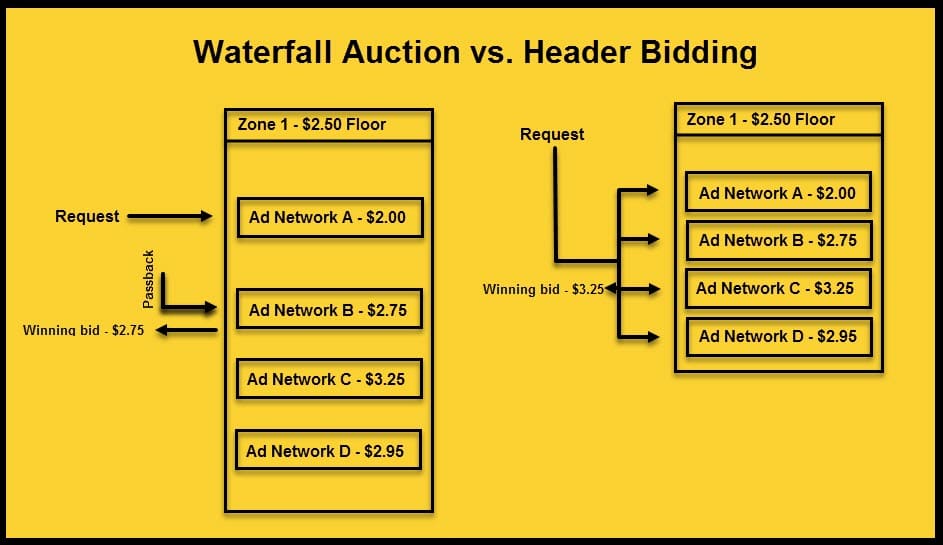
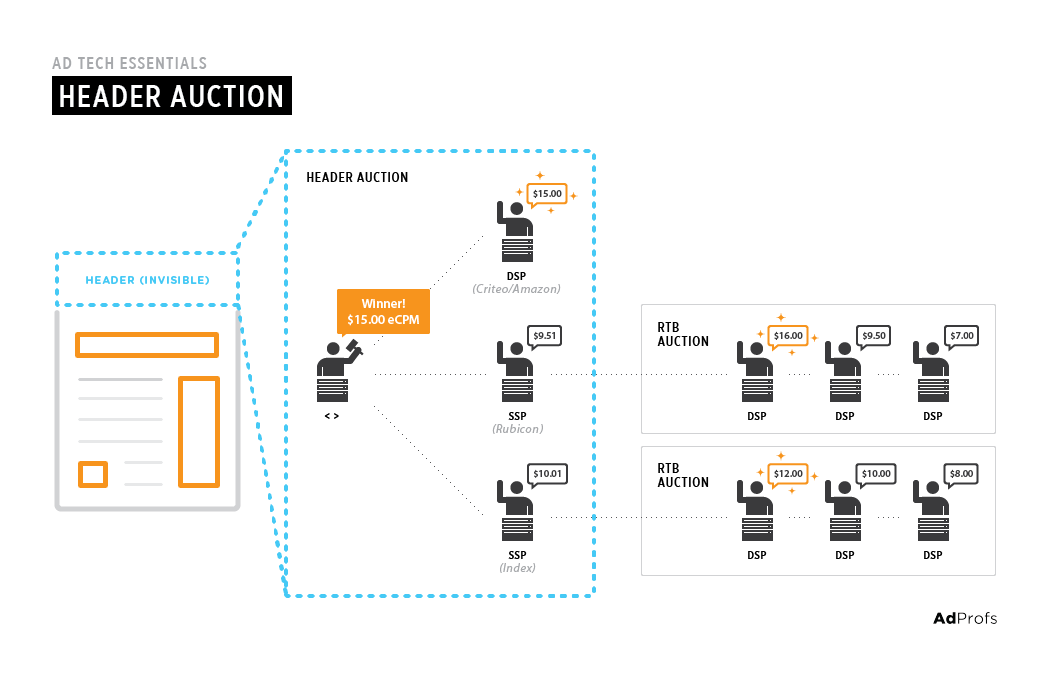
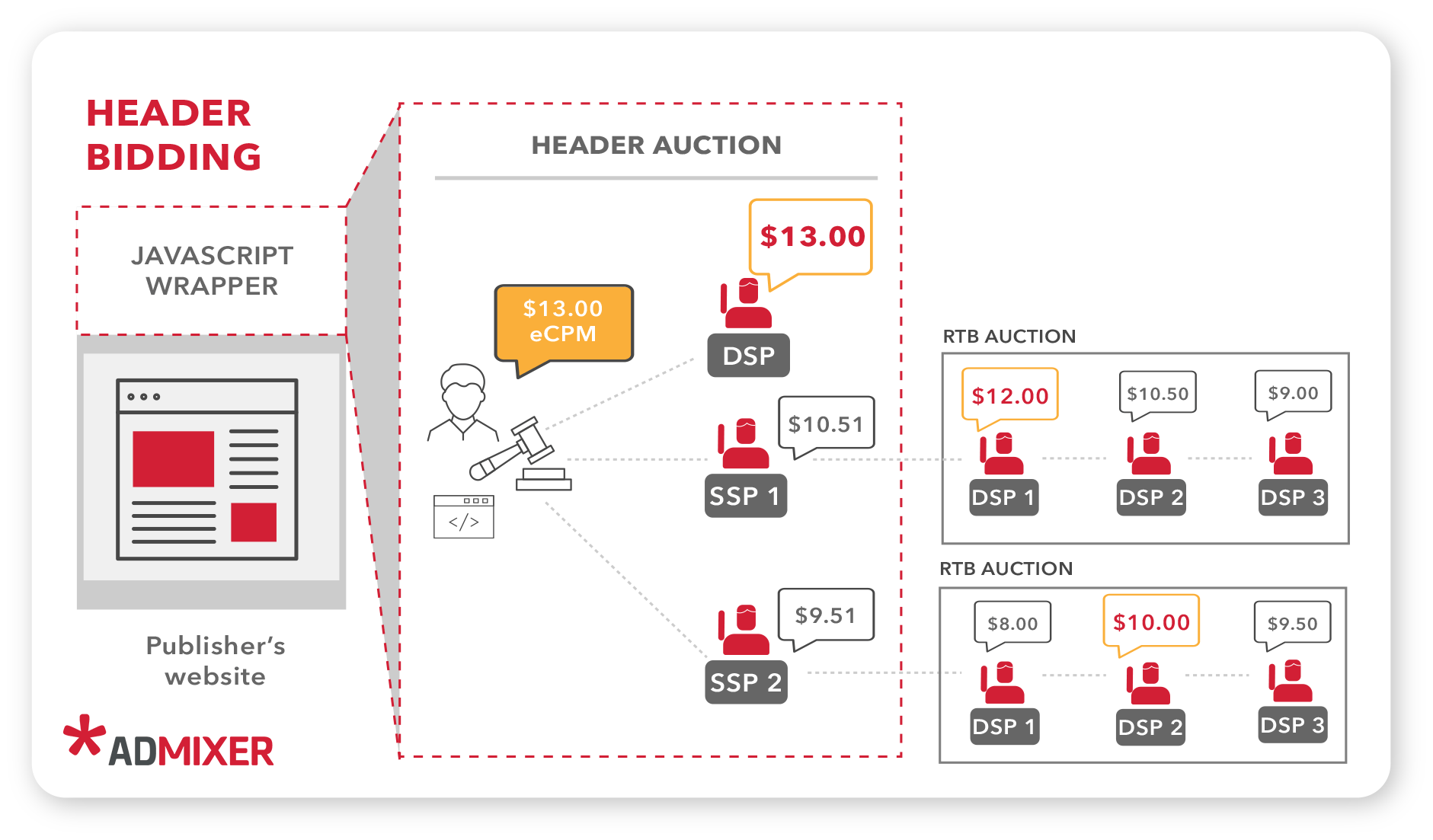
The core mechanism of header bidding involves embedding a JavaScript tag within the header of a publisher’s webpage. When a user visits the page, this tag initiates requests to various SSPs (Supply-Side Platforms) or ad exchanges in real-time. These SSPs then communicate with their connected DSPs, who represent advertisers looking to buy ad impressions. The critical difference is that all these bids arrive almost simultaneously, allowing the publisher’s ad server to compare them and award the impression to the highest bidder. This process typically happens in milliseconds, ensuring a seamless user experience while optimizing revenue for the publisher.
The rise of header bidding is a direct response to the inefficiencies and revenue leakage inherent in the traditional waterfall model. It empowers publishers by providing greater visibility into the demand for their inventory and fostering a more level playing field with large demand partners. Understanding header bidding is crucial for anyone involved in digital advertising, from publishers seeking to monetize their content to advertisers aiming to reach their target audiences efficiently.
The Evolution from Waterfall to Header Bidding
The shift from the traditional waterfall model to header bidding represents a significant advancement in programmatic advertising technology. Understanding this evolution is key to appreciating the benefits and intricacies of header bidding.
The Limitations of the Waterfall Model
For many years, the dominant method for selling digital ad inventory was the “waterfall” system. In this model, publishers would arrange their ad sources (ad networks, direct sales, programmatic partners) in a predetermined order. When an ad impression became available, the request would be sent sequentially to the first source in the waterfall. If that source offered a bid, the impression was sold. If not, the request moved to the next source, and so on, until an advertiser claimed the impression or it went unsold.
While seemingly straightforward, the waterfall model suffered from several critical drawbacks:
- Lack of Transparency: Publishers had limited visibility into the true market value of their impressions. They were at the mercy of the order in which demand partners were placed in the waterfall, and lower-priority partners could never bid on an impression if a higher-priority partner filled it, regardless of their actual willingness to pay more.
- Revenue Leakage: The sequential nature meant that valuable impressions could be sold at suboptimal prices. An advertiser in a lower position of the waterfall might have been willing to pay a higher price than the one who ultimately won the impression. This difference represented lost revenue for the publisher.
- Inefficiency: The process was inherently inefficient. Repeatedly sending requests and waiting for responses in a linear fashion was time-consuming and prone to latency issues.
- Limited Competition: The competition was artificial, dictated by the publisher’s predetermined order rather than true market demand. This stifled competition and reduced the potential for advertisers to bid aggressively.
The waterfall model, while functional for a period, became increasingly inadequate as the programmatic advertising ecosystem matured and the demand for premium inventory grew.
The Header Bidding Revolution
Header bidding emerged as a direct solution to the limitations of the waterfall. Its fundamental innovation lies in its ability to conduct a simultaneous auction among multiple demand sources.
- Simultaneous Auction: Instead of sequential requests, header bidding initiates requests to a multitude of SSPs and ad exchanges concurrently from within the webpage’s header. This means that all participating demand partners have an equal opportunity to bid on an impression at the same time.
- True Market Value Discovery: By bringing multiple buyers into a unified auction, header bidding allows for the discovery of the true, real-time market value of an impression. The highest bid, regardless of the source, wins, ensuring publishers receive the most competitive price.
- Increased Revenue Potential: The heightened competition and transparency directly translate to increased revenue for publishers. They can capture higher CPMs (Cost Per Mille, or cost per thousand impressions) as advertisers vie for their valuable inventory.
- Improved Control for Publishers: Header bidding offers publishers greater control over their monetization strategy. They can select which demand partners to work with and have more insight into the performance of each.
The transition from waterfall to header bidding was not instantaneous but rather a gradual adoption driven by the clear advantages it offered. Many publishers initially used a hybrid approach, integrating header bidding alongside their existing waterfall setup before fully migrating.
How Header Bidding Works: The Technical Architecture
The technical implementation of header bidding is sophisticated, involving JavaScript execution, real-time communication, and complex auction mechanics. Understanding these technical aspects is crucial for appreciating its power and potential challenges.
The Role of the Header Bidding Wrapper
At the heart of a header bidding setup is the “wrapper.” This is a piece of JavaScript code that publishers integrate into the <head> section of their website. The wrapper acts as a central orchestrator for the header bidding process.
- Tag Management: The wrapper contains tags for various SSPs or ad exchanges. When a user lands on the page, the wrapper executes these tags.
- Request Initiation: Each tag within the wrapper initiates an ad request to its respective SSP. These requests are sent in parallel, meaning they happen at the same time, not one after another.
- Bid Collection: The SSPs receive these requests and, in turn, communicate with their connected DSPs. DSPs analyze the impression opportunity based on their advertisers’ targeting parameters and submit bids back to the SSP.
- Timeout Management: A critical function of the wrapper is managing timeouts. Since bids arrive from different sources at varying speeds, the wrapper sets a predetermined time limit (e.g., 100-500 milliseconds) for all bids to be collected. If a bid doesn’t arrive within this timeframe, it’s excluded from the auction.
- Ad Server Integration: Once the bids are collected and the timeout is reached, the wrapper aggregates the bids and passes the highest bid and its corresponding ad creative information to the publisher’s primary ad server (e.g., Google Ad Manager).
- Final Decision: The publisher’s ad server then makes the final decision, awarding the impression to the winning bid. If the winning bid is from a header bidding partner, the ad server will serve the creative provided by that partner. If no bids meet the publisher’s floor price, or if the direct-sold campaigns are prioritized, the ad server can fall back to other demand sources or display a fallback ad.
The Unified Auction and Bid Request Lifecycle
The header bidding process can be broken down into a series of steps that occur in rapid succession for each ad impression.
- Page Load and Wrapper Execution: A user navigates to a webpage. The browser loads the HTML, including the
<head>section where the header bidding wrapper resides. - Tag Activation: The wrapper’s JavaScript code executes, activating the individual tags for each participating SSP.
- Parallel Bid Requests: Each SSP tag sends an ad request to its respective SSP/ad exchange. This request contains information about the user, the page, and the ad unit.
- SSP to DSP Communication: Upon receiving a bid request, the SSP broadcasts it to its network of DSPs.
- Advertiser Bid Submission: DSPs evaluate the request based on their advertisers’ campaigns, targeting criteria, and bidding strategies. They then submit a bid price (and potentially ad creative details) back to the SSP.
- Bid Aggregation and Timeout: The wrapper monitors incoming bids from all SSPs. It adheres to a pre-defined timeout duration. Any bids that arrive after the timeout are disregarded.
- Highest Bid Determination: After the timeout, the wrapper collects all valid bids and identifies the highest bid.
- Ad Server Integration: The wrapper sends the winning bid information (price, creative details) to the publisher’s ad server.
- Ad Rendering: The ad server then serves the winning ad creative to the user. This entire process, from initial request to ad rendering, typically takes less than a second.
This unified, real-time auction ensures that every impression is exposed to the broadest possible demand, leading to more efficient ad spend for buyers and higher revenue for sellers.
Key Players and Components in the Header Bidding Ecosystem
The successful implementation of header bidding relies on a collaborative ecosystem of various technologies and entities, each playing a distinct role.
Supply-Side Platforms (SSPs) and Ad Exchanges
SSPs are technology providers that enable publishers to manage and sell their ad inventory programmatically. In the context of header bidding, SSPs are the primary conduits through which publishers connect to a wide range of advertisers.
- Connecting Demand: SSPs aggregate demand from numerous DSPs, offering publishers access to a broad pool of potential buyers.
- Facilitating Auctions: They manage the auction process on their side, receiving bid requests from publishers’ wrappers and distributing them to their network of DSPs.
- Real-time Bidding (RTB) Infrastructure: SSPs possess the robust infrastructure necessary to handle millions of bid requests and responses in real-time.
- Ad Exchanges: Some SSPs also operate their own ad exchanges, which act as marketplaces where buyers and sellers can trade ad inventory. These exchanges are integral to the header bidding process, providing a platform for multiple parties to bid on impressions.
Demand-Side Platforms (DSPs)
DSPs are technology platforms used by advertisers and agencies to buy ad inventory programmatically. They represent the “demand” side of the header bidding equation.
- Campaign Management: DSPs allow advertisers to set up, manage, and optimize their advertising campaigns across various channels and inventory sources.
- Targeting and Optimization: They utilize sophisticated algorithms and data to identify and target specific audiences with relevant ads, ensuring that advertisers reach the right people at the right time.
- Bidding Strategy: DSPs execute bidding strategies on behalf of advertisers, determining how much to bid for each impression based on factors like audience value, campaign goals, and budget constraints.
- Integration with SSPs: DSPs connect to multiple SSPs to gain access to a wide range of ad inventory, including that made available through header bidding.
Publisher Ad Servers
The publisher’s ad server, such as Google Ad Manager, plays a crucial role as the ultimate decision-maker in the header bidding process.
- Receiving Bid Data: The header bidding wrapper sends the winning bid and associated creative information to the ad server.
- Prioritization and Decisioning: The ad server then decides which ad to display, often prioritizing direct-sold campaigns over programmatic bids or applying other business rules.
- Ad Rendering: If a header-bidding ad wins, the ad server facilitates its rendering on the webpage, ensuring the user sees the winning advertisement.
- Reporting and Analytics: Ad servers provide publishers with essential data on ad performance, revenue, and inventory utilization, helping them to analyze the effectiveness of their header bidding strategy.
Header Bidding Management Platforms (Optional but Common)
While not strictly essential, many publishers utilize header bidding management platforms or solutions.
- Simplified Implementation: These platforms often simplify the complex process of integrating and managing multiple header bidding tags.
- Performance Optimization: They offer tools for monitoring performance, optimizing bid timeouts, managing floor prices, and conducting A/B testing of different configurations.
- Unified Reporting: Many provide consolidated reporting across all participating SSPs, offering a clearer overview of overall header bidding performance.
This interconnected network of technologies and players creates a dynamic and efficient marketplace for digital advertising, with header bidding at its technical core.
Benefits and Challenges of Header Bidding for Publishers
Header bidding has revolutionized how publishers monetize their digital ad inventory, offering significant advantages but also presenting certain technical and operational hurdles.
Advantages for Publishers
The adoption of header bidding has been driven by a clear set of benefits that directly impact a publisher’s bottom line and operational efficiency.
- Increased Revenue: This is arguably the most significant benefit. By exposing inventory to a wider, more competitive pool of demand simultaneously, publishers can achieve higher CPMs and thus generate more revenue from their ad spaces. The unified auction principle ensures that the highest bid always wins, preventing revenue leakage associated with less competitive or poorly optimized waterfalls.
- Enhanced Transparency and Control: Header bidding provides publishers with greater visibility into the demand for their inventory. They can see which SSPs and advertisers are bidding, understand pricing dynamics, and make more informed decisions about their monetization strategy. This control extends to selecting partners, setting floor prices, and managing bid timeouts.
- Access to Diverse Demand Sources: Publishers are no longer limited to a few pre-selected ad networks. Header bidding allows them to connect with a vast array of SSPs, which in turn connect to thousands of DSPs and advertisers globally. This broad access diversifies revenue streams and reduces reliance on any single demand partner.
- Improved User Experience (Indirectly): While header bidding itself is a behind-the-scenes process, by maximizing revenue, publishers can reinvest in their content and infrastructure, which can indirectly lead to a better user experience through higher quality content and faster website loading times. Furthermore, efficient programmatic buying can lead to more relevant ad content for users.
- Fairer Competition: The unified auction creates a more equitable playing field for all demand sources. Smaller or niche demand partners have a chance to win impressions if they are willing to pay a premium, rather than being automatically excluded by the waterfall’s hierarchy.
Challenges and Considerations
Despite its powerful advantages, implementing and managing header bidding is not without its complexities.
- Increased Latency: The primary technical challenge is latency. Initiating multiple requests to various SSPs simultaneously can increase the overall load time of a webpage if not managed carefully. Publishers must meticulously configure bid timeouts to ensure a fast user experience. Excessive timeouts can lead to missed bids and reduced revenue.
- Technical Complexity and Management: Setting up and managing header bidding requires technical expertise. Integrating multiple SSP tags, configuring wrappers, and ensuring proper implementation can be challenging. Publishers often need specialized tools or partnerships to manage this complexity effectively.
- Data Management and Privacy: Header bidding relies on the efficient sharing of user data to facilitate targeting. Publishers must navigate evolving privacy regulations (like GDPR and CCPA) and ensure that their data practices are compliant across all participating SSPs and DSPs.
- Operational Overhead: Managing multiple SSP relationships, reconciling diverse reporting formats, and troubleshooting integration issues can create significant operational overhead for publishers.
- Choosing the Right Partners: The success of a header bidding strategy heavily depends on selecting the right SSP partners. A poorly chosen SSP might not bring sufficient demand or might have poor auction dynamics, negatively impacting revenue. Due diligence and continuous performance monitoring are essential.
- The Need for a Robust Ad Server: A capable ad server is crucial for effectively managing the volume of bids and making rapid decisions. Publishers with outdated or underpowered ad servers might struggle to leverage header bidding to its full potential.
Despite these challenges, for most publishers, the revenue uplift and control offered by header bidding far outweigh the difficulties, making it an indispensable component of modern digital advertising monetization strategies.
The Future of Header Bidding and Programmatic Advertising
The landscape of programmatic advertising is constantly evolving, and header bidding, as a foundational technology, is at the forefront of these advancements. Its influence is likely to continue shaping how digital ads are bought and sold, with several key trends pointing towards its future development.
Evolution of Header Bidding Technology
Header bidding is not a static solution; it is continuously being refined to address its inherent challenges and capitalize on new opportunities.
- Server-Side Header Bidding (SSHB): To combat the latency issues associated with client-side JavaScript execution, server-side header bidding is gaining significant traction. In SSHB, the auction process takes place on a server rather than directly in the user’s browser. This can drastically reduce page load times as fewer requests are made from the user’s device. It also offers more control over the auction process and can potentially reduce invalid traffic.
- Increased Focus on Privacy: As privacy regulations become more stringent, header bidding solutions are adapting. This includes exploring new methods for data sharing that comply with privacy laws, such as using first-party data more effectively and investigating anonymized or aggregated data approaches. The deprecation of third-party cookies also necessitates innovation in how audience data is utilized within header bidding auctions.
- Integration with Other Technologies: Header bidding is increasingly being integrated with other programmatic technologies, such as Connected TV (CTV) advertising, audio advertising, and native ad formats. This allows for a more unified approach to programmatic monetization across diverse media channels.
- AI and Machine Learning: Artificial intelligence and machine learning are being leveraged to optimize header bidding performance. This includes smarter bid timeout management, more sophisticated floor price optimization, fraud detection, and predictive analytics to forecast demand.
The Broader Impact on Programmatic Advertising
Header bidding has fundamentally reshaped the programmatic advertising ecosystem and its future trajectory.
- Democratization of Ad Tech: Header bidding has leveled the playing field for publishers, reducing their reliance on dominant ad exchanges and providing greater transparency and control over their monetization. This has fostered a more competitive and innovative ad tech landscape.
- Shift Towards Publisher-Centric Models: The success of header bidding has empowered publishers, leading to a greater emphasis on publisher-centric solutions and strategies. Publishers are increasingly taking more ownership of their data and technology stack.
- Continued Innovation in Auctions: The principles of unified auctions pioneered by header bidding are influencing other areas of programmatic advertising. We may see similar auction models applied to different ad formats and channels to ensure fair pricing and maximize efficiency.
- Increased Importance of Direct Relationships: While programmatic buying is dominant, header bidding can also facilitate more direct relationships between publishers and advertisers by providing better data and transparency, enabling publishers to offer more tailored inventory solutions.
- Consolidation and Specialization: The header bidding market is likely to see further consolidation, with larger players acquiring smaller ones. Simultaneously, there will likely be continued specialization in areas like server-side header bidding, privacy-compliant solutions, and specific vertical markets.
In conclusion, header bidding has moved from being a disruptive innovation to a cornerstone of modern programmatic advertising. Its evolution, particularly towards server-side implementations and privacy-centric approaches, will continue to drive efficiency, transparency, and revenue for publishers, while also shaping a more sophisticated and competitive digital advertising future for all participants.
aViewFromTheCave is a participant in the Amazon Services LLC Associates Program, an affiliate advertising program designed to provide a means for sites to earn advertising fees by advertising and linking to Amazon.com. Amazon, the Amazon logo, AmazonSupply, and the AmazonSupply logo are trademarks of Amazon.com, Inc. or its affiliates. As an Amazon Associate we earn affiliate commissions from qualifying purchases.