
In the modern digital landscape, consistent and high-speed internet is no longer a luxury—it is a utility as essential as electricity or water. However, many households struggle with the inherent limitations of wireless technology. Thick walls, interference from household appliances, and the sheer distance from a router can create frustrating “dead zones.” While many consumers turn to mesh Wi-Fi systems or expensive Ethernet rewiring, there is a powerful, often overlooked solution already hidden within the walls of most homes: the Gateway MoCA network.
MoCA, which stands for Multimedia over Coax Alliance, is a technology that leverages the existing coaxial cable wiring—the same cables used for cable television—to transmit high-speed internet data. When integrated into a “Gateway” (a device that combines a modem and a router), it creates a robust backbone for a home network that rivals the stability of professional Ethernet installations.
Understanding MoCA Technology and the Role of the Gateway
To understand a Gateway MoCA network, one must first break down the two primary components: the MoCA standard itself and the Gateway device provided by Internet Service Providers (ISPs).
The Fundamentals of Multimedia over Coax Alliance
MoCA is an industry standard developed to facilitate high-definition video distribution and high-speed data transfer over existing coaxial cables. The beauty of MoCA lies in its utilization of the shielded nature of coaxial cables. Unlike Wi-Fi, which transmits data through the air and is subject to interference from other radio frequencies, MoCA data travels through a dedicated physical medium designed to prevent signal leakage and external noise.
Since its inception, MoCA technology has evolved through several iterations. While early versions provided modest speeds, the current MoCA 2.5 standard can deliver throughput up to 2.5 Gbps. This makes it more than capable of handling gigabit internet plans, multiple 4K streams, and intensive online gaming simultaneously.
How a Gateway Acts as the Central Hub
In networking terminology, a “Gateway” is a singular hardware unit that serves as both the cable modem (which brings the internet into the home) and the router (which distributes that internet to various devices). Many modern gateways provided by ISPs like Xfinity, Cox, or Spectrum come with “MoCA-enabled” firmware.
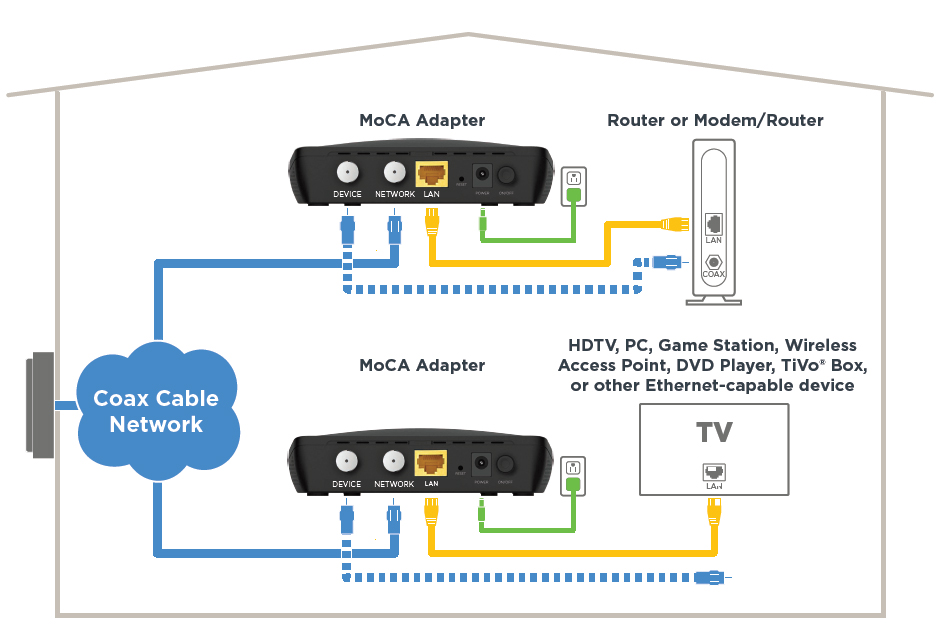
When you activate the MoCA feature on a Gateway, the device begins to broadcast an internet signal back through the coaxial port on the wall. This effectively turns every coaxial outlet in your home into a high-speed internet port. Instead of the Gateway only sending data out via Wi-Fi or its four Ethernet ports, it uses the entire copper infrastructure of the house as a wired data network.
How Gateway MoCA Networks Work: From Coax to High-Speed Internet
The operation of a Gateway MoCA network is a feat of digital engineering that allows multiple types of data—TV signals and internet packets—to coexist on the same wire without interfering with one another.
The Physical Layer: Utilizing Existing Wiring
Most homes built in the last forty years are “daisy-chained” or “home-run” with RG6 or RG59 coaxial cables. These cables were originally intended to carry analog or digital television signals. MoCA operates on a different frequency range (typically above 1125 MHz) than the frequencies used by standard cable TV and lower-frequency internet signals (DOCSIS).
Because they operate on different “lanes” of the frequency spectrum, you can watch live cable TV on the same wire that is currently delivering a 1 Gbps internet connection to your computer. The Gateway acts as the primary controller, managing the traffic and ensuring that data packets reach the correct destination within the home network.
MoCA Versions and Performance Specifications
When discussing Gateway MoCA networks, it is vital to identify which version of the technology is being used, as this dictates the maximum potential speed:
- MoCA 1.1: Provided speeds up to 175 Mbps. While revolutionary at the time, it is largely obsolete for modern high-speed needs.
- MoCA 2.0: Offered “Bonded” speeds up to 1 Gbps. This is common in many older ISP gateways and is sufficient for most standard home uses.
- MoCA 2.5: The current gold standard, capable of 2.5 Gbps actual data throughput. It features enhanced security and lower latency, making it the preferred choice for tech enthusiasts and power users.
A Gateway MoCA network is only as fast as its slowest link. If your Gateway supports MoCA 2.5 but you use a MoCA 2.0 adapter in another room, the connection in that room will be capped at the 2.0 specifications.
Key Benefits of Implementing MoCA in Your Home Network
For those living in larger homes or dwellings with radio-reflective materials like foil-backed insulation or concrete, a Gateway MoCA network offers several technical advantages over traditional Wi-Fi-only setups.

Reliability vs. Wi-Fi Dead Zones
Wi-Fi is notoriously fickle. It suffers from “attenuation,” meaning the signal weakens as it passes through objects. In contrast, a Gateway MoCA network provides a “hardwired” feel. Because the data is contained within a shielded cable, it does not drop out when someone uses the microwave or when a neighbor sets up a powerful new router. This reliability is essential for home offices where a dropped Zoom call can result in lost productivity.
Low Latency for Gaming and 4K Streaming
For gamers, “ping” or latency is often more important than raw download speed. Latency is the time it takes for a data packet to travel from your device to the server and back. Wi-Fi introduces “jitter” and lag spikes due to the nature of wireless transmission. A MoCA connection provides latency speeds nearly identical to a direct Ethernet connection (usually sub-5ms within the local network), providing a competitive edge in online gaming and ensuring that 4K Netflix streams do not buffer.
Cost-Effectiveness and Ease of Installation
Rewiring a home with Category 6 (Cat6) Ethernet cables can cost thousands of dollars and involve cutting into drywall. In contrast, a Gateway MoCA network uses what you already have. If your Gateway is already MoCA-enabled, the only additional cost is a MoCA adapter for the room where you need a wired connection. It is essentially a “plug-and-play” solution that transforms a TV jack into an Ethernet port in seconds.
Setting Up and Optimizing a Gateway MoCA Network
While the concept is simple, a successful Gateway MoCA network requires a few specific hardware components to ensure peak performance and security.
Required Hardware: MoCA Adapters and Splitters
To complete the bridge, you need a MoCA adapter at the “endpoint.” For example, if your Gateway is in the living room and your gaming PC is in the upstairs bedroom, you would plug a MoCA adapter into the bedroom’s coaxial wall jack. You then run an Ethernet cable from the adapter to your PC. The adapter “translates” the coaxial signal back into an Ethernet signal.
Crucially, you must ensure that any coaxial splitters in your home are “MoCA-compatible.” Standard splitters often cap out at 1000 MHz. For a MoCA network to function, splitters must support frequencies up to at least 1675 MHz. Using an outdated splitter is the number one cause of MoCA network failure or degraded speeds.
Security Considerations: The Point of Entry (PoE) Filter
One of the most critical, yet often overlooked, components of a Gateway MoCA network is the “Point of Entry” (PoE) filter. Since your home’s coaxial wiring is physically connected to the neighborhood’s cable line, it is theoretically possible for your MoCA signal to “leak” out of your house and into your neighbor’s home.
A PoE filter is a small, inexpensive device that you screw onto the main coaxial line where it first enters your home. This filter acts as a digital wall; it allows ISP signals to enter but reflects MoCA signals back into your home. Not only does this secure your data from neighbors, but it also improves network performance by keeping the signal concentrated within your internal wiring.
Comparing MoCA to Other Networking Alternatives
To fully appreciate the Gateway MoCA network, it helps to see how it stacks up against other popular home networking technologies.
MoCA vs. Ethernet (Cat6)
Ethernet is the gold standard of networking. It is slightly faster than MoCA 2.5 and has the lowest possible latency. However, for most users, the performance difference between 2.5 Gbps MoCA and 1-10 Gbps Ethernet is negligible. MoCA wins on convenience, as it avoids the labor-intensive process of running new wires through walls.
MoCA vs. Powerline Adapters
Powerline adapters attempt to send data over a home’s electrical wiring. While convenient, electrical lines are extremely “noisy” due to the constant fluctuations of power draw from appliances. Powerline speeds are rarely consistent and often fall far short of their advertised ratings. MoCA is significantly faster and more stable than Powerline because coaxial cable is shielded, whereas electrical wiring is not.
MoCA vs. Mesh Wi-Fi Systems
Mesh Wi-Fi systems (like Eero or Google Nest) are popular for their ease of use. However, even the best mesh systems use “wireless backhaul,” meaning the satellite nodes communicate with the main router via Wi-Fi. This still leaves them susceptible to interference. The most effective way to use a Mesh system is to use a Gateway MoCA network as a “wired backhaul.” By connecting the mesh nodes to MoCA adapters, the nodes communicate via the coaxial wires, leaving the entire Wi-Fi bandwidth available for your phones and laptops.

Conclusion
The Gateway MoCA network represents a perfect synergy between legacy infrastructure and cutting-edge digital demands. By unlocking the latent potential of the coaxial cables already present in our homes, we can achieve high-speed, low-latency connectivity without the headache of expensive renovations.
Whether you are a professional working from home, a competitive gamer seeking an edge, or a family trying to support a dozen streaming devices simultaneously, MoCA technology provides a robust, secure, and professional-grade backbone for the modern smart home. As internet speeds continue to climb toward multi-gigabit tiers, the Gateway MoCA network stands ready to ensure that every room in the house stays connected to the future.
aViewFromTheCave is a participant in the Amazon Services LLC Associates Program, an affiliate advertising program designed to provide a means for sites to earn advertising fees by advertising and linking to Amazon.com. Amazon, the Amazon logo, AmazonSupply, and the AmazonSupply logo are trademarks of Amazon.com, Inc. or its affiliates. As an Amazon Associate we earn affiliate commissions from qualifying purchases.