
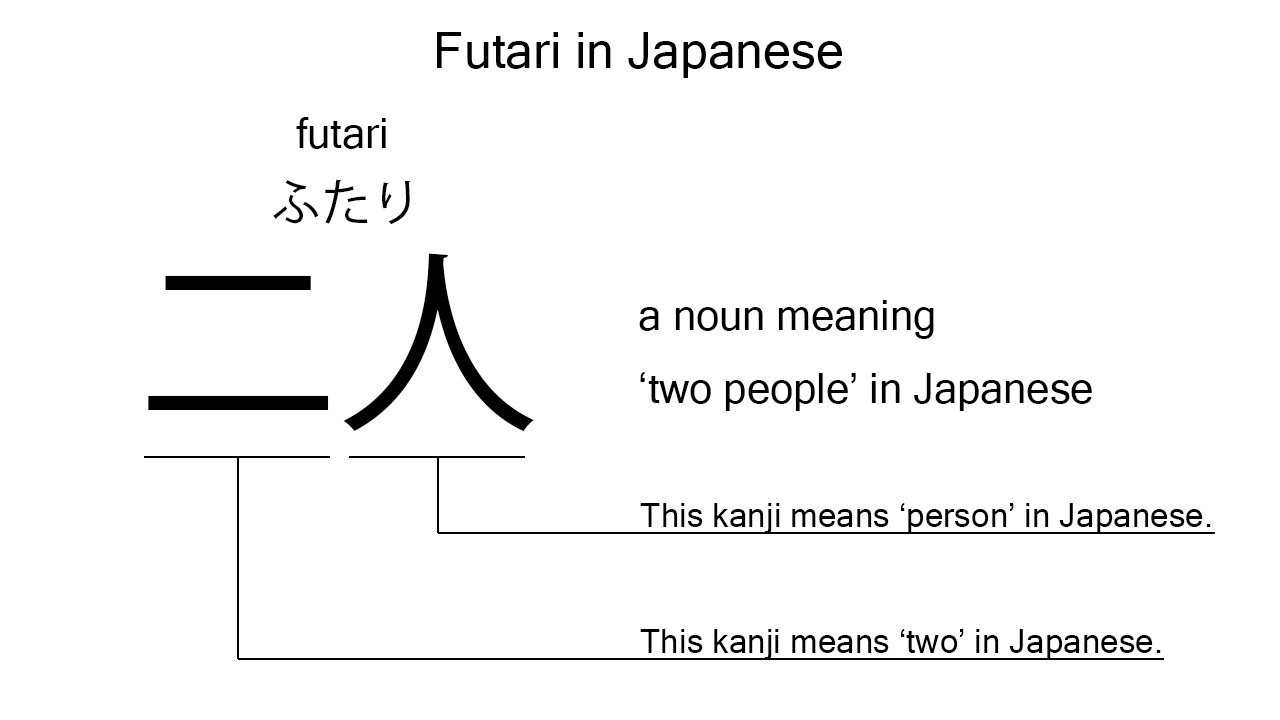
In the rapidly evolving landscape of mobile applications and digital platforms, the term “Futari”—a Japanese word meaning “two people” or “a couple”—has transcended its linguistic roots to become a significant identifier for a specialized niche in the technology sector. As social media platforms move toward massive, algorithm-driven feeds, a counter-movement has emerged: software designed exclusively for two. This shift toward “Futari tech” represents a pivot from the “global village” to the “digital home,” prioritizing intimate, secure, and highly functional shared spaces over broad public interaction.
Understanding Futari involves looking at the convergence of shared productivity tools, micro-social networking, and specialized user experience (UX) design. Whether it is the eponymous Japanese calendar app or the broader category of “couple-tech,” these platforms leverage sophisticated synchronization technology to solve the unique logistical and emotional challenges faced by partners in a digital age.
The Evolution of Micro-Social Platforms and Shared Ecosystems
The digital revolution of the early 2010s was defined by scale. Facebook, Twitter, and Instagram sought to connect billions of people simultaneously. However, as digital fatigue set in, users began seeking smaller, more private enclaves. This gave birth to the concept of the micro-social network—a platform where the total user base of a single “network” is capped at two.
Bridging the Gap in Digital Intimacy
Traditional communication tools like WhatsApp or iMessage are built for general-purpose messaging. While effective, they often lack the contextual framework required for managing a life together. Futari tech fills this gap by integrating specific modules—shared calendars, collaborative lists, memory archives, and location tracking—into a single, unified interface.
From a software development perspective, the challenge lies in creating a “dual-user” environment. Most apps are designed for an individual user with a single account. Futari apps require a unique architecture where two distinct accounts are permanently tethered, sharing a unified database state while maintaining individual device settings. This requires complex backend logic to ensure that synchronization is instantaneous and that data conflicts are handled without user intervention.
Core Functionality: More Than Just a Shared Calendar
At its technical core, Futari software is often a masterclass in synchronization. Take, for example, the shared calendar functionality that is central to many of these apps. Unlike a corporate Google Calendar, which is designed for scheduling meetings and checking availability, a Futari calendar is designed for life-logging and coordination.
The tech stack usually involves real-time database updates (often utilizing technologies like Firebase or WebSockets) to ensure that when one person adds an event, it appears on the other’s device in milliseconds. This is coupled with sophisticated push notification engines that must be intelligently tuned to avoid “notification spam” while ensuring critical updates—like a change in dinner plans or a grocery list addition—are seen immediately.
Engineering Intimacy: The Technical Architecture of Futari Software
Building a platform for two people sounds simpler than building one for millions, but it presents unique technical hurdles. The architecture must support deep integration across different mobile operating systems (iOS and Android) while ensuring that the shared experience is seamless, regardless of the hardware used by either partner.
Real-Time Synchronization and Conflict Resolution
One of the primary technical requirements for Futari apps is a robust data synchronization engine. Because these apps are used for critical logistical tasks like financial tracking or schedule management, data integrity is paramount. If both users edit a shared “To-Do” list at the exact same moment, the software must employ advanced conflict resolution algorithms.
Developers often use Operational Transformation (OT) or Conflict-free Replicated Data Types (CRDTs) to ensure that both users see the same version of the truth. These technologies, which also power collaborative tools like Google Docs, allow for offline editing and subsequent merging, ensuring that no data is lost when a user enters a subway tunnel or loses Wi-Fi connectivity.
Cross-Platform Parity and API Integration
For a Futari app to be successful, it must offer parity across platforms. If one partner uses an iPhone and the other uses a high-end Android device, the experience must be identical. This often leads developers to utilize cross-platform frameworks like Flutter or React Native, which allow for a single codebase to manage the complex logic of the two-person network while still providing native-level performance.
Furthermore, these apps often serve as a “hub” for other digital services. Modern Futari platforms are increasingly integrating with third-party APIs. For instance, a shared shopping list might integrate with an Instacart API to facilitate one-click ordering, or a shared calendar might pull data from a travel API like TripIt to automatically populate flight details. The technology behind Futari is essentially an exercise in orchestration—bringing disparate data points into a single, private ecosystem.
User Experience and Emotional Design in Shared Spaces
UX design for a two-person app differs fundamentally from design for a general-market app. In a traditional social media app, the goal is “time spent” or “engagement.” In Futari tech, the goal is “efficiency” and “connection.” The interface must feel personal, warm, and secure, moving away from the sterile, corporate aesthetics of many productivity tools.

Personalization and the Digital “Home”
The interface of a Futari app is often customizable in ways that public apps are not. Users can set shared backgrounds, use private emojis, or create unique notification sounds for their partner. This “emotional design” is a deliberate tech strategy aimed at increasing user retention and brand loyalty.
From a UI perspective, the layout must accommodate the “two-user” view. This might include split screens, shared progress bars for goals, or “presence indicators” that show when the other person is typing or viewing a shared page. These features utilize real-time state management to create a sense of digital presence, making the software feel less like a tool and more like a shared space.
Reducing Cognitive Load Through Automation
The most advanced Futari apps use machine learning to reduce the “administrative” burden of a relationship. For example, if the app detects that both users have an evening free on Friday, it might suggest a restaurant based on their shared history. If one user frequently adds “milk” to the grocery list on Tuesdays, the app can proactively prompt the other user if they are near a grocery store at that time.
This level of automation requires sophisticated geolocation services and pattern recognition. By leveraging the sensors built into modern smartphones—GPS, accelerometers, and even ambient light sensors—Futari apps can provide context-aware suggestions that make the technology feel intuitive and supportive rather than intrusive.
Security, Privacy, and Data Sovereignty
When two people share their lives through an app, the data generated is incredibly sensitive. It includes locations, financial records, intimate photos, and private thoughts. Consequently, the security architecture of Futari tech must be enterprise-grade.
End-to-End Encryption in Private Networks
To protect the privacy of the “two-person” network, many developers are moving toward end-to-end encryption (E2EE). In this model, the data is encrypted on one device and can only be decrypted by the tethered device of the partner. Not even the app developers or server administrators can access the content of the shared notes or messages.
This poses a technical challenge for features like “search” or “AI suggestions,” which traditionally require server-side access to data. To overcome this, Futari developers are increasingly utilizing on-device processing. By running machine learning models locally on the smartphone, the app can offer smart features without ever compromising the privacy of the users’ data.
Data Ownership and the “Break-up” Protocol
A unique aspect of Futari tech is the necessity of a “data sovereignty” or “exit” strategy. In a standard social network, if you leave, you take your data with you. In a shared app, the data belongs to two people. Developers must create technical protocols for what happens if the “two-person” network dissolves.
This involves complex permission logic: Which photos belong to whom? Can one person export the shared calendar? These ethical and technical questions are at the forefront of Futari software development, leading to the creation of “export and split” tools that allow users to maintain their digital history while severing the link to the shared account.
The Future of Futari: Beyond the Smartphone
As we look toward the next decade of technology, the concept of Futari is expanding beyond mobile apps into the broader Internet of Things (IoT) and the Smart Home. The “two-person” ecosystem is becoming a foundational layer for how couples interact with their environment.
Integration with Smart Home Ecosystems
The next evolution of Futari tech is the “Shared OS” for the home. Imagine a smart home system that recognizes when both members of the “Futari” unit are present and adjusts the lighting, temperature, and music to their shared preferences. If only one person is home, the system reverts to their individual profile.
This requires a high level of interoperability between different IoT devices and a central Futari hub. We are already seeing the beginnings of this with shared Apple HomeKit or Google Home accounts, but specialized Futari software aims to provide a more nuanced, relationship-centric layer of control that these broad platforms currently lack.

AI-Driven Life Management
As Artificial Intelligence continues to advance, the role of a “digital concierge” for couples will become more prominent. Future Futari platforms may use Large Language Models (LLMs) to act as a neutral mediator or a highly efficient personal assistant. From resolving scheduling conflicts to managing shared household budgets and even suggesting gifts based on years of shared data, the AI will act as a silent third party dedicated to the health of the “two-person” unit.
In conclusion, Futari is more than just a Japanese word or a specific app; it is a burgeoning category of technology that prioritizes the most fundamental human unit: the pair. By focusing on deep synchronization, emotional design, and uncompromising privacy, Futari tech is redefining how we use software to enhance, rather than replace, our most intimate connections. As our lives become increasingly digital, these platforms provide the essential infrastructure for modern companionship.
aViewFromTheCave is a participant in the Amazon Services LLC Associates Program, an affiliate advertising program designed to provide a means for sites to earn advertising fees by advertising and linking to Amazon.com. Amazon, the Amazon logo, AmazonSupply, and the AmazonSupply logo are trademarks of Amazon.com, Inc. or its affiliates. As an Amazon Associate we earn affiliate commissions from qualifying purchases.