
Mathematics is the language of the universe, and within its vast vocabulary, fractions represent one of the most fundamental yet often misunderstood concepts. Far from being an abstract academic exercise, understanding “what is a fraction in math” is a cornerstone of financial literacy, impacting everything from your daily budget to complex investment strategies. In a world increasingly driven by numbers, mastering fractions isn’t just about passing a math test; it’s about empowering yourself to make smarter, more informed financial decisions, navigate markets, and manage your wealth effectively.
This article will demystify fractions, breaking down their core components and illustrating their indispensable role across the spectrum of personal and business finance. From allocating a portion of your income to calculating investment returns, the fractional lens provides clarity and control over your financial destiny.

The Foundational Role of Fractions in Financial Literacy
At its core, a fraction represents a part of a whole. It’s a way to express quantities that are not full integers. This simple definition belies its profound impact on how we understand and manage money. Every time you divide a sum, calculate a percentage, or share a cost, you are, in essence, working with fractions.
Deciphering the Basics: Numerators, Denominators, and the Concept of a Whole
A fraction is typically written as two numbers separated by a horizontal bar: $frac{a}{b}$.
-
Numerator (a): The top number, which indicates how many parts of the whole are being considered. In financial terms, this could be the portion of your income dedicated to savings, the number of shares you own, or the profit generated from a sale.
-
Denominator (b): The bottom number, which represents the total number of equal parts that make up the whole. Financially, this might be your total monthly income, the total outstanding shares of a company, or the overall cost of a project.
-
The Whole: The complete unit or quantity from which parts are taken. This could be your entire budget, a company’s total assets, or a full investment portfolio.
For instance, if you allocate $300 out of a $3,000 monthly income to groceries, this can be represented as the fraction $frac{300}{3000}$, which simplifies to $frac{1}{10}$. This fraction immediately tells you that one-tenth of your income is spent on groceries, a crucial insight for budgeting.
Types of Fractions and Their Real-World Financial Interpretations
Understanding the different types of fractions helps in interpreting various financial scenarios:
-
Proper Fractions: Where the numerator is less than the denominator (e.g., $frac{1}{2}$, $frac{3}{4}$). These are common in finance when discussing parts of a whole, such as a company owning a fraction of another company, or a person saving a fraction of their paycheck. A budget line item, like spending $frac{1}{5}$ of your income on rent, is a proper fraction.
-
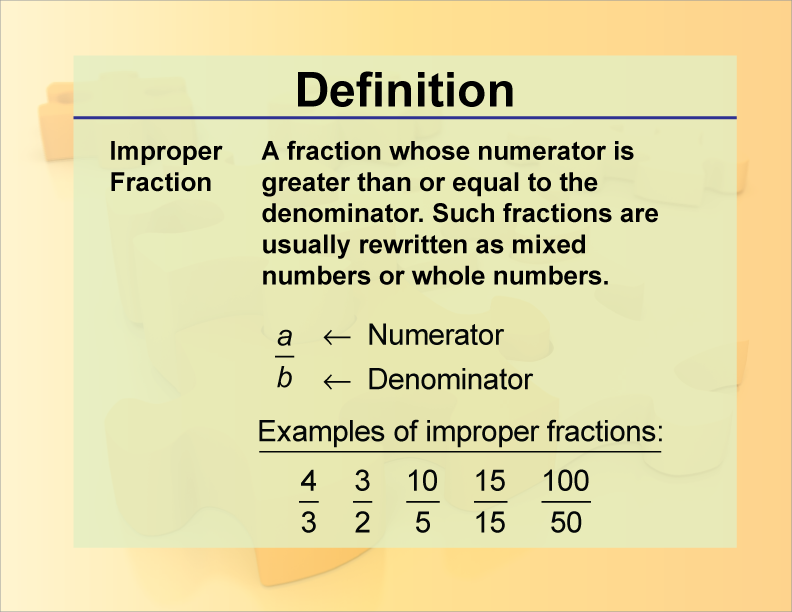
Improper Fractions: Where the numerator is greater than or equal to the denominator (e.g., $frac{5}{4}$, $frac{7}{3}$). These often arise when dealing with growth or multiples. For example, if an investment grows to $frac{5}{4}$ of its original value, it signifies a 25% increase, indicating that you now have more than your initial “whole” investment.
-
Mixed Numbers: A combination of a whole number and a proper fraction (e.g., $1frac{1}{4}$, $2frac{1}{2}$). These are useful for expressing quantities that are more than one whole, such as calculating compound interest over multiple periods, where your initial principal (the whole) grows by additional fractions.
-
Equivalent Fractions: Different fractions that represent the same value (e.g., $frac{1}{2}$ is equivalent to $frac{2}{4}$ or $frac{50}{100}$). This concept is vital for comparing financial ratios, understanding how different denominations of currency relate, or simplifying complex financial statements to their most understandable form. Percentages, for instance, are simply fractions out of 100.
Fractions in Personal Finance: Budgeting, Spending, and Savings
Personal finance is replete with fractions, whether explicitly stated or implicitly understood. From the moment you earn money to the way you spend and save it, fractional thinking is a powerful tool for maintaining financial health.
Budgeting as Fractional Allocation of Income
A budget is, at its heart, a fractional plan for your income. You divide your total earnings into different categories like housing, food, transportation, savings, and entertainment. Each category represents a fraction of your overall income.
Consider the popular 50/30/20 rule: 50% for needs, 30% for wants, and 20% for savings and debt repayment. These percentages are direct applications of fractions: $frac{50}{100}$ (or $frac{1}{2}$) for needs, $frac{30}{100}$ (or $frac{3}{10}$) for wants, and $frac{20}{100}$ (or $frac{1}{5}$) for financial goals. Without a clear understanding of these fractional proportions, effective budgeting becomes guesswork, leading to overspending and unmet financial objectives.
Understanding Discounts, Interest Rates, and Loan Payments
Fractions are fundamental to understanding discounts, sales, and interest rates. A “25% off” sale means you pay $frac{75}{100}$ (or $frac{3}{4}$) of the original price. Similarly, if a stock drops by “half,” its value is now $frac{1}{2}$ of its previous price.
Interest rates on loans, savings accounts, or credit cards are expressed as percentages, which are just fractions with a denominator of 100. A 5% interest rate means you pay or earn $frac{5}{100}$ of the principal amount annually. Understanding how these fractions accrue over time is crucial for calculating the true cost of borrowing or the real gains from saving. It helps you compare different loan offers, identify predatory lending, and maximize the growth of your savings.
Loan payments, whether for a mortgage, car, or student debt, involve paying back a fraction of the total principal and accrued interest over a set period. Each payment reduces the outstanding balance by a certain fraction, demonstrating the power of consistent, fractional repayment towards a larger financial goal.
Investing and Wealth Building Through a Fractional Lens
In the world of investing, fractions take on an even more critical role, dictating portfolio diversification, return calculations, and understanding ownership stakes.
Fractional Shares and Portfolio Diversification
The rise of fractional share investing has democratized access to high-priced stocks, allowing investors to buy a fraction of a share rather than needing enough capital to purchase a whole one. This means you can invest $50 into a stock that costs $1,000 per share, owning $frac{50}{1000}$ (or $frac{1}{20}$) of it.
This fractional approach is invaluable for diversification, enabling investors to spread their capital across a wider range of assets, even with a limited budget. Instead of putting all your money into one stock, you can own small fractions of many different companies, reducing risk and potentially increasing overall returns—a core principle of sound investing.
Calculating Returns on Investment and Understanding Market Shares
Calculating returns on investment (ROI) often involves fractions. If you invest $1,000 and it grows to $1,200, your profit is $200. Your ROI is $frac{200}{1000}$, or $frac{1}{5}$, which translates to a 20% return. Understanding these fractional relationships allows investors to accurately assess the performance of their holdings and compare different investment opportunities.
Furthermore, a company’s “market share” is a fractional representation of its sales or revenue relative to the total market. If a company captures $frac{1}{4}$ of the market, it means one out of every four dollars spent in that industry goes to that company. This metric is a vital indicator of a company’s competitive standing and potential for future growth, directly influencing investment decisions.
Business Finance: Profitability, Ownership, and Growth
Beyond personal finance, fractions are the lifeblood of business operations, influencing strategic decisions, financial reporting, and the distribution of ownership.
Analyzing Profit Margins and Cost-Benefit Ratios
Businesses constantly analyze financial ratios, many of which are inherently fractional. Profit margins, for example, express profit as a fraction of revenue. A gross profit margin of $frac{30}{100}$ (30%) means that for every dollar of revenue, 30 cents is left after covering the direct cost of goods sold. Net profit margin tells you what fraction of revenue becomes actual profit after all expenses. These fractional metrics are critical for assessing a company’s efficiency and profitability, guiding pricing strategies and cost-cutting measures.
Cost-benefit ratios are another fractional tool, comparing the costs of a project to its anticipated benefits. If the benefit-to-cost ratio is $frac{3}{1}$ (3:1), it implies that for every dollar spent, the company expects to gain three dollars in return. Such fractional analysis is indispensable for strategic planning, investment in new ventures, and resource allocation.
Equity Distribution, Shareholding, and Business Valuation
For businesses, particularly corporations, fractions define ownership. A company’s equity is divided into shares, and each share represents a fractional ownership stake in the company. If a company has 1,000 shares outstanding and you own 100, you own $frac{100}{1000}$ (or $frac{1}{10}$) of the company. This fraction dictates your voting power, your share of profits (dividends), and your claim on assets in case of liquidation.
Business valuation often involves fractional methodologies. Analysts might use a “price-to-earnings” (P/E) ratio, which is a fraction comparing a company’s stock price to its earnings per share. This fractional ratio helps investors determine if a stock is over- or undervalued relative to its earnings power. Understanding these fractional relationships is vital for entrepreneurs seeking investment, investors evaluating companies, and executives making strategic growth decisions.
Empowering Your Financial Future with Fractional Mastery
The journey to financial fluency is paved with strong mathematical foundations, and a solid grasp of fractions is unequivocally one of the most important. It equips you with the ability to dissect financial statements, compare investment opportunities, manage your budget with precision, and understand the true cost or benefit of any financial transaction.
Practical Strategies for Improving Fractional Comprehension
For those who find fractions challenging, several strategies can help bridge the gap:
-
Visualize: Use real-world examples. Imagine splitting a pizza (the whole) among friends, or dividing your monthly income into categories.
-
Practice Regularly: Engage with financial news, budget apps, or investment platforms. Actively look for percentages, ratios, and distributions, and try to convert them into fractions or understand their fractional basis.
-
Use Financial Tools: Spreadsheets (like Excel or Google Sheets) are powerful tools for performing fractional calculations. Experiment with different financial scenarios.
-
Focus on Application: Instead of viewing fractions as abstract, always connect them to their practical financial implications. Ask: “What fraction of my income does this represent?” or “What fraction of the total investment is this particular asset?”
-
Review the Basics: If necessary, revisit online tutorials or educational resources that explain fractions in a simplified, step-by-step manner.

The Long-Term Advantage: Making Informed Financial Decisions
In the long run, a robust understanding of fractions translates into greater confidence and competence in managing your money. You’ll be better equipped to:
-
Create realistic and achievable budgets that align with your financial goals.
-
Evaluate investment opportunities with a critical eye, understanding risk and potential returns.
-
Negotiate better deals by quickly calculating discounts and understanding payment terms.
-
Understand economic indicators and how they might affect your personal finances.
-
Plan for major life events like buying a home, saving for retirement, or funding education, by breaking down large sums into manageable fractional goals.
In conclusion, “what is a fraction in math?” is a question whose answer extends far beyond the classroom. It is a fundamental key to unlocking financial understanding and navigating the complexities of modern money management. By embracing fractions, you don’t just learn a mathematical concept; you gain a powerful tool that empowers you to build, protect, and grow your wealth throughout your life.
aViewFromTheCave is a participant in the Amazon Services LLC Associates Program, an affiliate advertising program designed to provide a means for sites to earn advertising fees by advertising and linking to Amazon.com. Amazon, the Amazon logo, AmazonSupply, and the AmazonSupply logo are trademarks of Amazon.com, Inc. or its affiliates. As an Amazon Associate we earn affiliate commissions from qualifying purchases.