
Fractions, at their core, represent parts of a whole. But what happens when those parts, while seemingly different, actually represent the exact same portion of that whole? This is the fundamental concept behind fraction equivalents, a cornerstone of mathematical understanding that proves surprisingly relevant even in our rapidly advancing, tech-saturated world. While we might be accustomed to dealing with sleek interfaces and instant digital solutions, the underlying principles of mathematics, including fractions, remain foundational to many of the innovations we interact with daily.
From the algorithms that power our AI assistants to the financial modeling that underpins our investment apps, a solid grasp of mathematical concepts like fraction equivalence is not just an academic exercise; it’s a gateway to deeper comprehension and more effective engagement with the technologies that shape our lives. This article will delve into the world of fraction equivalents, exploring what they are, why they matter, and how understanding them can enhance our perspective across various domains, including technology, branding, and personal finance.

Understanding the Core Concept: What Exactly is Fraction Equivalence?
At its heart, a fraction is a way to express a division of a whole into equal parts. It consists of a numerator (the top number) and a denominator (the bottom number). The denominator tells us how many equal parts the whole is divided into, and the numerator tells us how many of those parts we are considering.
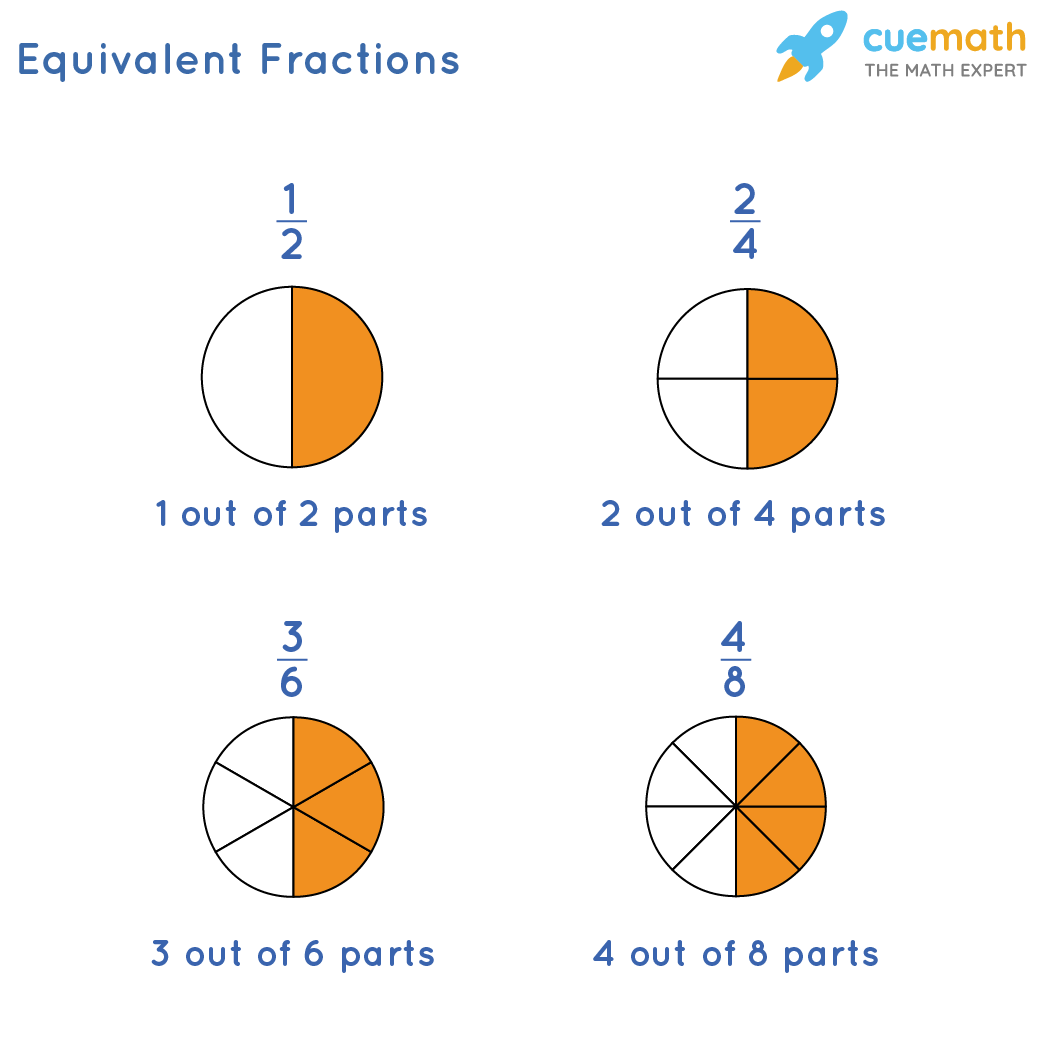
For example, the fraction $frac{1}{2}$ represents one part out of two equal parts. The fraction $frac{2}{4}$ represents two parts out of four equal parts. Intuitively, we can see that if we have a pizza cut into two slices and we take one, we have half. If we have the same pizza cut into four slices and we take two, we still have half. This visual understanding is key to grasping fraction equivalence.
Fraction equivalents are two or more fractions that represent the same value or proportion of a whole, even though they have different numerators and denominators. They are essentially different ways of writing the same number.
How to Find Fraction Equivalents
The primary method for finding fraction equivalents is by multiplying or dividing both the numerator and the denominator of a fraction by the same non-zero number. This process doesn’t change the value of the fraction because, in essence, we are multiplying or dividing by a form of ‘1’.
Let’s take our example of $frac{1}{2}$.
-
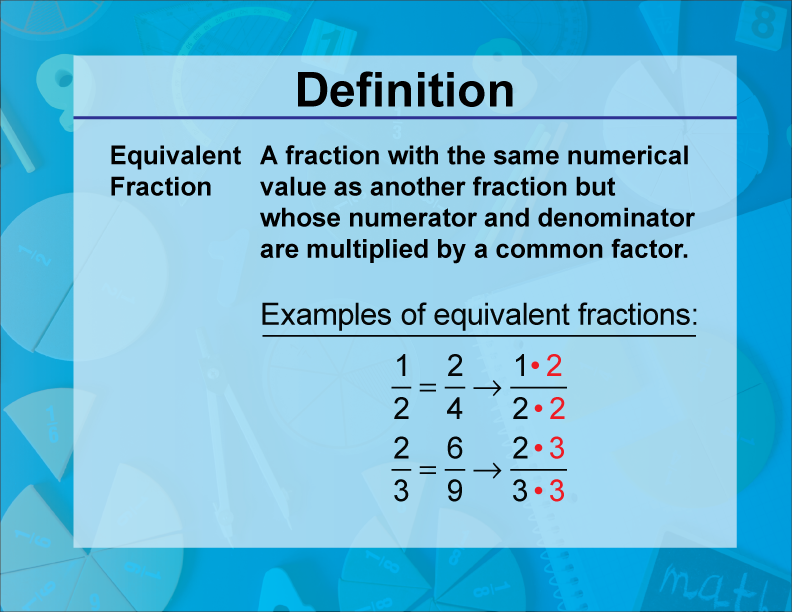
Multiplying: If we multiply both the numerator (1) and the denominator (2) by 2, we get:
$$ frac{1 times 2}{2 times 2} = frac{2}{4} $$
So, $frac{1}{2}$ is equivalent to $frac{2}{4}$. -
Multiplying again: If we multiply the original fraction $frac{1}{2}$ by 3:
$$ frac{1 times 3}{2 times 3} = frac{3}{6} $$
Thus, $frac{1}{2}$, $frac{2}{4}$, and $frac{3}{6}$ are all equivalent fractions. -
Dividing (Simplifying): Conversely, we can simplify a fraction to find an equivalent form. If we have $frac{6}{12}$ and we want to simplify it, we can find a common divisor for both the numerator (6) and the denominator (12). The greatest common divisor is 6.
$$ frac{6 div 6}{12 div 6} = frac{1}{2} $$
This process of simplification is crucial for making fractions easier to understand and compare.
The key principle behind this is that when you multiply or divide the numerator and denominator by the same number, you are effectively multiplying or dividing the fraction by 1 (e.g., $frac{2}{2}$, $frac{3}{3}$, $frac{6}{6}$). Multiplying any number by 1 does not change its value.
Why is Understanding Fraction Equivalence Important?
The ability to recognize and generate fraction equivalents is not merely a skill for solving textbook problems. It’s a fundamental building block for more complex mathematical concepts and has practical applications in various aspects of our technologically driven lives.
- Comparing Fractions: To compare two fractions with different denominators, you need to find equivalent fractions with a common denominator. For example, comparing $frac{2}{3}$ and $frac{3}{4}$ is easier if you convert them to equivalents with a common denominator, such as $frac{8}{12}$ and $frac{9}{12}$.
- Adding and Subtracting Fractions: Before you can add or subtract fractions, their denominators must be the same. This requires finding equivalent fractions.
- Understanding Ratios and Proportions: Ratios are often expressed as fractions, and understanding equivalence is key to solving proportion problems, which appear in everything from scaling recipes to analyzing data.
- Foundation for Higher Mathematics: Concepts like percentages, decimals, and algebraic expressions build upon the understanding of fractions and their equivalences.
Fraction Equivalents in the Digital Landscape: Tech and AI
In the realm of technology, the principles of mathematics, including fraction equivalence, often operate behind the scenes, powering the very tools we use. While we might not explicitly be calculating fractions when using an AI writing assistant or a data visualization app, the underlying algorithms rely on precise numerical relationships.
AI and Machine Learning: The Power of Data Representation
Artificial intelligence, particularly machine learning, thrives on data. This data is often processed and analyzed using mathematical models, where fractions and their equivalents play a subtle but critical role.
- Data Normalization and Scaling: Before data can be fed into machine learning models, it often needs to be normalized or scaled. This process involves transforming data values to fit within a specific range, often using fractional representations or percentages. For instance, a feature might be scaled to a range between 0 and 1, which is essentially representing values as fractions of the maximum possible value. Understanding that $frac{50}{100}$ is equivalent to $frac{1}{2}$ is crucial for interpreting these scaled datasets.
- Model Performance Metrics: When evaluating the performance of an AI model, metrics like accuracy, precision, and recall are often expressed as fractions or percentages. For example, an accuracy of $frac{90}{100}$ is equivalent to $frac{9}{10}$ or 90%. Recognizing these equivalences helps developers and users understand how well a model is performing.
- Algorithmic Efficiency: Complex algorithms, especially those dealing with resource allocation or optimization, might involve fractional calculations. Ensuring these calculations are precise and efficient often relies on understanding how to manipulate and compare fractional values effectively.
Software Development and User Interface Design
Even in the seemingly abstract world of software development and user interface (UI) design, fraction equivalents find their place.
- Layout and Proportions: Designing responsive web pages and mobile applications often involves defining layouts and proportions using relative units. These can be thought of as fractions of the total screen width or height. For instance, a column might be designed to take up $frac{1}{3}$ of the screen width, which is equivalent to 33.33% or $frac{2}{6}$ of the width. Understanding these fractional relationships ensures that interfaces scale gracefully across different devices.
- Image and Video Processing: When resizing images or videos, the aspect ratio is maintained to avoid distortion. This involves scaling dimensions proportionally, which is a direct application of ratios and equivalent fractions. If an image is 800 pixels wide and 600 pixels tall, its aspect ratio is $frac{800}{600}$, which simplifies to $frac{4}{3}$. Maintaining this ratio when resizing means that for every 3 units of height, there must be 4 units of width, ensuring the image looks correct.
Fraction Equivalents in the Realm of Brand and Marketing
Branding and marketing are about perception, positioning, and communicating value. While seemingly far removed from arithmetic, the underlying principles of proportion and equivalency are surprisingly relevant.
Brand Positioning and Market Share
Branding is about carving out a unique space in the market. This space can often be understood in terms of market share.
- Understanding Market Dominance: If a company holds $frac{1}{4}$ of the market, this is equivalent to 25% or $frac{50}{200}$ of the total market. Recognizing this equivalence allows for clear communication of a brand’s position relative to competitors. For instance, stating that a brand has “a quarter of the market” is directly comparable to another brand holding “half the market” ($frac{1}{2}$), as $frac{1}{2}$ is equivalent to $frac{2}{4}$.
- Target Audience Segmentation: Marketing efforts are often directed at specific segments of a larger audience. Understanding the proportion of the total audience represented by a target segment is crucial. If a campaign targets $frac{1}{5}$ of the total consumer base, and another targets $frac{2}{10}$, these represent the same proportional effort and reach.
Marketing Campaign Performance and ROI
The effectiveness of marketing campaigns is measured using various metrics, many of which can be expressed fractionally.
- Conversion Rates: A conversion rate, such as the percentage of website visitors who make a purchase, is fundamentally a fraction. A conversion rate of $frac{10}{100}$ is equivalent to $frac{1}{10}$, indicating that 1 in every 10 visitors converts. Understanding this helps in setting realistic goals and analyzing campaign success.
- Return on Investment (ROI): While ROI is often expressed as a percentage, it’s derived from a ratio of profit to investment. If an investment of $100 yields $150 in profit, the profit is $frac{150}{100}$ of the investment, or an ROI of 150%. Recognizing equivalent representations of this ratio is key to financial analysis in marketing.
Design and Visual Communication
Even in visual design, the concept of balanced proportions, which can be understood through fractional relationships, is paramount.
- The Golden Ratio: While not strictly a fraction in its common form ($approx 1.618$), the Golden Ratio informs aesthetically pleasing proportions. Its underlying mathematical principles are closely related to how parts relate to a whole, a concept directly connected to fractions and their equivalences. Designers often use fractional approximations of the Golden Ratio in layouts and compositions.
- Visual Hierarchy: The way elements are arranged on a page or screen to guide the viewer’s eye often involves proportional spacing and sizing. A design might allocate a certain visual “weight” or “space” to different elements, effectively using fractional divisions of the available canvas.
Fraction Equivalents and Personal Finance: Making Money Make Sense
In the personal finance sphere, understanding fractions and their equivalents can demystify complex financial concepts, empowering individuals to make smarter decisions about their money.
Budgeting and Expense Tracking
Managing personal finances effectively starts with understanding where your money goes.
- Allocating Funds: Budgets are essentially breakdowns of income into different spending categories, represented as fractions or percentages of the total income. If you allocate $frac{1}{3}$ of your income to housing and another $frac{2}{6}$ to savings, you’re allocating the same proportion to each, which might highlight areas for adjustment. Recognizing that $frac{1}{3}$ is equivalent to $frac{2}{6}$ helps in managing and reallocating funds efficiently.
- Tracking Savings Goals: Saving for a down payment on a house or retirement involves setting financial goals. If your goal is to save $50,000, and you’ve saved $25,000, you’ve saved $frac{25,000}{50,000}$, which simplifies to $frac{1}{2}$ or 50% of your goal. This clear fractional understanding makes progress tangible.
Investing and Returns
The world of investing is built on understanding growth and risk, often expressed through numerical ratios and rates.
- Understanding Investment Performance: When you invest, you’re looking for returns. If an investment grows by $frac{10}{100}$ of its value in a year, that’s equivalent to a 10% return, or an increase of $frac{1}{10}$. Understanding this equivalence is crucial for comparing different investment opportunities. A stock that gained $frac{2}{5}$ of its value is performing better than one that gained $frac{4}{10}$, as these are equivalent performance levels.
- Dividends and Interest: Interest on savings accounts and dividends from stocks are often calculated based on fractions of the principal amount or stock value. A dividend of $0.50 per share on a $10 stock represents a fractional return of $frac{0.50}{10}$, which simplifies to $frac{1}{20}$ or 5%.
Understanding Loans and Interest Rates
Loans involve borrowing money that must be repaid with interest, and fraction equivalents play a role in understanding the true cost of borrowing.
- Calculating Interest: While loan agreements usually specify interest rates, understanding how these translate into actual amounts paid requires comprehending fractional calculations. A 5% interest rate is equivalent to $frac{5}{100}$ or $frac{1}{20}$ of the principal amount.
- Loan Amortization: The process of paying off a loan over time involves a schedule of payments that include both principal and interest. The proportion of each payment that goes towards principal versus interest changes over the life of the loan, and these proportions can be understood through fractional analysis.
Conclusion: The Enduring Relevance of Fraction Equivalents
In a world increasingly dominated by digital interfaces and complex technologies, the foundational principles of mathematics remain indispensable. Fraction equivalents, far from being a relic of elementary education, are a powerful concept that underpins our understanding of technology, branding, marketing, and personal finance. By mastering the ability to recognize and manipulate equivalent fractions, we gain a clearer lens through which to view and interact with the world around us. Whether it’s optimizing an AI algorithm, crafting a compelling brand message, or making sound financial decisions, the quiet power of equivalent fractions is always at play, helping us to make sense of complexity and unlock deeper insights. The next time you encounter a proportion, a ratio, or a percentage, remember the fundamental elegance of fraction equivalence and the enduring value it brings to our modern lives.
aViewFromTheCave is a participant in the Amazon Services LLC Associates Program, an affiliate advertising program designed to provide a means for sites to earn advertising fees by advertising and linking to Amazon.com. Amazon, the Amazon logo, AmazonSupply, and the AmazonSupply logo are trademarks of Amazon.com, Inc. or its affiliates. As an Amazon Associate we earn affiliate commissions from qualifying purchases.