
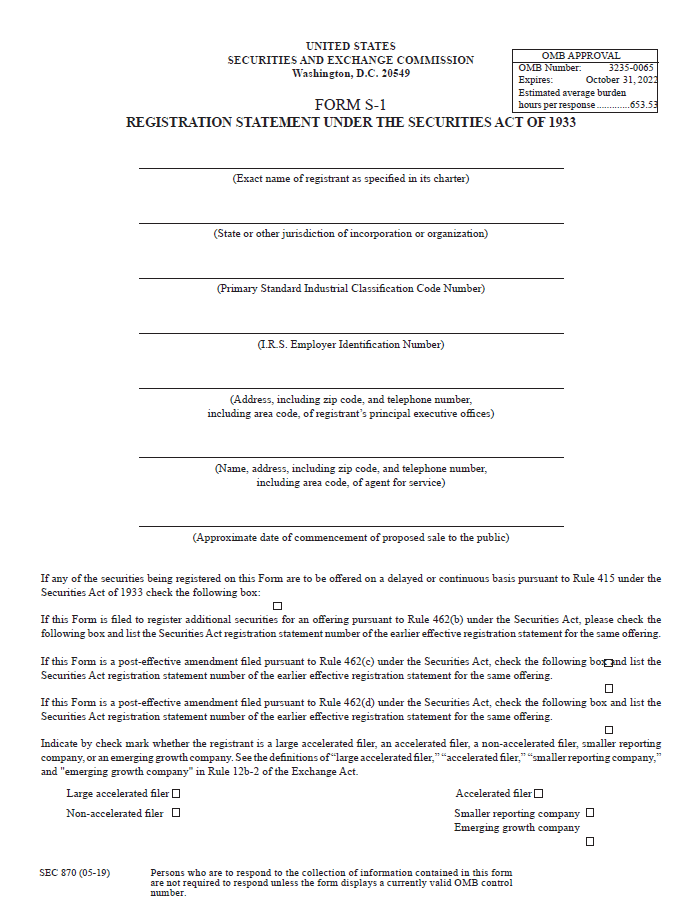
The journey of a private company to becoming publicly traded is a complex and highly regulated process. At its heart lies a pivotal document: Form S-1. This initial registration statement, filed with the U.S. Securities and Exchange Commission (SEC), is the comprehensive prospectus that lays bare a company’s financial health, business operations, risks, and the proposed terms of its public offering. For investors, underwriters, and the broader financial community, Form S-1 serves as the primary source of information to evaluate the viability and potential of a company seeking to enter the public markets. Understanding its intricacies is paramount for anyone involved in or observing the world of initial public offerings (IPOs).
The Genesis of Form S-1: Navigating Regulatory Requirements
The requirement for Form S-1 stems from the foundational principles of securities law in the United States. The Securities Act of 1933, often referred to as the “truth in securities” law, mandates that investors receive significant information about securities being offered publicly. This law aims to prevent fraud and protect investors by ensuring transparency and full disclosure. Form S-1 is the embodiment of this legislative intent, providing a standardized framework for companies to communicate essential details to potential shareholders.
The Securities Act of 1933 and Investor Protection
The Securities Act of 1933 was enacted in the wake of the 1929 stock market crash, a period marked by rampant speculation and a lack of transparency in the financial markets. The act’s primary objective was to restore investor confidence by establishing clear disclosure requirements. It dictates that before any security can be offered to the public, it must be registered with the SEC. This registration process involves submitting a detailed registration statement, and for most initial public offerings, this statement takes the form of Form S-1. The goal is not for the SEC to endorse the offering but to ensure that all material information is made available to investors so they can make informed decisions.
The Role of the SEC in the Registration Process
The U.S. Securities and Exchange Commission (SEC) is an independent federal agency tasked with regulating the securities markets in the United States. Its mission is to protect investors, maintain fair, orderly, and efficient markets, and facilitate capital formation. When a company files Form S-1, the SEC’s Division of Corporation Finance reviews the document to ensure it complies with all applicable rules and regulations and that it contains all the required disclosures. While the SEC does not “approve” the merits of an investment, it plays a crucial role in ensuring the completeness and accuracy of the information presented, challenging any ambiguities or omissions through a comment letter process. This iterative process of filing, reviewing, and amending is critical to the integrity of the IPO.
Unpacking the Contents of Form S-1: A Deep Dive into Disclosure
Form S-1 is an exhaustive document, designed to leave no stone unturned when it comes to presenting a company’s story and its future prospects. It is divided into two main parts: Part I, which contains the prospectus itself, and Part II, which includes additional information not required in the prospectus but filed with the SEC. The prospectus is the document that is distributed to potential investors.
Part I: The Prospectus – The Investor’s Roadmap
The prospectus is the most critical part of Form S-1, as it directly communicates with potential investors. It typically includes the following key sections:
- Risk Factors: This is arguably one of the most important sections, as it candidly outlines the potential risks associated with investing in the company. These risks can be broad, encompassing market conditions, industry-specific challenges, competition, regulatory changes, and operational uncertainties. They can also be specific to the company, such as its dependence on key personnel, the success of future products, or potential litigation. Investors are expected to read this section carefully to understand the potential downsides.
- Use of Proceeds: This section details how the company intends to use the capital raised from the IPO. Investors want to know where their money will be allocated – for research and development, acquisitions, debt repayment, working capital, or general corporate purposes. A clear and specific use of proceeds can instill confidence in the company’s strategic direction.
- Dividend Policy: If the company has a history of paying dividends or plans to do so in the future, this section outlines its dividend policy. This includes information on how dividends are determined, the frequency of payments, and any restrictions that might affect future dividend payouts. For many growth-oriented companies, reinvesting profits back into the business is prioritized over dividend payments.
- Selected Financial Data: This section provides a summary of the company’s financial performance over a period of several years. It typically includes key metrics such as revenue, net income, earnings per share, and total assets. This historical data allows investors to quickly assess the company’s financial trajectory.
- Management’s Discussion and Analysis of Financial Condition and Results of Operations (MD&A): This is a narrative explanation of the company’s financial results and its financial condition. It allows management to provide context and insights into the numbers, explaining significant trends, fluctuations, and the underlying drivers of financial performance. The MD&A is crucial for understanding the company’s business strategy, operational challenges, and future outlook.
- Business: This section provides a comprehensive overview of the company’s business operations. It includes details about its products and services, the markets it serves, its competitive landscape, its business strategy, its management team and key personnel, its intellectual property, its facilities, and any material contracts. This is where the company essentially tells its story and explains what it does and how it makes money.
- Properties: A description of the company’s principal physical properties, including leased and owned real estate, is provided here. This can be important for companies with significant manufacturing, research, or retail operations.
- Legal Proceedings: Any pending or threatened legal actions that could materially affect the company’s financial condition or operations are disclosed in this section.
- Management and Certain Security Holders: This part details the company’s executive officers and directors, their compensation, and their ownership of the company’s securities. It also discloses information about significant shareholders who own more than 5% of the company’s outstanding shares. This section provides insights into the governance and ownership structure.
Part II: Supplementary Information – The Behind-the-Scenes Details

Part II of Form S-1 contains information that is not required to be included in the prospectus but must be filed with the SEC. This part provides a more detailed look into the company’s affairs and includes:
- Exhibits: This section contains various supporting documents, such as articles of incorporation, bylaws, material contracts, underwriting agreements, and any other documents that are deemed important or required by the SEC.
- Undertakings: The company undertakes certain obligations to the SEC, such as agreeing to provide updated financial information or to comply with certain reporting requirements.
The IPO Process and Form S-1’s Role
Form S-1 is not a static document; it is the centerpiece of a dynamic and often lengthy process. Once filed, it undergoes rigorous review and can be amended multiple times before the IPO can proceed.
Filing and the “Quiet Period”
After the initial filing of Form S-1, a period known as the “quiet period” begins. During this time, the company and its underwriters are restricted in what they can publicly say about the company and the offering to avoid “gun jumping” – any activity that could be construed as an illegal solicitation of sales. The SEC then reviews the S-1 and typically issues a “comment letter” outlining any deficiencies or requests for additional information.
The Amendment Process and SEC Review
The company and its legal and financial advisors will respond to the SEC’s comments by amending the Form S-1. This back-and-forth process can involve several rounds of amendments and reviews. The goal is to address all of the SEC’s concerns and ensure that the document is accurate, complete, and compliant. This scrutiny is vital for ensuring that investors have all the necessary information to make informed decisions.
The Effectiveness and Pricing
Once the SEC is satisfied with the Form S-1 and its amendments, it will declare the registration statement “effective.” This allows the company to proceed with its IPO. The final pricing of the shares, typically determined by the underwriters in consultation with the company based on market demand and investor feedback, is then set, and the shares can begin trading on a stock exchange.
Beyond the IPO: Ongoing Reporting Obligations
The filing of Form S-1 is a crucial step, but it is not the end of the company’s reporting responsibilities. Once public, companies are subject to ongoing SEC reporting requirements, including quarterly reports (Form 10-Q) and annual reports (Form 10-K), as well as current reports on significant events (Form 8-K). These ongoing disclosures ensure that investors continue to receive timely and material information about the company’s performance and prospects.

Maintaining Transparency and Investor Confidence
The rigorous disclosure requirements associated with Form S-1 and subsequent public filings are fundamental to maintaining transparency and investor confidence in the capital markets. By providing a comprehensive and standardized view of a company’s financial health and business operations, Form S-1 empowers investors to make rational investment decisions, thereby contributing to efficient capital allocation and the overall health of the economy. It represents a critical bridge between private enterprise seeking growth capital and the public investors willing to provide it, underpinned by a commitment to information and accountability.
aViewFromTheCave is a participant in the Amazon Services LLC Associates Program, an affiliate advertising program designed to provide a means for sites to earn advertising fees by advertising and linking to Amazon.com. Amazon, the Amazon logo, AmazonSupply, and the AmazonSupply logo are trademarks of Amazon.com, Inc. or its affiliates. As an Amazon Associate we earn affiliate commissions from qualifying purchases.