
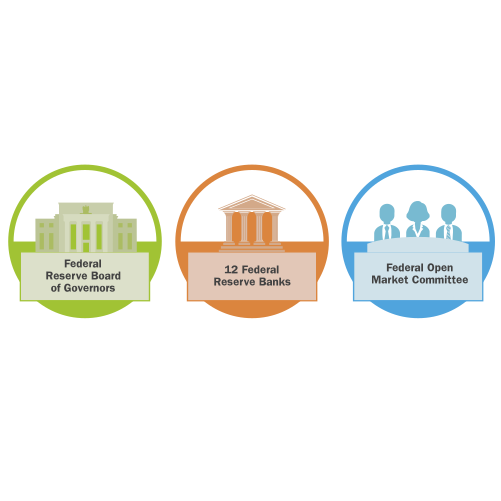
When one hears the term “the Feds” in an economic or financial discussion, it almost invariably refers to the Federal Reserve System—the central banking system of the United States. Established by Congress in 1913, the Federal Reserve, often simply called “the Fed,” was created to provide the nation with a safer, more flexible, and more stable monetary and financial system. Far from being a single entity, the Federal Reserve is a complex, decentralized structure comprising a Board of Governors in Washington, D.C., twelve regional Federal Reserve Banks, and the Federal Open Market Committee (FOMC). Understanding its role is paramount for anyone navigating personal finance, investing, or comprehending the broader economic landscape.
The Structure and Core Mandates of the Federal Reserve
The Federal Reserve’s unique structure blends central governmental oversight with regional autonomy. The Board of Governors, composed of seven members appointed by the President and confirmed by the Senate, provides leadership and sets national monetary policy. These governors serve staggered 14-year terms, designed to insulate them from political pressures and enable a long-term perspective on economic policy. Supporting the Board are the twelve Federal Reserve Banks, each serving a specific district and acting as the operating arm of the central bank. They conduct bank supervision, provide financial services to banks and the U.S. government, and gather economic data from their regions.
The most visible and influential body within the Fed is the Federal Open Market Committee (FOMC). This committee is responsible for setting the nation’s monetary policy and comprises the seven members of the Board of Governors and five of the twelve Federal Reserve Bank presidents. The president of the Federal Reserve Bank of New York serves as a permanent member, while the other four positions rotate among the remaining eleven presidents. The FOMC’s decisions on interest rates and the money supply directly influence the cost of borrowing and the availability of credit throughout the economy.
At its core, the Federal Reserve operates under a “dual mandate” bestowed upon it by Congress: to promote maximum sustainable employment and to maintain price stability.
Maximizing Employment
This aspect of the mandate means the Fed aims to achieve the lowest unemployment rate possible without triggering an unacceptable rise in inflation. It monitors a wide array of labor market indicators, including job growth, unemployment rates, wage growth, and labor force participation, to gauge the health of the employment situation. When unemployment is high, the Fed might pursue expansionary monetary policies to stimulate economic activity and job creation.
Maintaining Price Stability
Price stability refers to keeping inflation (the rate at which the general level of prices for goods and services is rising) at a low, stable, and predictable level. The Fed targets an average inflation rate of 2 percent over the longer run. High or volatile inflation erodes purchasing power, creates uncertainty for businesses and consumers, and can destabilize financial markets. Conversely, deflation (a sustained decrease in prices) can also be damaging, leading to reduced spending and economic contraction. The Fed uses its tools to prevent both excessive inflation and deflation, thereby protecting the value of money.
Beyond these two primary goals, the Fed also plays crucial roles in supervising and regulating banking institutions to ensure the safety and soundness of the financial system, maintaining the stability of the financial system itself, and providing financial services to depository institutions, the U.S. government, and foreign official institutions. These functions collectively ensure the smooth operation of the financial infrastructure that underpins all economic activity.
Monetary Policy Tools and Their Economic Impact
The Federal Reserve wields several powerful tools to implement its monetary policy and achieve its dual mandate. The adjustments made with these tools ripple through the economy, affecting everything from mortgage rates to business investment and the value of your savings.

The Federal Funds Rate
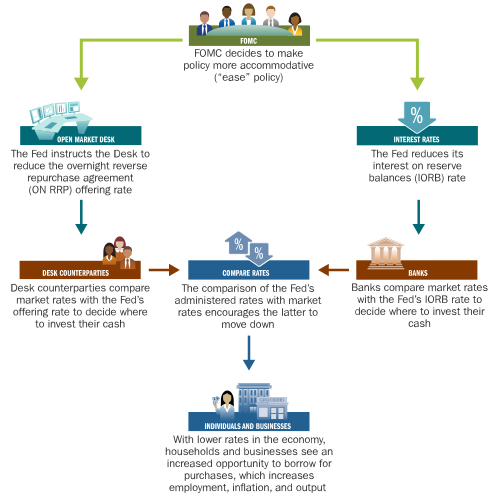
Perhaps the most widely discussed tool, the federal funds rate is the target rate that commercial banks charge each other for overnight loans of excess reserves. While the Fed does not directly set this rate, it influences it through its open market operations. By raising or lowering the target for the federal funds rate, the Fed signals its stance on monetary policy. A higher target generally means banks will charge more for loans, leading to higher interest rates across the board for consumers and businesses. Conversely, a lower target makes borrowing cheaper, encouraging spending and investment.
Open Market Operations (OMOs)
These are the primary means by which the Fed implements changes to the federal funds rate target. OMOs involve the buying and selling of government securities (like Treasury bonds) in the open market. When the Fed buys securities, it injects money into the banking system, increasing the supply of reserves and putting downward pressure on the federal funds rate. When it sells securities, it removes money from the system, decreasing reserves and putting upward pressure on the rate. These operations are conducted daily by the Federal Reserve Bank of New York and are critical for managing liquidity in the financial system.
The Discount Rate
This is the interest rate at which commercial banks can borrow money directly from the Federal Reserve’s discount window. While less frequently used than OMOs, the discount rate serves as a backup source of liquidity for banks. Changes in the discount rate can signal the Fed’s policy stance and act as a deterrent or an encouragement for banks to borrow. A higher discount rate suggests a tighter monetary policy, while a lower rate indicates a looser policy.
Reserve Requirements
Historically, the Fed mandated that banks hold a certain percentage of their deposits as reserves, either in their vaults or at a Federal Reserve Bank. Changes to these reserve requirements could significantly alter the amount of money banks had available to lend. However, as of March 2020, the Federal Reserve reduced reserve requirements for all depository institutions to zero, effectively rendering this tool inactive for routine monetary policy adjustments. This change aimed to simplify the implementation of monetary policy in an environment where banks typically hold ample reserves.
Quantitative Easing and Tightening (QE/QT)
In extraordinary economic circumstances, such as the 2008 financial crisis or the COVID-19 pandemic, the Fed has employed unconventional tools like quantitative easing. QE involves large-scale asset purchases beyond typical OMOs, primarily long-term government bonds and mortgage-backed securities, to put downward pressure on long-term interest rates and stimulate economic activity when short-term rates are already near zero. Quantitative tightening (QT) is the reverse process, where the Fed reduces its holdings of these assets, effectively removing liquidity from the financial system and putting upward pressure on long-term rates.
How the Feds Influence Your Money
The Federal Reserve’s actions, through the implementation of these monetary policy tools, have a profound and direct impact on the financial lives of individuals, families, and businesses across the nation.
Borrowing Costs
When the Fed raises its target for the federal funds rate, it generally translates into higher interest rates for a wide range of loans. This means a higher cost for new mortgages, car loans, personal loans, and credit card debt. Businesses face higher borrowing costs for expansion, inventory, or operations. Conversely, when the Fed lowers rates, borrowing becomes cheaper, encouraging consumers to take on debt for purchases and businesses to invest.
Savings and Investment Returns
Interest rates set by the Fed also influence the returns on savings accounts, certificates of deposit (CDs), and money market accounts. Higher rates mean savers earn more on their deposits, while lower rates reduce these returns. For investors, the Fed’s stance on monetary policy impacts bond yields, the attractiveness of different asset classes, and can even influence stock market valuations as corporate borrowing costs and consumer spending power shift.
Inflation and Purchasing Power
The Fed’s dual mandate to maintain price stability directly affects your purchasing power. If the Fed is successful in keeping inflation low and stable, your money retains its value over time, allowing you to buy roughly the same amount of goods and services in the future. However, if inflation escalates due to the Fed losing control or misjudging economic conditions, the value of your savings erodes, and your everyday expenses rise more rapidly.
Economic Growth and the Job Market
By influencing borrowing costs and liquidity, the Fed’s policies can either stimulate or cool down the economy. Expansionary policies (lower rates, more liquidity) aim to spur economic growth and job creation by making it easier and cheaper for businesses to invest and hire, and for consumers to spend. Contractionary policies (higher rates, less liquidity) are used to slow down an overheating economy and curb inflation, which might lead to a temporary slowdown in job growth. The health of the job market directly impacts individual income, financial stability, and long-term wealth accumulation.
In essence, the “Feds”—the Federal Reserve System—is the ultimate arbiter of the nation’s money supply and credit conditions. Its decisions, meticulously deliberated by economic experts, are designed to navigate the complex currents of the economy, aiming for a balance of robust employment and stable prices, all of which directly shape the financial environment in which individuals and businesses operate. Understanding its functions and influence is a cornerstone of financial literacy and sound economic decision-making.
aViewFromTheCave is a participant in the Amazon Services LLC Associates Program, an affiliate advertising program designed to provide a means for sites to earn advertising fees by advertising and linking to Amazon.com. Amazon, the Amazon logo, AmazonSupply, and the AmazonSupply logo are trademarks of Amazon.com, Inc. or its affiliates. As an Amazon Associate we earn affiliate commissions from qualifying purchases.