
In the modern professional landscape, job seekers are no longer just applicants; they are individual brands competing in a global marketplace. To successfully navigate this environment, one must understand that a job application is a targeted marketing campaign. At the heart of this campaign are two distinct but complementary pieces of brand collateral: the resume and the cover letter. While often discussed in the same breath, these documents serve radically different functions within your personal brand strategy.
Understanding the difference between a cover letter and a resume is not merely an academic exercise in career services—it is a strategic necessity for anyone looking to build a potent professional identity. One provides the data-driven evidence of your value, while the other provides the narrative context that makes that value resonate with a specific audience.

The Resume: Your Brand’s Technical Specification Sheet
If your personal brand were a high-end consumer product, the resume would be the technical specification sheet. It is a structured, concise, and high-density document designed to communicate your professional history, skills, and achievements at a glance. In the realm of brand strategy, the resume represents your “brand equity”—the accumulated value of your experiences and the measurable proof of your capabilities.
The Core Pillars of Professional Identity
A resume is built on hard facts. Its primary goal is to provide a chronological or functional overview of what you have done. It utilizes a standardized format to ensure that “purchasers” (recruiters and hiring managers) can quickly find the information they need to verify your qualifications.
From a branding perspective, the resume establishes your market positioning. It lists your “product features”: your education, your previous roles, your certifications, and your technical proficiencies. Each bullet point should be treated as a value statement, demonstrating how your brand has performed in various “market conditions” (past jobs). By focusing on metrics—such as percentage growth, revenue generated, or time saved—you provide the empirical evidence that supports your brand’s promises.
Optimizing for the Algorithm: Keywords and Consistency
In the digital age, resumes must also function as SEO-optimized landing pages for your personal brand. Most corporate brands use Applicant Tracking Systems (ATS) to filter candidates. This means your resume must be strategically designed with specific industry keywords that align with your brand’s niche.
However, brand consistency is equally vital. The language used in your resume should reflect the level of seniority and the specific industry you are targeting. A creative director’s resume will look and feel different from a financial analyst’s, yet both must adhere to the fundamental brand rule of clarity. Every line in the resume must reinforce the central “brand promise”: that you are a qualified, high-performing asset capable of delivering specific results.
The Cover Letter: Crafting Your Brand Narrative
While the resume is about the “what,” the cover letter is about the “why” and the “how.” In brand strategy, a product is rarely sold on its specs alone; it is sold on the story it tells and the problem it solves. The cover letter is your opportunity to step out from behind the bullet points and speak directly to the target audience, establishing a human connection that a resume cannot achieve.
Moving Beyond the Data: The Human Element
The cover letter is the narrative voice of your personal brand. It allows you to express your brand values, your professional philosophy, and your enthusiasm for the specific opportunity. If the resume is your “what,” the cover letter is your “who.”
In this document, you have the space to explain the “brand journey.” You can provide context for transitions in your career, highlight specific passions that drive your work, and demonstrate your cultural fit. For a brand, cultural alignment is often as important as technical capability. A cover letter allows you to signal that your personal brand values are in sync with the corporate brand values of the company you are targeting. This creates a sense of “brand affinity” that makes you a much more attractive candidate.
Solving the Brand Problem: Alignment and Value Proposition
Every job opening is essentially a “pain point” for a company. They have a problem that needs solving, and they are looking for a brand to solve it. Your cover letter should act as a bespoke proposal. While the resume is a general overview of your history, the cover letter is a targeted message that explains exactly how your unique brand of skills will address the specific challenges currently facing the employer.
By researching the company’s current market position, its challenges, and its goals, you can tailor your cover letter to position yourself as the solution. This is where you connect the dots for the recruiter: “You have Problem X; my brand has a proven track record of solving Problem X using Method Y.” This level of personalization is the hallmark of a sophisticated personal brand strategy.
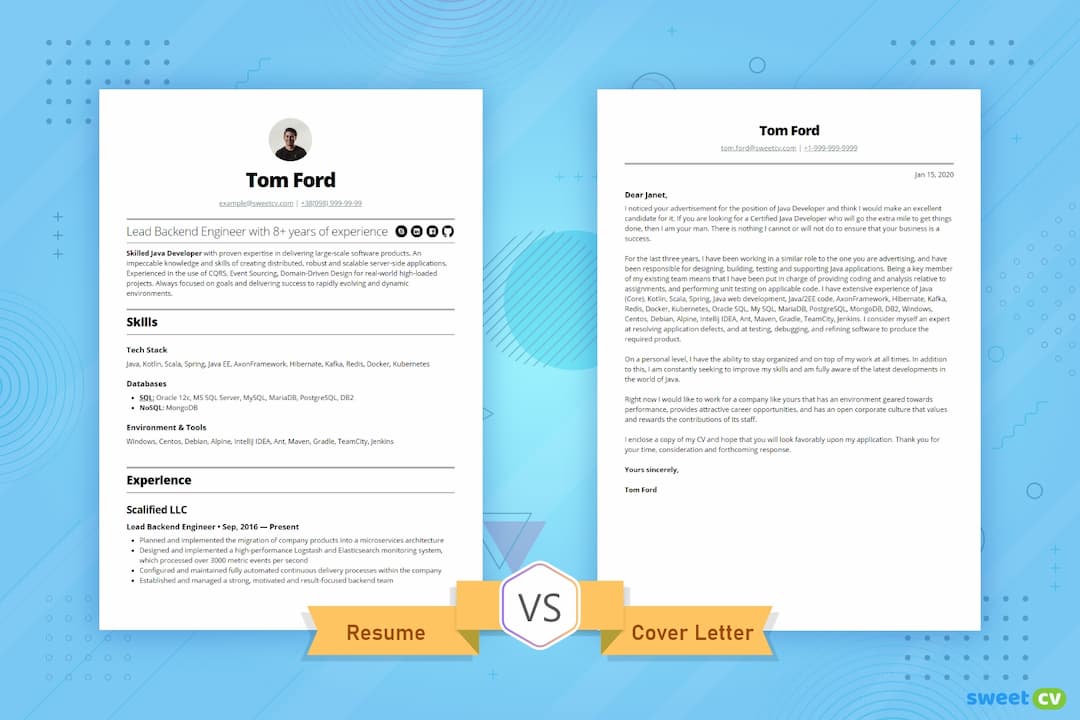
Strategic Synergy: How the Two Documents Build a Cohesive Brand Identity
To be effective, your resume and cover letter must work in tandem. They should not be carbon copies of one another, nor should they feel like they were written by two different people. Strategic synergy occurs when the two documents reinforce the same brand identity while covering different ground.
Visual Consistency Across Professional Touchpoints
A brand is recognized by its visual identity. When applying for a role, your resume and cover letter should share a consistent visual language. This includes using the same font families, margin sizes, and header designs.
If your resume uses a sleek, minimalist aesthetic with a specific color accent for your name, your cover letter should mirror that design. This visual continuity signals professionalism and attention to detail. It tells the employer that you understand the importance of brand presentation. When your documents look like a “set,” they convey a much stronger sense of organized, deliberate professional identity than two mismatched pages ever could.
Tone and Voice: Matching the Message to the Medium
The tone of your brand must be consistent across both documents, even if the “volume” of that tone changes. The resume is naturally more formal, clipped, and objective. The cover letter is more conversational and subjective. However, the underlying “brand voice” should be the same.
If your personal brand is built on being an “innovative disruptor,” that energy should be present in the active verbs of your resume and the bold, forward-thinking language of your cover letter. If your brand is built on “meticulous precision,” both documents should be flawlessly structured and use measured, authoritative language. This consistency builds trust with the recruiter, as it suggests a stable and authentic professional identity.
Avoiding Brand Dilution: Common Pitfalls in Application Documentation
One of the biggest mistakes in personal branding is “brand dilution”—where the core message becomes muddled or weakened by poor communication. In the context of job applications, this usually happens when the distinction between the resume and cover letter is ignored.
Redundancy vs. Reinforcement
A common error is simply rewriting the resume in paragraph form for the cover letter. This is a missed branding opportunity. A recruiter who has already scanned your resume for your job history does not want to read a summary of that same history in a letter.
Instead of being redundant, aim to be reinforcing. Use the cover letter to dive deeper into one or two specific “brand stories” that are only hinted at in the resume. If your resume mentions you “led a team of 50 to increase sales by 20%,” your cover letter can tell the story of the specific strategy you used, the obstacles you overcame, and the leadership philosophy that guided you. This adds depth to your brand without repeating the same data points.
The Danger of Generic Content in Personal Branding
A generic brand is a forgettable brand. Many candidates use “templates” for their cover letters that are so vague they could apply to any company. This is the equivalent of “white-labeling” your personal brand—it strips away everything that makes you unique.
To maintain a strong personal brand, every cover letter must be a unique piece of content. Using the same resume for similar roles is acceptable (provided the keywords are adjusted), but using a generic cover letter is a brand failure. It signals to the employer that you are not invested in their specific brand, which immediately lowers your value in their eyes.
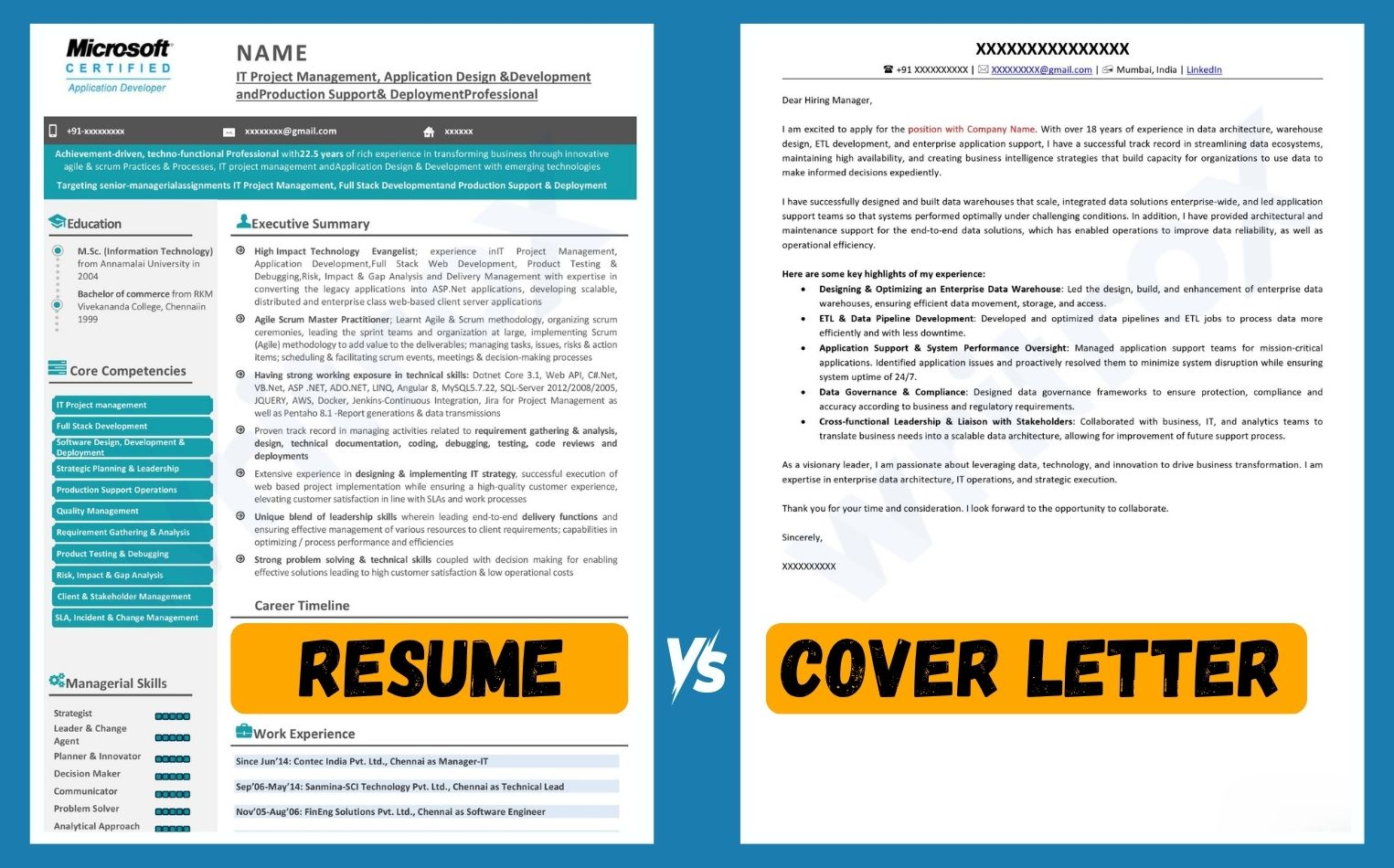
Future-Proofing Your Professional Brand in a Competitive Market
As the professional world becomes increasingly automated and AI-driven, the importance of the distinction between the resume and the cover letter will only grow. Resumes will likely become even more data-centric and machine-readable, while cover letters (and the personal branding they represent) will become the primary way for humans to differentiate themselves from one another.
A well-crafted resume proves you can do the job, but a well-crafted cover letter proves you are the right person for the brand. By mastering the difference between these two documents, you are doing more than just applying for a job; you are managing a sophisticated personal brand. You are ensuring that your professional identity is not just a list of dates and titles, but a compelling, cohesive narrative of value, growth, and potential.
In conclusion, view your resume as your brand’s foundation—the solid, unshakeable facts of your career. View your cover letter as the brand’s storefront—the inviting, persuasive narrative that draws the customer in. Together, they form a complete brand identity that is far more powerful than the sum of its parts. By respecting the unique role each document plays, you position yourself as a candidate who doesn’t just fit a job description, but someone who elevates the entire organization.
aViewFromTheCave is a participant in the Amazon Services LLC Associates Program, an affiliate advertising program designed to provide a means for sites to earn advertising fees by advertising and linking to Amazon.com. Amazon, the Amazon logo, AmazonSupply, and the AmazonSupply logo are trademarks of Amazon.com, Inc. or its affiliates. As an Amazon Associate we earn affiliate commissions from qualifying purchases.