
In the world of personal finance, the Annual Percentage Rate (APR) is the figure most consumers gravitate toward when comparing credit cards, personal loans, or mortgages. It is the headline number, the one displayed in bold on marketing materials and bank websites. However, the APR is actually a macro-level figure that masks a more granular, day-to-day calculation that determines exactly how much you owe the bank at the end of the month. This granular figure is known as the Daily Periodic Rate (DPR).
Understanding the Daily Periodic Rate is essential for anyone looking to master their debt management, optimize their cash flow, or simply avoid the pitfalls of high-interest revolving credit. While the APR tells you what a loan costs over a year, the DPR tells you what it costs you every single day you carry a balance.

The Anatomy of the Daily Periodic Rate
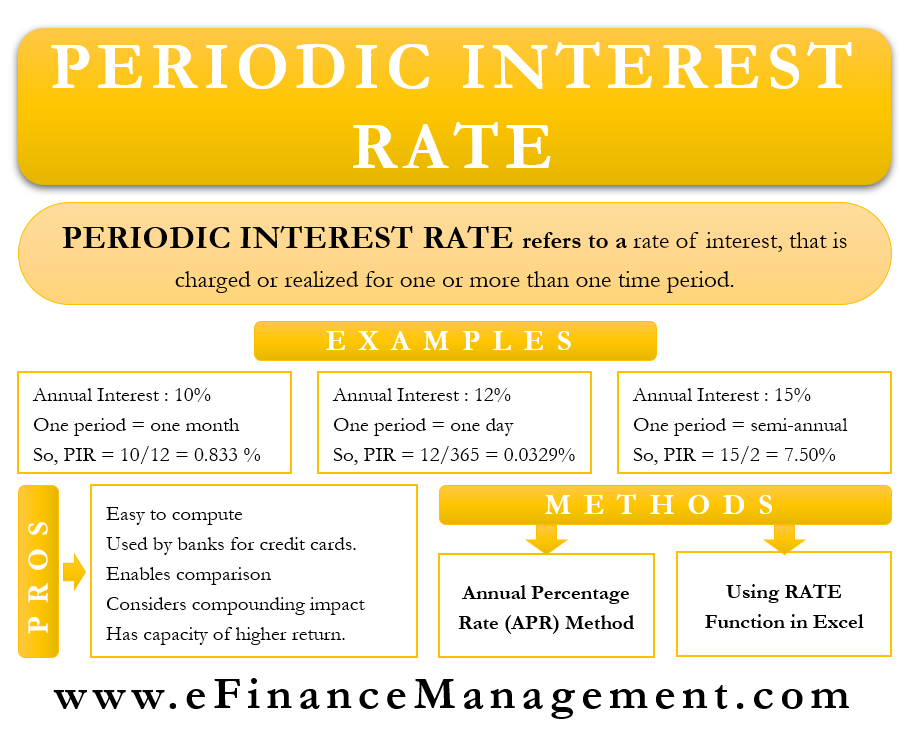
At its most basic level, the Daily Periodic Rate is the APR divided by the number of days in a year. While this sounds straightforward, the nuances of how financial institutions apply this rate can significantly influence the total interest paid over the life of a loan or the duration of a credit card balance.
The Mathematical Formula
To calculate the Daily Periodic Rate, a lender typically takes the stated APR and divides it by either 365 or 360. The choice between 365 and 360 is not arbitrary; it depends on the lender’s internal policies and the type of loan. Most consumer credit card companies use a 365-day year.
The formula is expressed as:
DPR = APR / Number of Days in the Year
For example, if you have a credit card with an 18% APR, the calculation would be:
0.18 / 365 = 0.000493 (or 0.0493% per day).
While 0.0493% seems like a negligible amount, it is applied to your balance every day. When dealing with large balances or long timeframes, these daily increments compound, leading to the substantial interest charges seen on monthly statements.
The 360-Day vs. 365-Day Year
In certain commercial lending environments and specific types of business finance, institutions use what is known as the “Banker’s Year,” which consists of 360 days (twelve 30-day months). Using a 360-day denominator instead of 365 actually results in a slightly higher Daily Periodic Rate for the consumer.
If we revisit our 18% APR example using a 360-day year:
0.18 / 360 = 0.0005 (or 0.05% per day).
While the difference between 0.0493% and 0.05% appears minute, in the context of multi-million dollar corporate lines of credit or long-term commercial real estate loans, that small variance results in thousands of dollars in additional interest expenses annually.
APR vs. APY vs. DPR
It is important to distinguish DPR from the Annual Percentage Yield (APY). While the APR and DPR focus on the periodic interest rate applied to a balance, the APY accounts for the effect of compounding. Because the Daily Periodic Rate is applied daily, and that interest is often added to the principal balance (compounding), the actual amount you pay over a year (APY) is usually higher than the stated APR. Understanding DPR is the first step in deconstructing how APR transforms into a much larger effective cost.
How Credit Card Issuers Use Daily Periodic Rates
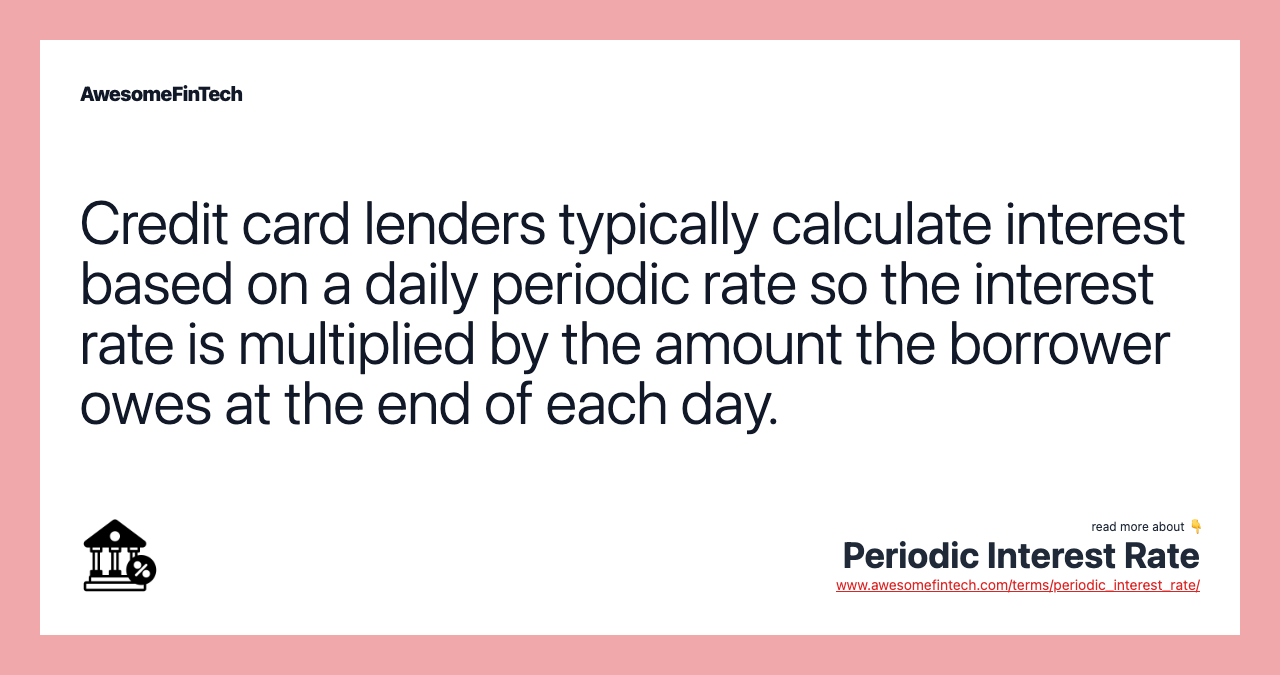
Credit cards are the most common financial products where the Daily Periodic Rate plays a central role. Unlike an installment loan—where you have a fixed payment schedule—credit cards are revolving lines of credit. This means your balance changes daily as you make purchases, returns, and payments. To account for this volatility, banks use the Daily Periodic Rate in conjunction with the “Average Daily Balance” method.
The Average Daily Balance Method
Most credit card issuers do not simply look at your balance on the last day of the month and apply interest. Instead, they track your balance every single day of the billing cycle. At the end of the cycle, they add up all the daily balances and divide by the number of days in the cycle to find the Average Daily Balance.
Once the Average Daily Balance is determined, the bank applies the Daily Periodic Rate for each day in the billing cycle.
Interest Charge = Average Daily Balance × DPR × Number of Days in Billing Cycle
This method ensures that the bank is compensated for the exact amount of credit you utilized throughout the month. If you carry a $5,000 balance for the first 15 days of the month and then pay off $4,000, leaving a $1,000 balance for the remaining 15 days, your Average Daily Balance (and resulting interest charge) will be significantly lower than if you had waited until the last day of the month to make that payment.
The Power of Daily Compounding
One of the more aggressive aspects of the Daily Periodic Rate is daily compounding. Some credit card issuers calculate the interest owed for the day and immediately add it to the principal balance. The next day, the DPR is applied to the new, slightly higher balance.
This creates a “snowball” effect where you are paying interest on your interest. While the daily additions might be measured in cents, over the course of a year, this compounding can add a full percentage point or more to the effective interest rate you are paying. This is why financial advisors emphasize that credit card debt is “sticky”—the mechanics of the DPR make it difficult to gain traction if you are only making minimum payments.
Impact on Loans and Revolving Lines of Credit
While credit cards are the primary vehicle for DPR application, other financial tools also rely on this metric. Personal lines of credit, Home Equity Lines of Credit (HELOCs), and certain types of adjustable-rate mortgages utilize daily periodic calculations to determine monthly interest obligations.
HELOCs and Business Lines of Credit
For homeowners using a HELOC or business owners utilizing a working capital line of credit, the Daily Periodic Rate is a critical variable. These accounts function similarly to credit cards but often involve much larger sums of money.
Because HELOCs are often used for home renovations or major expenses, the balance may fluctuate wildly as contractors are paid. By understanding the DPR, a borrower can see the immediate benefit of “parking” excess cash in the line of credit to reduce the daily balance, thereby lowering the interest accrued that day. In business finance, this is a standard strategy for managing liquidity while minimizing interest expenses.
Student Loans and Daily Accrual
Many student loans, particularly private ones, accrue interest daily. Even during periods of deferment or forbearance, the Daily Periodic Rate is still being applied to the principal balance. This is why many graduates are shocked to find their balance is higher when they start repayment than when they graduated. The DPR was quietly working in the background, adding interest every day, which was then “capitalized” or added to the principal balance.
Strategic Debt Management: Leveraging DPR Knowledge
Knowledge of the Daily Periodic Rate is not just academic; it provides a roadmap for strategic debt reduction. If you know that interest is calculated daily, you can change your behavior to minimize the cost of borrowing.
The Frequency of Payments
The most effective way to combat the Daily Periodic Rate is to increase the frequency of your payments. Most consumers pay their credit card bills once a month on the due date. However, since the interest is based on the Average Daily Balance, making smaller, more frequent payments throughout the month can save significant money.
Consider the “15/15” rule: making a payment 15 days before your due date and another payment on the due date. By making that first payment halfway through the cycle, you reduce the daily balance for the remaining 15 days of the month. The Daily Periodic Rate is then applied to a smaller number, resulting in less interest being capitalized.
Timing Your Purchases
For those who carry a balance, the timing of large purchases matters. If you make a major purchase at the very beginning of your billing cycle, that amount will be included in your Average Daily Balance for the entire month. If you can delay that purchase until the end of the billing cycle (or after the statement closes), you can effectively avoid the Daily Periodic Rate being applied to that amount for an extra 20 to 30 days.
Utilizing Grace Periods
It is worth noting that if you pay your statement balance in full every month, the Daily Periodic Rate effectively becomes zero for you. Most credit cards offer a “grace period” on new purchases. During this time, the bank does not apply the DPR to your balance. However, the moment you fail to pay the full statement balance and begin carrying debt, the grace period usually disappears, and the DPR begins accruing on every purchase from the date the transaction is made.
Regulatory Oversight and Consumer Protection
Because the Daily Periodic Rate is the engine behind interest charges, it is a point of focus for financial regulators. In the United States, the Truth in Lending Act (TILA) requires lenders to be transparent about how they calculate interest.
The Truth in Lending Act (TILA)
Under TILA, lenders are mandated to disclose the Daily Periodic Rate on your monthly statements. If you look at the fine print of your credit card statement—usually on the back or at the very end of the digital PDF—you will see a section titled “Interest Charge Calculation.” Here, the issuer must list the APR, the corresponding Daily Periodic Rate, and the balance to which those rates were applied.
This transparency allows consumers to audit their own statements. By multiplying their Average Daily Balance by the DPR and the number of days in the billing cycle, a consumer can verify that the bank’s math is correct. In an era of automated banking, errors are rare, but understanding these disclosures is a vital part of financial literacy.
The Evolution of Digital Tools
As financial technology (FinTech) evolves, new tools are emerging that help consumers visualize the impact of the Daily Periodic Rate in real-time. Some modern banking apps now show “interest accrued to date” within the billing cycle. This real-time feedback loop makes the cost of carrying a balance tangible. Instead of waiting for a monthly statement shock, users see their debt growing by a few dollars every day, which can act as a powerful psychological deterrent to overspending and an incentive for early repayment.
In conclusion, while the Annual Percentage Rate is a useful benchmark for comparison, the Daily Periodic Rate is the actual mechanism of cost. It is the pulse of your debt. By understanding how this rate is derived, how it interacts with your daily balance, and how it compounds over time, you can move from being a passive payer of interest to an active manager of your financial health. Whether it is through more frequent payments, strategic purchase timing, or choosing lenders with more favorable calculation methods, mastering the DPR is a fundamental step toward financial independence.
aViewFromTheCave is a participant in the Amazon Services LLC Associates Program, an affiliate advertising program designed to provide a means for sites to earn advertising fees by advertising and linking to Amazon.com. Amazon, the Amazon logo, AmazonSupply, and the AmazonSupply logo are trademarks of Amazon.com, Inc. or its affiliates. As an Amazon Associate we earn affiliate commissions from qualifying purchases.