
In the current landscape of digital transformation, the perimeter of cybersecurity has shifted. Gone are the days when a robust firewall and a strong antivirus were enough to protect corporate assets. Today, the “identity” of a user, machine, or application has become the new perimeter. At the heart of this paradigm shift is CyberArk, a global leader in Identity Security, specifically recognized for its pioneering work in Privileged Access Management (PAM).
To understand CyberArk is to understand how modern enterprises protect their most sensitive data. Whether it is a government agency safeguarding national secrets or a financial institution protecting trillions in assets, CyberArk provides the underlying technology that ensures only the right people (and the right machines) have access to the right resources at the right time.
The Evolution of Privileged Access Management (PAM)
CyberArk’s primary claim to fame is its development and refinement of Privileged Access Management (PAM). To appreciate the technology, one must first understand what a “privileged account” is. Unlike a standard user account—which might allow an employee to check emails or draft documents—a privileged account has the “keys to the kingdom.” These include administrative accounts, root accounts, and service accounts that can change system configurations, delete data, or create new users.
From Basic Password Vaults to Identity Security
In its early days, CyberArk was primarily known for its “Digital Vault” technology. This was a highly secure, encrypted repository for storing sensitive credentials. However, as cyber threats evolved from simple viruses to sophisticated, state-sponsored Advanced Persistent Threats (APTs), CyberArk expanded its scope. It transitioned from a simple storage solution to a comprehensive Identity Security platform that manages the entire lifecycle of an identity—from creation to authentication, authorization, and auditing.
Why Privileged Accounts are the Primary Target
Statistics consistently show that a vast majority of security breaches involve the misuse of privileged credentials. Once an attacker gains access to a low-level account, their next step is “lateral movement.” They search the network for privileged credentials that allow them to escalate their permissions. CyberArk’s technology is designed specifically to stop this progression. By securing these high-value targets, CyberArk effectively shuts down the most common pathway for data breaches and ransomware attacks.
Key Components and Features of the CyberArk Ecosystem
CyberArk is not a single tool but an integrated suite of modules designed to handle different aspects of security. Its architecture is built to be resilient, scalable, and capable of operating across on-premises, hybrid, and multi-cloud environments.
Enterprise Password Vault (EPV)
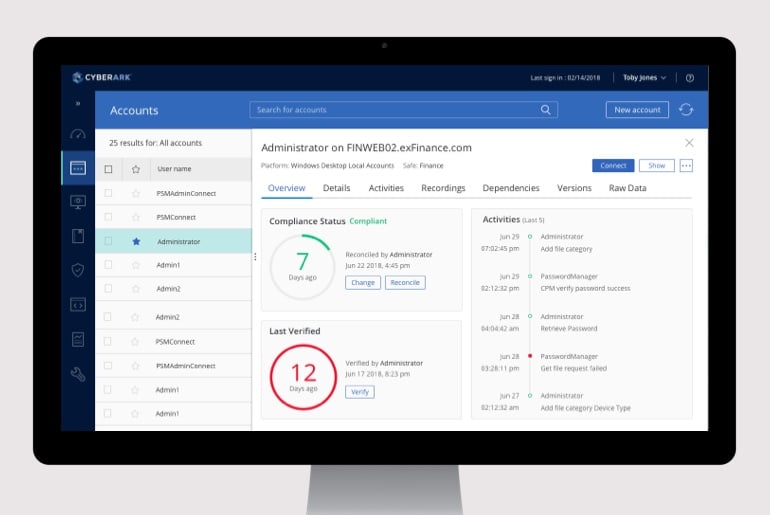
The EPV remains the foundation of the CyberArk Blueprint. It centralizes the management of privileged credentials. Instead of administrators knowing the passwords to various servers and databases, those passwords are “vaulted.” When an admin needs access, they request it through CyberArk. The system can then automatically rotate these passwords after every use or at set intervals, ensuring that a stolen password becomes useless almost immediately.
Privileged Session Manager (PSM)
The PSM acts as a proxy or a “jump server.” When a user accesses a sensitive system, they do not connect directly. Instead, they connect through CyberArk. This allows the organization to record the entire session—much like a security camera in a bank vault. If a database is accidentally deleted or a malicious command is executed, security teams can playback the session to see exactly what happened, providing an immutable audit trail for compliance and forensics.
Endpoint Privilege Manager (EPM)
Security doesn’t just happen in the data center; it happens at the workstation. CyberArk’s EPM helps organizations implement “least privilege” on the desktop. It allows users to run as standard users (which is safer) while “elevating” permissions only for specific, approved applications. This prevents malware from installing itself, as most malware requires administrative rights to execute and spread.
Secrets Manager for DevOps
In the modern tech stack, “non-human identities” are growing faster than human ones. These include API keys, certificates, and hardcoded credentials used by automated scripts, containers, and CI/CD pipelines. CyberArk Secrets Manager integrates with tools like Kubernetes, Jenkins, and Ansible to provide these automated processes with credentials securely and on-the-fly, eliminating the risk of “secret sprawl” in source code.

How CyberArk Implements a Zero Trust Framework
The industry has moved toward a “Zero Trust” model, which operates on the assumption that the network is already compromised. CyberArk is a foundational component of a Zero Trust architecture because it enforces the mantra: “Never trust, always verify.”
The Principle of Least Privilege (PoLP)
CyberArk enables organizations to move away from “all-or-nothing” access. Through its granular control systems, it ensures that an identity has only the minimum level of access required to perform its function. By limiting the scope of what any single account can do, CyberArk significantly reduces the “blast radius” of a potential compromise.
Just-in-Time (JIT) Access
One of the most innovative aspects of CyberArk’s technology is Just-in-Time access. Traditionally, an administrator might have “standing access”—they have high-level permissions 24/7. CyberArk changes this by granting elevated permissions only when needed and only for a specific duration. Once the task is finished, the permissions are revoked. This ensures that there are no “dormant” privileged accounts waiting to be exploited by hackers.
Continuous Authentication and Threat Analytics
CyberArk doesn’t just check your ID at the door; it monitors your behavior inside the building. Using AI and machine learning, CyberArk’s Privileged Threat Analytics (PTA) looks for anomalies. If a user who typically logs in from New York at 9:00 AM suddenly attempts to access a sensitive database from an unrecognized IP in another country at 3:00 AM, CyberArk can automatically trigger an alert, require multi-factor authentication (MFA), or even terminate the session in real-time.
The Strategic Benefits of Deploying CyberArk in the Modern Enterprise
While the technical capabilities are impressive, the business value of CyberArk lies in risk mitigation and operational continuity. In an era where a single breach can cost a company millions in fines and lost reputation, CyberArk serves as a critical insurance policy.
Mitigating Ransomware and Lateral Movement
Ransomware is the “nightmare scenario” for modern IT departments. Most ransomware works by gaining a foothold and then searching for credentials to encrypt as many servers as possible. By vaulting these credentials and requiring MFA for access, CyberArk makes it exponentially harder for ransomware to spread. It acts as a series of firebreaks in a forest, preventing a small spark from turning into a catastrophic wildfire.
Compliance and Regulatory Requirements
Regulatory frameworks like GDPR, HIPAA, PCI DSS, and SOX have strict requirements regarding who can access sensitive data. CyberArk provides the detailed logging and reporting necessary to prove to auditors that privileged access is tightly controlled and monitored. The ability to generate an “audit-ready” report at the click of a button saves organizations thousands of hours in manual preparation.
Operational Efficiency through Automation
There is a common misconception that security slows down productivity. CyberArk counters this through automation. By automating password rotations, account discovery, and session management, IT teams are freed from mundane administrative tasks. Developers can use CyberArk APIs to programmatically fetch secrets, allowing them to build secure applications faster without worrying about managing credentials manually.
Future Outlook: Identity in the Age of AI and Cloud-Native Environments
As we look toward the future, CyberArk is evolving to meet the challenges of an increasingly complex digital world. The rise of cloud-native environments and the integration of Artificial Intelligence present both opportunities and threats.
CyberArk is heavily investing in “Identity Security Intelligence.” As the volume of data grows, human analysts can no longer keep up with every log entry. The future of CyberArk lies in its ability to use AI to autonomously detect and respond to threats. Furthermore, as organizations move to multi-cloud environments (using AWS, Azure, and Google Cloud simultaneously), CyberArk provides a “single pane of glass” to manage identities across all these disparate platforms.
In conclusion, CyberArk is far more than a password manager for businesses. It is a comprehensive security layer designed to protect the most vulnerable and valuable part of any digital ecosystem: privileged access. By combining vaulting, session monitoring, endpoint protection, and behavioral analytics, CyberArk ensures that in a world where everyone is a target, the “keys to the kingdom” remain securely out of reach for those who wish to do harm. For any organization serious about its digital resilience, CyberArk is not just a tool—it is a necessity.
aViewFromTheCave is a participant in the Amazon Services LLC Associates Program, an affiliate advertising program designed to provide a means for sites to earn advertising fees by advertising and linking to Amazon.com. Amazon, the Amazon logo, AmazonSupply, and the AmazonSupply logo are trademarks of Amazon.com, Inc. or its affiliates. As an Amazon Associate we earn affiliate commissions from qualifying purchases.