
In the landscape of geometric proofs, few acronyms carry as much weight or utility as CPCTC. For students, educators, and anyone delving into the rigors of Euclidean geometry, understanding this principle is the key to unlocking the logic behind congruent triangles. While geometry is often perceived as a collection of shapes and formulas, it is fundamentally a system of logical deductions. CPCTC serves as one of the most reliable tools in that system, acting as the bridge between proving that two triangles are identical and proving that every individual part of those triangles shares the same relationship.

Deciphering the Acronym: Defining CPCTC
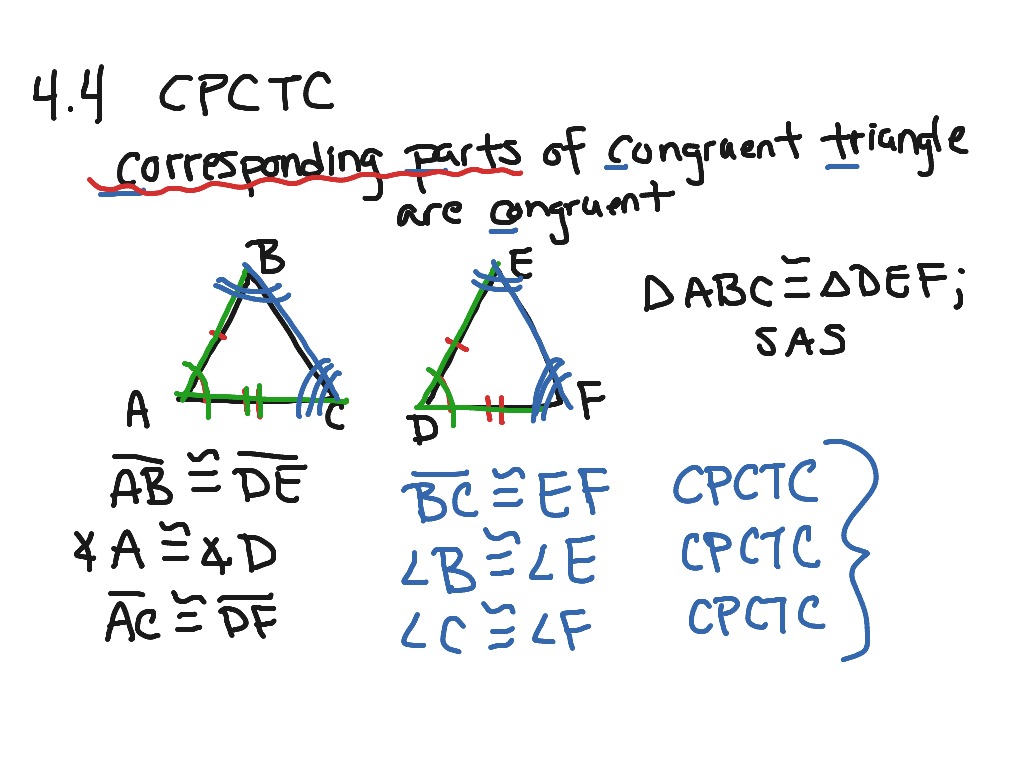
At its core, CPCTC stands for “Corresponding Parts of Congruent Triangles are Congruent.” When broken down, each word provides a specific instruction on how to interpret geometric data.
Corresponding Parts
In the context of two triangles, “corresponding parts” refers to the sides and angles that occupy the same relative positions in each figure. If you were to map one triangle onto another through a transformation—such as a rotation, reflection, or translation—the parts that land on top of one another are the “corresponding” parts. This includes the three sets of interior angles and the three sides that define the perimeter of the triangles.
Congruent Triangles
Congruence is the geometric equivalent of equality. Two triangles are congruent if they have the exact same size and shape. You do not reach the CPCTC stage until you have already established that the two triangles are, in fact, congruent. This is usually achieved through established shortcuts such as SSS (Side-Side-Side), SAS (Side-Angle-Side), ASA (Angle-Side-Angle), AAS (Angle-Angle-Side), or HL (Hypotenuse-Leg for right triangles).
The Logical Deduction
The “are congruent” part of the acronym is the conclusion. It posits that once you have confirmed congruence for the whole (the triangles), you can automatically claim congruence for the pieces (the sides and angles). It is the mathematical version of saying that if two objects are identical, then every feature of object A must be identical to the corresponding feature of object B.
The Role of CPCTC in Geometric Proofs
Mathematical proofs are built on a foundation of axioms, postulates, and previously proven theorems. CPCTC functions as a formal justification within these proofs. It is a “reason” column entry that allows a mathematician to bridge the gap between initial assumptions and the final target statement.
Moving Beyond the Minimum Requirements
To prove that two triangles are congruent, you only need three specific pieces of information (depending on the theorem). For example, using the SAS theorem, you need two sides and the included angle. However, a triangle has six parts in total—three sides and three angles. Once you use SAS to prove the triangles are congruent, you have technically proven that all six parts are congruent. CPCTC is the formal tool that allows you to “claim” the remaining three parts that weren’t part of your initial proof.
Structuring a Proof
A standard two-column proof in geometry involves a series of statements and their corresponding reasons. CPCTC typically appears toward the end of these proofs.
- Given: You are provided with specific information about the segments or angles.
- Strategy: You look for the three pieces of evidence needed to trigger a congruence theorem.
- Congruence: You state that the two triangles are congruent by SSS, SAS, etc.
- CPCTC: You use the triangles’ congruence to state that a specific angle or side (the one required by the proof’s objective) is congruent.
Without CPCTC, geometric proofs would be interminably long. We would have to reinvent the wheel for every single side or angle we wanted to identify. CPCTC streamlines this process, acting as a shortcut that respects the logical integrity of the geometric system.
Practical Applications and Problem-Solving
While the theoretical definition of CPCTC is vital, its power lies in its application to complex geometric figures. Often, the shapes we analyze are not isolated triangles but complex polygons or intersecting lines.
Deconstructing Complex Polygons
If you are asked to prove that the diagonals of a parallelogram bisect each other, or that the opposite sides of a rectangle are equal, you are essentially using CPCTC. By drawing a diagonal, you create two triangles. By proving those triangles are congruent, you can use CPCTC to state that the sides or angles of the original quadrilateral are congruent. This technique turns impossible-looking problems into manageable, familiar triangular proofs.
Real-World Engineering and Design
While architects and engineers use computer-aided design (CAD) software that handles these calculations automatically, the logic of CPCTC remains the silent engine beneath the interface. When software verifies the integrity of a structural support system, it is essentially running thousands of iterations of triangle congruence checks. Understanding CPCTC helps professionals troubleshoot why a design might be unstable or why a specific symmetry is failing. It ensures that the relationships between parts remain predictable and consistent, which is the cornerstone of structural reliability.
Developing Logical Reasoning
Beyond geometry, the logic of CPCTC is a powerful exercise in deductive reasoning. It teaches the brain to identify the “whole” and then break it down into its constituent parts based on established rules. This style of thinking is transferable to coding, law, and data analysis. In computer science, for instance, if you have proven that two objects (classes) are instances of the same prototype, then you can assume that their methods and properties (corresponding parts) will behave identically. This is the essence of object-oriented programming, demonstrating that the logic of geometry has profound reach into the digital world.
Common Pitfalls and Clarifications
Despite its simplicity, CPCTC is frequently misused or applied out of context. To maintain mathematical accuracy, one must respect the constraints of the principle.
The “Before” Trap
The most common mistake students make is attempting to use CPCTC before they have proven the triangles are congruent. CPCTC is not a standalone rule; it is a concluding statement. You cannot use it to prove congruence; you must use congruence to trigger CPCTC. If you find yourself reaching for CPCTC before you have cited a theorem like SSS or ASA, you have put the cart before the horse.
Corresponding Order
Geometry relies heavily on proper labeling. If triangle ABC is congruent to triangle DEF, then angle A corresponds to angle D, angle B to angle E, and angle C to angle F. If you mislabel your vertices, you will struggle to apply CPCTC correctly. Precision in naming the triangles is just as important as the proof itself. Always ensure that the order of the letters reflects the correspondence of the parts.
When CPCTC Doesn’t Apply
It is important to remember that CPCTC applies only to triangles. You cannot use it to compare circles, hexagons, or irregular quadrilaterals unless you have first subdivided those shapes into congruent triangles. It is a specialized tool for a specialized purpose, and its power is derived from the rigidity of triangle properties.

Mastery Through Practice
The best way to master CPCTC is through deliberate practice with increasingly complex diagrams. Start with basic proofs involving overlapping triangles and move toward proofs involving parallel lines, transversals, and circles. As you progress, you will begin to see the “hidden” triangles in almost every geometric figure. This shift in perspective—viewing complex shapes as a collection of congruent triangles—is the hallmark of a proficient mathematician. By internalizing the rule of CPCTC, you gain more than just a passing grade in geometry; you gain a robust framework for logical inquiry that will serve you throughout your academic and professional life.
aViewFromTheCave is a participant in the Amazon Services LLC Associates Program, an affiliate advertising program designed to provide a means for sites to earn advertising fees by advertising and linking to Amazon.com. Amazon, the Amazon logo, AmazonSupply, and the AmazonSupply logo are trademarks of Amazon.com, Inc. or its affiliates. As an Amazon Associate we earn affiliate commissions from qualifying purchases.