
Interest is the lifeblood of finance, the cost of borrowing, and the reward for saving or investing. While most individuals are familiar with simple and compound interest, a more advanced and often theoretical concept known as continuously compounded interest holds significant implications for financial calculations and strategic investment planning. Understanding this intricate form of compounding is crucial for anyone seeking to optimize their financial decisions, from evaluating investment opportunities to dissecting loan terms. It represents the ultimate limit of compounding frequency, where interest is calculated and added to the principal an infinite number of times over a given period.
The Foundations of Compounding Frequency
To truly grasp continuously compounded interest, it’s essential to first establish a strong understanding of its simpler counterparts and the fundamental principle of compounding itself.
Simple vs. Compound Interest
At its most basic, simple interest is calculated solely on the initial principal amount. For example, if you deposit $1,000 into an account with a 5% simple annual interest rate, you would earn $50 each year, regardless of how long the money remains in the account. The interest earned is not reinvested or added to the principal for subsequent interest calculations. This method is often seen in short-term loans or bonds where interest payments are made periodically without altering the principal.
Compound interest, conversely, is interest calculated on the initial principal and also on the accumulated interest from previous periods. It’s often referred to as “interest on interest.” Using the same $1,000 at a 5% annual rate, but with annual compounding:
- Year 1: $1,000 * 0.05 = $50. New principal: $1,050.
- Year 2: $1,050 * 0.05 = $52.50. New principal: $1,102.50.
- Year 3: $1,102.50 * 0.05 = $55.13. New principal: $1,157.63.
As evident, the interest earned grows over time because the base on which it is calculated increases. This compounding effect is a powerful driver of long-term wealth accumulation and is often lauded as the “eighth wonder of the world” due to its exponential growth potential.
The Power of Compounding Frequency
The frequency with which interest is compounded significantly impacts the total return on an investment or the total cost of a loan. Interest can be compounded annually, semi-annually, quarterly, monthly, weekly, or even daily. The more frequently interest is compounded, the faster your money grows, assuming all other factors remain constant.
Consider an investment of $10,000 at a 6% annual interest rate over five years:
- Annually: Interest is calculated once a year.
- Semi-annually: Interest is calculated twice a year (3% every six months).
- Quarterly: Interest is calculated four times a year (1.5% every three months).
- Monthly: Interest is calculated twelve times a year (0.5% every month).
- Daily: Interest is calculated 365 times a year (0.0164% every day).
While the stated annual interest rate remains 6%, the effective annual rate (EAR), which accounts for the impact of compounding frequency, will increase as the frequency increases. This means that a 6% interest rate compounded daily will yield slightly more than 6% compounded annually over a year. This subtle but significant difference highlights the advantage of higher compounding frequencies for investors and the increased cost for borrowers.
Delving into Continuous Compounding
Continuous compounding takes the concept of compounding frequency to its theoretical maximum, representing the limit as the number of compounding periods approaches infinity.
The Theoretical Limit
Imagine a scenario where interest isn’t just added daily, hourly, or by the second, but instantaneously and constantly. This is the essence of continuous compounding. Instead of discrete intervals, the interest is perpetually being calculated and added to the principal. While it’s a theoretical construct in most real-world applications, some financial models and instruments use it as a benchmark or approximation for very high-frequency compounding. It’s the most aggressive form of compounding, leading to the highest possible future value for an investment given a specific nominal interest rate and time frame.
The Mathematical Formula Explained
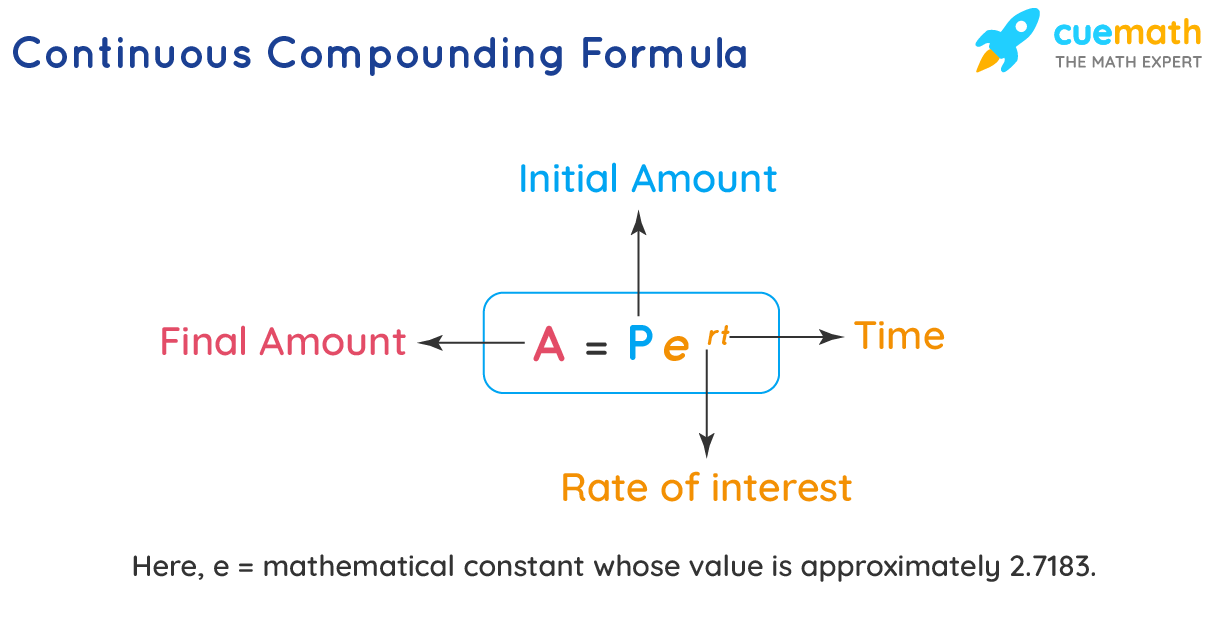
The formula for continuously compounded interest is a cornerstone of financial mathematics, leveraging Euler’s number ($e$). The formula is:
$A = P * e^{rt}$
Where:
- A = The future value of the investment/loan, including interest.
- P = The principal investment amount (the initial deposit or loan amount).
- e = Euler’s number, an irrational mathematical constant approximately equal to 2.71828. It appears frequently in various areas of mathematics and physics, especially in relation to natural growth or decay.
- r = The nominal annual interest rate (expressed as a decimal).
- t = The time the money is invested or borrowed for, in years.
Let’s break down the significance of $e$ in this context. Euler’s number naturally arises when calculating the growth of something that increases at a continuous rate proportional to its current size. In finance, it represents the maximum possible growth under continuous compounding. It is the limit that the effective annual rate approaches as compounding frequency increases infinitely.
To illustrate, let’s revisit our $10,000 investment at a 6% annual interest rate over five years, but this time with continuous compounding:
$A = $10,000 * $e^{(0.06 * 5)}$
$A = $10,000 * $e^{0.30}$
$A = $10,000 * 1.3498588…
$A approx $13,498.59

Comparing this to annual compounding for the same period:
$A = P * (1 + r)^t = $10,000 * $(1 + 0.06)^5 = $10,000 * $(1.06)^5 = $10,000 * 1.3382255776 approx $13,382.26
The difference between annual compounding and continuous compounding ($13,498.59 – $13,382.26 = $116.33) highlights the incremental benefit of continuous compounding, even over five years. While the difference might seem small for this example, it demonstrates the superior growth potential and can become substantial over longer periods or with larger principal amounts.
Practical Applications and Scenarios
While true continuous compounding is rare in everyday banking products like savings accounts or certificates of deposit (CDs), its theoretical framework is immensely valuable:
- Financial Modeling: Investment banks and financial analysts often use continuous compounding in complex models for valuing derivatives (like options and futures), risk management, and portfolio optimization, especially when interest rates or returns are assumed to change constantly.
- Theoretical Benchmarking: It serves as a benchmark for the maximum possible return an investment could generate or the maximum cost a loan could accrue, allowing for comparisons against other compounding frequencies.
- Academic and Professional Examinations: Understanding continuous compounding is fundamental for students and professionals in finance, economics, and actuarial science, as it forms the basis for more advanced financial theories.
- Certain Financial Instruments: Some financial instruments, particularly those with complex structures or very short-term durations that are constantly re-evaluated, might approximate continuous compounding in their effective returns. Examples include certain money market instruments or interbank lending rates, though these are often modeled rather than explicitly compounded continuously in a transactional sense.
Why Continuous Compounding Matters for Investors
For individuals and institutions involved in money management, the concept of continuous compounding offers insights that can influence strategic financial planning and decision-making.
Maximizing Returns on Investments
For investors, a higher compounding frequency is always preferable. Continuous compounding represents the peak of this preference. It means that any interest earned is immediately available to earn more interest, leading to the fastest possible growth of capital. When evaluating investment products, understanding the compounding frequency, and knowing that continuous compounding provides the theoretical maximum return, empowers investors to seek out products with higher frequencies or to understand the growth potential of various investment vehicles more comprehensively. Even if a product doesn’t explicitly offer continuous compounding, knowing this limit helps in comparing different annual percentage yields (APYs).
Impact on Loan Calculations and Debt
Conversely, for borrowers, continuous compounding implies the highest possible cost of borrowing. Just as it maximizes investment returns, it maximizes the accumulation of debt. While most consumer loans (mortgages, auto loans, credit cards) use discrete compounding (monthly or daily), the theoretical framework of continuous compounding serves as a reminder of how quickly interest can escalate when compounded frequently. This underscores the importance of minimizing high-interest debt and understanding the true cost of borrowing beyond the stated nominal annual percentage rate (APR).
Comparison with Other Compounding Frequencies
Let’s expand on the comparison to highlight the incremental differences over time. Assume a $1,000 principal at a 5% nominal annual rate over 10 years:
- Annually: $1,000 * $(1 + 0.05)^{10} = $1,628.89
- Semi-annually: $1,000 * $(1 + 0.05/2)^{10*2} = $1,000 * $(1.025)^{20} = $1,638.62
- Quarterly: $1,000 * $(1 + 0.05/4)^{10*4} = $1,000 * $(1.0125)^{40} = $1,643.62
- Monthly: $1,000 * $(1 + 0.05/12)^{10*12} = $1,000 * $(1.0041666…)^{120} = $1,647.01
- Daily: $1,000 * $(1 + 0.05/365)^{10*365} = $1,000 * $(1.0001369…)^{3650} = $1,648.66
- Continuously: $1,000 * $e^{(0.05 * 10)} = $1,000 * $e^{0.5} = $1,000 * 1.64872 = $1,648.72
As you can see, the value increases as the compounding frequency increases, eventually reaching the limit set by continuous compounding. The difference between daily and continuous compounding is minimal, demonstrating that once compounding becomes very frequent, the additional benefit from continuous compounding becomes marginal. However, the conceptual understanding remains potent for financial modeling and analysis.
Key Takeaways and Strategic Financial Planning
Embracing the concept of continuous compounding provides a deeper understanding of how money grows and how financial decisions can be optimized.
Identifying Financial Products Utilizing Continuous Compounding
While explicit continuous compounding is rare for consumer products, understanding it helps you interpret Annual Percentage Yield (APY) more accurately. The APY already accounts for the effect of compounding frequency and provides a standardized measure of the effective annual rate of return. When comparing savings accounts or CDs, always look at the APY, as it effectively levels the playing field regardless of the underlying compounding frequency. Products with very high compounding frequencies (like daily) will have an APY very close to their continuously compounded equivalent, offering a close approximation of the maximum theoretical return.
Leveraging the Concept in Personal Finance
For personal finance, the core lesson from continuous compounding is the immense power of time and consistent investment. The earlier you start investing and the longer your money remains invested, the more significant the compounding effect, even with lower frequencies. Focus on long-term growth and avoid unnecessary withdrawals to allow your capital to benefit from extended periods of compounding. Furthermore, being aware of the maximum theoretical growth can inform your expectations and help you set realistic financial goals, while also serving as a powerful motivator to keep your money working for you.

Tools and Resources for Calculation and Understanding
Numerous online calculators and spreadsheet functions (like EXP in Excel for Euler’s number) can help you perform continuous compounding calculations. Financial calculators often have a dedicated $e^x$ function. Utilizing these tools allows you to experiment with different principal amounts, interest rates, and time horizons to visualize the power of continuous compounding and its implications for your financial future. Resources from financial education platforms, university finance courses, and reputable financial news outlets can further deepen your understanding of this critical financial principle and its broader applications in investments and economic analysis. Mastery of these concepts equips you with a robust framework for making informed and strategic financial decisions.