
Compound interest, often hailed as the “eighth wonder of the world” by Albert Einstein, is a fundamental concept in personal finance and investing. It represents the interest earned not only on the initial principal but also on the accumulated interest from previous periods. Understanding its formula is not just an academic exercise; it’s a gateway to unlocking significant wealth accumulation and making informed financial decisions. This article will deconstruct the compound interest formula, explore its components, illustrate its power with practical examples, and provide insights into leveraging it for your financial success.
Understanding the Power of Compound Interest
To truly appreciate the formula, one must first grasp the underlying principle of compound interest and how it differs from its simpler counterpart. This understanding forms the bedrock of sound financial planning and investment strategy.
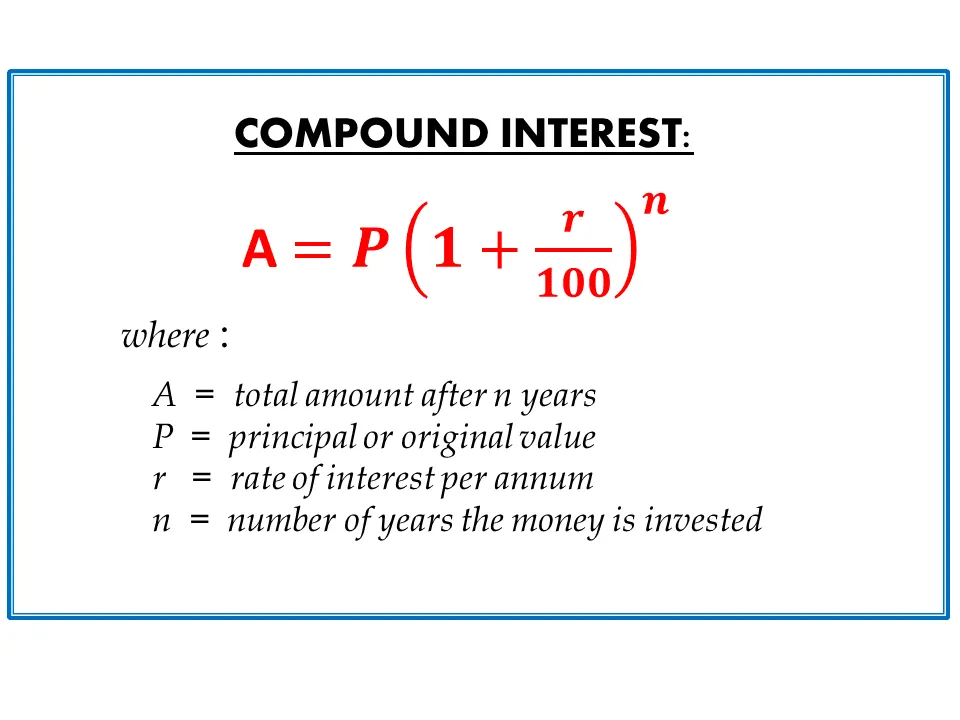
Simple vs. Compound Interest: A Fundamental Distinction
At its core, interest is the cost of borrowing money or the reward for lending it. The way this interest is calculated makes all the difference.
-
Simple Interest: Calculated only on the principal amount. For example, if you invest $1,000 at a 5% simple interest rate, you would earn $50 each year ($1,000 * 0.05). After five years, you’d have earned $250 in total interest, making your total $1,250. The interest earned remains constant year after year because it’s always based on the initial principal. While easy to calculate, simple interest offers limited growth potential, especially over extended periods. It’s commonly seen in short-term loans or some types of bonds.
-
Compound Interest: This is where the magic happens. Compound interest is calculated on the initial principal and on the accumulated interest from previous periods. Using the same example: if you invest $1,000 at a 5% compound interest rate annually, in the first year, you earn $50. But in the second year, you earn interest not on $1,000, but on $1,050, yielding $52.50. This means your interest earnings are accelerating. Over time, this “interest on interest” effect can lead to dramatically larger sums than simple interest. Compound interest is the driving force behind long-term savings accounts, retirement funds, and various investment vehicles.
The distinction is crucial: simple interest offers a linear growth path, while compound interest provides exponential growth, especially over longer time horizons.
Why Compound Interest is a Game-Changer for Wealth Accumulation
The exponential nature of compound interest makes it an unparalleled tool for building wealth. It allows your money to work harder for you, generating returns that themselves generate further returns. This virtuous cycle is what makes consistent, long-term investing so powerful.
Consider two individuals, both investing $100 per month at an average annual return of 7%. One starts at age 25, the other at age 35. By age 65, the individual who started at 25 would have significantly more, despite only contributing for an additional 10 years. The early start allows for an extra decade of compounding, where the interest itself begins to earn substantial returns. This concept is often referred to as “the time value of money” and underscores why starting early is perhaps the most critical factor in maximizing compound interest.
Beyond individual savings, compound interest is integral to understanding economic growth, business expansion, and even the dynamics of debt. Its influence permeates nearly every aspect of finance.
Deconstructing the Compound Interest Formula
To harness the power of compound interest, it’s essential to understand the mathematical framework that governs it. The formula itself is straightforward, but each variable plays a critical role in determining the final outcome.
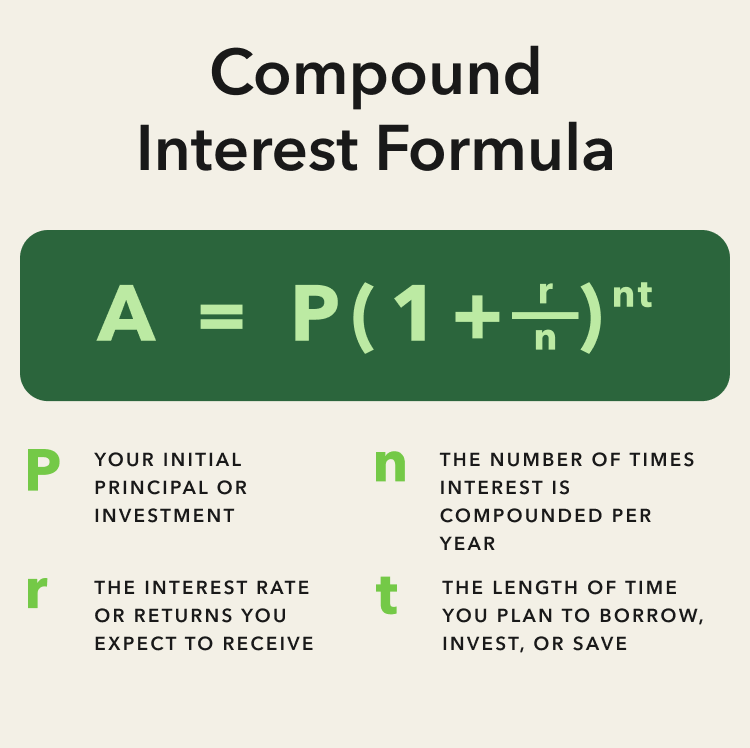
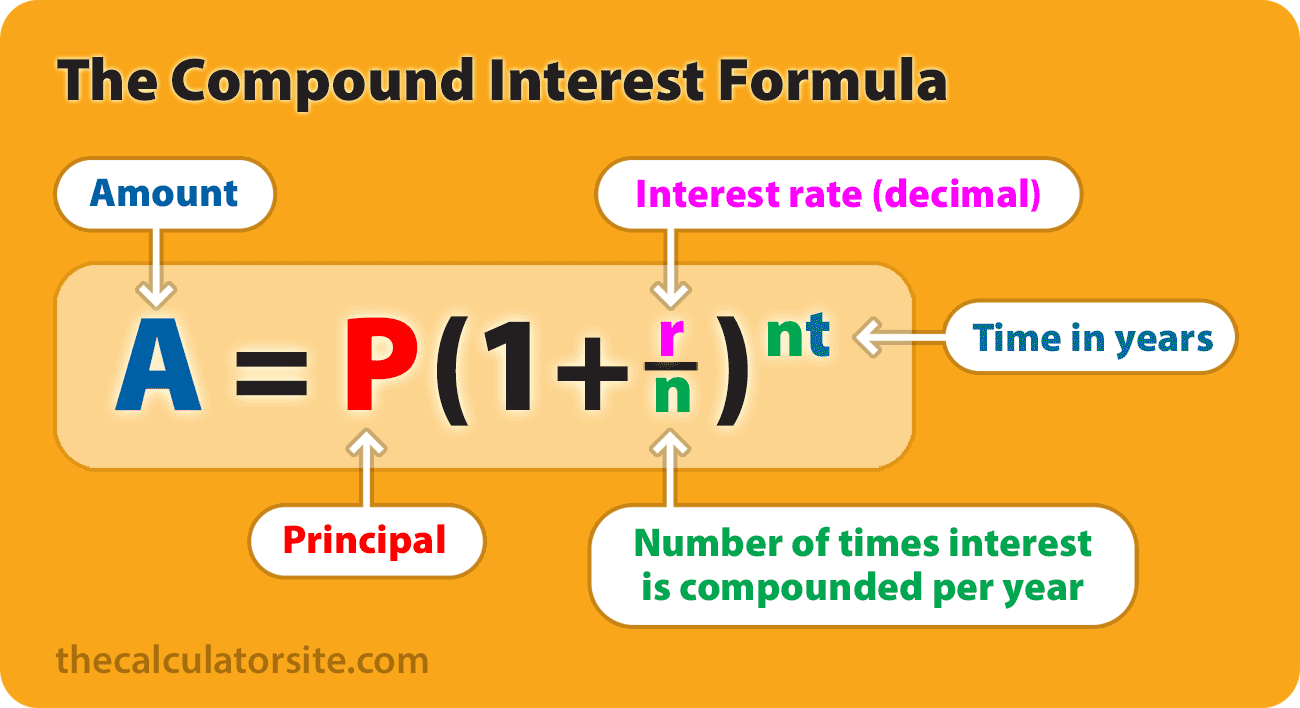
The Core Formula: A = P(1 + r/n)^(nt)
The standard formula for calculating compound interest is:
A = P(1 + r/n)^(nt)
Where:
-
A = The future value of the investment/loan, including interest
-
P = The principal investment amount (the initial deposit or loan amount)
-
r = The annual interest rate (as a decimal)
-
n = The number of times that interest is compounded per year
-
t = The number of years the money is invested or borrowed for
This formula calculates the total amount you will have at the end of the investment period, including your initial principal and all accumulated compound interest. To find just the interest earned, you would subtract the principal (P) from the final amount (A).
Breaking Down Each Variable: P, r, n, t
Let’s look at each component in more detail to understand its individual contribution:
-
P (Principal Amount): This is your starting point – the initial sum of money you deposit or invest. A larger principal inherently leads to a larger base for interest to compound upon, thus accelerating growth. Even small, consistent principal contributions over time can build a substantial base due to compounding.
-
r (Annual Interest Rate): This is the percentage rate at which your investment grows each year. It must be expressed as a decimal in the formula (e.g., 5% becomes 0.05). A higher interest rate means a faster growth rate for your investment. This rate can be fixed, as in a certificate of deposit (CD), or variable, as in some market-linked investments.
-
n (Number of Compounding Periods per Year): This variable indicates how often the interest is calculated and added back to the principal. Common compounding frequencies include:
-
Annually (n=1)
-
Semi-annually (n=2)
-
Quarterly (n=4)
-
Monthly (n=12)
-
Daily (n=365)
-
Continuously (this requires a slightly different formula involving the mathematical constant ‘e’, which is beyond the scope of this basic explanation but is generally considered the theoretical maximum compounding frequency).
The more frequently interest is compounded, the faster your money grows, because you start earning interest on your newly earned interest sooner.
-
-
t (Time in Years): This is the duration for which the money is invested or borrowed. Time is perhaps the most significant multiplier in the compound interest formula. Even a modest interest rate, given enough time, can turn a small principal into a substantial sum. The exponential nature of the formula means that growth accelerates dramatically in later years.
Practical Examples: Seeing the Formula in Action
Let’s illustrate with a few scenarios:
Example 1: Annual Compounding
You invest $5,000 for 10 years at an annual interest rate of 6%, compounded annually.
-
P = $5,000
-
r = 0.06
-
n = 1 (annually)
-
t = 10
A = 5000(1 + 0.06/1)^(1*10)
A = 5000(1.06)^10
A ≈ 5000 * 1.790847
A ≈ $8,954.24
Example 2: Monthly Compounding
You invest $5,000 for 10 years at an annual interest rate of 6%, compounded monthly.
-
P = $5,000
-
r = 0.06
-
n = 12 (monthly)
-
t = 10
A = 5000(1 + 0.06/12)^(12*10)
A = 5000(1 + 0.005)^120
A = 5000(1.005)^120
A ≈ 5000 * 1.819397
A ≈ $9,096.99
Notice how monthly compounding yields a slightly higher amount ($9,096.99 vs. $8,954.24) over the same period, demonstrating the impact of compounding frequency.
Factors Influencing Compound Growth
While the formula provides a clear mathematical representation, it’s crucial to understand how changes in its variables translate into real-world impact on your investment growth.
The Impact of Interest Rate (r)
The interest rate is a direct driver of growth. A higher ‘r’ means your money grows faster. Finding investments with competitive, yet realistic, interest rates is key. However, higher returns often come with higher risks, so balancing return expectations with your risk tolerance is vital. Even small differences in interest rates can lead to significant variations in future value over long periods. For instance, a 1% difference in annual return on a large sum over decades can easily amount to tens or hundreds of thousands of dollars.
The Significance of Compounding Frequency (n)
As seen in our examples, increasing the frequency of compounding (n) generally leads to slightly higher returns. The more often interest is calculated and added to the principal, the sooner that new, larger principal starts earning interest. While the difference between daily and monthly compounding might seem marginal in the short term, it can add up over decades. When evaluating investment products, always consider their compounding frequency.
The Unbeatable Advantage of Time (t)
Time is arguably the most powerful variable in the compound interest formula. Due to its exponential nature, the growth accelerates dramatically in the later years of an investment. This is why financial advisors consistently advocate for starting to save and invest as early as possible. Even small, consistent contributions made early in life can outgrow larger, later contributions simply because they have more time to compound. The “power of procrastination” works in reverse when it comes to compounding; delaying your start means missing out on crucial growth periods.
Initial Principal (P) and Regular Contributions
While the formula focuses on a single principal amount, in real-world personal finance, we often make regular contributions to our investments (e.g., monthly contributions to a retirement account). While the core formula would need to be adapted for a series of payments (often referred to as an annuity formula), the principle remains: a larger initial principal and consistent additional contributions both serve to increase the base upon which interest compounds, thereby accelerating wealth accumulation. Increasing your principal, whether initially or through ongoing deposits, provides more money to grow exponentially.
Leveraging Compound Interest for Financial Success
Understanding the formula is the first step; applying it strategically is where true financial success lies. Compound interest isn’t just for investors; it’s a principle that underpins many aspects of personal finance, including debt.
Investing Strategies: Stocks, Bonds, Mutual Funds
Compound interest is the engine behind most long-term investment growth.
-
Stocks: When you invest in stocks, you might receive dividends, which, if reinvested, compound over time. More importantly, the appreciation in stock value itself compounds. If a stock grows by 10% one year, the next year’s 10% growth is on the new, higher value.
-
Bonds: Bonds offer interest payments, and if these payments are reinvested (e.g., buying more bonds or other assets), they will compound.
-
Mutual Funds & ETFs: These professionally managed funds pool money from many investors and invest in a diversified portfolio of stocks, bonds, or other assets. The returns generated by these funds, whether from dividends, interest, or capital gains, are typically reinvested, allowing your investment to compound within the fund.
Choosing the right investment vehicle depends on your risk tolerance, time horizon, and financial goals. The key is to select investments that offer a reasonable rate of return and allow for consistent compounding over time.
Retirement Planning: IRAs, 401(k)s
Retirement accounts like Individual Retirement Arrangements (IRAs) and 401(k)s are prime examples of how compound interest facilitates long-term wealth building. These accounts often offer tax advantages, making compounding even more effective. Contributions made today have decades to compound before retirement, making even modest regular savings incredibly powerful by the time you reach your golden years. Maxing out these accounts, especially early in your career, is a cornerstone of robust retirement planning.
Debt Management: The Flip Side of Compounding
While compound interest is a boon for investors, it can be a significant burden for borrowers. The same powerful force that grows investments can also rapidly escalate debt. Credit card debt, for instance, often carries very high-interest rates that compound daily or monthly. If you only make minimum payments, the interest compounds on the outstanding balance, causing the debt to spiral and making it incredibly difficult to pay off. Understanding this reverse effect of compounding emphasizes the importance of paying down high-interest debt quickly to prevent it from growing out of control.
Tools and Calculators for Your Compound Journey
Fortunately, you don’t need to manually calculate compound interest for every scenario. Numerous online compound interest calculators are available. These tools allow you to input different values for P, r, n, and t, and even incorporate regular contributions, providing instant projections of your future wealth. Using these calculators can be incredibly insightful for visualizing the impact of different financial decisions and setting realistic goals. Many financial institutions, brokerage firms, and personal finance websites offer these free resources.
Beyond the Formula: Practical Tips for Maximizing Compounding
While the formula is the mathematical foundation, practical actions are what truly unlock its potential.
Start Early, Stay Consistent
This cannot be overstressed. The longer your money has to grow, the more significant the impact of compounding. Even small, regular investments made early can easily outperform larger, sporadic investments made later in life. Consistency in contributions, even during market downturns, ensures you are continuously adding to your principal base for compounding.
Reinvest Your Earnings
For compound interest to work its magic, the interest earned must be added back to the principal. If you withdraw the interest earned, you are effectively reverting to simple interest. Ensure that dividends, interest payments, or capital gains from your investments are automatically reinvested to maximize your compounding potential.
Understand and Minimize Fees
Fees, whether from investment advisors, mutual funds, or brokerage accounts, can erode your returns and diminish the effects of compounding. Even seemingly small annual fees (e.g., 1% of assets under management) can shave tens of thousands of dollars off your wealth over several decades. Be vigilant about understanding all fees associated with your investments and seek out low-cost options whenever possible.
Regular Review and Adjustment
Your financial situation, goals, and market conditions will change over time. Regularly review your investment portfolio, savings goals, and overall financial plan. Adjust your contributions, investment choices, or risk exposure as needed to stay on track. This proactive approach ensures your strategy remains aligned with your long-term objectives and continues to optimize for compound growth.
Conclusion
The compound interest formula, A = P(1 + r/n)^(nt), is far more than just an equation; it’s a testament to the incredible power of time, consistency, and disciplined financial habits. Understanding its components—principal, interest rate, compounding frequency, and time—empowers individuals to make informed decisions about saving, investing, and debt management. By embracing its principles, starting early, staying consistent, and leveraging available financial tools, anyone can harness the “eighth wonder of the world” to build substantial wealth and achieve their long-term financial aspirations.
aViewFromTheCave is a participant in the Amazon Services LLC Associates Program, an affiliate advertising program designed to provide a means for sites to earn advertising fees by advertising and linking to Amazon.com. Amazon, the Amazon logo, AmazonSupply, and the AmazonSupply logo are trademarks of Amazon.com, Inc. or its affiliates. As an Amazon Associate we earn affiliate commissions from qualifying purchases.