
In the modern era of interconnected technology, we often marvel at high-level software, cloud computing, and artificial intelligence. However, beneath the surface of the machines we rely on daily—from the cars we drive to the medical equipment in our hospitals—lies a sophisticated communication protocol that ensures every component speaks the same language. This is the Controller Area Network, or CAN bus.
Developed originally to simplify the internal wiring of automobiles, the CAN bus has evolved into a cornerstone of industrial and embedded technology. It acts as the “central nervous system” of a machine, allowing microcontrollers and devices to communicate with each other’s applications without a host computer. To understand why your vehicle’s dashboard can display engine temperature, tire pressure, and media playback simultaneously and instantaneously, you must understand the CAN bus.
What is CAN Bus? The Evolution of a Networking Powerhouse
To appreciate the significance of the CAN bus, one must look back at the technological landscape of the early 1980s. As electronics began to permeate the automotive industry, manufacturers faced a literal “weighty” problem. Every new electronic feature—power windows, electronic fuel injection, anti-lock brakes—required its own dedicated wiring.
Historical Context: From Wires to Waves
Before the advent of CAN, automotive wiring was a point-to-point nightmare. If one sensor needed to send data to three different control units, it required three separate wires. By the mid-1980s, car wiring harnesses were becoming massive, heavy, and incredibly difficult to diagnose when a fault occurred.
In 1983, engineers at Robert Bosch GmbH began developing a solution that would allow multiple electronic control units (ECUs) to share a single pair of wires. This led to the official release of the CAN protocol in 1986. By 1991, the Mercedes-Benz W140 became the first production vehicle to feature a CAN-based multi-plex wiring system. What started as a solution for automotive weight reduction has since become an international standard (ISO 11898) used in almost every automated industry.
How CAN Bus Functions in the Modern Tech Ecosystem
In a modern tech ecosystem, the CAN bus is a “multi-master serial bus standard.” In simpler terms, it is a communication highway. Unlike a traditional network where a central server tells peripherals what to do, every node on a CAN bus is an intelligent agent.
Each node (such as a sensor or an actuator) is connected via a simple two-wire bus. When a node has information to share—for example, a wheel speed sensor detecting a skid—it broadcasts that information to the entire network. Every other node “hears” the message and decides, based on its pre-programmed logic, whether that information is relevant to its function. This decentralized approach is what makes the technology incredibly fast and reliable.
The Technical Architecture: How CAN Bus Communication Works
The brilliance of CAN bus lies in its simplicity and its ability to manage “conflicts” on the line without the need for a complex central processor. In a high-speed environment like a jet engine or a racing car, there is no room for data collisions or latency.
The Concept of Multi-Master Communication
In most computer networks, there is a hierarchy. In a CAN bus, there is no “master” in the traditional sense. Instead, any node can initiate communication when the bus is idle. This is known as multi-master communication.
Each node consists of a central processing unit (CPU), a CAN controller, and a transceiver. The CPU decides what the data means, the controller converts that data into a standardized “frame,” and the transceiver sends and receives those signals over the physical wires. Because every node is equal, the system is highly redundant; if one node fails, the rest of the network continues to function perfectly.
Message-Based Protocol and Arbitration
Unlike the internet, which uses IP addresses to send data to specific locations, CAN bus uses a “Message ID” system. Data is not sent to a specific destination; instead, it is “broadcast” with a unique identifier.
When two nodes try to send a message at the same time, the system uses a process called “non-destructive bitwise arbitration.” Every message has a priority level determined by its ID. For example, a “Brake System” message will have a higher priority (a lower ID value) than a “Climate Control” message. If both try to speak at once, the higher-priority message wins the right to finish its transmission, while the lower-priority node waits and tries again immediately after. This ensures that critical safety data is never delayed.
Physical Layer and Differential Signaling
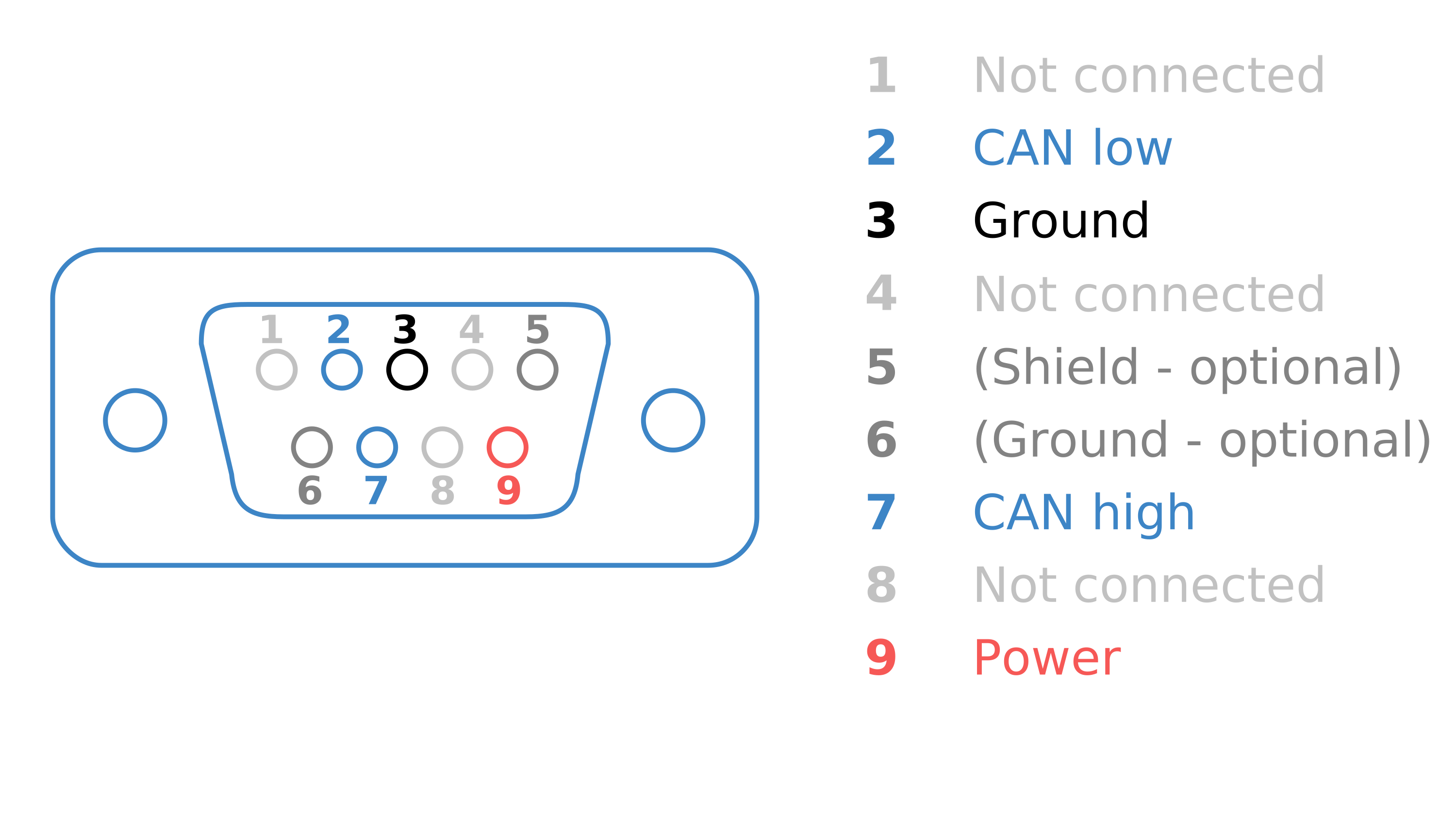
CAN bus typically operates over two wires: CAN High (CANH) and CAN Low (CANL). To combat electrical noise—which is prevalent in environments with large motors or high-voltage components—CAN uses “differential signaling.”

The system doesn’t look at the absolute voltage on the wires; it looks at the difference between them. If electromagnetic interference hits the cable, it usually affects both wires equally, leaving the difference between them unchanged. This makes the CAN bus incredibly robust and capable of operating in the harshest electrical environments, from factory floors to the engine bays of heavy-duty trucks.
Key Benefits of the Controller Area Network
Engineers continue to choose CAN bus for new tech developments because it solves three major problems: complexity, reliability, and cost.
Reduced Wiring Complexity and Weight
In a modern electric vehicle, there can be upwards of 70 to 100 ECUs. Without CAN bus, the wiring harness would weigh hundreds of pounds and contain miles of copper. By using a shared bus, manufacturers can reduce the amount of wiring by over 40%. This not only makes the vehicle lighter and more fuel-efficient but also simplifies the assembly process significantly.
High Robustness and Error Resistance
Industrial and automotive environments are “noisy.” Heat, vibration, and magnetic fields can easily corrupt digital data. CAN bus features built-in error detection mechanisms. Each message includes a Cyclic Redundancy Check (CRC), which allows the receiving node to verify that the data wasn’t corrupted during transit. If a node detects an error, it can signal the entire network to disregard the message, forcing the sender to re-transmit.
Cost-Effectiveness in Large-Scale Manufacturing
Because CAN is an open and widely adopted standard, the hardware required to implement it is mass-produced and inexpensive. Microcontrollers with built-in CAN controllers are available for a few dollars. Furthermore, the simplicity of the two-wire physical layer means that repairs and diagnostics are standardized. A technician can plug a single diagnostic tool into a vehicle’s OBD-II port (which uses the CAN protocol) and read the status of every single component on the network.
CAN Bus in Action: From Automotive to Industrial IoT
While the “CAN” in CAN bus stands for Controller Area Network, it could easily stand for “Connects Almost anything.” Its versatility has seen it migrate from luxury cars to nearly every sector of modern technology.
The Automotive Industry: Connecting the Modern Vehicle
In your car, the CAN bus handles everything. When you press a button on your steering wheel to increase the volume, a message is sent via CAN to the head unit. When the engine’s oxygen sensor detects a lean fuel mix, it alerts the engine control module via CAN. Advanced Driver Assistance Systems (ADAS), such as lane-keeping assist and adaptive cruise control, rely on the high-speed data exchange provided by CAN to make split-second decisions that save lives.
Industrial Automation and Robotics
Modern factories are filled with robotic arms, conveyor belts, and sensors that must work in perfect synchronization. CAN bus (often in the form of higher-layer protocols like CANopen or DeviceNet) allows these components to coordinate. In a robotic assembly line, the “hand” of the robot must know exactly where the “arm” is positioned. The CAN bus provides the real-time feedback loop necessary for this precision.
The Role of CAN Bus in the Internet of Things (IoT)
As we move toward the “Smart Factory” and the Internet of Things, CAN bus acts as the bridge between the physical world and the digital cloud. While Wi-Fi and 5G handle long-distance data transmission, the CAN bus handles the “local” communication within the machine. An IoT-enabled tractor, for example, uses CAN to gather data on soil moisture and fuel consumption, which is then sent via a cellular gateway to a farmer’s smartphone.
The Future of CAN Bus: CAN FD and Beyond
Technology never stands still, and the original CAN specification is reaching its limits in terms of data speed. Modern sensors, like LIDAR and high-resolution cameras used in self-driving cars, generate more data than the original 1 Mbps (Megabit per second) CAN limit can handle.
Transitions to CAN FD (Flexible Data-Rate)
To address the need for more bandwidth, the industry is moving toward CAN FD (Flexible Data-Rate). Developed by Bosch in 2011, CAN FD allows for larger data packets and faster transmission speeds (up to 8 Mbps or more) while remaining backward compatible with original CAN hardware. This allows engineers to increase data throughput without completely redesigning their existing network architectures.

Security Challenges and the Rise of Automotive Cybersecurity
As machines become more connected to the internet, the security of the CAN bus has become a critical tech topic. Historically, CAN was a “trusted” network—it assumed every message on the bus was legitimate. However, researchers have shown that if a hacker gains access to the bus (e.g., through a car’s infotainment system), they can potentially send “spoofed” messages to control the steering or brakes.
This has led to the development of Secure CAN protocols, which add encryption and authentication to the message frames. In the coming decade, digital security will be just as important to CAN bus development as physical reliability.
The CAN bus is a testament to the power of elegant engineering. By solving a complex wiring problem in the 1980s, it created a foundation for the highly automated, smart, and efficient world we live in today. Whether it is powering the next generation of electric vehicles or coordinating a fleet of warehouse robots, the CAN bus remains the silent, reliable pulse of modern technology.
aViewFromTheCave is a participant in the Amazon Services LLC Associates Program, an affiliate advertising program designed to provide a means for sites to earn advertising fees by advertising and linking to Amazon.com. Amazon, the Amazon logo, AmazonSupply, and the AmazonSupply logo are trademarks of Amazon.com, Inc. or its affiliates. As an Amazon Associate we earn affiliate commissions from qualifying purchases.