
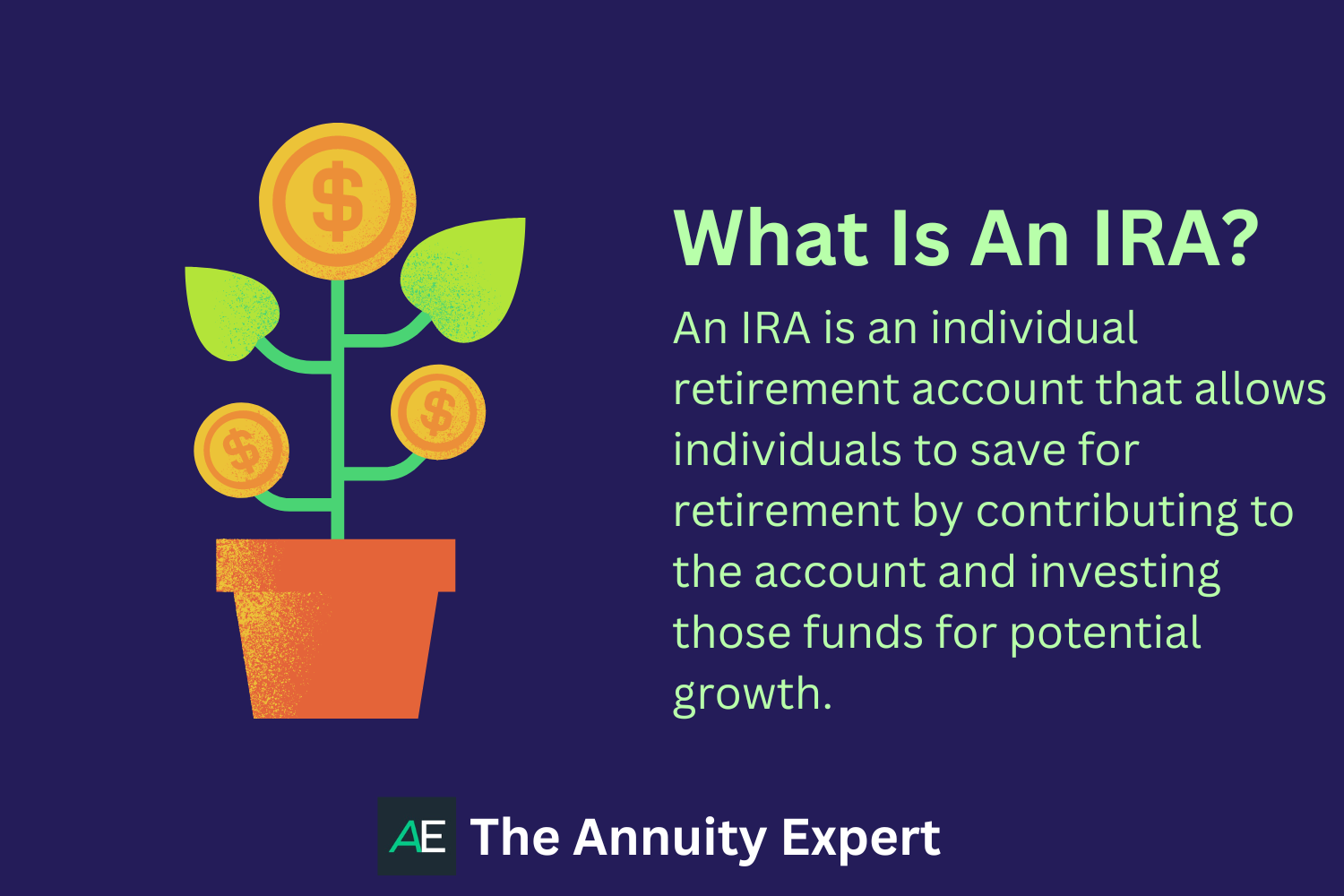
Planning for the future is one of the most significant financial responsibilities an individual faces. While Social Security and employer-sponsored plans like the 401(k) are common pillars of retirement planning, they are often insufficient on their own to maintain a comfortable lifestyle in one’s later years. This is where the Individual Retirement Account, or IRA, becomes a vital tool. An IRA is more than just a savings account; it is a tax-advantaged investment vehicle designed to help individuals accumulate wealth for retirement.
Understanding the mechanics of an IRA—how it operates, the different types available, and the tax benefits it provides—is essential for anyone looking to secure their financial freedom. Whether you are just starting your career or are a seasoned professional, leveraging an IRA can significantly alter your long-term financial trajectory.

The Core Mechanics of an IRA
At its most basic level, an IRA is a type of account provided by financial institutions that allows you to save for retirement with tax advantages. Unlike a standard brokerage account, where you pay taxes on capital gains and dividends every year, an IRA provides a protective shell around your investments, allowing them to grow either tax-deferred or tax-free.
The Power of Tax-Advantaged Growth
The primary draw of an IRA is its tax structure. In a traditional brokerage account, if you sell a stock for a profit, you owe capital gains tax. If you receive a dividend, that income is usually taxable in the year it is received. Within an IRA, these “tax drags” are eliminated during the accumulation phase. This means that every dollar earned through interest, dividends, or capital appreciation remains in the account to be reinvested. Over decades, the power of compounding—interest earning interest without being shaved off by the IRS—can result in a balance significantly higher than that of a taxable account.
Contribution Limits and Eligibility
The IRS sets strict rules on who can contribute to an IRA and how much they can put in annually. As of 2024, the annual contribution limit is $7,000 for individuals under age 50, and $8,000 for those aged 50 and older (the additional $1,000 is known as a “catch-up contribution”).
To contribute to an IRA, you must have “earned income.” This includes wages, salaries, bonuses, and self-employment income. Passive income, such as rental income or interest from other investments, does not count toward the eligibility requirements. Furthermore, while you can have multiple IRA accounts, the total contribution across all of them cannot exceed the annual limit.
Custodians and Investment Flexibility
Unlike a 401(k), which is managed by an employer and usually offers a limited menu of mutual funds, an IRA is opened by the individual at a bank, credit union, or brokerage firm (the “custodian”). This provides the investor with almost limitless flexibility. Within an IRA, you can typically invest in a wide array of assets, including:
- Individual stocks
- Bonds
- Exchange-Traded Funds (ETFs)
- Mutual funds
- Real Estate Investment Trusts (REITs)
- Certificates of Deposit (CDs)
Choosing Your Path: Traditional vs. Roth IRAs
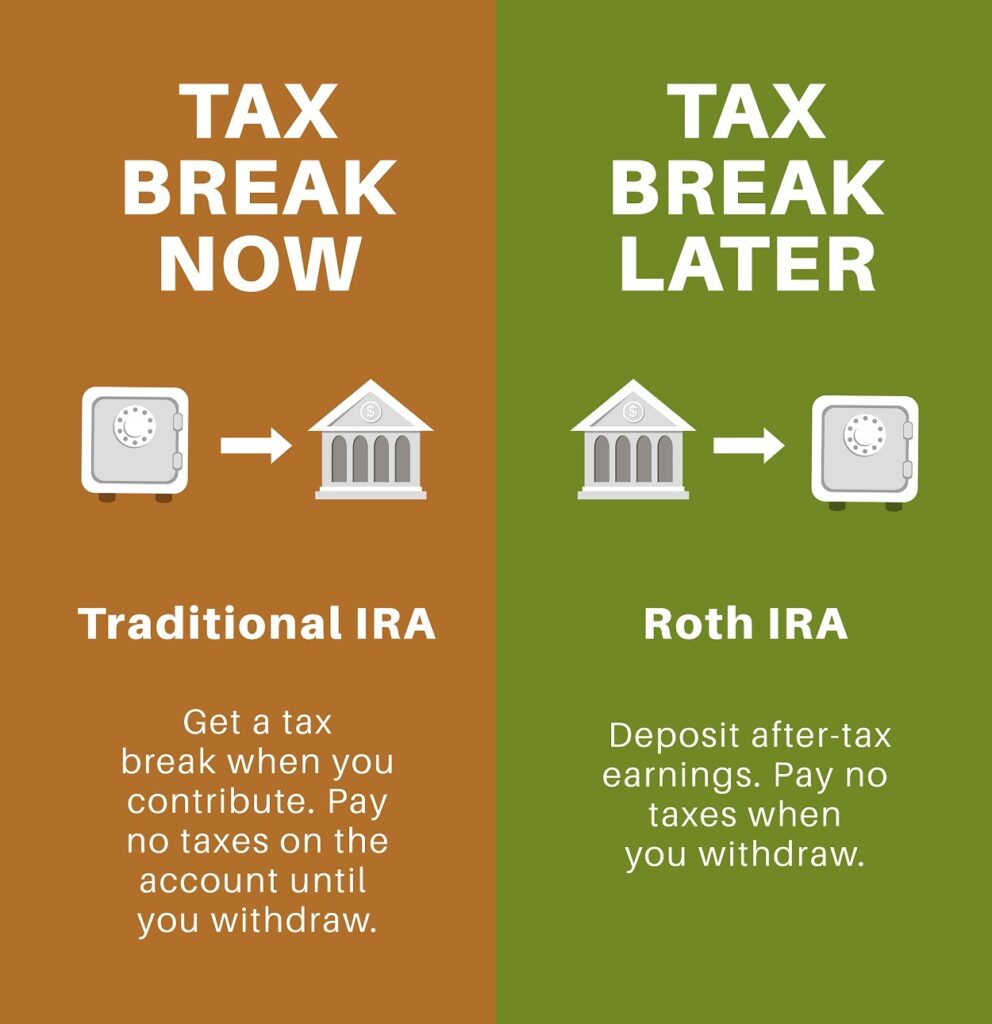
The two most common types of IRAs are the Traditional IRA and the Roth IRA. The fundamental difference between them lies in when you receive the tax break. Choosing the right one depends largely on your current income and what you expect your tax bracket to be during retirement.
Traditional IRA: Upfront Tax Deductions
The Traditional IRA is the original version of the account. Its hallmark is the potential for an immediate tax deduction. Contributions to a Traditional IRA are often “pre-tax,” meaning you can deduct the amount you contribute from your gross income on your tax return. For example, if you earn $60,000 and contribute $7,000 to a Traditional IRA, the IRS only taxes you as if you earned $53,000.
However, there is a trade-off. While you get a break today, the money is taxed as ordinary income when you withdraw it in retirement. This is ideal for individuals who are currently in a high tax bracket and expect to be in a lower tax bracket when they retire.
Roth IRA: Tax-Free Growth and Withdrawals
The Roth IRA, established in 1997, flips the tax benefit. Contributions to a Roth IRA are made with “after-tax” dollars, meaning there is no immediate tax deduction. However, the true power of the Roth IRA is found at the finish line: all qualified withdrawals in retirement are 100% tax-free.
Because you have already paid taxes on the principal, and the IRS allows the growth to go untaxed, the Roth IRA is one of the most potent wealth-building tools available. It is particularly beneficial for younger investors who have decades of growth ahead of them and are likely in a lower tax bracket now than they will be in the future.
Income Limits and Phase-Outs
It is important to note that not everyone can contribute to a Roth IRA or deduct Traditional IRA contributions. The IRS imposes income “phase-out” ranges. If you earn too much money, your ability to contribute directly to a Roth IRA is restricted. Similarly, if you or your spouse are covered by a retirement plan at work (like a 401(k)), your ability to deduct Traditional IRA contributions may be limited based on your Modified Adjusted Gross Income (MAGI). Understanding these thresholds is a critical part of financial planning to avoid over-contribution penalties.
Specialized IRAs for Business Owners and the Self-Employed
For entrepreneurs, freelancers, and small business owners, the standard IRA limits of $7,000 to $8,000 may feel restrictive. To address this, the government created specialized IRAs that allow for much higher contribution limits, functioning more like a hybrid between an IRA and a corporate retirement plan.
SEP IRA (Simplified Employee Pension)
The SEP IRA is a popular choice for self-employed individuals and small business owners with few or no employees. The primary advantage of a SEP IRA is its high contribution limit. In 2024, a business owner can contribute up to 25% of their net earnings from self-employment or $69,000, whichever is less.
Like a Traditional IRA, SEP contributions are tax-deductible for the business, and the investments grow tax-deferred until retirement. It is exceptionally easy to set up and maintain compared to a traditional 401(k), making it a favorite for “solopreneurs.”
SIMPLE IRA (Savings Incentive Match Plan for Employees)
The SIMPLE IRA is designed for small businesses with 100 or fewer employees. It allows employees to contribute a portion of their salary to the account, and requires the employer to make a matching contribution (usually up to 3% of the employee’s compensation) or a fixed non-elective contribution.
The SIMPLE IRA has higher contribution limits than a standard IRA but lower limits than a SEP IRA or a 401(k). For 2024, the employee contribution limit is $16,000. This account type is an excellent middle ground for small businesses that want to offer retirement benefits without the administrative complexity of a large-scale corporate plan.
Managing and Growing Your Portfolio
Simply opening an IRA and moving money into the account is only half the battle. An IRA is merely a “bucket”; for that bucket to grow, you must choose how to invest the cash within it. Professional management of an IRA requires a focus on asset allocation, risk tolerance, and long-term vision.
Strategic Asset Allocation
How you divide your money between stocks, bonds, and cash is the single most important driver of your IRA’s performance. Stocks generally offer higher potential returns but come with higher volatility. Bonds provide more stability and income but lower growth potential.
A common rule of thumb is the “Rule of 100” (or 110/120), where you subtract your age from 100 to determine the percentage of your portfolio that should be in stocks. For example, a 30-year-old might have 70% to 80% of their IRA in stocks to capitalize on long-term growth, while a 60-year-old might shift toward a 50/50 split to protect their capital as retirement nears.
The Impact of Compounding and Consistency
The most successful IRA investors share two traits: consistency and time. Because of the way compounding works, the money you contribute in your 20s is mathematically more valuable than the money you contribute in your 50s.
Consider an investor who puts $500 a month into an IRA starting at age 25. Assuming a 7% annual return, they would have over $1.2 million by age 65. If that same investor waited until age 35 to start, they would end up with roughly $600,000—half the amount for a delay of only ten years. This underscores the importance of starting as early as possible, even with small amounts.
Withdrawal Rules and Strategies
The “R” in IRA stands for retirement, and the IRS is very specific about when and how you can access your money. Because these accounts are designed for long-term savings, there are significant deterrents for early access, as well as requirements for eventually taking the money out.
The 59½ Rule and Early Withdrawal Penalties
Generally, if you withdraw funds from a Traditional IRA before you reach age 59½, you will face a 10% early withdrawal penalty in addition to the regular income taxes owed on the distribution.
There are, however, a few “hardship” exceptions. You may be able to withdraw funds penalty-free for:
- A first-time home purchase (up to a $10,000 lifetime limit).
- Qualified higher education expenses.
- Major unreimbursed medical expenses.
- The birth or adoption of a child (up to $5,000).
Roth IRAs offer more flexibility here; you can always withdraw your contributions (the money you put in) at any time without taxes or penalties, as you have already paid taxes on that money. Only the earnings are subject to the 59½ rule.
Required Minimum Distributions (RMDs)
The IRS eventually wants its tax money. For Traditional, SEP, and SIMPLE IRAs, you must begin taking Required Minimum Distributions (RMDs) once you reach age 73 (this age has increased recently due to the SECURE Act 2.0). The amount you must withdraw is calculated based on your life expectancy and account balance. Failing to take an RMD can result in a massive penalty—up to 25% of the amount that should have been withdrawn.
Notably, Roth IRAs do not require RMDs during the original owner’s lifetime. This makes the Roth IRA an incredibly effective tool for estate planning, as the account can continue to grow tax-free for as long as the owner lives and can be passed on to heirs.
Conclusion
An IRA is an indispensable component of a modern financial plan. By offering a sanctuary from immediate taxation, it allows individuals to harness the full potential of the financial markets over the long term. Whether you opt for the immediate tax relief of a Traditional IRA, the long-term tax-free bounty of a Roth IRA, or the high-limit options of a SEP or SIMPLE IRA, the key is to begin. By understanding the rules, maximizing your contributions, and investing with a disciplined strategy, you can transform an IRA from a simple account into a robust engine for lifelong financial security.
aViewFromTheCave is a participant in the Amazon Services LLC Associates Program, an affiliate advertising program designed to provide a means for sites to earn advertising fees by advertising and linking to Amazon.com. Amazon, the Amazon logo, AmazonSupply, and the AmazonSupply logo are trademarks of Amazon.com, Inc. or its affiliates. As an Amazon Associate we earn affiliate commissions from qualifying purchases.