
In the world of finance, whether you are managing a multinational corporation, a small business, or your personal investment portfolio, understanding how assets lose value over time is fundamental. Two of the most critical concepts in this arena are amortization and depreciation. While they are often mentioned in the same breath—particularly on income statements under the “D&A” line item—they represent distinct accounting treatments for different types of assets.
At their core, both amortization and depreciation are non-cash expenses that allow a business to spread the cost of an asset over its useful life. This practice adheres to the “matching principle” in accounting, which dictates that expenses should be recognized in the same period as the revenues they help generate. By mastering these concepts, investors and business owners can gain a clearer picture of profitability, tax liability, and cash flow management.
The Mechanics of Depreciation: Managing Tangible Assets
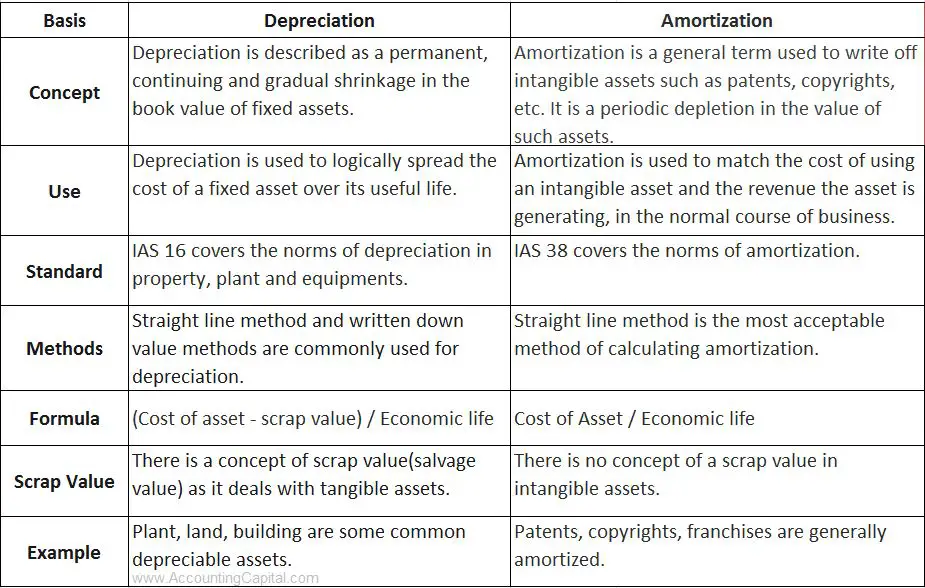
Depreciation is the process of allocating the cost of a tangible, physical asset over its expected useful life. These are items you can touch, see, and store—machinery, office equipment, vehicles, and buildings. As these assets are used to generate revenue, they experience wear and tear, obsolescence, or general decay. Depreciation accounts for this decline in value.
Common Methods of Calculating Depreciation
The way a business chooses to calculate depreciation can significantly impact its reported earnings and tax obligations. There are several standard methodologies used in business finance:
- Straight-Line Depreciation: This is the simplest and most common method. The cost of the asset (minus its estimated salvage value) is divided by the number of years in its useful life. This results in a consistent expense every year. For example, a $50,000 delivery truck with a five-year life and a $5,000 salvage value would depreciate at $9,000 per year.
- Double Declining Balance: This is an “accelerated” depreciation method. It allows a business to write off a larger portion of the asset’s value in the early years of its life. This is often used for assets that lose value quickly, such as technology or vehicles, and it provides a greater tax shield in the immediate future.
- Units of Production: This method links depreciation to the actual usage of the asset rather than the passage of time. A piece of factory machinery might be depreciated based on the number of units it produces. This aligns the expense directly with the revenue-generating activity.
The Tax Impact of Depreciation
For business owners, depreciation is a powerful financial tool because it is a deductible expense. Even though no actual cash leaves the bank account when depreciation is recorded, it reduces the company’s taxable income. This “tax shield” allows businesses to retain more cash for reinvestment. In many jurisdictions, governments offer “bonus depreciation” or specific tax codes (such as Section 179 in the U.S.) to encourage businesses to purchase equipment by allowing them to deduct a larger portion of the cost upfront.
Deciphering Amortization: Intangible Assets and Debt Structure
Amortization functions similarly to depreciation but applies to two very different financial areas: intangible assets and the repayment of debt. In the context of business finance, it refers to the spreading out of the cost of non-physical assets. In the context of personal finance and banking, it refers to the schedule of loan repayments.
Amortization of Intangible Assets
Intangible assets are items of value that lack physical substance but provide long-term economic benefits. These include patents, trademarks, copyrights, franchise agreements, and proprietary software. Because these assets do not “wear out” in the physical sense, the term amortization is used to describe the gradual reduction of their book value over time.
Unlike depreciation, which often uses accelerated methods, amortization is almost exclusively calculated using the straight-line method. For instance, if a pharmaceutical company spends $10 million to acquire a patent that expires in 10 years, they will record an amortization expense of $1 million per year. Notably, “Goodwill”—the premium paid when acquiring another company—is no longer amortized under modern accounting standards (GAAP), but is instead tested annually for “impairment.”
Amortization in Personal Finance: Loan Schedules
For most individuals, the term amortization is most familiar through a “loan amortization schedule.” This is a table detailing each periodic payment on an amortizing loan, such as a mortgage or an auto loan.
In the early stages of a long-term loan, a significant portion of each payment goes toward interest, while only a small fraction reduces the principal balance. As the loan matures, the interest portion decreases because it is calculated on a shrinking principal, and the amount applied to the principal increases. Understanding this trajectory is vital for homeowners and investors who are considering refinancing or making extra principal payments to save on long-term interest costs.
Crucial Distinctions: Amortization vs. Depreciation
While both concepts involve the systematic allocation of costs, the distinctions between them are vital for accurate financial analysis.
Asset Type and Physicality

The most fundamental difference is the nature of the asset. Depreciation is strictly for tangible, fixed assets. If it can rust, break, or require oil, it is likely depreciated. Amortization is reserved for intangible assets and financial instruments. This distinction is important because it dictates how an asset appears on a balance sheet and how it is treated by tax authorities.
Salvage Value and Residual Worth
Depreciation almost always accounts for “salvage value”—the estimated amount an asset will be worth at the end of its useful life. For example, a crane might be used for 20 years and then sold for scrap metal. Amortization, however, rarely involves a salvage value. An expired patent or a finished copyright typically has no residual value to the original holder, so the entire cost is usually amortized down to zero.
Implementation and Consistency
As noted, depreciation offers a variety of formulas (accelerated vs. straight-line) to reflect the actual economic reality of the asset’s use. Amortization is more rigid. Because it is harder to prove that a trademark “wears out” faster in its first year than its fifth, the straight-line method is the default standard for intangible assets.
The Strategic Role of Non-Cash Expenses in Business Finance
Understanding amortization and depreciation is not just an exercise in bookkeeping; it is a strategic necessity for interpreting the health of a business. These “non-cash” expenses can create a significant gap between a company’s net income and its actual cash flow.
The Significance of EBITDA
Investors frequently use the metric EBITDA—Earnings Before Interest, Taxes, Depreciation, and Amortization—to evaluate a company’s operational performance. By adding back depreciation and amortization to net income, analysts can see how much cash a business is generating from its core operations without the “distortion” of accounting choices related to historical asset purchases.
For example, a company that recently invested heavily in new machinery will show a high depreciation expense, which might make their net income look low. However, their EBITDA might be very high, indicating a strong, growing business that is simply recouping its capital investments through the tax code.
Capital Expenditure (CapEx) and Reinvestment
D&A (Depreciation and Amortization) serves as a proxy for how much a company needs to spend just to maintain its current position. If a company’s depreciation expense is $1 million a year, but they are only spending $200,000 on new equipment (CapEx), it suggests the company is “liquidating” its asset base or failing to modernize. Conversely, if CapEx significantly exceeds D&A, the company is likely in an aggressive growth phase, investing in future capacity.
Investor Perspectives: Analyzing Financial Statements
For the savvy investor, looking at the D&A figures provides insights into the “quality of earnings.” It is a window into the management’s philosophy regarding asset management and long-term planning.
Red Flags and Management Incentives
Because the “useful life” of an asset is often an estimate made by management, it can be manipulated. If a company suddenly extends the estimated life of its machinery from 10 years to 15 years, the annual depreciation expense drops, and reported profits rise instantly. Investors should look for consistency in these estimates. A sudden change in how a company amortizes or depreciates its assets without a clear operational reason can be a red flag that management is trying to “window dress” the financial statements to meet earnings targets.
The Role of Amortization in Tech and Biotech
In sectors like technology and pharmaceuticals, amortization is often the dominant non-cash expense. When a tech giant acquires a smaller AI startup, they are often paying for “intellectual property” rather than physical factories. The resulting amortization of those intangible assets can weigh down net income for years. Investors in these sectors must become comfortable looking past these accounting charges to see the underlying value of the technology being integrated.

Conclusion: Mastering the Flow of Value
Amortization and depreciation are the mechanisms that allow the financial world to bridge the gap between long-term investment and daily operations. For the business owner, they represent a path to tax efficiency and sustainable growth. For the individual borrower, amortization is the roadmap to debt freedom. For the investor, these concepts are the tools required to peel back the layers of a financial report and see the true economic reality of an enterprise.
By recognizing that value is not just something you have or don’t have, but something that flows and changes over time, you can make more informed decisions in both your business ventures and your personal financial journey. Whether it is the slow wear of a machine or the steady expiration of a patent, mastering the “why” and “how” of these expenses is a cornerstone of financial literacy.
aViewFromTheCave is a participant in the Amazon Services LLC Associates Program, an affiliate advertising program designed to provide a means for sites to earn advertising fees by advertising and linking to Amazon.com. Amazon, the Amazon logo, AmazonSupply, and the AmazonSupply logo are trademarks of Amazon.com, Inc. or its affiliates. As an Amazon Associate we earn affiliate commissions from qualifying purchases.