
In the landscape of modern finance, few entities command as much gravity as Alphabet Inc. To the average consumer, the name might be a mere footnote or a corporate technicality, but to the global investment community, Alphabet represents one of the most sophisticated and profitable holding companies in history. Born from a massive corporate restructuring of Google in 2015, Alphabet Inc. was designed to provide clarity, accountability, and a venture-capitalist spirit to a business that had grown far beyond the confines of a simple internet search engine.
Understanding Alphabet Inc. requires looking past the colorful logo and into the mechanics of a multi-billion-dollar balance sheet. It is a study in how a dominant market leader manages massive cash flows from a core business while simultaneously funding high-risk, high-reward “moonshots” that aim to redefine the future of industry.

The Conglomerate Structure: From Search Engine to Holding Company
The transition from Google to Alphabet Inc. was not merely a cosmetic name change; it was a fundamental shift in corporate governance and financial reporting. Before 2015, Google’s diverse interests—ranging from life sciences to self-driving cars—were all managed under one umbrella. This created “blurring” on the financial statements, making it difficult for investors to see how much the core search business was earning versus how much was being spent on experimental projects.
The 2015 Restructuring Strategy
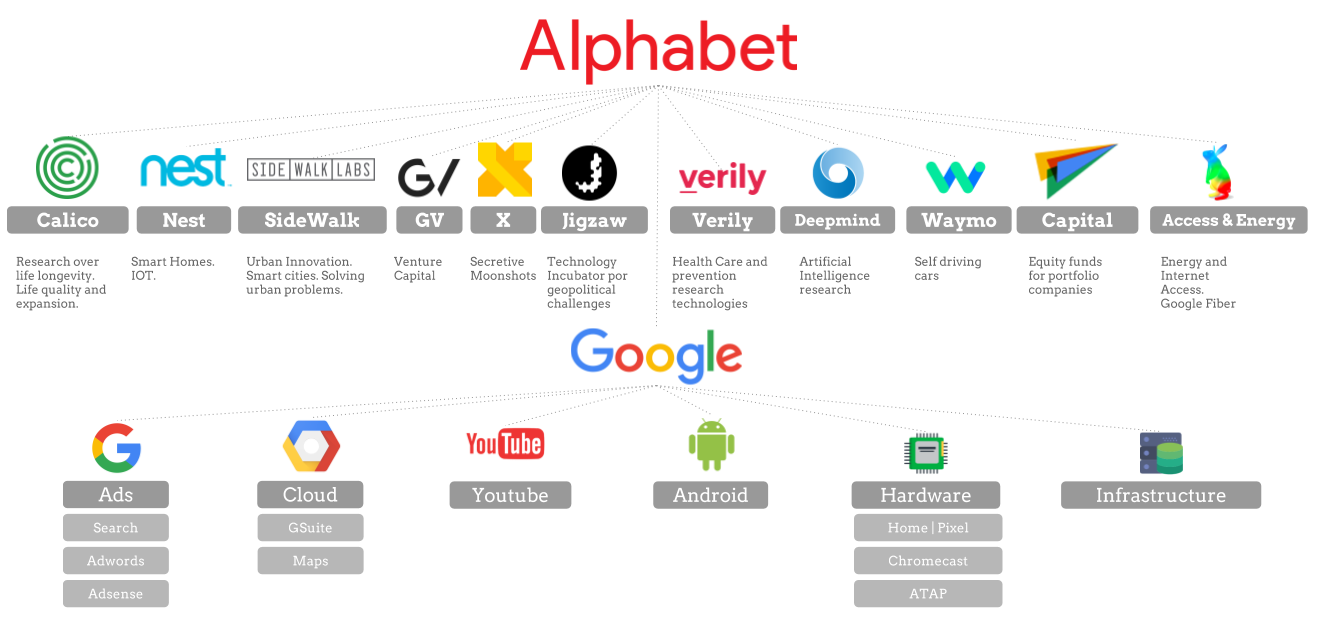
The creation of Alphabet was a strategic move by co-founders Larry Page and Sergey Brin to implement a “holding company” model, similar to Warren Buffett’s Berkshire Hathaway. By establishing Alphabet as the parent company, Google became a subsidiary, alongside other independent entities. This allowed the leadership to install CEOs for each individual business unit, fostering an entrepreneurial environment while maintaining a centralized capital allocation strategy. For the investor, this provided a cleaner look at the “Google Services” margins without the noise of speculative R&D spending.
Segment Reporting: Google Services vs. Google Cloud
Alphabet’s financial health is primarily analyzed through its reporting segments. The most significant is Google Services, which includes Search, YouTube, the Play Store, and hardware like the Pixel. This segment is the company’s primary “cash cow.” The second major pillar is Google Cloud, which has transitioned from a high-loss growth phase into a profitable enterprise powerhouse. By separating these from “Other Bets,” Alphabet allows the market to value the company based on its operational efficiency in core markets while acknowledging its growth potential in the enterprise tech space.
Revenue Streams: How Alphabet Generates Billions
Alphabet Inc. is, at its core, a data and attention economy juggernaut. While it has diversified into hardware and cloud computing, the vast majority of its top-line growth is driven by its ability to monetize intent and engagement.
The Advertising Powerhouse (Search, YouTube, and Network)
Digital advertising remains the bedrock of Alphabet’s financial dominance. Google Search is arguably the most valuable real estate in the history of commerce, capturing “intent-based” data that allows for hyper-targeted advertising. YouTube has evolved into a dual-threat revenue generator, earning through both high-margin advertising and a growing subscription base (YouTube Premium and YouTube TV). For investors, the resilience of these ad revenues, even during economic downturns, provides a unique layer of financial security that few other companies can match.
Cloud Growth and Enterprise Diversification
While advertising pays the bills today, Google Cloud is the engine for tomorrow’s enterprise valuation. Competing directly with Amazon Web Services (AWS) and Microsoft Azure, Google Cloud provides infrastructure-as-a-service (IaaS) and software-as-a-service (SaaS) to global corporations. From a business finance perspective, Cloud is a vital diversification tool. It moves Alphabet away from being 100% dependent on the cyclical nature of the advertising market and plugs it into the recurring, “sticky” revenue of long-term enterprise contracts and AI-driven infrastructure.
The “Other Bets” Portfolio: Investing in the Future
One of the most intriguing aspects of Alphabet’s financial identity is its “Other Bets” segment. These are companies that operate independently from Google and focus on radical innovation. While they often report operational losses in the billions, they represent the venture capital arm of the Alphabet empire.
Moonshots and Venture Capital Logic
The businesses within “Other Bets”—such as Waymo (autonomous driving), Verily (life sciences), and Calico (biotechnology)—are projects with long horizons. Alphabet utilizes the massive profits from Google Search to fund these experiments. This allows the company to stay at the forefront of the next technological paradigm shift without needing to seek external venture funding. From a financial strategy standpoint, this is a “hedging” move; if search engines were ever to be disrupted, Alphabet likely owns the company that will replace them.
Calculating Risk and Long-term Valuation
Critics often point to the “Other Bets” segment as a drain on capital. However, savvy investors view this through the lens of optionality. If Waymo successfully scales a global robotaxi network, its valuation could rival that of a major automotive manufacturer or a logistics giant. By keeping these losses transparent on the balance sheet, Alphabet demonstrates a commitment to disciplined spending, often trimming projects that fail to show a path toward commercialization, such as the recent scale-backs in some of their fiber or drone delivery initiatives.
Investor Analysis: Understanding GOOG vs. GOOGL
For those looking to put capital into Alphabet, understanding the stock’s structure is as important as understanding its products. Alphabet is famous for its multi-class share structure, which was designed to protect the long-term vision of the founders from the short-term pressures of Wall Street.
Share Classes and Governance
Alphabet trades under two primary tickers: GOOGL (Class A) and GOOG (Class C). Class A shares come with one vote per share, while Class C shares have no voting rights. There is also a Class B tier, held exclusively by insiders and founders, which carries ten votes per share. This structure ensures that Larry Page and Sergey Brin retain majority control over the company’s direction. For the retail investor, the choice between GOOG and GOOGL usually comes down to a slight price discrepancy, though they both represent the same underlying economic interest in the company.
Buybacks, Dividends, and Capital Allocation
Historically, Alphabet was known for hoarding cash. However, as the company matured, its approach to capital allocation evolved. Alphabet has become a master of the “share buyback,” spending tens of billions of dollars annually to repurchase its own stock. This reduces the total share count and increases earnings per share (EPS), a move highly favored by institutional investors. Furthermore, the company’s recent initiation of a dividend signals a transition into a more “mature” financial phase, where it balances aggressive R&D with returning direct value to shareholders.
Financial Outlook and Market Position
As we look toward the next decade, Alphabet Inc. faces a unique set of financial challenges and opportunities. The rise of Artificial Intelligence (AI) and the tightening of global antitrust regulations are the two primary variables that will dictate the company’s market cap.
Competitive Pressures and Regulatory Risks
Alphabet currently faces significant scrutiny from regulators in the U.S. and the EU regarding its dominance in search and advertising technology. Legal battles regarding “default” search status on devices could potentially impact their revenue margins. From an investment perspective, these legal costs and potential fines are “priced in,” but they remain a persistent tail risk that requires careful monitoring.
The AI Capex Cycle
The current financial narrative at Alphabet is dominated by the AI “arms race.” The company is currently in a period of heavy Capital Expenditure (CapEx), spending billions on data centers and custom chips (TPUs) to power its Gemini AI models. While this weighs on short-term margins, the goal is to integrate AI into every facet of the Alphabet ecosystem—making Search more efficient, Cloud more powerful, and YouTube more engaging. For the long-term investor, the question is not whether Alphabet can afford this spend, but how quickly they can turn these AI investments into a new, high-margin revenue stream that rivals the traditional search business.
In summary, Alphabet Inc. is far more than a tech company; it is a financial fortress. By balancing the unprecedented cash generation of Google with the visionary risks of its “Other Bets,” Alphabet has created a corporate structure designed for longevity. For those navigating the worlds of business and finance, Alphabet serves as the ultimate case study in how to scale a dominant market position into a diversified, global conglomerate that is built to own the future.
aViewFromTheCave is a participant in the Amazon Services LLC Associates Program, an affiliate advertising program designed to provide a means for sites to earn advertising fees by advertising and linking to Amazon.com. Amazon, the Amazon logo, AmazonSupply, and the AmazonSupply logo are trademarks of Amazon.com, Inc. or its affiliates. As an Amazon Associate we earn affiliate commissions from qualifying purchases.